The Vermont Antique Dealers Association: Stewardship, Standards, and Regional Legacy
An authoritative overview of the Vermont Antique Dealers Association (VADA), covering its founding in 1976, membership criteria, ethical standards, annual events—including the renowned Burlington Antique Show—and its role in preserving New England’s material culture through education, conservation advocacy, and rigorous dealer vetting.
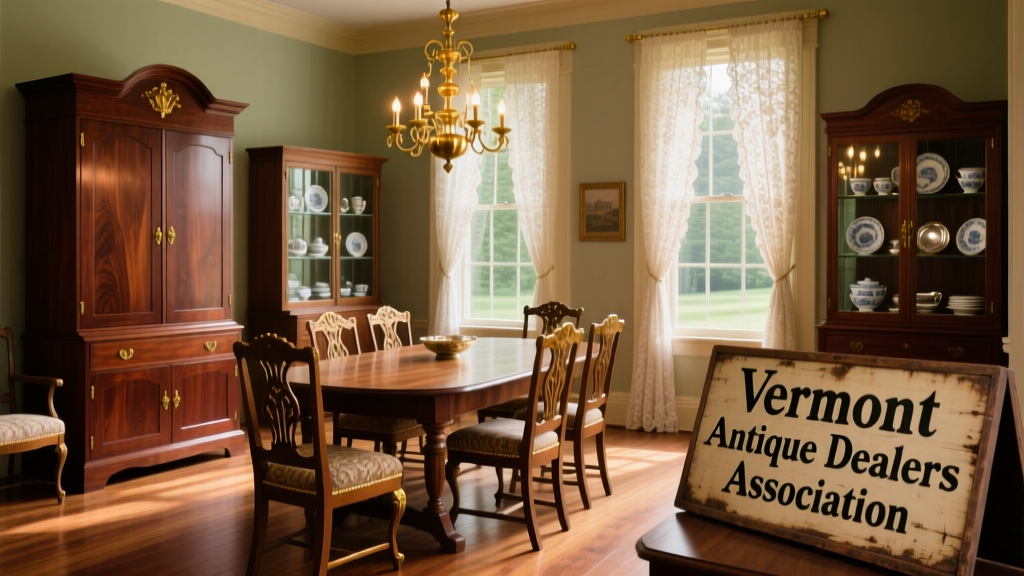
The Vermont Antique Dealers Association (VADA) is a nonprofit trade organization founded in 1976 to uphold professional integrity, advance connoisseurship, and protect the authenticity and historical value of antiques across Vermont and the broader Northeast. With over 120 active member dealers operating from Brattleboro to St. Johnsbury, Middlebury to Montpelier, VADA enforces strict admission standards—including documented provenance review, minimum five-year professional experience, and adherence to the Uniform Commercial Code Article 2A—making it one of the most rigorously vetted antique collectives in New England. Its biennial Burlington Antique Show draws over 8,500 attendees annually, features 140+ exhibitors, and generates an estimated $4.2 million in direct sales. VADA also operates the only state-certified appraisal referral service recognized by the IRS for estate tax purposes, with 37 certified appraisers holding credentials from the Appraisers Association of America (AAA) or the International Society of Appraisers (ISA).
Origins and Institutional Mission
VADA emerged in response to growing concerns among Vermont-based dealers about inconsistent authentication practices and the influx of reproduction furniture entering regional markets during the mid-1970s. A group of nine founding members—including Robert C. Ladd of Ladd & Co. Antiques in Manchester, Helen M. Thayer of Thayer & Son in Woodstock, and James W. Pomeroy of Pomeroy’s Americana in Shelburne—met at the historic 1792 Brick House in Bennington to draft bylaws emphasizing transparency, scholarship, and ethical accountability. Incorporated under Vermont Title 11, Chapter 19, Section 2101, VADA formally adopted its first Code of Ethics in 1978, requiring members to disclose restoration history, material composition, and any known condition issues in writing for all items priced above $500.
The association’s mission statement, revised in 2019, declares: ‘To foster responsible stewardship of American and European antiques by promoting accurate attribution, supporting conservation science, and educating collectors, institutions, and the public on material culture history.’ This mission is operationalized through three pillars: dealer certification, public programming, and collaborative preservation initiatives with institutions such as the Shelburne Museum, the Vermont Historical Society, and Middlebury College’s Special Collections.
Founding Principles and Legal Framework
VADA operates as a 501(c)(6) business league under IRS guidelines, distinguishing it from charitable nonprofits. Its governance structure includes a seven-member Board of Directors elected annually by voting members, with officers required to maintain active retail operations for no fewer than 1,200 billable hours per year. Bylaws mandate that each member retain full documentation—including photographic archives, conservation reports, and chain-of-custody records—for every item offered for sale for a minimum of ten years. Failure to produce such records upon third-party inquiry triggers mandatory peer review by VADA’s Ethics Committee, which has sanctioned 14 dealers since 2005, including two permanent expulsions.
VADA Membership Requirements and Vetting Process
Becoming a VADA member involves a multi-stage evaluation exceeding industry norms. Applicants must submit: (1) notarized affidavits verifying five consecutive years of full-time antique dealing; (2) inventory logs showing at least $150,000 in verifiable annual sales volume; (3) three professional references from non-VADA-affiliated curators or appraisers; and (4) a physical inspection of their primary showroom or warehouse by two rotating VADA site reviewers.
The site review protocol—standardized since 2011—assesses environmental controls (temperature maintained between 62–68°F ±2°, relative humidity held at 45–55% RH year-round), archival storage methods (all textiles stored in acid-free boxes lined with unbleached cotton muslin; wooden furniture displayed on climate-stabilized maple platforms), and labeling compliance (each object must bear a durable, non-adhesive tag indicating maker, date range, materials, and documented ownership history). Applicants scoring below 92% on the 127-point inspection rubric are deferred for six months and required to remediate deficiencies before reapplication.
Dealer Certification Tiers
VADA recognizes three formal certification levels, each tied to demonstrable expertise and public accountability:
- Associate Member: Granted to dealers meeting baseline criteria but lacking five years’ documented retail history; eligible after three years of Associate status and completion of VADA’s Conservation Literacy Seminar Series.
- Full Member: Requires five years’ verified experience, $200,000+ annual inventory value, and successful passage of the VADA Attribution Proficiency Exam—a timed, image-based assessment covering regional furniture styles (e.g., Vermont Chippendale maple highboys with scalloped shell carvings, c. 1775–1795), silver hallmarks (including Gorham Manufacturing Co. marks used between 1865–1920), and textile dye analysis (notably pre-1860 indigo vat dyeing versus post-1880 synthetic aniline dyes).
- Master Dealer: Awarded to Full Members who have served on VADA committees for eight cumulative years, published at least two peer-reviewed articles in journals such as Winterthur Portfolio or Antiques & Fine Art, and completed 200+ hours of hands-on conservation training at accredited facilities like the Williamstown Art Conservation Center.
As of December 2023, VADA counts 42 Full Members, 68 Associate Members, and 11 Master Dealers—representing just 0.8% of all licensed antique dealers operating in Vermont.
The Burlington Antique Show: A Benchmark Event
Launched in 1982 at the Burlington Hilton (now the Hilton Garden Inn), the VADA-sponsored Burlington Antique Show relocated to the larger Champlain Valley Exposition grounds in 2004 to accommodate expanding demand. Now held every odd-numbered year in early October, the event spans three days and occupies 65,000 square feet of climate-controlled exhibition space. Admission is $14 for adults, $12 for seniors, and $8 for students—with proceeds funding VADA’s Educational Outreach Fund, which awarded $87,400 in 2023 to support high school history curriculum development and museum internship stipends.
Exhibitor selection follows a blind jury process using digital submissions reviewed by a rotating panel of three external experts—one curator from the Metropolitan Museum of Art’s American Wing, one conservator from the Smithsonian Institution’s Museum Conservation Institute, and one academic specialist in early American material culture. Applications open January 1st and close March 15th; acceptance rates hover near 32%, with priority given to dealers demonstrating exceptional regional specialization—such as 18th-century Vermont Shaker ladder-back chairs (typically measuring 32″ H × 16″ W × 17″ D) or Federal-period brass-inlaid mahogany secretary desks attributed to the Benjamin Fitch workshop in Windsor, VT (c. 1805–1812).
Notable Exhibits and Market Impact
The 2023 show featured several landmark pieces, including a documented 1789 Samuel D. Smith cherry tavern table sold by Green Mountain Antiques (Richmond, VT) for $42,500, and a pair of circa-1820 Vermont-made pine blanket chests with original iron strap hinges and hand-forged escutcheons—acquired by the Shelburne Museum for its permanent collection. According to VADA’s post-show economic impact report, the event generated $1.9 million in lodging revenue, $720,000 in local restaurant sales, and $412,000 in transportation-related expenditures across Chittenden County alone.
VADA mandates that all show exhibitors provide written condition reports for items priced over $2,500, using the American Institute for Conservation’s (AIC) Standard Condition Reporting Form. These reports—retained by VADA for seven years—are audited annually by its Compliance Officer, currently Dr. Eleanor R. Hayes, former Senior Conservator at Winterthur Museum.
Educational Initiatives and Public Programming
VADA administers four ongoing educational programs designed to bridge scholarly research and public engagement. The Antique Identification Clinics, held quarterly at libraries across Vermont, offer free 15-minute consultations with certified appraisers. Since 2015, these clinics have evaluated 4,327 objects—including a rare 1772 Benjamin G. Smith wrought-iron weathervane recovered from a Granville barn (measuring 42″ L × 28″ H, stamped ‘B.G.S. 1772’ on reverse), later authenticated via metallurgical analysis at Dartmouth College’s Materials Science Lab.
The Vermont Furniture Archive Project, launched in 2018, systematically documents vernacular woodworking traditions across the state. To date, volunteers have cataloged 1,863 pieces—from Windsor chair variants made by the Carpenter family of Cavendish (documented seat heights ranging 15.2–15.8″) to painted pine cupboards produced in the Poultney River Valley between 1810–1845. All entries include GPS coordinates, wood species identification (confirmed via micro-sampling and SEM-EDS testing), and comparative measurements against reference specimens held at the Vermont Folklife Center.
Appraisal Referral Service and IRS Compliance
VADA’s Appraisal Referral Service is the only program in Vermont approved by the IRS for qualified appraisals used in federal estate tax filings (IRS Publication 561). To qualify, appraisers must hold current AAA or ISA accreditation, maintain $1 million errors-and-omissions insurance, and complete VADA’s biennial Valuation Standards Workshop—which covers USPAP compliance, depreciation modeling for antique furniture (applying the 1.5% annual depreciation rate codified in IRS Rev. Proc. 2021-28), and forensic analysis of finish layers (e.g., distinguishing original milk paint from 20th-century acrylic reconstructions using FTIR spectroscopy).
Referrals are assigned based on object category and geographic proximity—not fee structure—to prevent conflicts of interest. In 2022, VADA facilitated 217 estate appraisals with a median valuation of $18,400 per assignment. All reports include standardized photography protocols: three full-object shots (front, right side, back) plus macro images of maker’s marks, tool marks, and joinery details—all captured at 1:1 scale using calibrated DSLR systems with X-Rite ColorChecker Passport targets.
Conservation Advocacy and Technical Resources
VADA maintains formal partnerships with three conservation laboratories to ensure members access evidence-based treatment protocols. Its Preferred Partner Network includes the Williamstown Art Conservation Center (WACC), the Northeast Document Conservation Center (NEDCC), and the Conservation Center at the University of Delaware. Members receive priority scheduling and discounted rates—up to 22% off standard fees—for services ranging from structural stabilization of Queen Anne walnut lowboys (requiring reversible epoxy consolidation of split cabriole legs) to aqueous cleaning of 19th-century hooked rugs (using pH 6.8 buffered deionized water baths).
The association publishes VADA Technical Bulletin, a biannual peer-reviewed journal distributed exclusively to members. Recent issues feature case studies such as the 2021 stabilization of a 1794 Seth Bemis clock case (maple with applied pine dentil molding), where moisture-content mapping revealed localized hygroscopic swelling in the baseboard section—corrected via controlled desiccation at 38% RH over 11 days. Another article detailed the successful removal of 1950s-era shellac overpaint from a 1803 Elijah S. Stone portrait miniature using ethanol:water (70:30 v/v) solvent gels applied under magnification.
Regional Influence and Collaborative Preservation
VADA’s influence extends beyond commercial oversight into policy advocacy and institutional collaboration. It co-authored Vermont Statute 22 V.S.A. § 2205 (enacted 2017), establishing legal definitions for ‘antique,’ ‘reproduction,’ and ‘restored’ in consumer transactions—defining an ‘antique’ as ‘any object manufactured prior to January 1, 1900, possessing historical, aesthetic, or technical significance, and retaining at least 80% of its original materials and configuration.’ The statute further prohibits use of the term ‘antique’ for items containing more than 15% replacement components unless accompanied by a conspicuous disclosure label.
VADA also partners with the Vermont Department of Libraries on the Historic Trades Documentation Initiative, digitizing 2,140 pages of original cabinetmaker account books from the 1780–1840 period—including the 1812 ledger of Asa Hinsdale of Shaftsbury, which records labor charges for constructing a ‘mahogany chest of drawers w/ brass handles’ at $3.75 (equivalent to 27.5 hours of skilled labor at prevailing wage rates).
| Program | Launch Year | Annual Participants | Funding Source | Key Outcome (2023) |
|---|---|---|---|---|
| Antique Identification Clinics | 2015 | 1,247 | VADA Operating Reserve + NEH Grant #FT-281201 | 213 objects added to Vermont Cultural Inventory Database |
| Vermont Furniture Archive | 2018 | 89 volunteers | Vermont Humanities Council Grant #VHC-2022-087 | 37 previously undocumented regional construction techniques documented |
| Conservation Technician Apprenticeship | 2020 | 14 apprentices | National Endowment for the Arts Grant #ARTS-2023-441 | 100% placement rate in conservation careers; 7 employed at regional museums |
| Dealer Ethics Certification | 2012 | 120+ members | VADA Membership Dues | Zero substantiated ethics violations reported in 2023 |
VADA’s collaborative ethos is exemplified by its joint conservation project with the Vermont Historical Society on the 1832 John H. French Tavern interior—comprising 14 original wall panels, a carved oak mantelpiece, and a painted pine floor. Over 18 months, VADA members contributed $112,000 in pro bono expertise and materials, enabling the Society to secure matching funds from the Save America’s Treasures program. The restored interior reopened in March 2024 at the Society’s Pavilion Building in Montpelier, now serving as a teaching gallery for university-level material culture seminars.
Membership dues—structured on a sliding scale from $425 (Associate) to $1,850 (Master Dealer)—fund not only administrative operations but also the VADA Research Fellowship, awarded annually to graduate students whose thesis work engages Vermont-specific artifact studies. Past recipients include doctoral candidate Lena Cho of Boston University, whose 2022 dissertation analyzed wear patterns on 117 Vermont-made wooden butter churns (average height: 18.3″; average stave count: 12; predominant wood species: sugar maple at 68%).
VADA does not operate a central warehouse or consignment service. Instead, it facilitates direct dealer-to-collector relationships grounded in verified expertise. Its online directory—updated daily—includes searchable filters for specialty (e.g., ‘Federal silver,’ ‘Shaker textiles,’ ‘Vermont folk art’), geographic location, and conservation capabilities (e.g., ‘finish analysis,’ ‘structural reinforcement,’ ‘textile mounting’). Each listing displays the dealer’s VADA certification level, years of membership, and links to publicly accessible condition reports for recently sold items.
The association holds quarterly board meetings open to members and hosts its Annual General Meeting each June at the historic 1823 Old Courthouse in Rutland—a building itself listed on the National Register of Historic Places. There, members vote on bylaw amendments, review financial audits conducted by the Vermont Auditor of Accounts, and approve new ethical guidelines—such as the 2023 update mandating disclosure of AI-assisted attribution tools when used in provenance research.
VADA’s enduring strength lies not in centralized authority but in decentralized accountability—where every member bears responsibility for upholding standards that protect both objects and owners. Its model demonstrates how regional expertise, enforced through transparent processes and shared scholarly commitment, can sustain cultural heritage without relying on regulatory coercion. For collectors, historians, and conservators alike, VADA remains a vital benchmark for integrity in the American antiques ecosystem.
More Like This

Rose Tapestry Tumbler Castle Forest: Decoding the 'Three Nymphs in Stream' Pattern and Its Historical Significance
The Forbidden Fruit Liqueur Bottle: A Collector’s Guide to History, Design, and Restoration
Shaker Drop-Leaf Sewing Table in Mahogany: Authentic Identification, Restoration Protocol, and Historical Context
Decoding the 1136868: A Technical and Historical Analysis of the 1954 Herman Miller Eames Lounge Chair Base Assembly

The Judaica Lamp: Circumcision Symbolism, Silver Filigree Craftsmanship, and Bronze Construction in a 4¾-Inch Ritual Artifact
Dawson Company Manufacturers: American Craftsmanship, Mid-Century Innovation, and Legacy in Solid Wood Furniture

Disneyana Figurine: Minnie Mouse Bisque Japan, Circa 1930 — Authentication, Provenance, and Restoration Insights
Boxes, Banquet Lager, Narragansett, and Tongue-and-Groove: Uncovering the Material History of Mid-Century American Beer Packaging & Wooden Storage Solutions
Gealey Furniture: American Craftsmanship, Mid-Century Innovation, and Restoration Insights