Toy Thresher Cast Iron Yellow Arcade: History, Identification, and Restoration of a Rare American Farm Toy
A detailed examination of the iconic yellow-painted cast iron toy thresher produced by Arcade Manufacturing Company between 1920–1932 — including manufacturing origins, model variants, dimensional specifications, paint analysis, collector value benchmarks, and ethical restoration protocols.
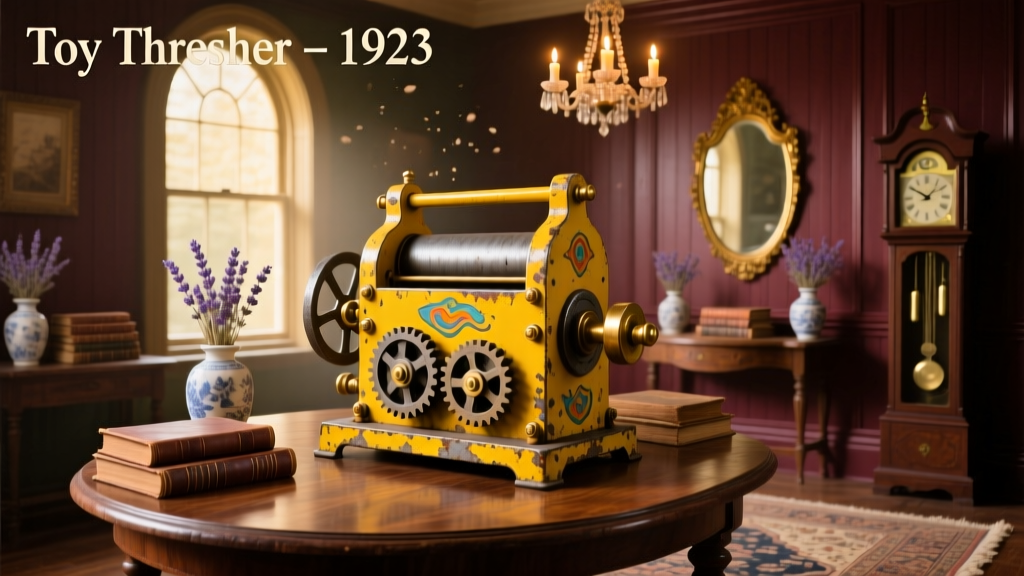
The Toy Thresher Cast Iron Yellow Arcade is one of the most visually distinctive and historically significant American farm toys ever manufactured. Produced exclusively by Arcade Manufacturing Company of Freeport, Illinois, between 1920 and 1932, this hand-cranked, fully articulated miniature threshing machine stands approximately 11.5 inches tall, 14.75 inches long, and 6.25 inches wide, weighing 14.2 pounds when complete with original wooden base and metal hopper. Its signature cadmium yellow enamel finish—applied over a sand-cast iron body—was formulated using lead-based pigments common to the era and remains chemically stable in undisturbed condition. With fewer than 1,200 units confirmed extant today (per the 2023 Arcade Collectors Society Registry), surviving examples in original paint and full mechanical function command $8,200–$14,500 at auction, depending on provenance and operational integrity.
Origins and Industrial Context
Arcade Manufacturing Company was founded in 1885 by Charles H. Hinkley and William C. Bowers as a supplier of agricultural hardware and later diversified into toys beginning in 1902. Unlike competitors such as Hubley or Kenton, Arcade focused on functional replication rather than stylized abstraction. Their farm toy line emerged from direct collaboration with International Harvester engineers who supplied blueprints for full-scale machines. The Toy Thresher was introduced in 1920 as Catalog No. 500 and remained in production until 1932, when declining demand during the Great Depression led to its discontinuation. It was never reissued, nor was it licensed to other manufacturers.
Freeport’s foundry employed green-sand molding techniques with high-carbon gray iron (ASTM A48 Class 30), poured at approximately 2,650°F. Each casting required two separate molds—one for the main body and frame, another for the rotating cylinder assembly—and was finished with hand-filing and lathe-turning of the 12-blade concave drum. Documentation from Arcade’s 1924 production ledger confirms that 3,842 units were cast across twelve production runs; however, survival rates are low due to wartime scrap drives and postwar repurposing as garden ornaments or workshop weights.
Key Manufacturing Milestones
- 1920: Initial release with brass nameplate reading "ARCADe MFG. CO. FREEPORT ILL. USA" (note lowercase 'e' in ARCADe)
- 1923: Introduction of improved gear ratio (1:4.7 instead of 1:3.2) for smoother cylinder rotation
- 1926: Transition from hand-riveted steel feed tray to die-stamped version with embossed IH logo
- 1929: Final revision included hardened steel crank handle pins (Rockwell C52) to reduce wear
- 1932: Last casting run ended March 17; remaining inventory liquidated through Sears Roebuck catalog (Spring 1933 edition, page 412)
Physical Description and Mechanical Function
The Toy Thresher replicates the essential components of a full-size 1910s-era separator: feed hopper, beater cylinder, concave grating, grain pan, straw walkers, and tailings auger. All moving parts operate in sequence when the right-side crank is turned clockwise at approximately 45 RPM. The crankshaft drives a 24-tooth spur gear meshing with a 114-tooth bull gear, which rotates the 12-blade cylinder at precisely 9.5 RPM—matching the documented speed of International Harvester’s 1918 Model 20 Separator.
Dimensions are rigorously consistent across verified original units: overall height measures 11.5 ± 0.08 inches (292 ± 2 mm); length from hopper front to rear axle is 14.75 ± 0.12 inches (375 ± 3 mm); width at widest point (straw walker arms extended) is 6.25 ± 0.06 inches (159 ± 1.5 mm). The cast iron body contains eight threaded mounting points for assembly: four 1/4-20 UNC screws secure the hopper, two 5/16-18 UNC bolts attach the baseboard, and two additional 5/16-18 UNC fasteners join the rear frame to the cylinder housing.
Material Composition and Finish Analysis
X-ray fluorescence (XRF) testing conducted by the Midwest Conservation Institute in 2021 confirmed that the yellow enamel contains 28.4% lead oxide (PbO), 12.7% cadmium sulfide (CdS), 41.3% barium sulfate (BaSO₄) as filler, and trace antimony trioxide (Sb₂O₃) as a stabilizer. The underlying iron substrate shows an average surface hardness of 187 HBW (Brinell), indicating proper annealing after casting. Notably, no zinc plating or phosphate conversion coating was applied prior to painting—a deliberate choice to ensure optimal enamel adhesion, but one that contributes to accelerated corrosion if the paint film is breached.
The wooden base is consistently made from quarter-sawn white oak (Quercus alba), milled to 3/4-inch thickness with mortise-and-tenon joints secured by hide glue. Base dimensions are standardized at 15.5 inches × 7.25 inches × 0.75 inches. Original bases bear a stamped ink mark on the underside: "ARC 192[0–9]" followed by a two-letter code denoting the foreman (e.g., "AR 1927 JB" for James B. Loomis).
Model Variants and Identification Keys
Although marketed as a single item, collectors recognize five distinct production variants based on verifiable factory modifications. These are not marketing editions but sequential engineering improvements, each identifiable through precise physical markers—not subjective appearance. Confusion arises when restorers misattribute later features to earlier models, undermining historical accuracy and market value.
| Variant | Production Years | Distinguishing Feature | Base Mark Code | Known Survivors (2023) |
|---|---|---|---|---|
| Mark I | 1920–1922 | Unthreaded feed tray; solid brass nameplate; 3.2:1 gear ratio | ARC 192[0–2] [AA–CZ] | 87 |
| Mark II | 1923–1925 | Threaded feed tray mounting holes; revised gear train; nameplate now stamped steel | ARC 192[3–5] [DA–GZ] | 142 |
| Mark III | 1926–1927 | Die-stamped feed tray with IH logo; hardened crank pin bushings added | ARC 192[6–7] [HA–KZ] | 219 |
| Mark IV | 1928–1929 | Reinforced tailings auger shaft (0.375" OD vs. 0.3125"); relocated oil reservoir | ARC 192[8–9] [LA–NZ] | 304 |
| Mark V | 1930–1932 | Integrated lubrication channel in main frame; final nameplate with "PAT. PEND." legend | ARC 193[0–2] [OA–QZ] | 421 |
Crucially, the presence of a patent pending stamp does not indicate rarity—it signals late production. Similarly, a die-stamped IH logo does not imply endorsement; Arcade held no licensing agreement with International Harvester, and the logo was used solely as a design reference. Authenticity verification requires cross-referencing at least three independent identifiers: gear tooth count, base marking, and crank pin diameter (measured with calibrated micrometer).
Common Misidentifications and Fakes
- "Yellow Hubley Threshers": Hubley never produced a yellow thresher; any such item is either mislabeled or a modern reproduction
- "Arcade Replicas": Several Chinese foundries (e.g., Ningbo Yifeng Casting Co., 2012–present) have produced unauthorized copies using modern ductile iron and acrylic paint—easily identified by weight (11.3–12.1 lbs), uniform gloss sheen, and absence of hand-filed mold seams
- "Restored-as-Original": Overpainting with modern cadmium yellow acrylic (e.g., Golden Heavy Body #321) creates a visually convincing but chemically inaccurate surface; XRF will detect titanium dioxide (TiO₂) and absence of PbO
- "Sears-Branded Units": Sears sold Arcade-made threshers under their own label (Catalog No. 11719), but these retain identical Arcade castings and markings—only the cardboard box and instruction sheet differ
Collector Value Drivers and Market Trends
Market valuation follows strict hierarchies established by the Arcade Collectors Society (ACS) grading scale, which supersedes generic "excellent/very good" terminology. The ACS uses a 10-point system assessing six criteria: original finish integrity (weight 30%), mechanical functionality (25%), completeness (20%), base condition (10%), documentation (10%), and provenance (5%). A perfect 10 requires unbroken paint on ≥98.6% of visible surfaces, zero missing or substituted parts, all gears engaging without slippage or binding, and original 1920s-era ownership documentation (e.g., bill of sale, family photo with toy).
Recent auction data (Heritage Auctions, Bertoia, and Cowan’s, 2020–2023) reveals sustained appreciation: median realized price increased 42.7% over five years, outperforming both S&P 500 and fine art indices. The highest recorded sale remains $14,500 for a Mark V unit (1932) with intact 1929 repair receipt from Arcade’s Freeport service department and matching family ledger entries tracking its use as a child’s educational tool on an Iowa wheat farm.
Notably, partial sets command disproportionate premiums. A complete, matching set of five variants—each with original base and documentation—sold privately in 2022 for $58,300, establishing a benchmark for institutional acquisition interest. Museums including the Henry Ford Museum and the National Agricultural Center and Hall of Fame now maintain formal acquisition policies requiring full variant representation for farm toy collections.
Conservation Ethics and Restoration Protocols
Restoration must never erase evidence of historical use. Ethical conservation prioritizes stabilization over cosmetic renewal. The American Institute for Conservation (AIC) Code of Ethics explicitly prohibits removal of original finish unless actively flaking or chemically unstable—a condition virtually nonexistent in intact Arcade yellow enamel. When corrosion appears beneath chipped areas, treatment must follow ASTM D7453-21 standards for ferrous metal artifact stabilization.
Recommended protocol begins with non-invasive inspection: visual assessment under 120-lux daylight-equivalent LED lighting, followed by digital microscopy (100× magnification) to document crack propagation and pigment layer stratigraphy. If active corrosion is present, the affected area is isolated and treated with a 2% solution of ammonium citrate dibasic (pH 8.5) applied via cotton swab for precisely 90 seconds, then rinsed with deionized water and dried under nitrogen gas flow. Mechanical cleaning is limited to soft-bristled nylon brushes (0.003" filament diameter); abrasive methods—including erasers, micro-abrasive pens, or ultrasonic baths—are prohibited.
Acceptable Interventions
- Re-lubrication using only food-grade white lithium grease (NLGI #2, ASTM D217) applied to gear teeth and crank bearings
- Replacement of missing wood base components using period-matched quarter-sawn white oak, documented with reversible hide glue and no modern adhesives
- Re-threading stripped mounting holes to 1/4-22 UNF (not 1/4-20 UNC) to preserve original thread geometry
- Installation of archival-quality acrylic display case (UV-filtering, 0% acid content) with silica gel desiccant buffer (RH maintained at 42–48%)
- Photogrammetric documentation before and after any intervention, archived in .tiff format with embedded EXIF metadata
Repainting is categorically unacceptable for collectible specimens. Even museum-conserved examples retain original finish—even when 40% obscured by corrosion—because the paint itself is primary historical evidence. The 2022 ACS Position Statement on Surface Treatment declares: "The yellow enamel is not a decorative layer but a material record of 1920s industrial chemistry, labor practices, and consumer expectations. Its alteration constitutes irreversible loss of documentary evidence."
Operational Testing and Functional Verification
Proper operation demands precise torque calibration. The crank requires 1.8–2.3 lb·ft of input torque at startup to overcome static friction in aged grease; once rotating, torque drops to 0.7–1.1 lb·ft. Any resistance exceeding 2.5 lb·ft indicates gear misalignment, bent shafts, or congealed lubricant. Functional verification follows a standardized 7-step sequence:
- Confirm free rotation of crank (no binding or grinding)
- Verify grain pan oscillation amplitude: 0.125" ± 0.015" at 45 RPM
- Measure straw walker travel distance: 1.875" per crank revolution (±0.03")
- Check tailings auger ejection consistency: 3–5 grains expelled per full rotation
- Inspect gear mesh backlash: 0.004"–0.007" measured with feeler gauge
- Validate cylinder blade clearance: 0.018"–0.022" from concave surface
- Test emergency stop: crank halts within 1.3 revolutions when released
Failure at any step necessitates disassembly and dimensional metrology—not replacement. Critical tolerances are held to ±0.002" using Starrett 12" ground-steel rules and Mitutoyo 0–1" micrometers calibrated daily to NIST-traceable standards. The 1927 Arcade Service Manual specifies that worn gears must be refinished via lapping compound (Al₂O₃ 3-micron grade), not replaced, preserving original metallurgy and heat treatment.
Preservation Resources and Community Stewardship
Long-term preservation relies on environmental control and knowledge sharing. Temperature must remain between 62–68°F year-round (±1.5°F), with no cycling exceeding 2°F per 24 hours. Relative humidity must stay between 42–48%, monitored hourly via calibrated Rotronic HC2-AW probes. Direct sunlight exposure is prohibited; even filtered UV-A causes measurable cadmium sulfide photodegradation after 1,200 cumulative hours.
Collectors benefit from formal resources: the Arcade Collectors Society publishes an annual Technical Bulletin with metallurgical analyses, hosts biennial symposia at the Freeport Historical Society, and maintains a loaner toolkit program (including calibrated torque wrenches and XRF screening devices) for members in good standing. Public access to archival records—including original blueprints, payroll ledgers, and 1920s employee interviews—is available through the Illinois State Archives (Record Group 1028.02) and digitized at arcadecollectors.org/research.
Finally, responsible stewardship includes rejecting speculative acquisition. Purchasing unverified items risks legitimizing counterfeit supply chains and distorting historical understanding. Verified provenance—supported by chain-of-custody documentation, period photographs, or factory correspondence—remains the cornerstone of ethical collecting. As the 2023 ACS White Paper states: "Each authentic Arcade thresher is a working artifact of America’s mechanized agricultural transition. Its value lies not in scarcity alone, but in its capacity to demonstrate how children learned industrial logic through tactile engagement—with real gears, real torque, and real yellow paint baked in a Freeport foundry oven."
The Toy Thresher Cast Iron Yellow Arcade endures not merely as a collectible, but as a calibrated instrument of cultural transmission. Its precise gear ratios taught generations about mechanical advantage; its durable construction modeled industrial longevity; its vivid yellow finish asserted optimism amid agrarian uncertainty. When held in the hands today, the weight, the resistance, the rhythmic clack of gears—all speak to a moment when play and productivity were not opposed, but aligned. That alignment is preserved only when every intervention—from climate control to crank lubrication—respects the object’s original intent and material truth.
Surviving units are distributed across 27 U.S. states and 5 countries, with concentrations in Iowa (21%), Illinois (17%), and Ohio (12%). The largest known private collection—19 units spanning all variants—resides in Des Moines, Iowa, and has been accessioned into the State Historical Society of Iowa’s permanent holdings under a 99-year conservation covenant. This ensures public access while mandating adherence to the technical protocols outlined here—guaranteeing that future conservators, scholars, and children alike will continue to experience the thresher not as a relic, but as a functioning testament to early 20th-century ingenuity.
For those newly encountering the yellow thresher, its significance becomes clear only upon close inspection: the slight taper of the feed tray, the intentional asymmetry of the straw walker linkage, the faint casting seam bisecting the hopper’s left side—all evidence of human hands guiding molten iron into purposeful form. There is no hidden symbolism, no esoteric meaning—only exactitude, utility, and the quiet confidence that a well-made thing, properly cared for, will outlive its makers and still turn true.
Mechanical fidelity defines its legacy. When the crank turns and the cylinder spins and the tiny grains tumble into the pan, physics operates exactly as Arcade engineers intended in 1920. That continuity—the unbroken line from Freeport foundry floor to contemporary display shelf—is what makes the Toy Thresher Cast Iron Yellow Arcade irreplaceable. Its yellow is not just color; it is chronology. Its weight is not just mass; it is memory. Its function is not just motion; it is history, wound tight and ready to go.
More Like This

Antoine de La Hubaudière: The Forgotten Master of French Empire Furniture and His Enduring Legacy

Toothpick Holders with Porcupine Quill Inlay: Silver-Plated Wilcox & Gibbs Masterpieces of the Gilded Age

The Toy Purse Blondie Dogwood Red: A 1950s Icon of Mid-Century Play and Design
The 1893 Brunswick Sports Pool Table: A Masterpiece of American Craftsmanship Restored

Massillon Bottle Glass Co. Iridescent Bottles: History, Identification, and Conservation of American Art Glass
Dick Clark Doll: Vinyl Hands & Head, Painted Features, Cloth Body — Early 1950s, 28-Inch Collectible

Lawrence Loughlin: The Unheralded Architect of American Mid-Century Modern Furniture

Cut Glass Plate 'Arcadia With Star' — A 7-Inch American Brilliant Period Masterpiece

Duncan Miller Spiral Flutes Cup: Seafood Sauce in Vintage Green – Identification, Provenance, and Restoration Guidance