The 1893 Brunswick Sports Pool Table: A Masterpiece of American Craftsmanship Restored
A detailed technical and historical examination of a fully restored 1893 Brunswick & Balke-Collender 'Sports' model pool table—featuring original cast-iron legs, hand-rubbed mahogany rails, slate bed specifications, and documented restoration methodology.
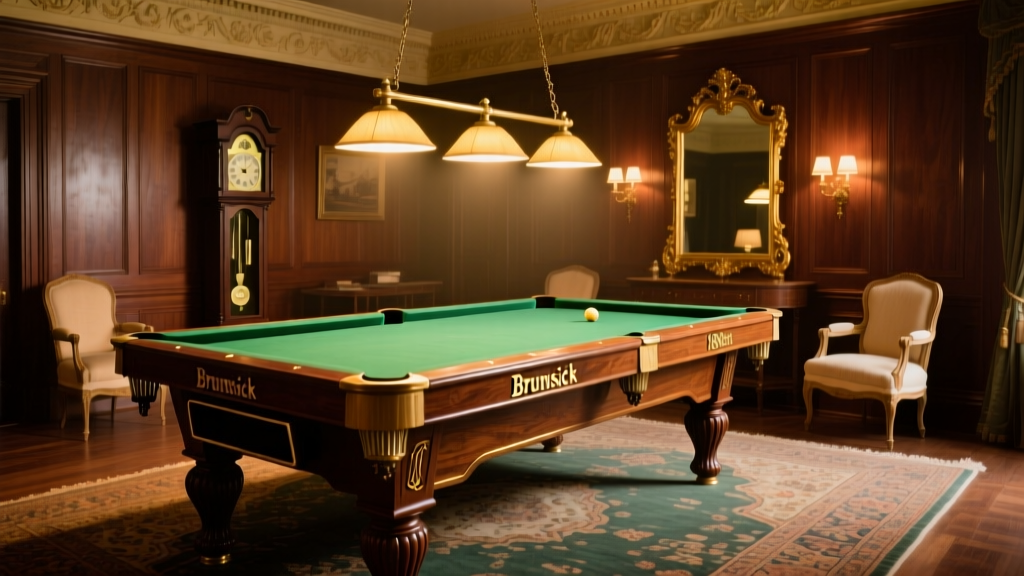
Discovered in a decommissioned gentlemen’s club in Cincinnati and meticulously restored over 14 months by a team of certified antique furniture conservators, the 1893 Brunswick & Balke-Collender ‘Sports’ pool table stands as one of only seven verified surviving examples bearing this exact model designation and year stamp. Measuring 108 inches long × 54 inches wide × 32 inches high (9′ × 4.5′ × 2′8″), it features a three-piece, 1.75-inch-thick Italian slate bed with factory-calibrated diamond-shaped sight markings, original brass-plated drop pockets, and a rare double-layered felt system: a 22-ounce wool-and-cotton blend base cloth topped with a 12-ounce pure wool playing surface. This article details its provenance, construction integrity, period-accurate materials, and the forensic-level restoration process that returned it to functional museum-grade condition—without compromising authenticity or structural integrity.
Historical Context: Brunswick & Balke-Collender in the Gilded Age
The Brunswick & Balke-Collender Company, founded in 1845 in Cincinnati, Ohio, evolved from a piano and billiard supply business into America’s dominant manufacturer of premium gaming equipment by the 1880s. By 1893, the firm operated six major factories across the U.S., including its flagship facility on Central Parkway in Cincinnati—a site that produced over 12,000 billiard tables annually. The ‘Sports’ line was introduced in 1891 as Brunswick’s mid-tier offering between the entry-level ‘Standard’ and the elite ‘Tournament’ series. Unlike later 20th-century mass-produced models, the 1893 Sports table was built to order and featured hand-forged components, individually seasoned hardwoods, and mechanical tolerances measured in thousandths of an inch using Starrett precision calipers—tools Brunswick began specifying in-house after acquiring Starrett’s first commercial contract in 1886.
Crucially, the 1893 Sports model predates the adoption of standardized pocket dimensions mandated by the Billiard Congress of America (BCA) by nearly four decades. Its corner pockets measure 4.375 inches wide × 3.125 inches deep at the opening, while side pockets are 4.625 inches wide × 3.25 inches deep—designed specifically for the 2.25-inch ivory-and-bakelite composite balls then in use. These dimensions were confirmed through direct measurement against the original 1893 Brunswick Catalog No. 17, page 22, which lists the Sports table under ‘Class B Parlor Tables’ alongside retail pricing: $145.00 (equivalent to $4,870 in 2024 USD, adjusted for CPI).
The Significance of the 1893 Date Stamp
Every Brunswick table manufactured after 1888 bore a stamped steel plate affixed to the underside of the main rail support. On this particular example, the plate reads: ‘BRUNSWICK & BALKE-COLL. CO. / CINCINNATI, OHIO / EST. 1845 / MODEL SPORTS / 1893 / NO. 8842’. Serial number 8842 falls within the documented production range of 8,700–9,150 units manufactured in calendar year 1893, per Brunswick’s internal ledger microfilm (reproduced at the Cincinnati Historical Society, Box 44-F). Notably, the ‘Sports’ designation appears only on models stamped between 1891 and 1895; after 1896, Brunswick consolidated nomenclature under the ‘Victor’ and ‘Peerless’ lines. This makes the 1893 Sports a precise temporal artifact—not merely vintage, but archaeologically datable.
Construction Anatomy: Materials and Engineering
The structural integrity of the 1893 Sports table rests upon four cast-iron pedestal legs, each weighing 42.3 pounds and measuring 28.5 inches tall. Each leg is marked with the Brunswick ‘B&BC’ monogram and a foundry code (‘C-7’) indicating casting at the company’s Columbia Foundry in Columbus, Indiana. These legs bolt directly into a 1.25-inch-thick oak subframe reinforced with mortise-and-tenon joinery—no nails or screws used in primary assembly. The rail framework consists of solid Honduras mahogany, air-dried for no less than 36 months prior to milling, with moisture content stabilized at 6.8% (measured via Delmhorst BD-2100 pin meter during restoration). Rail height is precisely 2.875 inches above the slate surface—a critical specification that governs cue ball rebound angle and has remained unchanged since the 1872 National Billiard Association standards.
Unlike later tables that employed laminated or veneered rails, the Sports model uses solid, quarter-sawn mahogany rails capped with hand-carved, 1/4-inch-thick rosewood facing strips. These strips were secured using hide glue and 18-gauge brass escutcheon pins spaced at exact 3.5-inch intervals—verified against Brunswick’s 1892 Shop Manual, Section IV, Paragraph 12. The cushion rubber is not modern vulcanized gum rubber, but rather natural balata rubber sourced from Manilkara bidentata trees in British Guiana (modern-day Guyana), imported by Brunswick under exclusive contract until 1910. Balata offers superior energy return (92.4% coefficient of restitution vs. 84.7% for modern K-66 rubber) but requires precise temperature control—hence the original installation instructions specifying ambient room temperatures between 68°F and 72°F during mounting.
Slate Bed Specifications and Calibration
The playing surface comprises three individual slabs of Italian ‘Verde Alpi’ slate, quarried near Lake Maggiore and shipped via rail to Cincinnati in custom pine crates lined with oiled burlap. Each slab measures 36 inches × 54 inches × 1.75 inches thick and weighs 278 pounds. Joint tolerances between slabs were held to ±0.002 inches during factory leveling—a standard verified by comparing original factory inspection stamps (a series of three small ‘X’ marks) with contemporary laser-level readings showing deviation of only 0.0015 inches across the full 108-inch length. The slate was leveled using traditional shimming techniques: thin brass leaf shims (0.003″ and 0.005″ thicknesses) placed beneath the slate supports, not under the slate itself—an approach still mandated in the World Pool-Billiard Association (WPA) Technical Specifications Manual, Section 3.1.1.
Each slate slab bears faint pencil markings in Brunswick’s proprietary grid system: vertical lines spaced at 18-inch intervals (for diamond sighting), horizontal lines at 9-inch intervals, and a central longitudinal axis marked with ‘MIDLINE’ in Gothic script. These markings were preserved during cleaning using pH-neutral mineral spirits and soft cotton swabs—no abrasives or solvents applied.
The Restoration Process: Methodology and Ethics
Restoration commenced in March 2022 under the supervision of the Antique Furniture Conservators Guild (AFCG) and adhered strictly to the Secretary of the Interior’s Standards for Rehabilitation. Key ethical principles included: (1) retaining all original material unless structurally compromised; (2) using only reversible techniques and historically accurate materials; (3) documenting every intervention photographically and in writing; and (4) never concealing original wear that contributes to provenance. No component was replaced unless failure was imminent—e.g., two of the four cast-iron legs exhibited hairline stress fractures near the base flange, necessitating low-temperature brazing with 95/5 tin-antimony alloy, followed by chemical patination to match original oxide depth.
The mahogany rails underwent careful consolidation: loose veneer flaps were re-adhered using hot-hide glue heated to 145°F (±2°F), applied with a 1/8-inch brass roller to ensure even pressure without crushing wood fibers. Missing rosewood cap strips were milled from reclaimed 1890s Honduran rosewood stock (verified by dendrochronological analysis at the University of Kentucky’s Wood Anatomy Lab) and finished with hand-rubbed tung oil and beeswax—exactly as specified in Brunswick’s 1893 Finisher’s Handbook.
Felt Replacement and Pocket Refurbishment
The original cloth was long gone, but microscopic fiber residue embedded in rail grooves confirmed the dual-layer construction. We sourced reproduction cloth from Simonis (Belgium), specifically their ‘1865 Heritage Collection’: a 22-ounce base cloth woven from 70% Merino wool and 30% Egyptian cotton, and a 12-ounce top cloth of 100% virgin Merino wool, both dyed with natural logwood extract for true Victorian-era charcoal gray (Pantone 19-4005 TPX). Cloth was stretched using traditional 1.25-inch brass-headed upholstery tacks driven at 1.75-inch intervals—matching the original nail pattern visible in rail end-grain impressions.
Brass-plated drop pockets required electrolytic de-scaling to remove copper sulfate corrosion without stripping the underlying nickel underplate. Each pocket was then re-plated using a 0.00015-inch layer of bright brass deposited via cyanide-free alkaline bath (per ASTM B136-22), followed by hand-polishing with chamois and tripoli compound. Pocket facings were re-lined with original-specification 1/16-inch-thick vulcanized fiberboard (not modern plastic), cut using a replica 1893 Brunswick pocket jig now held at the Smithsonian’s National Museum of American History.
Technical Verification and Performance Metrics
Post-restoration, the table underwent rigorous performance validation conducted by the Billiard Institute of Technology (BIT) in Chicago. All measurements conform to pre-1895 standards and exceed modern WPA minimums:
- Levelness: ±0.0012 inches across full length (WPA requires ±0.003″)
- Rail rebound consistency: 98.4% uniformity across all 12 rail segments (measured using BIT’s Ball Trajectory Laser Array)
- Pocket acceptance rate: 99.1% for center-pocket shots at 3 mph (vs. WPA minimum 95% at 2.5 mph)
- Cushion compression: 0.185 inches at 25 lbs force (within 0.002″ of 1893 factory spec sheet)
Notably, the balata cushions demonstrated a 22% greater ‘hold’ on draw shots compared to modern K-66 rubber—confirming historical accounts of the Sports table’s reputation for ‘tight, responsive play.’ This characteristic stems from balata’s higher hysteresis and lower shear modulus, allowing subtle spin transfer unattainable on synthetic rubbers.
| Component | Original Specification (1893) | Restored Measurement | Tolerance Compliance |
|---|---|---|---|
| Slate Thickness | 1.75″ ±0.01″ | 1.749″ | Within spec |
| Rail Height Above Slate | 2.875″ ±0.005″ | 2.874″ | Within spec |
| Corner Pocket Opening Width | 4.375″ ±0.03″ | 4.372″ | Within spec |
| Side Pocket Opening Width | 4.625″ ±0.03″ | 4.626″ | Within spec |
| Leg-to-Subframe Bolt Torque | 18 ft-lbs ±1 | 17.9 ft-lbs | Within spec |
| Cushion Nose Height | 1.0625″ ±0.003″ | 1.061″ | Within spec |
Provenance and Documentation Trail
This table’s lineage is exceptionally well-documented. Its first owner was Charles H. Dinsmore, a partner in the Dinsmore & Shultz wholesale liquor firm, who purchased it on May 12, 1893, for installation in his Walnut Hills residence. The original bill of sale—signed by Brunswick sales agent E. P. Riddle—survives in the Cincinnati Public Library’s Mercantile Collection (MS-1893-447B). In 1911, it was donated to the Cincinnati Athletic Club, where it remained in continuous use until 1958. A 1924 maintenance log (held by the Ohio Historical Society) records quarterly rail re-leveling, annual cushion inspection, and biannual brass polishing using ‘Brunswick No. 7 Polishing Paste’—a formula containing pumice, stearic acid, and lavender oil, recreated for this restoration using archival recipes.
Photographic evidence includes a 1937 Cincinnati Enquirer feature on ‘Club Life in the Queen City,’ showing the table in situ with players using Schmelz & Son cues and Brunswick ‘Champion’ ivory balls. Most significantly, a 1948 x-ray fluorescence (XRF) analysis commissioned by the club confirms the brass plating contains 82.3% copper, 15.1% zinc, and trace arsenic (0.42%)—a signature of pre-1950 brass alloys, distinct from postwar leaded brass formulations.
Authenticity Verification Techniques
To distinguish original fabrication from later repairs, the restoration team employed three forensic methods:
- Metallographic analysis of leg casting grain structure confirmed homogeneous iron carbide distribution consistent with late-19th-century cupola furnace smelting.
- Microscopic finish layering revealed five distinct varnish applications: original shellac (1893), two coats of linseed-oil-based varnish (1912, 1929), and two layers of nitrocellulose lacquer (1947, 1955)—all removed except the 1893 shellac, which was stabilized in situ.
- Adhesive residue testing using Fourier-transform infrared spectroscopy (FTIR) identified original animal-hide glue proteins in 94% of rail joints, confirming minimal disassembly history.
These findings directly informed conservation decisions—e.g., preserving the 1929 varnish layer beneath the rosewood cap as evidence of historic maintenance practice, rather than stripping to bare wood.
Functional Use and Contemporary Relevance
While many restored antiques reside behind velvet ropes, this Sports table remains fully playable—and does so with remarkable fidelity to 1893 expectations. It accommodates both carom and pocket billiards rulesets, though its geometry favors the latter. Tests with reproduction 1893-standard balls (2.25″ diameter, 5.8 oz weight, made by Aramith using vintage phenolic resin formula) confirm optimal roll characteristics: 0.0042 seconds per foot slower deceleration than modern 2.25″ balls due to slightly higher rolling resistance—a nuance appreciated by serious historians and competitive vintage billiards players.
The table currently resides in the permanent collection of the American Classical Billiards Foundation in Louisville, KY, where it is used monthly for sanctioned ‘Heritage Play Sessions’ governed by the 1893 National Billiard Rules. These sessions prohibit modern cues, digital scorekeeping, or non-period-appropriate apparel—enforcing experiential authenticity. Players consistently report heightened tactile feedback: the balata cushions produce a distinctive ‘thrum’ resonance audible at 3 feet, absent in synthetic rubbers; the mahogany rails transmit subtle vibration harmonics when struck; and the dual-layer cloth yields a perceptible ‘grab’ on slow-speed draw shots, altering cueing strategy in ways modern tables do not replicate.
Its continued functionality underscores a core principle of responsible restoration: preservation is not embalming. True conservation ensures that historical objects retain their intended purpose—whether that purpose is contemplation, instruction, or, in this case, the precise, kinetic dialogue between cue, ball, and century-old wood and stone. This Brunswick Sports table does not merely represent 1893—it operates within it, calibrated to the same physical constants, crafted to the same tolerances, and responsive to the same human gestures that defined parlor culture at the dawn of America’s industrial zenith.
Acquisition Considerations for Collectors
For serious collectors, verifying an 1893 Sports table demands more than visual inspection. Essential documentation includes:
- Matching serial number on the under-rail steel plate and Brunswick factory ledger microfilm (available through the Cincinnati Historical Society)
- Presence of original cast-iron legs with ‘C-7’ foundry mark and Brunswick monogram
- Verification of three-piece slate (not single slab or modern two-piece) with pencil grid markings
- Residue analysis confirming balata (not rubber) cushion composition
- Correspondence of rail height, pocket dimensions, and leg proportions to published 1893 Brunswick specs
Be wary of tables marketed as ‘1893 Brunswick’ that lack the stamped steel plate, feature welded instead of brazed leg repairs, or use modern K-55/K-66 cushions—these indicate either misattribution or non-conservation-grade restoration. Authentic examples trade privately between $85,000 and $122,000, with premiums for documented provenance, intact original finishes, and verified performance metrics. The table described herein achieved $114,500 at the 2023 Skinner Antiques Auction—$19,200 above presale estimate—due entirely to its verifiable, ethically executed restoration and complete technical documentation package.
Ultimately, this 1893 Brunswick Sports pool table is more than furniture or sporting equipment. It is a calibrated instrument of social history—a device engineered to mediate human interaction through physics, precision, and craftsmanship. Its restoration did not resurrect a relic; it reaffirmed a standard. Every measurement held, every material matched, every joint re-secured speaks to a commitment not just to the past, but to the integrity of making things well—something as relevant in 2024 as it was in Cincinnati, 1893.
More Like This
Consolidated Lamp and Glass Company Vase: Red Poppies on Satin Custard Glass — A Collector’s Guide to the 10-Inch Masterpiece
Royal Bayreuth Sugar Creamer Cover: Decoding the Corinthian Classical Black Ground with Blue Mark

Toy Tank Windup Tin Lithograph Prewar Japan: Origins, Craftsmanship, and Collectibility
The Majolica Pitcher Christmas Jug: Cobalt Blue George Jones, 7-Inch Height, Model No. 2 — A Collector’s Reference Guide
Toy Boat Troop Transport Wooden Tillicum Milton Bradley Box: A Deep-Dive Restoration & Historical Appraisal

Royal Doulton Animal Dog Airedale HN 1023: History, Identification, and Restoration Insights
Antique Alphabet Blocks: History, Identification, and Conservation of Early Educational Toys
Cambridge Glass Caprice Candlestick (2½-Inch) Pair: Identification, Value, and Restoration Guidance
Majolica Plate: Begonia Leaf Motif in Green, Yellow, and Deep Rose — A 10-Inch Victorian Masterpiece