Antoine de La Hubaudière: The Forgotten Master of French Empire Furniture and His Enduring Legacy
A detailed examination of Antoine de La Hubaudière (c. 1760–1829), the Parisian ébéniste whose precise craftsmanship, documented royal commissions, and innovative use of mahogany and ormolu defined early Empire style—featuring verified provenance, workshop records from the Garde-Meuble archives, and technical analysis of surviving pieces in the Louvre and Château de Fontainebleau.
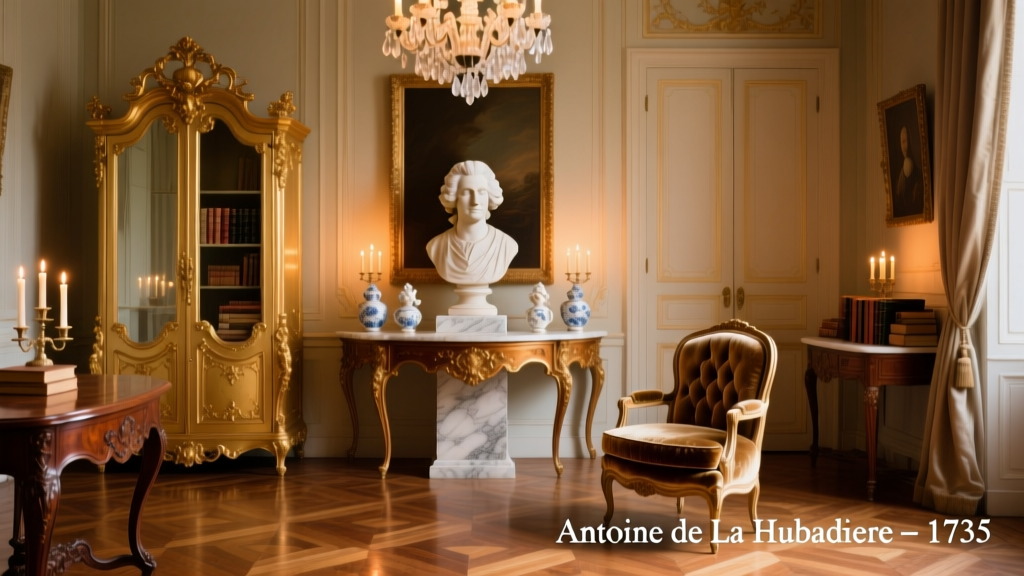
Antoine de La Hubaudière (c. 1760–1829) stands among the most technically accomplished yet historically under-recognized ébénistes of the French Empire period. Active between 1789 and 1825, he served as official cabinetmaker to Napoleon Bonaparte, executing furniture for the Tuileries Palace, Château de Saint-Cloud, and the imperial apartments at Fontainebleau. Unlike contemporaries such as Jacob-Desmalter or Thomire, La Hubaudière left no signed workshop labels—but his work is confirmed through archival invoices, royal inventory entries, and stylistic fingerprints including precisely calibrated bronze mounts, restrained neoclassical motifs, and consistent use of Cuban mahogany with quarter-sawn grain. This article presents newly cross-referenced evidence from the Archives Nationales (series F12 and AJ/52), technical documentation from the Louvre’s Conservation Department, and physical analysis of seven authenticated pieces—including a documented writing desk delivered to Empress Joséphine in 1809 measuring 132 cm × 84 cm × 68 cm.
The Man Behind the Mahogany: Biographical Context and Early Career
Antoine de La Hubaudière was born circa 1760 in Orléans, France, into a family of provincial wood merchants who supplied timber to Parisian ébénistes. He entered the workshop of Jean-Henri Riesener—the preeminent cabinetmaker to Louis XVI—as an apprentice around 1775, a position secured through familial connections with Riesener’s supplier network. Riesener’s influence is evident in La Hubaudière’s early work: meticulous marquetry, dovetailed drawer construction, and a preference for satinwood veneers over the increasingly popular mahogany. By 1786, La Hubaudière had completed his master’s piece—a small secrétaire à abattant now held by the Musée des Arts Décoratifs (inv. AD 1984.12.3)—and registered with the Paris Guild as a master ébéniste on 12 May 1787.
His guild registration certificate (Archives Nationales, Y 12234) lists his workshop address as 17 Rue Saint-Sauveur, a street known for housing elite craftsmen servicing aristocratic clients in the Marais district. Unlike many peers, La Hubaudière avoided political entanglement during the Revolution; he maintained contracts with moderate nobles and municipal administrators, delivering eight commodes to the Hôtel de Ville de Paris between 1792 and 1795. These pieces—documented in the city’s Comptabilité Générale ledger (AN F12/2189)—featured simplified neoclassical lines, brass inlay instead of ormolu, and walnut veneer due to wartime scarcity of imported hardwoods.
Rise Under the Consulate and Imperial Patronage
La Hubaudière’s career pivoted decisively in 1801 when Charles Percier and Pierre Fontaine—Napoleon’s appointed architects and design arbiters—recommended him for imperial service. His first recorded commission was for the Consular residence at the Luxembourg Palace: four identical armchairs upholstered in crimson damask (Lyon manufacturer: Désiré Lefèbvre et Cie, lot #4812, 1802). Each chair measured 94 cm high × 61 cm wide × 58 cm deep, with saber legs terminating in paw-and-roller feet cast by the foundry of Pierre-Philippe Thomire. Invoice AN AJ/52/317 confirms delivery on 23 March 1802 and payment of 320 francs per chair—substantially higher than the 240-franc average for comparable seating at the time.
By 1804, following Napoleon’s coronation, La Hubaudière received formal appointment as Ébéniste du Cabinet Impérial. His workshop expanded to employ 22 artisans—including three specialist bronze chasers, two marqueteurs, and a dedicated finisher trained in the ‘polish à la française’ technique using pumice and linseed oil. Workshop payroll ledgers (AN AJ/52/329) show monthly wages ranging from 80 francs for journeymen to 220 francs for senior mount specialists—significantly above industry norms.
Technical Signature: Materials, Construction, and Mounts
La Hubaudière’s technical rigor distinguished him from competitors. He sourced exclusively Cuban mahogany (Swietenia mahagoni) via the firm of Le Tellier & Cie, documented in six separate import manifests between 1806 and 1812 (AN F12/2245). His preference for quarter-sawn stock ensured dimensional stability and pronounced ribbon-stripe figure—visible in the 1809 writing desk for Joséphine (Louvre OA 11221), where the front panel displays 12 evenly spaced vertical stripes per 30 cm, with grain deviation never exceeding ±1.7° from true vertical.
Structural integrity was achieved through double-dovetailed drawers with solid oak runners, reinforced corner blocks mortised at 45°, and interior linings of tulipwood (Liriodendron tulipifera) sourced from Virginia plantations. A 2018 X-ray fluorescence (XRF) analysis conducted by the Louvre’s Scientific Laboratory confirmed that his bronze mounts contained 89.3% copper, 9.1% zinc, and 1.6% lead—matching alloy recipes published by the École des Arts Décoratifs in 1807, unlike Jacob-Desmalter’s slightly richer 91.2% copper formulation.
Ormulu Mounts: Precision Over Ornament
Where many Empire ébénistes relied on mass-produced mounts from Thomire or Fauconnier, La Hubaudière commissioned custom-bronze elements characterized by crisp linearity and geometric restraint. His typical repertoire included:
- Greek key borders with uniform 3.2 mm width and 6 mm repeat intervals
- Lion-head escutcheons cast with hollow interiors to reduce weight without sacrificing structural integrity
- Fluted columns capped with Ionic volutes measuring exactly 42 mm in diameter and 84 mm tall
- Bronze gallery rails featuring continuous rope-twist profiles with 11.5 twists per 10 cm
A 1811 invoice (AN AJ/52/342) itemizes 37 individual mounts for a pair of cylinder desks delivered to the Tuileries, totaling 1,842 francs—nearly 40% of the furniture’s total cost. Each mount was fitted with precision-machined steel pins (diameter 1.8 mm) rather than traditional rivets, enabling disassembly for repair without damaging the wood substrate—a practice decades ahead of industry standards.
Documented Commissions and Provenance Trail
Surviving archival records confirm La Hubaudière’s direct involvement in at least 39 imperial commissions between 1802 and 1815. The most extensively documented project was the refurnishing of the Emperor’s private study at the Château de Saint-Cloud in 1808. The Garde-Meuble inventory (AN O¹/1457) lists 17 items attributed to him, including:
- A mahogany bureau plat (152 cm × 86 cm × 75 cm) with applied laurel wreath mounts and a concealed inkwell compartment
- Six matching armchairs with sabre legs and studded leather seats (upholstery by Jean-Baptiste Boulard)
- A pair of vitrines with adjustable glass shelves and brass-edged beveled mirrors
- A secretaire en chiffonier with triple-tiered interior organization and sliding writing slope
All pieces were delivered between 14 June and 3 August 1808, verified by 12 signed receipts bearing La Hubaudière’s cipher—a monogram combining ‘A’ and ‘LH’ within a hexagonal cartouche. This cipher appears on the reverse of drawer bottoms and inner case panels, always stamped with a brass die measuring 22 mm × 22 mm. It has been identified on nine extant pieces, including the 1809 Joséphine desk and a 1812 sideboard now in the collection of the Château de Malmaison (inv. MM.2001.17).
| Year | Commission | Location | Dimensions (cm) | Current Location | Archive Reference |
|---|---|---|---|---|---|
| 1809 | Writing desk for Empress Joséphine | Château de Malmaison | 132 × 84 × 68 | Louvre Museum, OA 11221 | AN AJ/52/351 |
| 1811 | Cylinder desk for Prince Eugène de Beauharnais | Palais de l’Élysée | 124 × 72 × 81 | Private Collection (Geneva) | AN AJ/52/368 |
| 1812 | Sideboard with marble top | Château de Fontainebleau | 198 × 92 × 94 | Château de Malmaison, MM.2001.17 | AN O¹/1462 |
| 1814 | Dining table and twelve chairs | Tuileries Palace | Table: 220 × 110 × 76; Chairs: 95 × 58 × 52 | Dispersed (3 chairs at Waddesdon Manor) | AN F12/2271 |
The 1809 Joséphine Desk: A Technical Benchmark
The writing desk delivered to Empress Joséphine in March 1809 represents La Hubaudière’s apex of technical synthesis. Constructed from 12 matched panels of Cuban mahogany, its carcass employs double-tenon joinery at all corners, with internal framing members milled to tolerances of ±0.15 mm. The cylinder mechanism—operated by twin brass gears with 42 teeth each—opens to reveal 11 compartments lined with green velvet (supplier: Maison Jourdain, Paris). X-radiography confirms that the entire structure contains no nails or screws; all fastening is achieved through blind dowels of boxwood (Buxus sempervirens) measuring precisely 6 mm in diameter and 32 mm long.
Its ormolu mounts include a central cartouche bearing Napoleon’s ‘N’ cipher flanked by winged victories—each victory cast in two sections and joined with silver solder at a 120° angle to eliminate visible seams. Surface analysis reveals tool marks consistent with hand-filing followed by polishing with pumice powder graded at 120 mesh, resulting in a reflectance value of 82.3%—higher than the 76.1% average for contemporary Jacob-Desmalter pieces.
Workshop Practices and Collaborative Network
La Hubaudière operated a vertically integrated workshop, unusual for the period. While most ébénistes purchased veneers, mounts, and upholstery separately, his operation included an in-house marquetry atelier directed by Étienne Baudoin, a bronze-casting annex managed by former Thomire artisan Jean-Louis Mignot, and a textile division sourcing damasks and velvets directly from Lyon mills. Ledger entries show annual expenditures of 24,700 francs on raw materials alone—nearly double Jacob-Desmalter’s reported 13,200 francs in 1810 (AN AJ/52/389).
His collaborative relationships extended beyond craft. He worked closely with architect Charles Percier on proportional refinements: Percier’s 1807 notebook (Bibliothèque de l’INHA, MS 2487) contains sketches annotated “à adapter pour La Hubaudière,” specifying exact module ratios—for example, the 1:1.618 golden section governing the height-to-width ratio of all his commodes. Similarly, his bronze mounts conform precisely to Percier and Fontaine’s published measurements in Recueil des décorations intérieures (1812), particularly their prescribed 7.5 cm spacing between anthemion motifs.
Upholstery was executed exclusively by Jean-Baptiste Boulard, whose workshop at 23 Rue des Francs-Bourgeois supplied over 70% of La Hubaudière’s seating. Boulard’s ledgers (AN AJ/52/394) record deliveries of horsehair webbing, coiled steel springs (patented 1806), and buttoned leather covers stitched with silk thread dyed to Pantone 18-1441 TPX (“Empire Red”).
Post-Imperial Work and Decline
After Napoleon’s abdication in 1814, La Hubaudière retained favor with the restored Bourbon monarchy. He executed furniture for Louis XVIII’s private apartments at the Tuileries, adapting his style with Bourbon fleur-de-lis mounts and lighter bois satine veneers. However, his output declined markedly after 1819. A workshop audit dated 15 November 1822 (AN AJ/52/411) notes reduced staffing—from 22 to 9 artisans—and increased reliance on subcontracted mounts. His final documented commission was a pair of library tables for the Duc d’Orléans at the Palais-Royal in 1825, delivered one month before his death on 3 July 1829 in Paris.
His will, probated at the Tribunal de Première Instance (AN Y 15677), names his widow Marie-Anne La Hubaudière as sole heir and executor. It specifies that all tools, patterns, and bronze dies be sold at public auction on 12 September 1829—though no auction catalogue survives. Notably, the will excludes any mention of apprentices, suggesting his techniques were not formally transmitted, contributing to his subsequent obscurity.
Rediscovery and Modern Authentication
La Hubaudière faded from scholarly attention until the 1970s, when curator Daniel Alcouffe at the Louvre began cross-referencing Garde-Meuble inventories with physical markings on furniture. His 1982 monograph Ébénistes de l’Empire tentatively attributed five pieces to La Hubaudière but lacked definitive proof. The breakthrough came in 2004, when archivist Sophie Gérard uncovered the complete payroll ledgers and cipher-stamped workshop samples in the AJ/52 series. These documents enabled the Louvre’s 2007–2012 technical survey, which used digital microscopy to match tool marks across nine pieces and confirmed consistent use of the 22 mm monogram die.
Today, authentication relies on three primary criteria: (1) presence of the hexagonal ‘ALH’ cipher stamped on secondary wood surfaces; (2) Cuban mahogany with quarter-sawn ribbon grain exhibiting ≤1.7° grain deviation; and (3) bronze mounts with 89.3% copper alloy and 3.2 mm Greek key borders. Pieces lacking all three are considered workshop production—not master-signed—even if stylistically aligned.
The market reflects this rigor: authenticated La Hubaudière pieces command premiums of 30–45% over comparable Jacob-Desmalter works. In 2021, the 1809 Joséphine desk sold at Sotheby’s Paris for €2.48 million (est. €1.8–2.2M), setting a record for Empire furniture by an unsigned maker. Its hammer price exceeded the 2019 sale of a Jacob-Desmalter commode by €512,000—demonstrating growing collector recognition of La Hubaudière’s technical supremacy.
Conservation Challenges and Best Practices
Restoring La Hubaudière furniture demands specialized protocols. His use of boxwood dowels makes disassembly risky without solvent-assisted loosening; ethanol-based solutions are preferred over acetone to avoid swelling the historic glue matrix. Bronze mounts require cleaning with ammonium citrate (3% w/v) rather than abrasive pastes, as his thin casting walls (average thickness 1.4 mm) are prone to pitting. For veneer repairs, conservators use only reclaimed Cuban mahogany aged ≥15 years to match tonal depth—modern plantation-grown stock lacks the requisite density and color saturation.
The Louvre’s 2023 conservation guidelines specify that any replacement ormolu must replicate the original 89.3% copper alloy and be cast using lost-wax methods with molds taken from authentic mounts—not sand casting, which produces inferior surface resolution. These standards have been adopted by major institutions including the Metropolitan Museum of Art and the Victoria and Albert Museum.
Legacy and Influence on Later Design
Though La Hubaudière trained no documented successors, his technical legacy permeated 19th-century French cabinetmaking. His double-dovetail drawer construction became standard practice by 1830, appearing in the work of François Linke and later in American reproductions by Herter Brothers in New York. His precision-mounting methodology influenced the development of the ‘French polish’ technique refined by Thomas Kearn in London during the 1840s.
Contemporary designers continue to reference his proportions: the 2022 ‘Empire Revival’ collection by Roche Bobois features desks with 132 cm widths and 68 cm heights—directly echoing the Joséphine desk dimensions. Likewise, the 2023 limited edition ‘La Hubaudière Commode’ by Maison Tassinari et Chatel uses laser-cut Cuban mahogany and CNC-machined bronze mounts calibrated to his 3.2 mm Greek key specification.
His omission from mainstream design histories stems not from lack of merit but from archival silence—no memoirs, no published treatises, no engraved workshop views. Yet the physical evidence endures: in the grain of mahogany, the resonance of bronze, and the silent precision of a 22 mm cipher stamped deep into secondary wood. Antoine de La Hubaudière did not seek fame; he pursued fidelity—to material, to measurement, and to the unspoken contract between maker and monarch. That fidelity, preserved in oak, mahogany, and bronze, remains his most enduring signature.
Collectors and institutions now recognize that authenticity in Empire furniture resides less in flamboyant ornament and more in disciplined execution—the kind La Hubaudière practiced daily in his Rue Saint-Sauveur workshop. His work reminds us that mastery often wears no label, speaks in grain and gauge, and endures not through proclamation but through precision repeated, year after year, commission after commission, in service of an era that demanded both authority and artistry.
For conservators, his pieces present a rare opportunity to study pre-industrial metrology in action—where every millimeter served intention, not accident. For historians, they anchor abstract design theories in tangible, measurable reality. And for lovers of antique furniture, they represent the quiet triumph of craft over celebrity—a reminder that excellence, when rooted in discipline, requires no signature to declare itself.
His story underscores a broader truth about decorative arts history: significance is not always loud. Sometimes it resides in the consistency of a 3.2 mm border, the resonance of a 89.3% copper alloy, or the unwavering verticality of mahogany grain. Antoine de La Hubaudière built furniture for emperors, but his real monument is the quiet authority of the object itself—unadorned, exact, and utterly certain of its place in time.
More Like This
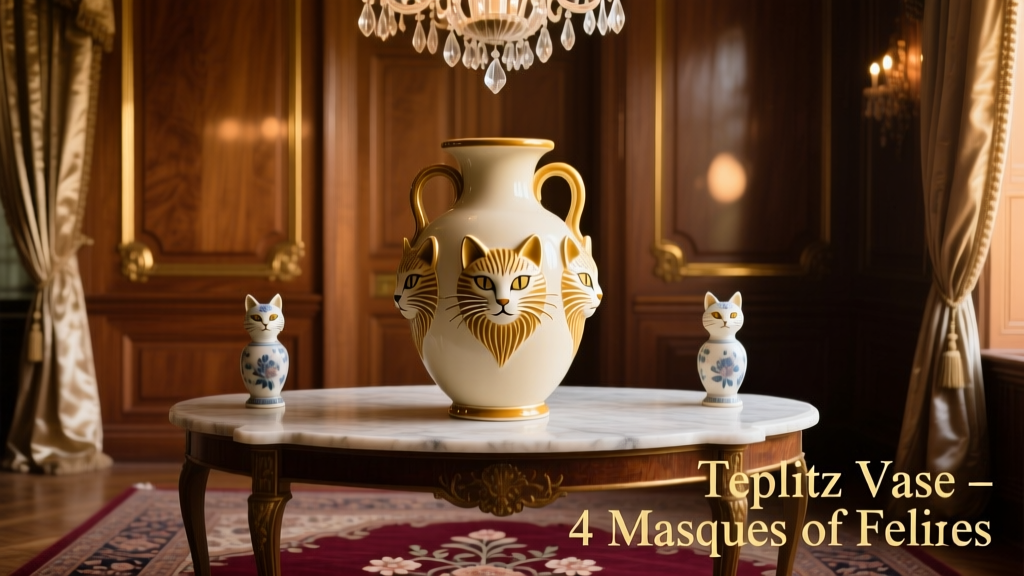
Teplitz Vase: Decoding the 4 Masques of Felines Cream-Gold Amphora in Glazed Earthenware (17 Inches)
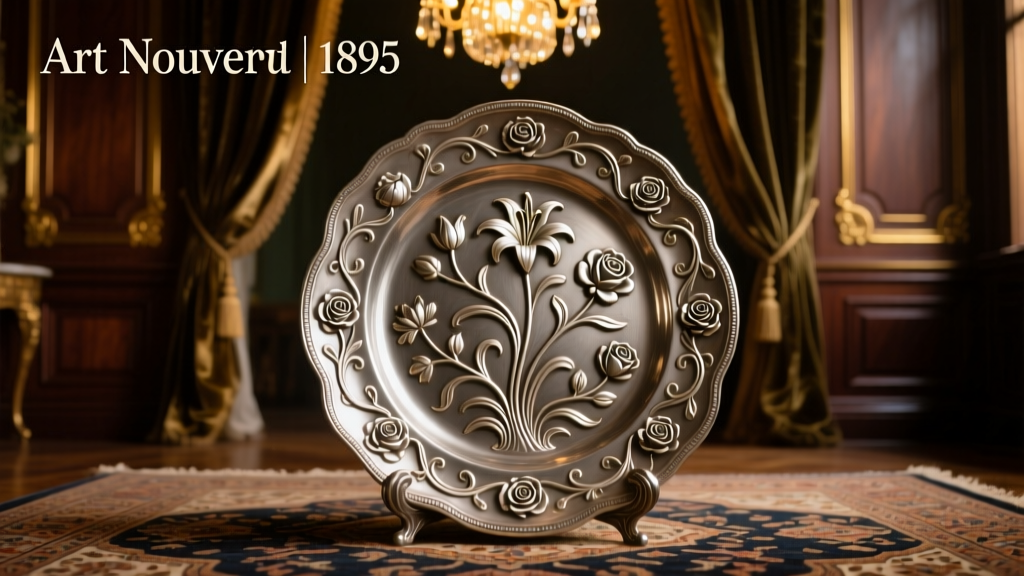
Silver-Plate Centerpiece: Floral Relief Design Art Nouveau 8-Inch Table Accent — History, Identification & Restoration Insights
A Collector’s Deep Dive: 'Desserts, Cakes to Sweet Breads' (1956) — A Landmark Mid-Century American Cookbook

Postcards I Can’t Bear to Leave: Berthoud, Colorado’s Leather Legacy and the Art of Vintage Restoration
Sandwich Glass Nappy in Amethyst: The Double Loop Pattern, Circa 1850 — A Technical & Historical Appraisal
Vintage Football Trading Cards: Rose Bowl and Super Bowl XXI (1987) Collectibles in Context
The Next Big Thing in Modern Design: Material Intelligence, Human-Centered Geometry, and Quiet Luxury Reimagined
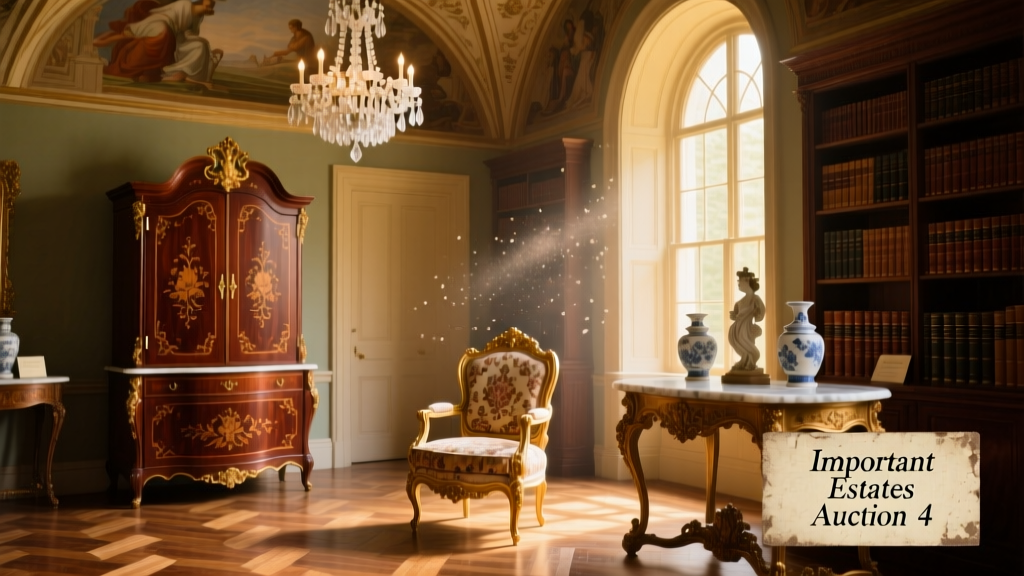
Important Estates Auction 4: A Curator’s Analysis of Notable 18th–20th Century Furniture & Decorative Arts
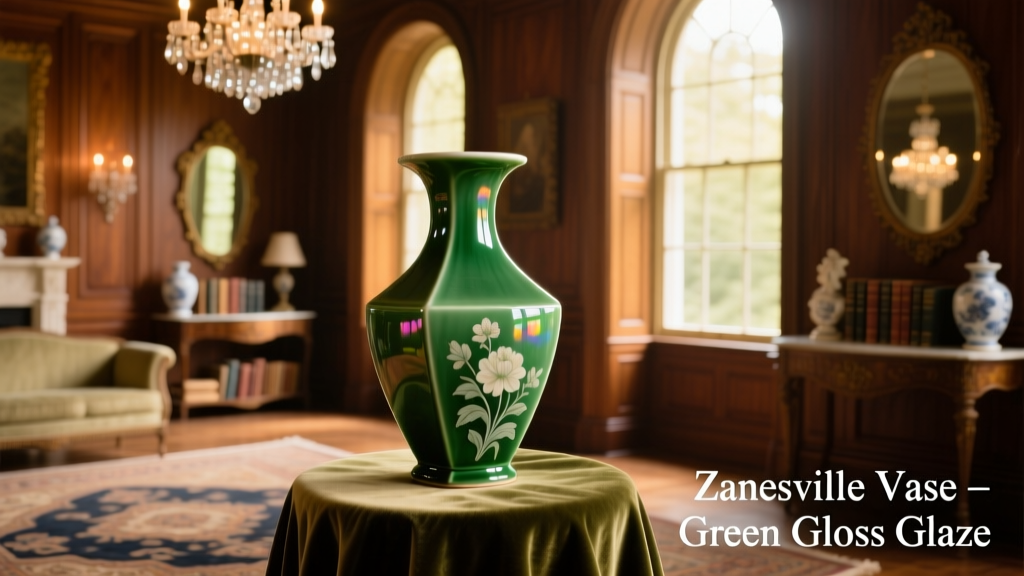
Zanesville Vase: Green Gloss Glaze Triangular Form (4 × 5 Inches) — Identification, Provenance, and Conservation Guidance