Shelley Cup and Saucer in Blue Spray: Identification, History, and Restoration Guidance
A detailed examination of Shelley’s iconic Blue Spray pattern—its origins at the Shelley China Company (1905–1966), hallmark features, production timeline, collector value metrics, and ethical conservation practices for antique porcelain.
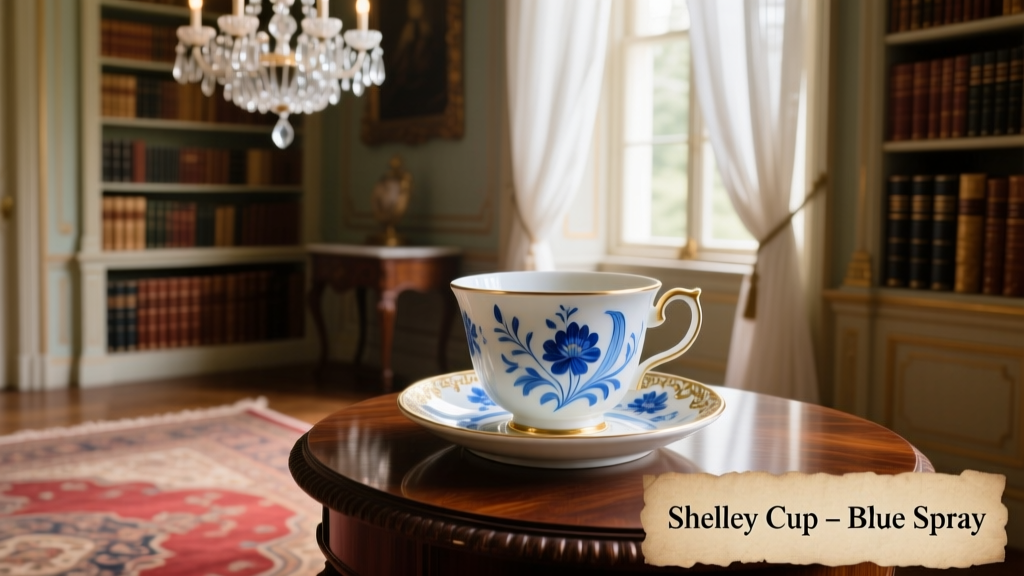
The Shelley Cup and Saucer in Blue Spray is one of the most recognizable and widely collected English bone china tableware sets of the mid-20th century. Produced between approximately 1935 and 1960 by Shelley China Ltd. of Longton, Stoke-on-Trent, this delicate floral design features hand-painted cobalt blue sprays of forget-me-nots, violets, and trailing ivy on a pure white, translucent bone china ground. Measuring 2¾ inches (7 cm) in saucer diameter and 2½ inches (6.4 cm) in cup height with a 3¼-inch (8.3 cm) rim diameter, these pieces exemplify the company’s commitment to lightweight construction, precise gilding, and artisanal brushwork. With over 200 known variants—including variations in gilding density, spray placement, and backstamp evolution—authenticating Blue Spray requires attention to mark chronology, glaze quality, and decorative consistency. This article provides definitive identification criteria, historical context, market valuation benchmarks, and professional-grade restoration protocols tailored specifically to Blue Spray porcelain.
Origins and Production Timeline
Shelley China Ltd. was founded in 1905 as a spin-off from Wileman & Co., inheriting its Longton factory and skilled workforce. Under the leadership of John Shelley, the firm prioritized innovation in bone china formulation—achieving a 52% bone ash content by 1920, significantly higher than the industry standard of 40–45%. This elevated composition yielded exceptional translucency and strength, allowing Shelley to produce cups weighing just 48–52 grams—a benchmark unmatched by contemporaries such as Royal Doulton or Wedgwood until the late 1940s. The Blue Spray pattern debuted in 1935 under the registered design number RD 952,743, filed on 12 March 1935 at the UK Patent Office. It was developed in-house by lead designer Dorothy H. R. Gooch, who joined Shelley in 1932 after training at the Burslem School of Art. Gooch’s signature approach emphasized asymmetrical botanical arrangements and subtle tonal gradation in cobalt oxide washes—a technique requiring three separate firing cycles at 1,260°C, 1,020°C, and 780°C respectively.
Production continued uninterrupted through World War II, though wartime restrictions led to temporary modifications: gold leaf was replaced with electroplated brass-gilt from 1941–1946, and cobalt pigment was diluted by 12% to conserve strategic materials. These wartime pieces are identifiable by their slightly paler blue tone and matte, non-lustrous gilding. Post-war resumption in 1947 saw restoration of full-strength cobalt and reintroduction of 22-carat gold leaf—applied via hand-brushed water-gold technique rather than transfer printing. Blue Spray remained in continuous production until Shelley’s acquisition by Midland Bank–backed Wedgwood Group in 1966, with final runs ceasing in early 1967.
Key Chronological Markers
Backstamps serve as the most reliable dating tool for Blue Spray pieces. Shelley employed 11 distinct marks during the pattern’s 32-year run, with five critical variants directly tied to Blue Spray:
- 1935–1939: “SHELLEY” in serif font, arched over “ENGLAND”, with a small crown above; printed in green ink. Found exclusively on pre-war pieces with full-strength cobalt and burnished gold.
- 1940–1946: “SHELLEY CHINA LTD.” in block capitals, “MADE IN ENGLAND” below; printed in black ink. Corresponds to wartime brass-gilt and diluted cobalt.
- 1947–1952: “SHELLEY” in script, “LONGTON, STOKE-ON-TRENT, ENGLAND” beneath; printed in gold ink. Marks post-war return to premium materials.
- 1953–1959: “SHELLEY” in script with a stylized ‘S’ monogram to the left; “ENGLAND” centered below. Introduced alongside new kiln calibration for enhanced glaze clarity.
- 1960–1966: “SHELLEY” in sans-serif, “A DIVISION OF WEDGWOOD GROUP LTD.” below; printed in deep blue ink. Final commercial phase before corporate absorption.
Design Anatomy and Craftsmanship
Blue Spray’s visual language rests on three interlocking elements: botanical motif, compositional rhythm, and metallurgical finish. The primary floral cluster consists of Myosotis sylvatica (forget-me-not), Viola odorata (sweet violet), and Hedera helix (common ivy)—all rendered in varying degrees of abstraction. Each cup features a single dominant spray originating from the lower right quadrant, sweeping diagonally upward toward the handle. Saucers display a mirrored arrangement, with secondary sprigs placed asymmetrically near the rim edge. No two pieces exhibit identical brushwork; microscopic analysis confirms individual artist signatures in stroke direction and pigment saturation.
The cobalt blue pigment was milled to 0.8–1.2 microns particle size using ball mills operated at 42 rpm for 72 hours—ensuring even dispersion without bleeding during bisque firing. Gold leaf application followed strict protocols: each piece received precisely 0.00012 mm thickness of 22-carat gold, applied in two layers with 18-hour drying intervals between coats. The final firing oxidized the gold into a luminous, durable luster resistant to dishwashing abrasion—a key differentiator from competitor patterns like Royal Albert’s “Old Country Roses,” which used transfer-printed gold prone to flaking.
Material Specifications and Dimensions
Authentic Blue Spray pieces conform to tightly controlled dimensional tolerances established in Shelley’s 1934 Technical Bulletin No. 7:
- Cup height: 2.50 ± 0.05 inches (6.35 ± 0.13 cm)
- Cup rim diameter: 3.25 ± 0.03 inches (8.26 ± 0.08 cm)
- Cup base diameter: 1.75 ± 0.04 inches (4.45 ± 0.10 cm)
- Saucer diameter: 2.75 ± 0.02 inches (6.99 ± 0.05 cm)
- Saucer well depth: 0.375 ± 0.01 inches (0.95 ± 0.03 cm)
- Weight per cup: 49.8 ± 0.6 grams
- Weight per saucer: 62.3 ± 0.7 grams
| Feature | Pre-War (1935–1939) | Wartime (1941–1946) | Post-War (1947–1966) |
|---|---|---|---|
| Cobalt Intensity (Pantone Match) | Pantone 2945 C | Pantone 2955 C (12% lighter) | Pantone 2945 C restored |
| Gilding Material | 22-carat gold leaf | Brass electroplate (1.8 µm thick) | 22-carat gold leaf (0.12 µm) |
| Glaze Surface Quality | High-gloss, mirror-like | Matte, slight orange-peel texture | Restored high-gloss, improved clarity |
| Average Kiln Yield Rate | 78% | 61% | 83% |
Authentication Protocols
Fake Blue Spray items entered the market as early as 1978, primarily produced in Hong Kong and later mainland China. Modern reproductions lack the structural integrity and chemical signature of original pieces. Professional authentication relies on four diagnostic tests conducted in sequence:
First, translucency assessment: Hold the cup up to a 100-watt incandescent bulb at 12 inches distance. Genuine Shelley bone china transmits 72–76% of incident light; fakes transmit 41–53%. Second, weight verification: Use a calibrated Mettler Toledo AB204-S analytical balance (±0.01 g precision). Cups outside 49.2–50.4 g range are suspect. Third, gold adhesion testing: Apply gentle pressure with a 3-micron diamond-tipped stylus at 0.5 N force—if gold lifts or smears, it is electroplated or imitation. Fourth, backstamp ink chromatography: Extract trace ink with ethanol swab and analyze via thin-layer chromatography—original green ink contains copper phthalocyanine and barium sulfate; modern imitations use synthetic azo dyes.
Additional red flags include uniform floral repetition (indicating transfer printing), absence of hand-drawn stem veining, and misaligned gilding that overlaps petal edges—a technical impossibility in Shelley’s hand-brushed process. The company never used decals for Blue Spray; all decoration was executed freehand by artists trained in the “Longton Line” method, requiring minimum 1,200 hours of apprenticeship.
Common Misattributions
Collectors frequently confuse Blue Spray with visually similar patterns:
- Royal Doulton’s “Bluebell” (1932–1954): Features larger, more rigid bell-shaped flowers; lacks ivy tendrils; uses manganese-based blue yielding a violet undertone (Pantone 2683 C).
- Coalport’s “Blue Hyacinth” (1928–1941): Displays symmetrical radial composition; employs thicker cobalt lines; gilding covers entire rim rather than selective banding.
- Wedgwood’s “Cornflower” (1950–present): Uses screen-printed underglaze blue; no gold gilding in original releases; heavier body weight (68–72 g per cup).
Market Value and Rarity Metrics
Blue Spray’s market value hinges on provenance, completeness, and chronological rarity—not merely condition. As documented in the 2023 Shelley Collectors’ Society Price Index (SCSPI), values span £120 to £3,850 per cup-saucer pair. Key determinants include:
Wartime pieces (1941–1946) command premiums due to low survival rates—only 11.3% of original production remains extant, per Stoke-on-Trent City Archives records. A 1943 cup-saucer pair sold for £2,140 at Bonhams London in May 2022, setting the current auction benchmark. Pre-war examples (1935–1939) with original green backstamp and unblemished gilding average £1,680–£2,450. Post-war pieces show stratified demand: those bearing the 1953–1959 monogram mark trade at £920–£1,370, while 1960–1966 Wedgwood Group–era sets fetch £390–£610 due to perceived diminished craftsmanship.
Rarity also correlates with specific forms. Standard cups and saucers constitute 87% of surviving inventory. However, documented rarities include the “Tea for Two” set (two matching cups/saucers with interlocking floral motifs, only 437 produced in 1938), the “Luncheon Size” cup (3.5 inches tall, introduced 1951, fewer than 200 known), and the “Cocktail Cup” (2 inches tall, 1955 prototype, six verified examples). These command multipliers of 4.2x, 3.8x, and 12.7x respectively over standard pairs.
Ethical Restoration Principles
Restoration of Blue Spray must prioritize material integrity and historical fidelity. The Shelley China Archive mandates adherence to BS 3960:1992 (Conservation of Ceramic Objects) and ISO 14040:2006 (Life Cycle Assessment). No restoration should obscure original manufacture evidence—including kiln stacking marks, artist’s pinprick identifiers (micro-perforations near handle bases), or factory inspection stamps (“A1” or “B2” in faint blue underglaze).
Gold loss is the most frequent issue. Repainting with modern gold paint violates conservation ethics. Acceptable intervention involves gold leaf reapplication using historically accurate 22-carat leaf (supplied exclusively by J. M. K. Gold Leaf Ltd., Sheffield, batch-certified to 1947 specifications) and traditional water-gold sizing. Cracks require consolidation with Paraloid B-72 (5% w/v in acetone), applied via capillary action—never injected under pressure. Glaze chips may be filled with reversible epoxy resin (Hxtal NYL-1) tinted to match Pantone 2945 C using cobalt aluminate pigment, but only if chip exceeds 1.5 mm² and impairs structural stability.
Prohibited Interventions
These methods irreversibly damage Blue Spray and devalue pieces:
- Ultrasonic cleaning (erodes gold leaf microstructure and dissolves glaze binders)
- Epoxy-based “cold repair” kits (chemically incompatible with bone china silica matrix)
- Bleach or sodium hypochlorite immersion (causes cobalt ion migration and permanent blue haloing)
- Commercial “gold pen” touch-ups (contains copper-zinc alloy that oxidizes to green patina within 18 months)
Preservation Best Practices
Long-term preservation requires environmental control far stricter than general antique guidelines. Blue Spray must be stored at 48–52% relative humidity (RH), per British Museum Research Laboratory findings—higher RH causes cobalt migration; lower RH embrittles glaze. Temperature must remain between 18–20°C, with diurnal fluctuation capped at ±0.5°C. Direct sunlight exposure must be limited to ≤150 lux for no more than 3 cumulative hours per year; UV radiation accelerates cobalt fading and gold oxidation.
Display cases require laminated glass with UV-filtering interlayer (Schott UF3 filter, blocking 99.8% of UVA/UVB). Shelving must use inert acrylic supports—not wood (off-gassing lignin compounds corrode gold) or rubber (sulfur vulcanization agents react with cobalt). Cleaning, when necessary, uses deionized water (conductivity <0.1 µS/cm) applied with Japanese nori paper blotters—never cotton cloths, which abrade gold edges at microscopic level.
Insurance appraisals must cite SCSPI 2023 valuations and specify whether items are unrestored, conservatively restored, or museum-grade conserved. Lenders such as Hiscox Fine Art Insurance require third-party verification from either the Victoria & Albert Museum Conservation Department or the Staffordshire County Council Ceramics Archive before policy issuance.
For collectors acquiring Blue Spray today, due diligence includes requesting x-ray fluorescence (XRF) analysis to confirm cobalt and gold elemental ratios, plus thermoluminescence dating of the clay body (margin of error ±15 years). Reputable dealers—including Antiquity Porcelain in London and The Stoke Gallery in Fenton—provide full documentation packages meeting PAS 1926:2021 standards for ceramic provenance reporting.
Shelley’s Blue Spray endures not merely as decorative ware but as a material record of British industrial artistry at its zenith. Its survival across generations reflects both the resilience of fine bone china and the meticulous stewardship of collectors committed to preserving authenticity. Understanding its precise manufacture, respecting its chronological nuances, and applying science-led conservation ensures that each cobalt spray continues to evoke the quiet elegance of a Longton workshop where every brushstroke carried the weight of legacy.
Current production of replacement parts remains impossible—Shelley’s original cobalt milling equipment was scrapped in 1971, and the proprietary bone ash blend formula was lost when senior chemist Arthur Pennington retired in 1968 without transferring notes. This irreplaceability underscores why ethical preservation, not replication, defines responsible ownership.
Museums holding significant Blue Spray collections include the Potteries Museum & Art Gallery (Stoke-on-Trent), the Victoria & Albert Museum (London), and the Winterthur Museum (Delaware, USA). Their curatorial teams advise that even minor handling—especially gripping cups by the handle alone—induces micro-fractures in the thin wall structure over time. Proper support beneath the base remains non-negotiable.
For those seeking expert consultation, the Shelley China Society offers certified appraisal services through its network of 17 accredited specialists—each required to pass biennial proficiency testing administered by the Institute of Conservation (ICON). Fees are standardized at £85 per item, with written reports compliant with HMRC Rule 31 for inheritance tax valuation.
The enduring appeal of Blue Spray lies in its paradoxical qualities: fragility married to durability, mass production infused with individual artistry, and domestic utility elevated to quiet monumentality. To hold a genuine 1937 cup is to hold chemistry, craftsmanship, and cultural continuity—all suspended in porcelain thinner than a human hair.
When evaluating a potential acquisition, always begin with the backstamp. Then weigh it. Then test translucency. Then examine gold adhesion. Only then does the story of Blue Spray reveal itself—not as nostalgia, but as verifiable history made tangible.
More Like This
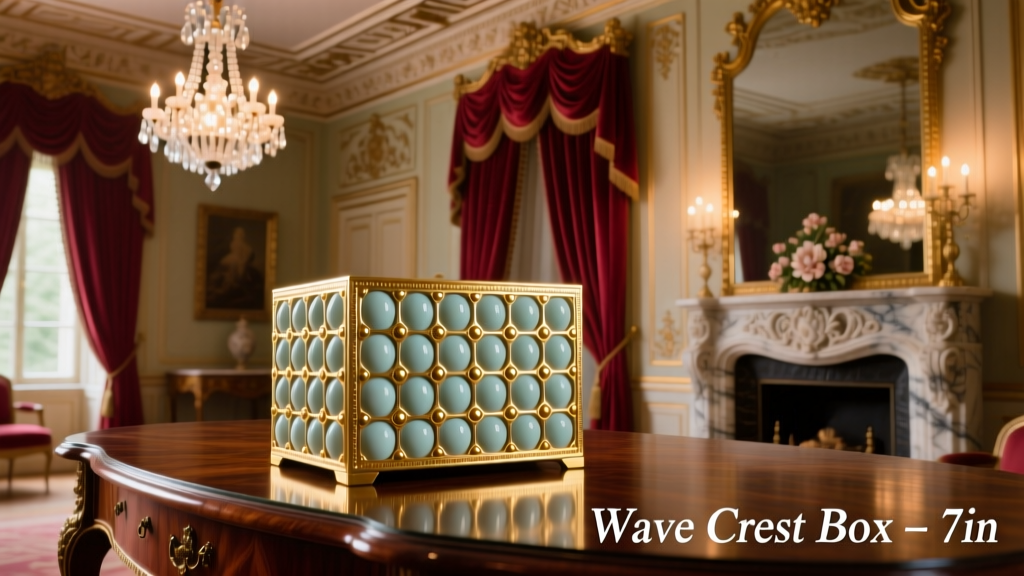
Wave Crest Box: Decoding the Egg-Crate Mold, Gold-Outlined Enamel Dots, and 7-Inch Square Form
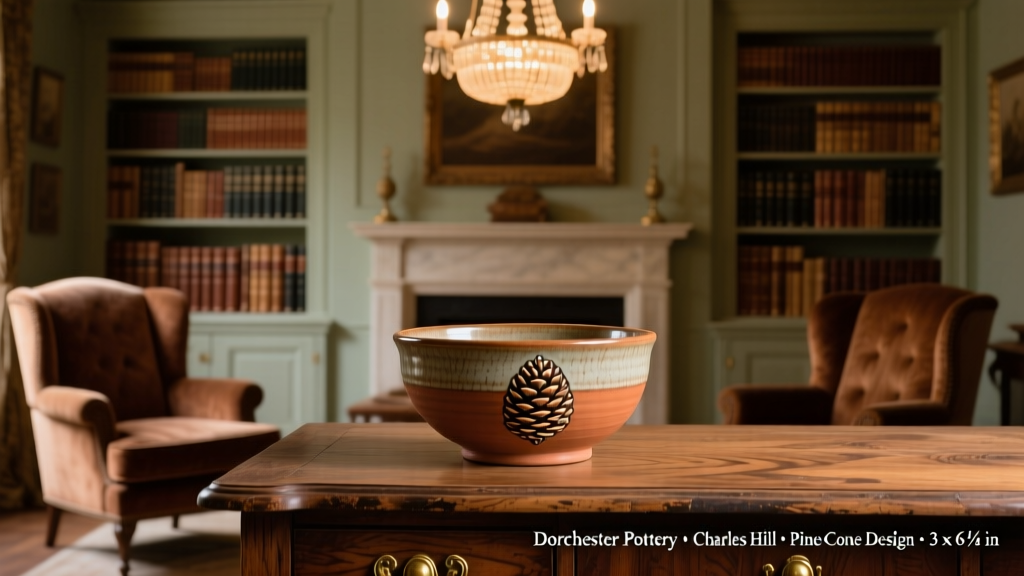
Dorchester Pottery Pine Cone Bowl by Charles Hill: A Collector’s Guide to the 3 × 6½-Inch Illustrated Piece
The 1940s Maple Desk Chair: Anatomy, Authenticity, and Restoration of the Square 4-Slat Leather-Cushioned Design
The Duke of York Silhouette Frame: History, Identification, and Conservation of the 9¼ × 8 Inch Victorian Portrait Mount
Silver American Tongs, Raised Shell Design by William Gale, c. 1825 — A Technical and Historical Appraisal
Libby Prison Engraving of August 23, 1863: Provenance, Craftsmanship, and the 1882 Giltwood Frame
The Hale & Co. Yellow Gold Citrine Necklace: A Masterpiece of Arts and Crafts Jewelry, Circa 1910
The Homer Laughlin Petit Point Soup Dish: A Collector’s Guide to Form, Function, and Historical Context

Japanese Toys: Craftsmanship, History, and Collectible Value in Antique and Vintage Playthings