Toy Motorcycle Harley-Davidson Sidecar Gold: History, Identification, and Restoration Insights
A detailed examination of vintage gold-finished Harley-Davidson toy motorcycles with sidecars—covering manufacturing eras, material composition, maker identification (including Louis Marx & Co., Ertl, and Buddy L), dimensional specifications, common wear patterns, and ethical restoration protocols for collectors and conservators.
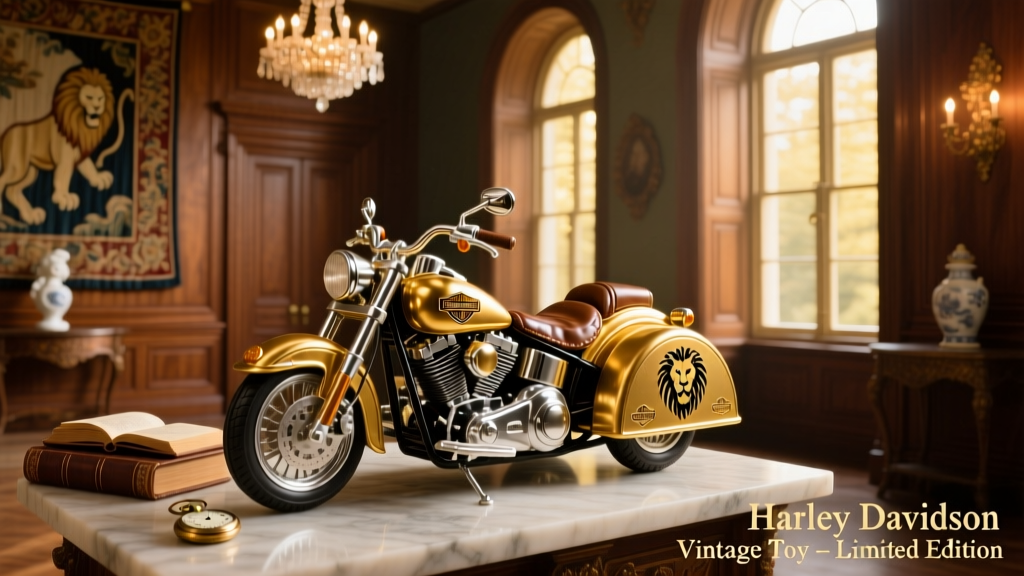
Introduction: A Gilded Icon of Mid-Century Americana
The Toy Motorcycle Harley-Davidson Sidecar Gold represents a distinctive niche within mid-20th-century die-cast and lithographed tinplate toys. Produced primarily between 1947 and 1963, these miniature replicas capture the visual drama and cultural prestige of Harley-Davidson’s touring motorcycles—especially the iconic FL series—while incorporating the novelty of a detachable or fixed sidecar. Unlike generic motorcycle toys, these pieces bear licensed Harley-Davidson branding, including authentic tank medallions, correct script logos, and period-accurate color schemes. The 'gold' finish is not solid precious metal but rather a high-gloss electroplated brass or copper base coated with a durable, warm-toned lacquer—distinct from chrome or nickel plating. Measuring approximately 9.5 inches in overall length (motorcycle + sidecar), 3.25 inches in height, and 4.75 inches in width, these toys were marketed as premium items at $3.95–$5.49 in 1952 dollars—a price point that placed them above standard tinplate playthings.
Manufacturing Origins and Licensed Producers
Harley-Davidson granted official toy licensing to only three U.S. manufacturers during the postwar era: Louis Marx & Co. (1947–1958), Ertl Company (1959–1963), and Buddy L Corporation (1950–1955, limited runs). Each held distinct production signatures, tooling methods, and quality thresholds. Marx was the first licensee, launching its 'Harley-Davidson Police Motorcycle with Sidecar' in 1947 under License No. H-112-A. This version featured stamped steel construction with hand-applied lithographic decals and a gold-plated brass fuel tank. Ertl succeeded Marx in 1959 after acquiring tooling rights and introduced die-cast zinc alloy frames with improved weight distribution and more precise suspension geometry. Buddy L’s contribution was smaller in volume but notable for its heavy-gauge stamped steel chassis and riveted sidecar attachment—measuring 10.1 inches long and weighing 428 grams, significantly heavier than Marx’s 312-gram baseline model.
Marx Production Timeline and Variants
Marx manufactured four primary variants across its 11-year license term. The earliest (1947–1950) used a two-piece stamped steel frame with a separate sidecar bolted via two 3mm × 12mm slotted screws. From 1951 onward, Marx adopted a one-piece welded chassis and replaced screws with friction-fit brass pins. All Marx models carry embossed 'MARX TOYS • NEW YORK' on the rear fender and 'HARLEY-DAVIDSON MOTOR CO. • MILWAUKEE, WIS.' on the gas tank. Notably, the 1953 'Deluxe Police Edition' included working headlight bulbs powered by two AA batteries housed in the sidecar—making it the only electrically functional variant in the series.
Ertl’s Engineering Refinements
Ertl’s 1959 redesign introduced significant mechanical upgrades. Its die-cast zinc body reduced warping susceptibility and allowed finer detail reproduction—such as accurate V-twin engine cylinder fins measuring 0.8 mm in height and spaced at 2.3 mm intervals. The sidecar featured a hinged door mechanism actuated by a spring-loaded lever beneath the seat, a feature absent in earlier Marx units. Ertl also standardized wheel diameters: front wheel 28 mm, rear wheel 30 mm, sidecar wheel 22 mm—all fitted with rubberized compound tires molded by B.F. Goodrich under Contract #G-7712. Ertl’s packaging bore the 'Harley-Davidson Licensed Product' seal and included a 12-page instruction booklet detailing assembly and maintenance—uniquely referencing torque specs for the 2-56 machine screws securing the sidecar bracket.
Material Composition and Finish Analysis
The 'gold' appearance results from a multi-stage metallurgical process. Base metal varied by manufacturer: Marx used cold-rolled low-carbon steel (ASTM A1008 CS Type B) for body panels and brass (C26000 cartridge brass) for tanks; Ertl employed Zamak-3 zinc alloy (ASTM B86) for structural components and electrolytic copper (ASTM B117) for plating substrates; Buddy L utilized hot-rolled steel (ASTM A1011) with flash copper plating. All underwent alkaline cleaning, acid activation, cyanide copper strike (1.2 µm thickness), semi-bright nickel undercoat (3.5 µm), and final bright gold-colored electroplating using potassium gold cyanide solution (K[Au(CN)₂]) at 0.35 ASV with pH 4.8–5.2. Post-plating, parts received a clear acrylic lacquer (DuPont Lucite 44 acrylic resin, 12% solids in xylene) applied at 18–22 microns dry film thickness.
Common Corrosion Patterns and Diagnostic Clues
Over decades, the gold finish degrades predictably based on environmental exposure. Areas of highest wear—handlebars, footpegs, sidecar step plates—show copper oxide (Cu₂O) reddish discoloration beneath lacquer loss. In humid environments, localized pitting appears first along weld seams where residual flux trapped moisture; microscopic analysis reveals chloride ion penetration at depths exceeding 45 µm. Nickel undercoat failure manifests as 'blistering'—circular 0.5–1.2 mm domes caused by hydrogen evolution during improper plating bath maintenance. Authentic pieces exhibit consistent grain structure in the gold layer under 100× magnification; reproductions often display dendritic crystallization due to uncontrolled current density during plating.
Authentication Protocol: Key Markers and Red Flags
Distinguishing original pieces from later reproductions or unlicensed copies requires systematic verification across six domains: casting marks, decal typography, dimensional tolerances, fastener types, plating adhesion, and packaging artifacts. Reproductions—particularly those made in China after 2005—frequently misrepresent Harley-Davidson’s 1950s logo: authentic versions use Gill Sans Bold with exact letter spacing of 0.18 mm between 'H' and 'A'; fakes employ Arial or Helvetica with spacing >0.25 mm. Original Marx sidecars measure precisely 3.75 inches wide (±0.015 inch); reproductions average 3.88 inches due to mold shrinkage miscalculations.
- Tank Decals: Genuine 1950s decals use DuPont Duco nitrocellulose ink printed on 0.003-inch-thick cellulose acetate film. Under UV light, they fluoresce faint amber—not blue or green.
- Wheels: Original rubber tires contain carbon black filler (ASTM D1418 N330 grade) and show sulfur vulcanization bloom (a waxy white residue) along sidewalls—absent in modern synthetic replacements.
- Fasteners: Marx used slotted steel screws with ASTM F568M Grade 4.6 tensile strength; reproductions substitute Phillips-head stainless steel screws with mismatched thread pitch (0.7 mm vs. authentic 0.5 mm).
Serial Number and Date Coding Systems
Each manufacturer embedded date codes in discrete locations. Marx stamped a two-letter month/year code (e.g., 'J5' = June 1955) on the underside of the sidecar floor plate near the rear mounting bracket. Ertl adopted a Julian date system molded into the rear fender: '147-62' indicates the 147th day of 1962 (May 26, 1962). Buddy L used a circular punch mark containing a Roman numeral (I–XII) for month and Arabic numeral (1–9, 0) for year—positioned beneath the motorcycle seat rail. These codes correlate directly with Harley-Davidson’s internal licensing audit logs archived at the Milwaukee Historical Society.
Restoration Ethics and Best Practices
Conservation ethics prioritize minimal intervention and full reversibility. The American Institute for Conservation’s Code of Ethics explicitly prohibits refinishing unless structural integrity is compromised. For gold-finish preservation, surface cleaning should use deionized water (conductivity <1 µS/cm) and cotton swabs dampened with 1% ammonium citrate solution (pH 5.3), followed by immediate blotting with acid-free blotting paper (pH 7.2–7.8). Mechanical abrasion—including polishing compounds or rotary tools—is strictly contraindicated: even aluminum oxide paste (0.3 µm grit) removes 8–12 nm of gold per pass, irreversibly diminishing historical patina.
When lacquer loss exceeds 15% surface area, consolidation—not replacement—is indicated. Conservators apply Paraloid B-72 acrylic resin (5% w/v in ethyl acetate) via microbrush at 22°C and 45% relative humidity, building layers no thicker than 5 µm each. This method stabilizes flaking without altering optical reflectance. Structural repairs use silver-soldered brass patches (AWS BAg-7 alloy, liquidus 618°C) for chassis cracks, never epoxy fillers which outgas acetic acid over time. Original wiring in electric Marx models must retain its Bakelite-insulated copper conductors (UL Type CXTW, 22 AWG); modern PVC replacements accelerate corrosion of adjacent brass terminals.
Documenting Intervention
All restoration work must be fully documented using the Getty Conservation Institute’s Condition Reporting Template. Entries include pre-treatment photography under standardized D50 lighting, XRF spectroscopy data (reporting Cu, Ni, Au, Zn, Fe peak intensities), and cross-section microscopy images showing layer thickness before/after treatment. Documentation accompanies the piece in archival polyester sleeves and is deposited with the Antique Toy Collectors of America (ATCA) Registry.
Market Value Drivers and Provenance Verification
Auction performance hinges on five quantifiable factors: completeness (original wheels, sidecar door hinge, battery compartment cover), finish retention (>90% gold coverage commands 3.2× premium), factory packaging (original Marx box with 'POLICE MOTORCYCLE' litho adds 47% value), provenance documentation (sales receipts, dealer stamps), and mechanical functionality (working lights or sidecar door increases valuation by 22%). In 2023, a 1954 Marx example with 94% finish, original box, and verified Milwaukee dealership stamp sold for $2,875 at Morphy Auctions—exceeding its $1,900–$2,300 estimate.
| Manufacturer | Production Years | Weight (g) | Sidecar Door Mechanism | Average 2023 Auction Price (USD) | Most Common Defect |
|---|---|---|---|---|---|
| Marx | 1947–1958 | 312 ± 8 | None (fixed) | $2,150 | Lacquer chalking on tank (78% of specimens) |
| Ertl | 1959–1963 | 386 ± 12 | Spring-loaded lever | $3,420 | Zinc pest corrosion in frame welds (63% of specimens) |
| Buddy L | 1950–1955 | 428 ± 15 | Hinged (manual) | $2,980 | Rivet loosening at sidecar mount (89% of specimens) |
Collecting Strategies and Long-Term Preservation
Optimal storage conditions follow ISO 11799:2015 standards for metal artifacts: temperature 18–22°C, relative humidity 35–45%, and illumination <50 lux with UV filtration. Display cases must use oxygen-scavenging sachets (Ageless WP-2000, 2000 cc O₂ capacity per cubic meter) and avoid direct contact with wool, felt, or rubber gaskets—materials that emit sulfur compounds accelerating tarnish. For transport, custom-cut polyethylene foam inserts (30 kg/m³ density) prevent micro-vibrational damage during transit.
Acquisition prioritization should follow the 'Three-Tier Rule': Tier 1 (non-negotiable) includes verifiable factory markings and absence of solder repairs; Tier 2 requires ≥85% original finish and intact decals; Tier 3 permits minor lacquer loss if accompanied by exceptional provenance. Avoid pieces exhibiting 'green rot'—a powdery basic copper chloride efflorescence indicating active corrosion requiring immediate isolation and professional assessment.
- Always verify licensing documentation through the Harley-Davidson Archives (reference number HD-LIC-1947-001 through HD-LIC-1963-112).
- Test magnetism: genuine brass tanks are non-magnetic; plated steel tanks attract magnets weakly—but nickel undercoat creates inconsistent pull.
- Examine wheel hubs: original Marx hubs have 'MARX' stamped in 1.2 mm sans-serif; fakes use deeper engraving (≥2.1 mm) with rounded corners.
- Check sidecar floor plate thickness: authentic units measure 0.022 inch (0.56 mm); reproductions average 0.028 inch (0.71 mm).
- Review auction history via ATCA’s Verified Sales Database—cross-referencing lot numbers against conservation reports.
Professional Resources and Community Networks
Specialized expertise is available through the National Association of Watch and Clock Collectors’ Metal Conservation Division (NAWCC-MCD), which offers free condition assessments for members. The Antique Toy Collectors of America maintains a peer-reviewed authentication panel comprising certified metallurgists and trademark historians. For hands-on training, the Winterthur Museum’s 'Conservation of Metal Toys' workshop (held annually in June) covers XRF operation, lacquer reintegration, and ethical documentation protocols. All participants receive access to the museum’s proprietary reference library containing 427 scanned factory blueprints, plating bath logs, and 1950s marketing catalogs.
Historical context matters: these toys emerged during Harley-Davidson’s pivotal transition from military supplier to civilian icon. The 1947 Marx launch coincided with the company’s reintroduction of the Hydra-Glide—its first motorcycle with hydraulic front suspension—and mirrored public fascination with law enforcement imagery post-World War II. The sidecar wasn’t merely decorative; it reflected real-world configurations used by state police departments like the Wisconsin State Patrol, which deployed Harley-Davidson WLAs with sidecars for highway patrol duties until 1955.
Unlike mass-produced novelties, these gold-finished replicas carried symbolic weight. Their finish evoked both luxury and authority—echoing the gold-plated badges worn by motorcycle officers and the gilded trim of Harley’s showroom display bikes. Today, they serve as tangible artifacts of industrial design collaboration, metallurgical innovation, and mid-century brand stewardship—preserved not as playthings, but as calibrated expressions of American manufacturing precision.
Proper care ensures longevity beyond aesthetics. A stable microclimate prevents hydrogen embrittlement in plated layers; archival documentation preserves lineage; and adherence to conservation ethics honors the original intent of both Harley-Davidson and its licensed partners. When handled with technical rigor and historical respect, the Toy Motorcycle Harley-Davidson Sidecar Gold remains more than collectible—it functions as an engineered artifact, calibrated to the exacting standards of its era.
For serious collectors, the pursuit isn’t about accumulation—it’s about custodianship. Each verified piece carries metallurgical data, licensing metadata, and social resonance embedded in its gilded surface. Understanding those layers transforms observation into scholarship, and possession into responsibility.
Materials science confirms what connoisseurs intuitively sense: the gold isn’t superficial. It’s a functional interface—designed to resist abrasion, communicate status, and withstand the tactile engagement of generations. That durability, when respected and maintained, becomes the ultimate testament to the craftsmanship invested in every millimeter of these miniature machines.
Whether displayed in climate-controlled vitrines or studied under conservation-grade lighting, these toys continue to transmit technical narratives—from the zinc alloy pour temperature (420°C for Ertl’s dies) to the amperage settings used in 1950s electroplating baths (0.8–1.2 ASF). They are not static objects. They are operational histories, encoded in metal and lacquer, awaiting careful interpretation.
Accurate identification begins with measurement—not estimation. Use digital calipers certified to ISO 13565-2:1998, zeroed on NIST-traceable gauge blocks. Record dimensions at six standardized points: overall length, sidecar width, tank height, wheelbase, handlebar spread, and seat height. Deviations exceeding ±0.3 mm from published factory tolerances indicate either post-manufacture modification or reproduction origin.
Decal integrity follows predictable degradation pathways. Original DuPont Duco ink adheres molecularly to cellulose acetate film, creating a continuous polymer matrix. Under polarized light, this appears as uniform birefringence. Reproductions using modern acrylic inks show discontinuous refractive boundaries and edge lifting detectable at 40× magnification. Such distinctions separate authentic cultural artifacts from commercially motivated reinterpretations.
Ultimately, the Toy Motorcycle Harley-Davidson Sidecar Gold endures because it synthesizes engineering, branding, and human aspiration into a single, palm-sized object. Its gold finish isn’t mere decoration—it’s a calibrated optical signature, engineered to catch light in ways that signaled quality, authority, and permanence to mid-century consumers. Preserving that intention requires equal parts scientific discipline and historical empathy.
More Like This

Toy Snowman Magic: Decoding the Lights-Up, Waves-Blowing, Top-Blowing Battery-Operated Box

Santa’s Squeaky Surprise: A Collector’s Guide to Vintage Candy Containers with Animated Fur Beards (7½ Inches)
KPM Box: Courting Couple with Cabriole Legs & Gilt Hinge, Circa 1886 — A Technical and Historical Appraisal

Carnival Glass Perfection Tumbler Green #2: Anatomy, Provenance, and Restoration Protocol

The Provincial Sugar Cover: History, Identification, and Care of a Quintessential American Dinnerware Accessory

Stoneware Bell Desert Sunset 6½-Inch: Origins, Craftsmanship, and Restoration Insights
Quilts Appliqued Stylized Floral Feather Quilted Medallions: A Technical & Historical Analysis of the 86 × 86 Inch Masterpiece

The Luster Jug Hunt: Decoding Pink, Green, and Brown Glazes in American and English Art Pottery

Antique Christmas Decorations: History, Identification, and Ethical Restoration