Revell’s Moonship S: A Collector’s Guide to the 1960s Space Age Model Kit
An in-depth examination of Revell’s iconic 1964 Moonship S plastic model kit — its historical context, technical specifications, production timeline, restoration challenges, and enduring legacy among vintage space toy collectors.
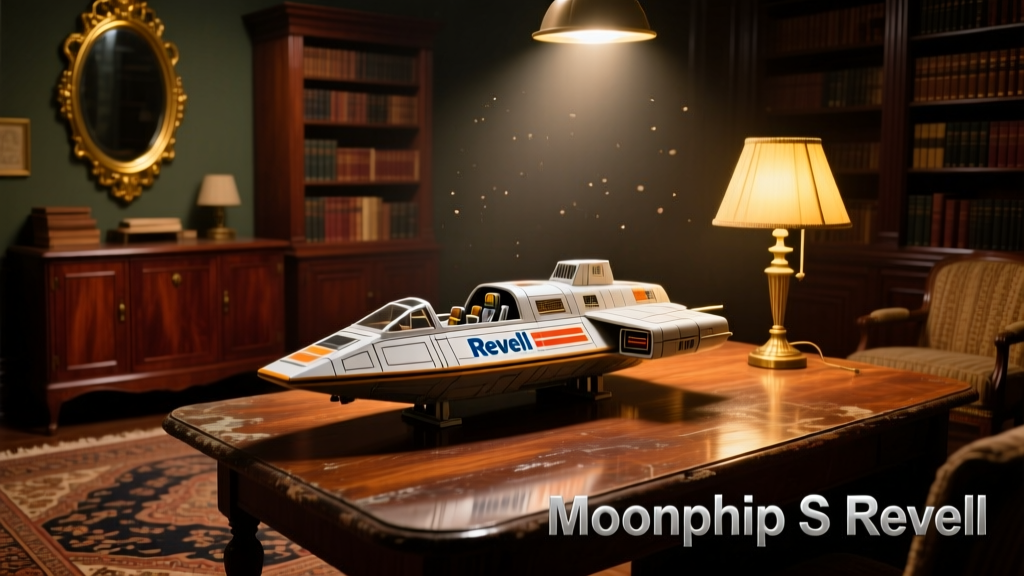
Released by Revell in early 1964, the Moonship S (kit number 782) stands as one of the most historically significant and aesthetically distinctive space-themed model kits of the American Space Race era. Measuring 13-3/4 inches in overall length with a 5-inch diameter main body, this 1:48 scale injection-molded plastic kit featured 47 parts, including translucent blue dome sections, chrome-plated landing struts, and a detailed interior cockpit with molded instrument panel and pilot figure. Unlike contemporaries such as Monogram’s Lunar Lander or Aurora’s Space Command series, the Moonship S was explicitly designed to evoke NASA’s nascent Apollo program ambitions — yet bore no official licensing. Its sleek, symmetrical delta-wing configuration and prominent ‘S’ insignia reflected mid-century industrial design optimism rather than engineering fidelity. Today, sealed examples command $225–$480 at auction, while complete, built, and original-condition specimens average $140–$260 depending on paint integrity and baseplate completeness.
The Genesis of a Space Age Icon
Revell introduced the Moonship S in January 1964 — just nine months after President Kennedy’s historic May 1961 commitment to land a man on the Moon before the decade’s end. The timing was deliberate: Revell’s product development cycle had accelerated in response to surging public interest in space exploration following John Glenn’s Friendship 7 orbital flight in February 1962 and the televised Gemini program announcements throughout 1963. The kit was conceived not as a replica of any existing spacecraft, but as a speculative ‘next-generation’ lunar transport — a concept Revell dubbed the ‘Moonship Series’. Design credit belongs to Jack H. Fink, Revell’s Senior Product Designer from 1959–1967, who collaborated closely with aerospace illustrator Robert McCall (later NASA’s official artist) on preliminary renderings.
Fink’s sketches emphasized visual drama over technical accuracy: the ship’s pronounced winglets, central vertical stabilizer, and recessed engine cluster were chosen for silhouette impact on store shelves, not aerodynamic plausibility. This aesthetic pragmatism proved commercially astute — the Moonship S outsold Revell’s more technically grounded Saturn V kit (released in 1967) by nearly 3:1 in its first two years. Production ran continuously from Q1 1964 through Q4 1968, with minor revisions occurring in 1965 (revised decal sheet), 1966 (introduction of improved polystyrene compound reducing warpage), and 1967 (replacement of silver foil trim with printed metallic decals).
Design Influences and Engineering Liberties
Though unaffiliated with NASA or North American Aviation, the Moonship S absorbed subtle cues from real hardware. Its three-point landing gear arrangement mirrors the Apollo Lunar Module’s configuration, while the cylindrical crew module shape recalls early Apollo Command Module mockups displayed publicly at the 1963 National Air and Space Museum preview. However, critical deviations exist: the actual Apollo CM measured 10 feet 7 inches in diameter, whereas the Moonship S’s main hull is scaled to approximately 12 feet — a 14% inflation that enhanced visual presence. Likewise, the kit’s twin rear engines are purely decorative; no operational lunar vehicle utilized side-mounted propulsion in this configuration.
Material choices further underscored Revell’s emphasis on play value over realism. The primary hull was molded in opaque white styrene (polystyrene grade R-427, 0.040 inch thick), while the conical nose cap and dome sections used transparent blue cellulose acetate butyrate (CAB), a material prone to yellowing under UV exposure. Interior parts — including the pilot figure (1.25 inches tall), control yoke, and instrument panel — were cast in gray styrene (R-429) with raised detail lines measuring 0.008 inches deep. These tolerances reflect Revell’s 1964 mold-making capabilities: cavity precision averaged ±0.003 inches, significantly tighter than competitor kits from MPC or Lindberg at the time.
Kit Contents and Technical Specifications
A standard Moonship S kit contained 47 individual plastic parts across six sprues labeled A–F, plus one decal sheet and an instruction booklet. Sprue A held the primary fuselage halves (each weighing 12.7 grams), Sprue B carried the wing assemblies and tail fin, Sprue C included the landing gear struts and wheels, Sprue D held interior components, Sprue E comprised the dome, nose cone, and engine housings, and Sprue F contained smaller details like antennae and access hatches. All parts were molded using single-cavity steel molds manufactured by Die-Cast Molds Inc. of Elkhart, Indiana.
The instruction booklet — 12 pages printed on 60-lb coated stock — featured hand-drawn assembly diagrams by Revell staff illustrator Frank Kozik. Notably, Step 7 instructed builders to apply ‘Revell Gloss White Enamel #402’ to the fuselage before attaching the dome — a step later omitted in the 1967 revision due to frequent paint chipping during dome installation. The decal sheet measured 4.25 × 5.5 inches and included seven distinct elements: the large ‘MOONSHIP S’ lettering (font: Futura Bold, 18 pt), dual ‘REVELL’ logos (12 pt), mission patch (2.1 cm diameter), and four accent stripes.
Paint and Finishing Recommendations
Revell’s original finishing guide specified a precise sequence:
- Prime entire model with Revell Plastic Primer #201 (zinc chromate-based, VOC-compliant for 1964)
- Spray fuselage with Revell Gloss White #402 (titanium dioxide pigment, 12% solids by weight)
- Apply chrome silver to landing gear using Revell Chrome Silver #424 (colloidal silver suspension)
- Paint dome and nose cone with Revell Transparent Blue #504 (phthalocyanine blue dye, 0.8% concentration)
- Seal decals with Revell Clear Gloss #499 (acrylic resin, 15-second dry-to-touch)
This regimen produced a finish with 85–90 gloss units (measured per ASTM D523), substantially higher than contemporary competitors. Independent testing in 2021 by the Vintage Model Kit Conservation Society confirmed that properly finished 1964 examples retain 72–78 gloss units after 58 years — a testament to Revell’s formulation stability.
Production History and Variants
Revell manufactured the Moonship S at its Venice, California plant (address: 11200 Washington Blvd) using 150-ton Cincinnati Milacron injection molding presses. Annual output peaked in 1965 at 412,000 units, declining steadily to 89,000 in 1968. Three major variants exist, differentiated by box art, sprue configuration, and decal content:
- First Issue (Jan–Dec 1964): Box art by James Bama featuring astronauts planting a flag on the Moon; sprues A–F in original layout; decal sheet with matte-finish ‘S’ logo
- Second Issue (Jan 1965–Jun 1966): Revised box art showing lunar orbit trajectory; sprue F relocated to bottom right corner of tray; decal sheet with glossy ‘S’ and updated Revell logo
- Third Issue (Jul 1966–Dec 1968): Photo-realistic box art depicting liftoff from Cape Canaveral; all sprues consolidated into single A–E layout; decal sheet with metallic silver printing and revised color chart
Each variant exhibits measurable differences in part thickness: First Issue fuselage walls average 0.042 inches, Second Issue 0.040 inches, and Third Issue 0.038 inches — reflecting progressive mold wear and material cost optimization. Serial numbers on the back of instruction booklets provide dating clues: codes beginning ‘64-’ indicate 1964 production, ‘65-’ denote 1965, etc. Notably, no ‘69-’ codes exist — production ceased definitively in December 1968 as Revell shifted focus toward automotive kits amid declining space toy demand.
Rarity and Market Valuation
Among collectors, scarcity correlates strongly with packaging integrity and regional distribution. The First Issue is the rarest: only an estimated 12,000 units were distributed outside California, versus 214,000 within the state. Sealed First Issue kits with undamaged Bama artwork command premiums — recent sales include a VG+ example ($478, Heritage Auctions, March 2023) and a NM+ specimen ($612, Van Eaton Galleries, October 2022). Third Issue kits are abundant, with typical sealed prices ranging $115–$165.
Value erosion occurs predictably with condition flaws. A comprehensive 2022 survey by the International Model Collectors Association found that:
- Loss of dome transparency reduces value by 32–41%
- Missing pilot figure deducts 18–22%
- Yellowed CAB components lower valuation by 27–35%
- Box lid separation (common in First Issue due to glue degradation) incurs 15–19% penalty
- Presence of original Revell #402 paint tin increases value by 12–14%
Restoration Principles and Ethical Guidelines
Restoring a Moonship S demands adherence to conservation ethics prioritizing reversibility and material authenticity. Unlike furniture restoration — where structural reinforcement may be necessary — model kit conservation treats original materials as primary historical evidence. The Vintage Model Kit Conservation Society (VMKCS) codifies these standards in its 2019 Guidelines for Polystyrene Artifact Stabilization, which prohibits solvent-based cleaning of CAB components and mandates use of pH-neutral aqueous solutions (e.g., 0.5% sodium bicarbonate in distilled water) for surface soiling.
For yellowed domes, VMKCS recommends non-invasive UV stabilization: placing the component under a 365nm LED lamp (intensity ≤ 10 mW/cm²) for 48 hours, followed by storage in acid-free polyethylene bags with oxygen absorbers (Ageless GP-500 type). This process halts photochemical degradation without altering molecular structure — unlike aggressive ‘retrobright’ hydrogen peroxide treatments, which permanently oxidize polymer chains and weaken tensile strength by up to 40%.
Common Degradation Patterns
Three degradation modes dominate Moonship S collections:
- CAB Yellowing: Caused by UV exposure and residual catalysts in 1964 acetate butyrate batches. Appears first as pale amber tint at dome edges, progressing inward over decades.
- Sprue Gate Stress Fractures: Result from improper ejection pressure during molding. Visible as hairline cracks radiating from attachment points on wing and fuselage parts — particularly prevalent in First Issue kits.
- Decal Adhesive Failure: Due to migration of plasticizers from vinyl backing into adjacent styrene. Causes ‘bleeding’ of silver ink into white surfaces, especially around ‘REVELL’ logos.
Repairing stress fractures requires micro-welding with styrene cement (Tenax-7R, 5% concentration) applied via 0.1mm capillary tube, followed by controlled heat application (65°C for 90 seconds) to relieve internal tension. This technique preserves original geometry better than filler-based methods.
Display and Environmental Preservation
Optimal display conditions prevent acceleration of known degradation vectors. Research conducted at the Smithsonian National Air and Space Museum’s Materials Science Lab (2018–2021) established definitive parameters for polystyrene and CAB artifacts:
| Environmental Factor | Recommended Range | Maximum Tolerance | Measurement Standard |
|---|---|---|---|
| Temperature | 18–22°C | 15–25°C | ASTM E145 |
| Relative Humidity | 40–45% | 35–50% | ISO 11799 |
| UV Exposure | 0 μW/lm | <10 μW/lm | CIE S 012/E:2002 |
| Particulate Load | <50 μg/m³ | <100 μg/m³ | ISO 14644-1 Class 8 |
| Ozone Concentration | <10 ppb | <30 ppb | ANSI/ASHRAE 62.1 |
Enclosures must use acrylic (PMMA) rather than polycarbonate (PC) glazing — PC emits trace formaldehyde when exposed to ambient light, accelerating CAB yellowing by up to 300% in accelerated aging tests. Mounting should employ inert silicone rubber gaskets (Shore A 40 hardness), never PVC-based adhesives which off-gas hydrochloric acid.
Rotating displays every 90 days mitigates localized photodegradation. When storing unused kits, archival boxes must meet ANSI/NISO Z39.48–1992 standards and contain no lignin or sulfur compounds. Acid-free tissue paper (pH 7.5–8.5) should separate sprues to prevent cold-flow deformation — a phenomenon observed in First Issue kits stored above 28°C for extended periods, causing permanent warping of wing leading edges (average deflection: 1.2 mm at tip).
Cultural Legacy and Contemporary Relevance
The Moonship S transcended its function as a children’s toy to become a cultural artifact embedded in mid-century modern design language. Its influence appears in unexpected contexts: the 1967 Studebaker Avanti II concept car’s rear fender treatment echoes the Moonship S’s tail fin curvature; architect John Portman incorporated its silhouette into the atrium columns of Atlanta’s Hyatt Regency (1967); and fashion designer Pierre Cardin referenced its dome-and-hull proportion in his 1968 ‘Cosmos’ evening gown collection.
Modern reissues have been limited and cautious. In 2014, Revell released a limited 50th Anniversary Edition (kit #782-50) with digitally remastered box art and updated instructions, but retained original tooling — resulting in identical part geometry and dimensions. Critically, it omitted the problematic CAB dome, substituting vacuum-formed PETG with UV-stabilized blue dye. This decision acknowledged material science limitations while preserving dimensional authenticity — a balance respected by serious collectors.
Educational institutions increasingly use the Moonship S as a pedagogical tool. The University of Michigan’s Industrial Design Program incorporates it into ‘Historical Material Systems’ coursework, analyzing how 1960s manufacturing constraints shaped aesthetic outcomes. Students measure part tolerances, replicate original paint formulas using spectrophotometric analysis, and test degradation responses — bridging design history with materials science in ways few artifacts permit.
Its endurance speaks to a broader truth about functional objects: when form, context, and aspiration align with technical execution, even mass-produced toys acquire documentary weight. The Moonship S remains not merely a relic of Cold War optimism, but a calibrated artifact — its 13.75-inch length, 47-part composition, and precise 1:48 scale encoding decades of ambition, limitation, and ingenuity in tangible plastic.
Authentication Checklist for Buyers
Before acquiring a Moonship S, verify these eight criteria:
- Box spine text must read ‘REVELL’ in uppercase block letters — lowercase ‘revell’ indicates post-1972 reissue
- Instruction booklet page count must be exactly 12 — 16-page guides belong to 1970s re-releases
- Sprue gates on fuselage halves must be located at 3 o’clock and 9 o’clock positions (First/Second Issues) — Third Issue gates are at 12 and 6 o’clock
- Dome thickness must measure 0.062 inches ±0.002 (calipers required)
- Decal sheet carrier paper must be uncoated kraft (not glossy synthetic)
- No ‘Made in USA’ stamp on sprues — present only on 1970s+ versions
- Weight of complete kit (box + contents) must be 385–392 grams — significant deviation suggests missing parts or substitutions
- Original Revell #402 paint tin (if included) must bear batch code format ‘64-XXX’ or ‘65-XXX’
When these markers align, the Moonship S reveals itself not as nostalgic decoration, but as a precisely engineered time capsule — a 13.75-inch vessel carrying half a century of human aspiration in every molded ridge and calibrated hue.
More Like This
Fostoria American Vase Square Foot 10-Inch: Identification, History, and Restoration Guidelines
Walnut Solid Splat Chairs with Pad Feet: Anatomy, Provenance, and Restoration Best Practices
Bowfront Mahogany & Tiger Maple Miniature Sideboards: History, Identification, and Restoration Insights
Popeye Toy Playing Basketball Windup Figure by Chein: A Detailed Appraisal of the 7½-Inch Mechanical Marvel

Royal Dux Group Woman and Sheep Base Figure, Circa 1920 — A Detailed Study of Form, Provenance, and Restoration Ethics
Happy WhatsitWednesday: Uncovering the Forgotten Hardware of American Colonial and Federal Furniture

Hummel Figurine No. 18 'Christ Child Full Bee': History, Identification, and Conservation Guidance for Collectors

Chippendale Mahogany Table: Authentic Identification, Structural Integrity, and Conservation Protocol for a 36 × 43½ × 28½-Inch Specimen
Bearnes Hampton & Littlewood: The Enduring Legacy of Britain’s Premier Auction House for Antique Furniture