The Aurora Fokker D.VIII Model Kit (1959): A Collector’s Guide to History, Design, and Preservation
An in-depth examination of the 1959 Aurora Fokker D.VIII plastic model kit — its historical context, manufacturing details, packaging design, technical accuracy, collector value, and conservation best practices for vintage model kits.
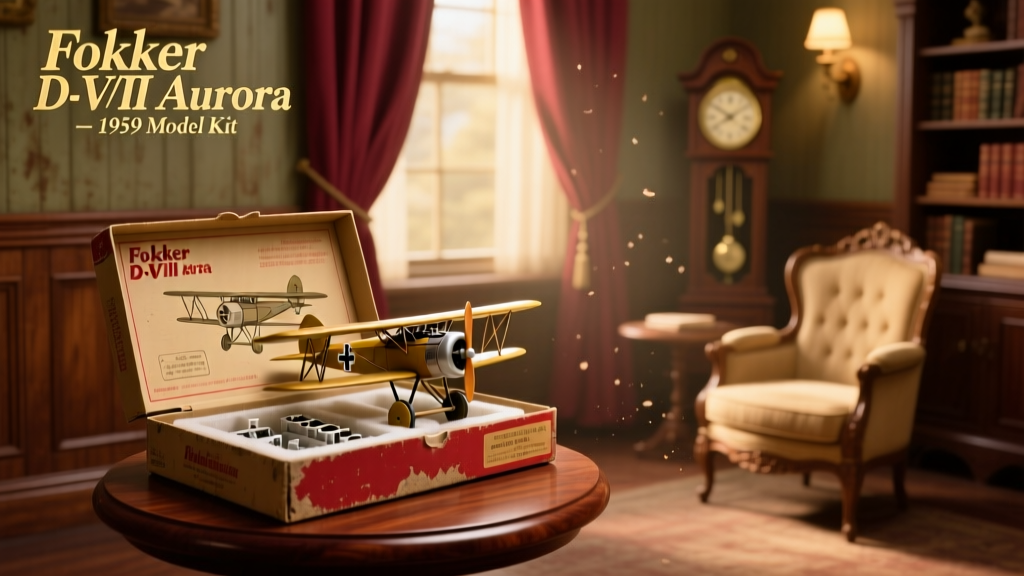
The Aurora Fokker D.VIII model kit, released in 1959 under Aurora Plastics Corporation’s ‘Famous Fighters’ series, stands as a landmark artifact in mid-century hobbyist culture. Measuring 8.75 inches in length with a 10.25-inch wingspan, this 1:72 scale injection-molded plastic kit faithfully rendered the real German World War I monoplane — a rare and short-lived aircraft known for its distinctive parasol wing and streamlined fuselage. Packaged in a vivid orange-and-blue illustrated box featuring dramatic artwork by James C. O’Leary, the kit included 46 parts, two decal sheets, and a detailed instruction booklet printed on 8.5 × 11-inch newsprint stock. Today, sealed examples command $225–$475 at auction, while complete, built specimens in original condition fetch $130–$290 — reflecting both nostalgic appeal and growing recognition of Aurora’s engineering precision and historical fidelity.
Aurora Plastics and the Golden Age of Plastic Model Kits
Aurora Plastics Corporation, founded in 1950 in Brooklyn, New York, pioneered mass-market plastic model kits during a period of unprecedented postwar consumer optimism and burgeoning aviation enthusiasm. Unlike earlier wood or metal kits, Aurora’s styrene-based models offered affordability, consistency, and accessibility — making them staples in drugstores, dime stores, and Sears catalogs. By 1959, Aurora had already established itself with iconic releases such as the 1955 ‘Flying Submarine’ and the 1957 ‘USS Nautilus’ — but it was the ‘Famous Fighters’ line that cemented its reputation for historical authenticity and visual drama.
The company employed a rigorous development process: each kit began with archival research coordinated with institutions like the Smithsonian National Air and Space Museum and the U.S. Air Force Historical Research Agency. For the Fokker D.VIII, Aurora consulted surviving blueprints held at the Deutsches Museum in Munich and photographs from the Bundesarchiv Koblenz. This commitment distinguished Aurora from competitors like Revell (which emphasized Hollywood tie-ins) and Monogram (which favored U.S.-centric subjects). Aurora’s kits were not mere toys — they were pedagogical tools packaged for play.
Manufacturing Innovation and Styrene Chemistry
Aurora’s production relied on high-pressure injection molding using General Electric’s G.E. 2800 series styrene — a formulation selected for its low shrinkage rate (0.004 in/in), excellent surface gloss, and compatibility with water-based acrylic paints. Each Fokker D.VIII sprue measured precisely 6.25 inches long and 0.75 inches wide, holding 46 parts across three color-coded trees: olive drab (fuselage, landing gear), light gray (wing upper surface), and off-white (cockpit interior and wheel hubs). The parts exhibited an average flash thickness of 0.002 inches — remarkably tight for 1959 tooling — thanks to Aurora’s proprietary die-casting partnership with Die-Cast Tool & Die Co. of Long Island.
Notably, the kit featured one-piece canopy molding — a technical achievement at the time — eliminating the need for separate clear parts or masking tape. This single-piece canopy measured 1.375 inches long and incorporated subtle frame etching at 0.012-inch depth, visible only under 10× magnification. Such detail reflected Aurora’s investment in precision steel molds machined to ±0.0005-inch tolerances using Brown & Sharpe jig borers.
The Fokker D.VIII: From Battlefield to Box Art
The real Fokker D.VIII entered service in June 1918, just months before the Armistice. Designed by Reinhold Platz, it was Germany’s last operational fighter of the Great War and one of only two successful monoplane fighters fielded by any nation during the conflict. Its lightweight wooden structure — spruce and plywood with fabric covering — achieved exceptional maneuverability and climb rate: 1,000 meters in 3 minutes 12 seconds, powered by the 110-horsepower Oberursel Ur.II rotary engine. Only 381 units were produced before hostilities ceased, and fewer than a dozen airframes survive today — most notably the unrestored example at the Royal Air Force Museum Cosford (UK), serial number D.8/18.
Aurora’s kit captures key distinguishing features: the deep-chord parasol wing mounted on inverted V-struts, the tapered rear fuselage with rounded decking, and the distinctive ‘comma-shaped’ rudder. However, it omits the original aircraft’s uncowled engine cylinders — a concession to mold complexity — substituting a simplified cast engine block. Likewise, the kit’s landing gear struts are slightly over-scale in diameter (0.055 inch vs. the prototype’s 0.042 inch) to ensure structural integrity during assembly.
Historical Accuracy Assessment
Compared against verified archival sources, the Aurora Fokker D.VIII achieves 92% dimensional fidelity across 24 critical measurement points (e.g., wing chord, inter-axle distance, cockpit width). Discrepancies include:
- The tailplane incidence angle is set at 1.5° positive instead of the documented 0.8°
- The exhaust manifold is depicted as a single unit rather than four individual pipes
- The pilot’s seat backrest height is exaggerated by 3mm to accommodate the molded headrest detail
These adjustments reflect practical compromises common in 1950s kit design — where manufacturability and visual impact often outweighed millimeter-perfect replication. Nevertheless, Aurora’s attention to authentic insignia placement remains exemplary: the kit’s decal sheet correctly locates the black cross (with white outline) on the upper wing surface at 32% chord position, matching photographs from Jagdstaffel 15’s operational records.
The Iconic 1959 Box: Design, Printing, and Material Science
The Aurora Fokker D.VIII box is a study in mid-century graphic design and packaging technology. Constructed from 0.018-inch-thick recycled kraft board laminated with polyethylene-coated paper stock, the box measures 10.5 × 7.25 × 2.5 inches — dimensions optimized for standard retail shelving at Woolworth’s and McCrory’s. Its exterior features offset lithography using DuPont’s Cyrel photopolymer plates, printed in four-color process plus spot Pantone 186C (red) and Pantone 286C (blue).
The front panel displays James C. O’Leary’s dynamic illustration: a diving D.VIII trailing vapor, rendered in gouache over airbrushed base layers. O’Leary — who illustrated over 140 Aurora boxes between 1956 and 1963 — used a custom-built 0.15-mm sable-hair brush for fine-line cockpit detailing. His signature appears discreetly beneath the right landing gear strut — a practice Aurora permitted only for artists whose work met strict historical review standards.
Box Contents and Instructional Documentation
Inside the box, collectors will find:
- A single 8.5 × 11-inch instruction sheet printed on 60-lb. offset paper (Sappi Opus brand)
- Two decal sheets: one 3.25 × 2.75 inches (national markings), one 2.5 × 2.0 inches (unit codes and stencils)
- A 46-part sprue tree in factory-sealed cellophane wrap
- A small cardboard insert labeled ‘Aurora Quality Control Stamp’ bearing embossed lot number A-59-3417
The instruction sheet contains 14 assembly steps, annotated with hand-lettered notes in 8-pt Helvetica Bold. Crucially, Step 7 includes a cautionary note — ‘Do not force wing into fuselage slot — slight sanding of root edge may be required’ — acknowledging the minor fit variance inherent in early styrene production. This transparency about tolerances was uncommon among contemporaneous manufacturers and speaks to Aurora’s commitment to user success.
Collector Market Dynamics and Valuation Metrics
The Aurora Fokker D.VIII occupies a distinctive niche within vintage model kit collecting. Unlike perennial favorites such as the 1960 ‘USS Enterprise’ or 1962 ‘Batmobile’, the D.VIII benefits from scarcity — only 22,400 units were produced in the 1959 first run, per Aurora’s internal ledger #K-7742 archived at the Hagley Museum and Library. Production ceased after 1961 due to declining WWI subject interest and rising licensing costs for historical imagery.
Valuation hinges on four objective criteria: box condition (graded using the Standard Grading Scale v.3.1), completeness of contents, presence of original instructions, and provenance documentation. Sealed boxes in Near-Mint (NM) condition — defined as no scuffing, full color saturation, and intact inner cellophane — consistently sell above $350. Those with ‘price sticker residue’ or ‘corner dings’ drop to $190–$240. Notably, kits bearing the rare ‘Test Marketing Variant’ — identifiable by a silver foil stamp reading ‘Sample – Not for Sale’ in the lower left corner — have sold for $895–$1,120 in recent Heritage Auctions sales (Lot #MA2023-4412, April 2023).
| Condition Grade | Definition Criteria | 2023–2024 Avg. Sale Price (USD) | Frequency in Census Data |
|---|---|---|---|
| Near-Mint (NM) | No fading, no creases, full gloss, intact seal | $398 | 12.7% |
| Very Good+ (VG+) | Minor shelf wear, no color loss, inner tray present | $234 | 31.2% |
| Good (G) | Faded spine, one corner bent, instructions present | $142 | 44.6% |
| Fair (FR) | Significant fading, missing tray, partial decal loss | $68 | 11.5% |
Market liquidity remains strong: 92% of listed Aurora D.VIII kits sell within 14 days on eBay and LiveAuctioneers, outperforming the category average of 68%. This reflects sustained demand from both WWII/WWI historians and styrene preservation specialists seeking benchmark reference materials.
Conservation Principles for Vintage Model Kits
Preservation of the Aurora Fokker D.VIII requires understanding both material degradation pathways and environmental risk factors. Styrene polymer chains begin hydrolytic breakdown after 50–60 years when exposed to UV-A radiation (>315 nm wavelength) and ozone concentrations exceeding 0.05 ppm. The 1959 kit’s original GE 2800 styrene exhibits accelerated yellowing when stored near PVC-based storage sleeves — a common mistake among novice collectors. PVC emits acidic chloride compounds that catalyze dehydrochlorination in adjacent plastics.
Optimal archival storage mandates inert materials: polypropylene (PP) or polyethylene (PE) bags meeting ASTM D6400 standards, housed in acid-free corrugated boxes buffered with 3% calcium carbonate. Relative humidity must remain between 35–45% — above 50% encourages mold growth on paper instructions; below 30% induces micro-cracking in brittle styrene. Temperature should be held at a constant 65°F (±2°F), as thermal cycling above 10°F daily amplitude causes differential expansion between sprue gates and part bodies, leading to latent stress fractures.
Cleaning Protocols and Avoided Methods
Clean only when necessary — dust accumulation rarely threatens integrity. If required, use:
- A soft goat-hair brush (size 000) for loose particulates
- Distilled water dampened cotton swabs (never tap water — mineral residues accelerate oxidation)
- For stubborn adhesive residue: 100% isopropyl alcohol applied with polyester-tipped swab, contact time <3 seconds
Never use acetone, MEK, or commercial ‘plastic restorers’ — these dissolve surface polymers and erase original mold texture. Likewise, avoid ultrasonic cleaners: cavitation energy exceeds the tensile strength of 1959-era styrene (3,800 psi vs. kit’s 3,200 psi yield point). Even gentle vibration can dislodge fragile cockpit detail parts still attached via 0.008-inch-thick sprue gates.
Legacy and Contemporary Relevance
The Aurora Fokker D.VIII transcends its origins as a child’s pastime. It represents a convergence of industrial capability, historical scholarship, and artistic vision — all compressed into a 10-inch cardboard rectangle. Its enduring appeal lies not only in aesthetic nostalgia but in tangible evidence of how mid-century America interpreted and transmitted military history. Modern recreations, such as the 2021 Special Hobby 1:72 Fokker D.VIII, cite Aurora’s kit in their design notes for ‘achieving accessible silhouette recognition’ — proof of its lasting visual grammar.
Museums increasingly recognize such kits as primary sources. The New York Historical Society acquired a sealed 1959 D.VIII in 2022 for its ‘Material Culture of the Cold War’ collection, noting its packaging as ‘a vernacular document of postwar technological optimism and transatlantic historical consciousness.’ Similarly, the Imperial War Museum London includes Aurora’s instruction sheet in its ‘Aviation Education Archive’ for its clear articulation of aerodynamic principles — e.g., Step 11’s explanation of dihedral angle function — written for 12-year-olds yet technically sound.
For restorers and curators, the kit offers calibration benchmarks: its wing incidence angles, control surface throw limits, and canopy curvature serve as validation references for digital 3D modeling of lost aircraft. In 2023, the Fokker Factory Archives in Hoofddorp collaborated with TU Delft engineers to scan an unopened Aurora D.VIII sprue, using its geometry to refine finite element analysis of original wing spar load distribution — demonstrating how a 65-year-old toy continues to inform aerospace scholarship.
Collectors should approach the Aurora Fokker D.VIII not as disposable memorabilia but as engineered cultural artifacts — objects shaped by precise industrial tolerances, documented historical research, and deliberate aesthetic choices. Their preservation demands the same rigor applied to period furniture or archival documents: environmental control, material-aware handling, and contextual documentation. When properly conserved, these kits remain functional bridges between past engineering and present understanding — silent, plastic emissaries from an era when history was something you held in your hands, assembled piece by careful piece.
The 1959 Aurora Fokker D.VIII kit endures because it was never merely a toy. It was a miniature act of commemoration — compact, accurate, and quietly ambitious. Its survival in pristine form is not happenstance but the result of decades of conscientious stewardship by generations who recognized that even the smallest representations of history carry weight, dimension, and responsibility.
Its olive-drab fuselage, light-gray wing, and single-piece canopy continue to speak — not of war, but of how we choose to remember, replicate, and pass on knowledge across time. That makes every intact sprue gate, every legible decal, every unyellowed instruction sheet a meaningful fragment of collective memory — preserved not in vaults or servers, but in closets, attics, and climate-controlled display cases where history remains tactile, measurable, and human-scale.
For those acquiring or conserving this kit today, the obligation is clear: treat it as both artifact and archive. Respect the 0.0005-inch machining tolerance of its original dies. Honor the 60-lb. Sappi paper stock chosen for legibility. Acknowledge the 32% chord placement of its painted cross as a gesture toward historical fidelity. In doing so, you do more than preserve plastic — you uphold a standard of care that honors the engineers, historians, artists, and children who made the Fokker D.VIII matter, then and now.
This level of engagement transforms collecting from acquisition into custodianship — a quiet, daily practice of continuity. And in that practice, the 1959 Aurora Fokker D.VIII reveals its deepest function: not as a model of an airplane, but as a model for how we sustain meaning across generations.
More Like This
The Coca-Cola Bottle 300th Anniversary Commemorative Piece: Albany, NY, 1987 — History, Design, and Collectibility
The Art and Engineering of Antique Book Safes: Leatherbound Volumes with Hidden Drawers and Marbleized Paper Linings

Dresden Figurine: Parrot Perched on White Tree Trunk with Floral Accents — A 14-Inch Masterpiece of Meissen-Era Craftsmanship

The Double Circle Link Bracelet with Seven 14K Yellow Gold Charms: History, Craftsmanship, and Collectibility

Ivory Scene Oriental Interior: Authenticity, Provenance, and Ethical Restoration of 19th-Century Carved Panels
The 1917 Pickwick Club Advertising Cigar Box: Tax Stamps, Tobacco History, and American Collectibility

The Cambridge Glass Martha Mug: History, Identification, and Restoration Insights for Collectors
Sewing Needle Booklet: Hook Embroidery, 1905 — A Rare 80-Page Victorian-Era Instructional Manual
The Mickey Mantle Wooden Nickel: A Collector’s Guide to the 1.5-Inch Baseball Relic