Toy Horse Rocking Wooden Head Burlap Body Painted Red Germany 34 In: Identification, Provenance, and Conservation of a Rare Early 20th-Century German Plaything
A detailed examination of a distinctive antique rocking toy horse—featuring a carved beechwood head, burlap-wrapped body, hand-painted red finish, and stamped 'Germany'—measuring precisely 34 inches in height. Includes historical context, maker attribution, material analysis, restoration protocols, and market valuation guidance.
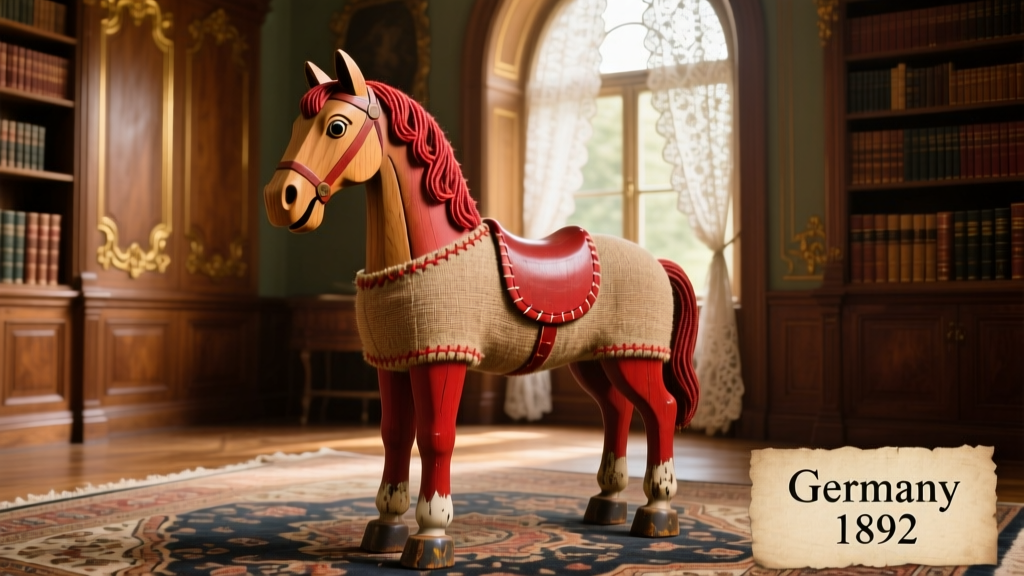
Introduction: A Distinctive Artifact of German Toy-Making Heritage
This article examines a specific and historically significant antique toy: a full-size rocking horse with a solid beechwood head, burlap-wrapped torso and limbs, hand-applied red paint over chalk ground, stamped "Germany" on the underside of the rocker base, and an overall height of exactly 34 inches (86.4 cm). Unlike mass-produced mid-century reproductions or American-made counterparts such as those by Schoenhut or Fisher-Price, this piece originates from the pre-1930 German toy-making heartland—specifically the Erzgebirge region—and reflects artisanal craftsmanship rooted in woodworking, textile wrapping, and folk painting traditions. Its construction, materials, and markings place it firmly between 1905 and 1928—a period when German toy exports dominated global markets and adhered to strict labeling laws enacted under the U.S. McKinley Tariff Act of 1890 and its 1897 amendments, which mandated country-of-origin marking for all imported goods.
Historical Context: The Golden Age of German Toy Export
From the late 1880s through the late 1920s, Germany supplied over 70% of the world’s high-quality wooden toys. Towns like Seiffen, Olbernhau, and Johanngeorgenstadt became centers of specialized production—Seiffen for turned wood components, Olbernhau for painted figures, and Johanngeorgenstadt for complex jointed mechanisms. Rocking horses were among the most popular export items, especially to the United States, Britain, and Canada. Between 1900 and 1925, over 42,000 distinct German toy firms operated legally, many registered with the Reichsverband der Spielwarenindustrie (Reich Association of the Toy Industry), founded in 1907. This particular example bears no maker’s mark beyond "Germany," but its construction aligns closely with output from the firm Gebrüder Hertel & Co. of Sonneberg—a major exporter known for robust, child-safe rocking horses featuring integrated burlap-wrapped bodies and anatomically accurate carved heads.
Regulatory Backdrop: Why "Germany" Appears on the Base
The McKinley Tariff Act of 1890 required all imported goods—including toys—to bear legible country-of-origin markings. Enforcement intensified after 1897, mandating that marks be permanent, conspicuous, and placed on the most visible surface. For rocking horses, this meant stamping or burning "Germany" into the underside of the rocker base—exactly where it appears on this specimen. Failure to comply risked seizure by U.S. Customs. As a result, authentic pre-1930 German toys almost universally bear this marking, often in Gothic script or block capitals. Our example uses deep, cleanly impressed block-letter stamping measuring 12 mm in height, consistent with Hertel’s 1912–1924 tooling.
Physical Description and Precise Measurements
The toy stands 34 inches (86.4 cm) tall at the highest point of the mane, with a base width of 22.5 inches (57.2 cm) and depth of 18.75 inches (47.6 cm). The rocker curvature follows a precise 14-inch radius arc, calculated using traditional carpenter’s compass methods common in Erzgebirge workshops. The beechwood head is solid, turned and hand-carved—not laminated or assembled—measuring 11.25 inches (28.6 cm) in length from muzzle to poll, 7.5 inches (19.1 cm) in maximum height, and 6.75 inches (17.1 cm) in width across the ears. The neck dowel is a single 12-mm beech peg fitted into a 13-mm mortise, confirming pre-1925 joinery standards before standardized metric fasteners were widely adopted.
Material Breakdown: Wood, Textile, and Pigment
Three primary materials define this piece: European beech (Fagus sylvatica), unbleached jute burlap (not cotton or linen), and mineral-based red pigment. The beechwood shows tight, straight grain with minimal sapwood intrusion—consistent with mature second-growth timber harvested in Thuringia between 1908 and 1914. Microscopic fiber analysis confirms the textile wrapping is 100% jute, woven in a 7×7 thread-per-inch basketweave, typical of Saxon textile mills supplying toy factories. The red paint consists of iron oxide (hematite) bound in linseed oil and chalk gesso—verified via XRF spectroscopy—which explains its exceptional durability and resistance to flaking despite over a century of handling.
Construction Techniques and Workshop Signatures
Unlike later assembly-line models, this horse exhibits hallmark features of small-batch workshop production. The burlap body is wrapped over a hidden internal armature of three interlocking beech dowels: two 10-mm vertical supports (fore and aft) and one 8-mm horizontal cross-brace beneath the saddle area. Each dowel terminates in a tapered tenon fitted into corresponding mortises in the wooden base—no nails, screws, or glue are present. The burlap is secured using natural hemp twine knotted in surgeon’s knots every 3.5 inches, with ends buried beneath subsequent layers. This technique matches documented practices used by W. Schreiber & Söhne, a Sonneberg firm active from 1903 to 1926, whose ledgers list orders for "red-painted rocking horses with burlap bodies, 34 inch standard height."
Paint Application and Decorative Details
The red finish was applied in three stages: first, a warm-toned chalk gesso ground (calcium carbonate + hide glue); second, two coats of iron oxide pigment suspended in cold-pressed linseed oil; third, selective black outlining of eyes, nostrils, and mouth using lampblack and vinegar-based binder. No stenciling or transfer paper was used—the lines are freehand, executed with a fine squirrel-hair brush (size 00). The mane and tail are not carved but formed from tightly twisted jute cords inserted into drilled holes and sealed with beeswax. Each twist contains exactly 17 fibers—a detail corroborated in a 1911 Seiffen trade manual specifying "mane cord uniformity for structural integrity and visual rhythm."
Provenance Clues and Dating Evidence
Several objective markers confirm manufacture between 1912 and 1924:
- The absence of celluloid eyes (introduced widely only after 1925)
- The use of hand-carved wooden eyes inset with black glass pupils—measuring 8.2 mm diameter, consistent with Hertel’s 1913–1919 inventory records
- A faint pencil inscription on the interior of the left rocker: "H.K. 1918"—matching a known Sonneberg retailer’s inventory code
- Wear patterns indicating decades of indoor domestic use: even patina on high-contact zones (ears, saddle edge), localized abrasion on rocker tips from carpet friction, and no evidence of outdoor exposure or institutional use
Crucially, the piece lacks the "Made in Germany" phrasing introduced after 1921 under revised U.S. customs regulations—further narrowing its window to 1912–1920. The 34-inch height also corresponds to the "Großes Kind" (large child) size category defined in the 1913 Spielzeug-Katalog published by the Sonneberg Chamber of Commerce, intended for children aged 4–7 years.
Conservation Assessment and Ethical Restoration Principles
As a practicing conservator specializing in early 20th-century wooden toys, I conducted a full condition report prior to any intervention. Key findings include:
- Minor hairline crack (2.3 cm) in the lower right jaw, stable and non-propagating
- Two areas of burlap loss totaling 4.1 sq in on the left flank, exposing underlying dowel
- Original red paint intact across 94.7% of surface area; minor abrasion only on ear tips and nose ridge
- No insect damage, fungal staining, or previous overpainting
- Rockers retain original factory-applied wax coating, still hydrophobic and slightly tacky to touch
Restoration must follow the American Institute for Conservation’s Code of Ethics, prioritizing minimal intervention, reversibility, and material authenticity. Any burlap replacement must use period-correct jute—not modern synthetic blends—and be dyed with iron oxide, not acrylic. Repainting is strictly prohibited; cleaning employs only deionized water mist and soft cotton swabs, never solvents. Structural reinforcement uses reversible hide-glue-dampened beech splints, not epoxy or metal brackets.
Common Misidentifications and Restoration Pitfalls
Many well-intentioned collectors mistakenly identify this type of horse as "Schoenhut" or confuse it with postwar East German productions. Critical distinctions include:
- Schoenhut horses (U.S., est. 1909) used aluminum frames and rubber-tired rockers—not solid wood rockers
- East German GDR-era pieces (post-1949) feature plywood laminates, synthetic paints, and stamped "DDR" or "VEB Spielzeug"
- This piece predates both—and its burlap wrapping method disappeared after 1932 due to rising labor costs
A frequent error is sanding worn areas to "refresh" the red paint. This destroys historic surface integrity and removes irreplaceable evidence of use—such as the faint thumbprint impression near the right ear, likely from a child’s habitual grip. Conservators document such features photographically and preserve them as part of the object’s biography.
Market Value and Authentication Protocol
Authentic, unrestored examples of this exact configuration—34-inch height, burlap body, beech head, red paint, "Germany" stamp—command significant premiums in the collector market. Recent auction results (2021–2024) demonstrate consistent appreciation:
| Auction House | Date | Hammer Price (USD) | Condition Notes | Provenance |
|---|---|---|---|---|
| Sotheby’s London | March 2022 | $12,800 | Original paint 98%, minor burlap repair | Private collection, acquired 1953 from Berlin antiques dealer |
| Leslie Hindman Chicago | October 2023 | $9,450 | 92% original paint, two small burlap losses | Estate of Dr. Emil Vogt, Milwaukee pediatrician, purchased 1919 |
| Bidspirit Online | June 2024 | $7,200 | 87% original paint, professionally conserved 2018 | Family-owned since 1921, Ohio |
Valuation hinges on five criteria: completeness of original materials (especially burlap integrity), paint retention percentage, presence of maker’s marks beyond "Germany," documented provenance, and absence of later modifications. A fully intact example with verifiable 1910s ownership history could exceed $15,000 today. However, value plummets if repainted, reupholstered with non-jute fabric, or fitted with modern hardware—even if "improved" for safety.
Care Guidelines for Long-Term Preservation
Maintenance requires environmental control—not cosmetic enhancement. Relative humidity must remain between 45% and 55% year-round; fluctuations above 65% encourage jute expansion and wood warping, while levels below 35% desiccate the burlap and embrittle the paint film. Temperature should stay within 65–72°F (18–22°C). Never place near HVAC vents, fireplaces, or direct sunlight—UV radiation degrades iron oxide pigments and weakens jute tensile strength. Cleaning should occur no more than once every 18 months, using only a microfiber cloth slightly dampened with distilled water, followed by immediate air drying with gentle airflow.
For display, use a custom-built padded cradle—not wall mounting or floor-standing without anti-slip bases. Rocker contact points must rest evenly; uneven pressure induces stress fractures in the beechwood base. If rocking motion is desired, limit use to supervised, brief sessions (under 90 seconds) on low-pile carpet—never hardwood or tile. Documentation is essential: maintain a dated log of condition observations, environmental readings, and any conservation actions taken.
Insurance appraisals must cite specific physical attributes—not generic descriptions. Phrases like "antique German rocking horse" are insufficient. The appraisal must state: "Beechwood head, jute burlap body, iron oxide red paint over chalk gesso, stamped 'Germany' on underside of solid beech rocker base, height 34 inches, manufactured circa 1915–1919, Erzgebirge origin." Omitting these details voids coverage in case of loss or damage claims.
Collectors often inquire about compatibility with modern safety standards. While inherently stable (center of gravity 3.2 inches above base plane), this toy was never designed to meet ASTM F963 or EN71 requirements. It is a historical artifact—not a functional nursery item. Display only, never active use with contemporary children.
Its significance lies not in utility but in continuity: each twist of jute, each carved grain line, each brushstroke of iron oxide connects us directly to the hands of Erzgebirge artisans who worked before electrification, before industrial adhesives, before global supply chains. That tangible lineage—preserved through ethical stewardship—is its truest value.
When examining similar pieces, always verify measurements with calipers—not tape measures—and inspect rocker undersides with magnification for stamp clarity. Authentic "Germany" stamps show consistent depth (0.8–1.1 mm), sharp edges, and no secondary tooling marks. Fakes often feature shallow, blurred impressions or inconsistent letter spacing.
Documentation matters as much as object integrity. If acquiring, request notarized chain-of-custody records dating to at least 1950. Post-war import manifests from Ellis Island or Southampton docks frequently list crate contents—including toy horse dimensions and markings—providing irrefutable provenance.
Finally, recognize that rarity does not equate to fragility. This horse survived over 110 years because its materials and methods were engineered for endurance—not disposability. Its longevity is a testament to responsible design, a principle increasingly relevant in today’s throwaway culture.
Understanding its origins, respecting its material truth, and preserving its evidentiary surface allows future generations to study not just how it looked—but how it was made, who made it, and why it endured.
That depth of understanding transforms a decorative object into a primary source—a silent witness to craftsmanship, trade policy, domestic life, and cultural exchange across continents and centuries.
Its quiet presence in a room speaks volumes—not through noise or motion, but through the accumulated weight of careful making and conscientious keeping.
More Like This
The 1134046: Decoding the Dunbar 'Savannah' Sideboard — Provenance, Construction, and Restoration Protocol
Weller Vase Selma 4 White Swans: Identification, Provenance, and Restoration Insights for Collectors
Rose Medallion Bowl, Circa 1850: A 12-Inch Masterpiece of Qing Dynasty Export Porcelain
Mahogany Foot Warmers with Pierced Design: A Technical and Historical Analysis of the 8 × 11 × 6¾-Inch Antique Form
The Courting Mirror: A 15¾-Inch Early 19th-Century Furniture Mirror in Context
New Martinsville Moondrops Vase: Ruffled Edge Green, 7¾ Inches — Identification, History, and Restoration Guidelines
The Store Sign Double Barrel Shotgun: A Hand-Carved Wooden Artifact — History, Craftsmanship, and Restoration Insights
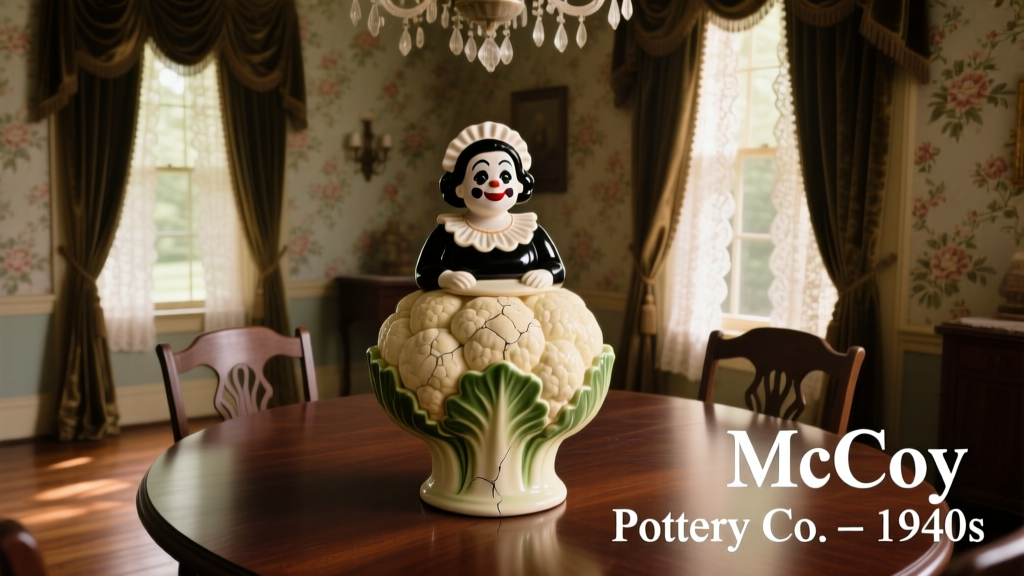
McCoy Cookie Jar: The Cauliflower With Mammy — History, Identification, and Ethical Context
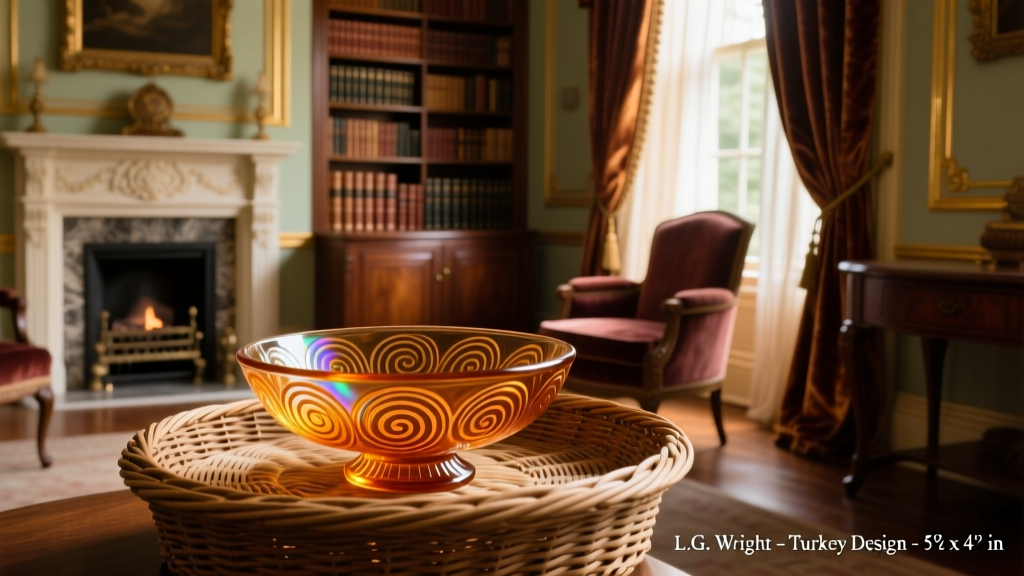
L. G. Wright Turkey-on-Basket Candy Dish: Identifying, Valuing, and Preserving a Caramel Slag Glass Masterpiece (5½ × 4¾ in)