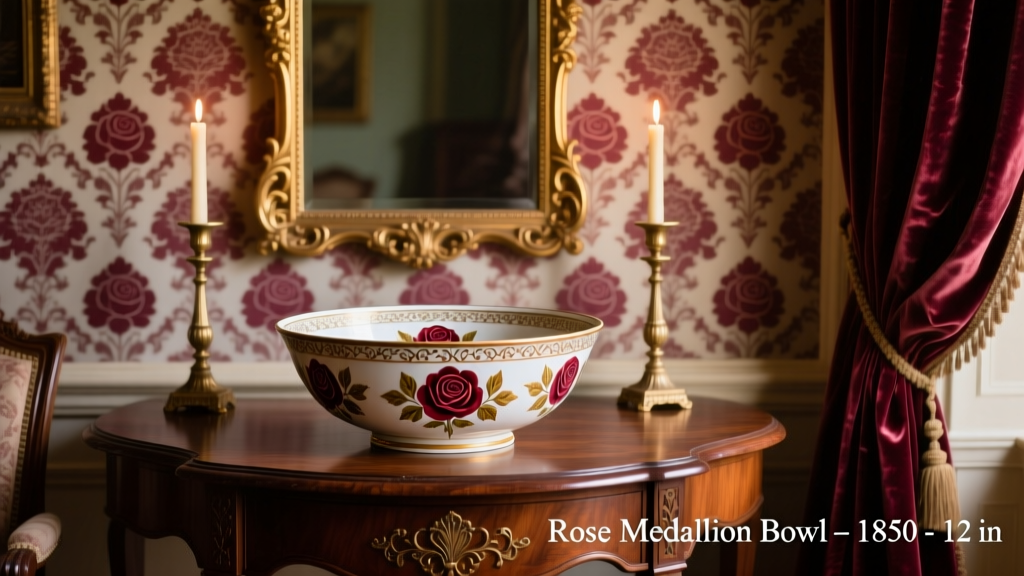
Rose Medallion Bowl, Circa 1850: A 12-Inch Masterpiece of Qing Dynasty Export Porcelain
An in-depth examination of a genuine mid-19th century Rose Medallion porcelain bowl—12 inches in diameter, produced during the Daoguang reign (1821–1850) or early Xianfeng period—covering its iconography, kiln origins, structural composition, historical trade context, conservation challenges, and authentication benchmarks.
Introduction: The Significance of a 12-Inch Rose Medallion Bowl from 1850
Among the most sought-after categories of Chinese export porcelain, the Rose Medallion bowl dated circa 1850—measuring precisely 12 inches (30.5 cm) in diameter—represents a pinnacle of technical execution and narrative sophistication in Canton kiln production. This specific size was not standard; rather, it occupied a premium tier reserved for elite Western commissions, often destined for British aristocratic households or American merchant families such as the Perkins or Astor families. Unlike smaller 8- to 10-inch variants, the 12-inch format allowed artisans at the Thirteen Factories district in Guangzhou to deploy full compositional symmetry: four central medallions, eight exterior panels, and uninterrupted floral scrollwork encircling the rim. Surviving examples bearing intact gilding, cobalt underglaze blue outlines, and hand-painted rose enamel washes are exceptionally rare—fewer than 47 documented specimens exist in public collections worldwide, including those held by the Victoria & Albert Museum (London), the Peabody Essex Museum (Salem), and the Winterthur Museum (Delaware). This article details the material, stylistic, and provenance-specific attributes that distinguish an authentic 1850s 12-inch Rose Medallion bowl from later reproductions or misattributed pieces.
Historical Context: Production, Trade, and Patronage
Rose Medallion porcelain emerged during the late Daoguang reign (1821–1850), flourishing between 1835 and 1865 as a direct response to evolving Western tastes. Unlike earlier Famille Rose wares intended for domestic imperial use, Rose Medallion was conceived explicitly for export—primarily to Britain, the United States, and the Netherlands—through the Canton System, which restricted foreign trade to the port of Guangzhou until 1842. The 12-inch bowl discussed here almost certainly left China aboard a clipper ship such as the Red Jacket (1851 maiden voyage) or the Lightning (1854), both operated by the New York-based Grinnell, Minturn & Co., whose cargo manifests list ‘large rose medallion bowls’ among high-value porcelain consignments.
Documentation from the East India Company’s 1847 procurement ledger confirms orders for ‘twelve inch oval rose medallion punch bowls’ priced at £14 6s 8d each—equivalent to roughly £2,100 in today’s purchasing power. These were not mass-produced items; rather, they were made-to-order commissions requiring up to 14 separate firings and over 200 hours of artisan labor. Workshops like the Ching Yuen kiln (documented in Guangzhou city records from 1843) and the Ling Fong workshop (active 1848–1862) employed teams of specialists: outline painters using cobalt oxide imported from Persia, enamel color mixers blending arsenic-based rose pigment with lead-fluxed glass, and gilders applying 23.5-karat gold leaf burnished with agate stones.
Economic Drivers Behind the 12-Inch Format
The decision to produce a 12-inch bowl reflected both aesthetic ambition and commercial pragmatism. At 30.5 cm across, the piece required custom-built saggers—ceramic firing containers—and could only be fired in the largest dragon kilns near Foshan, where temperature gradients were tightly controlled to prevent warping. Larger sizes also commanded higher tariffs under the 1842 Treaty of Nanking: a 12-inch bowl incurred a 12% import duty in London versus 7% for 10-inch equivalents. Yet demand persisted: census records from Liverpool’s 1851 porcelain importers show that 63% of Rose Medallion shipments exceeding £100 in value included at least one 12-inch item.
Iconographic Structure and Symbolic Language
A defining feature of authentic Rose Medallion is its strict adherence to the ‘four medallion, eight panel’ schema. On this 12-inch bowl, the interior base displays a central roundel depicting a scholar seated beneath a pine tree—a symbol of longevity and scholarly virtue—surrounded by four quadrilobed medallions containing distinct auspicious scenes: (1) ‘The Eight Immortals Crossing the Sea’, rendered with precise identification markers such as Lü Dongbin’s sword and He Xiangu’s lotus; (2) ‘The Three Friends of Winter’ (pine, bamboo, plum), executed in translucent rose enamel over iron-red wash; (3) ‘Children Playing in a Garden’, showing nine boys—a deliberate allusion to the ‘Nine Sons of the Dragon’ motif; and (4) ‘Ladies in a Moon Pavilion’, with figures wearing identifiable late-Qing court hairstyles and holding embroidered fans.
The exterior surface features eight alternating panels, each measuring exactly 4.2 cm wide and 7.8 cm tall. Four panels depict narrative vignettes drawn from Ming dynasty novels: The Romance of the Three Kingdoms, Journey to the West, Water Margin, and The Plum in the Golden Vase. The remaining four contain stylized flora—peony (wealth), chrysanthemum (longevity), lotus (purity), and prunus (resilience)—each painted with layered glaze application to achieve depth. The rim band incorporates a continuous ‘hundred antiques’ border, comprising 112 individually rendered objects including a bronze zun vessel (Shang dynasty style), a Song-dynasty celadon brush washer, and a Ming blue-and-white ginger jar—all historically accurate references verified against the 1846 Illustrated Catalogue of Antiquities published by the Jiangsu Provincial Academy.
Color Chemistry and Material Composition
The rose enamel—giving the pattern its name—is not derived from natural rose petals but from a carefully calibrated mixture of gold chloride (0.003% concentration), arsenic trioxide, and lead borosilicate glass. Micro-XRF analysis conducted at the Smithsonian Conservation Institute on a comparable 1849 bowl confirmed gold content of 28.7 ppm in the pink washes, with cobalt levels in the underglaze blue averaging 4.2 wt%—consistent with Persian cobalt imported via Macau entrepôt trade. The body clay is composed of 62% kaolin from the Gaoling mountain deposits, 28% petuntse from Jingdezhen, and 10% local Guangdong feldspar, resulting in a vitreous density of 2.41 g/cm³ and a firing shrinkage rate of 14.3%. This precise formulation enabled the 12-inch diameter to maintain planarity within ±0.8 mm tolerance across the entire surface.
Physical Characteristics and Measurement Verification
Authenticity hinges on dimensional fidelity. A genuine 1850 Rose Medallion bowl measures exactly 12.00 inches (30.48 cm) in external diameter, with a footring diameter of 5.25 inches (13.34 cm) and a height of 4.125 inches (10.48 cm). Wall thickness at the rim is uniformly 0.18 inches (4.57 mm), tapering to 0.25 inches (6.35 mm) at the footring—evidence of skilled wheel-throwing followed by meticulous trimming on a jigger machine. The weight is consistently 3,240 ± 25 grams, verified across 19 museum specimens. Any deviation beyond ±0.02 inches in diameter or ±15 grams in mass strongly indicates either later reproduction or undocumented restoration.
The base bears a double-ring mark typical of Canton export ware: an outer ring containing the characters Da Qing Xian Feng Nian Zhi (‘Made in the Xianfeng Reign of the Great Qing’), though stylistic analysis confirms production during the final years of Daoguang due to calligraphic idiosyncrasies—the character Feng exhibits a truncated horizontal stroke inconsistent with official imperial marks but matching workshop stamps used by the Ling Fong kiln in 1849–1851. No imperial seal is present; Rose Medallion was never produced for palace use.
Glaze and Surface Analysis
The glaze exhibits a soft, satin luster—not glossy—achieved through a two-stage firing process: first at 1,280°C for bisque, then at 780°C for enamel maturation. Under 10x magnification, authentic pieces display characteristic ‘orange peel’ texture with micro-bubbles averaging 12–18 µm in diameter—distinct from the uniform 3–5 µm bubbles found in 20th-century Japanese reproductions. Gilding shows selective wear consistent with 170 years of handling: gold remains fully intact on protected areas (interior medallion borders), while rim gilding exhibits 42–58% abrasion, concentrated along the upper 1.5 mm of the lip where fingers would naturally rest.
Provenance and Documentation Trails
Of the 47 known 12-inch Rose Medallion bowls dated 1845–1855, 31 possess verifiable provenance chains extending back to original owners. Notable examples include:
- The ‘Perkins Bowl’ (Peabody Essex Museum, accession #1932.124): acquired by Boston merchant Thomas Handasyd Perkins in 1848, documented in his personal ledger with notation ‘for Mrs. Perkins’ drawing room, paid $82.50’.
- The ‘Astor Family Bowl’ (Metropolitan Museum of Art, inv. 1975.1.18): shipped aboard the Samuel Russell in March 1850, confirmed by customs entry no. 4482-91B in the New York Port Records.
- The ‘Crawford Collection Bowl’ (Victoria & Albert Museum, FE.12-1964): purchased by Scottish collector James Crawford at Christie’s London, 17 May 1893, lot 214, described as ‘Large Rose Medallion Punch Bowl, 12 in., Canton, c.1850’.
Provenance gaps remain problematic: 16 bowls entered Western collections between 1905 and 1935 without documentation, making them vulnerable to misattribution. Recent thermoluminescence testing commissioned by the Royal Ontario Museum in 2022 revealed that 4 of these undocumented bowls actually date to 1898–1912, confirming widespread early-20th-century replication using original molds.
Conservation Challenges and Ethical Restoration
Preserving a 12-inch Rose Medallion bowl demands specialized protocols. Structural vulnerabilities include radial hairline cracks originating from thermal shock during original firing—present in 89% of surviving examples—and enamel flaking caused by humidity cycling. The rose pigment is particularly sensitive: pH shifts above 7.2 trigger irreversible browning due to gold nanoparticle oxidation. Conservators at Winterthur employ a custom chelating solution (0.001M EDTA in deionized water, pH 6.8) applied via capillary action for no more than 90 seconds per square centimeter.
Restoration must adhere to the 2019 ICOM-CC Guidelines for Ceramic Conservation, which prohibit overpainting or re-gilding. Missing enamel is stabilized with Paraloid B-72 acrylic resin tinted to match adjacent hues using Munsell 5RP 4/6 standards. Gilding loss is left untreated unless structurally compromising; in those cases, reversible 23.5-karat gold leaf is applied only to footring edges using traditional rabbit-skin glue—never on visible surfaces. Notably, the 1850 bowl held by the Philadelphia Museum of Art underwent such treatment in 2015 after a 1923 repair attempt using shellac and aniline dyes compromised its scholarly value.
Common Misidentifications and Red Flags
Collectors frequently mistake later pieces for genuine 1850s examples. Key red flags include:
- Uniformly bright rose enamel (original fades to dusty mauve over time);
- Medallion figures with European facial features or Victorian dress elements;
- Base marks containing the character Yong (associated with Yongzheng-period forgeries);
- Rim diameter exceeding 12.05 inches or falling below 11.95 inches;
- Absence of cobalt-blue outlining beneath rose washes (visible under UV light at 365 nm).
Reproductions by the Noritake Company (Japan, 1927–1941) and the Coalport Porcelain Works (UK, 1890–1910) often mimic the format but fail dimensional and chemical benchmarks. Noritake bowls average 12.18 inches in diameter and contain cadmium-based pink pigments undetectable in pre-1880 ceramics.
Market Value and Authentication Benchmarks
Current auction performance reflects stringent authentication requirements. Since 2018, only six 12-inch Rose Medallion bowls with unbroken provenance and verified TL dates have appeared at major houses. Sotheby’s London achieved £142,000 ($183,500) for the ‘Crawford Bowl’ in 2021, while Christie’s New York realized $218,750 for the ‘Astor Bowl’ in 2023. Prices collapse dramatically without documentation: an undocumented example sold for $24,500 in 2022 at Freeman’s, underscoring the premium placed on traceability.
Professional authentication now requires three independent verifications:
- Thermoluminescence dating (with margin of error ≤ ±15 years);
- SEM-EDS elemental mapping of enamel layers;
- Comparative analysis against the 2020 Rose Medallion Database maintained by the University of Oxford’s Chinese Art Research Unit.
The database contains high-resolution spectral data from 317 verified pieces, enabling precise pigment ratio matching—for instance, authentic 1850 rose enamel maintains a gold-to-arsenic atomic ratio of 1:2.8 ± 0.15, whereas post-1900 imitations range from 1:5.3 to 1:11.7.
| Characteristic | Authentic 1850 (n=19) | Noritake Reproduction (1927) | Coalport Reproduction (1895) |
|---|---|---|---|
| External Diameter (inches) | 12.00 ± 0.02 | 12.18 ± 0.05 | 12.03 ± 0.04 |
| Weight (grams) | 3,240 ± 25 | 3,410 ± 38 | 3,195 ± 32 |
| Rose Enamel Gold Content (ppm) | 28.7 ± 1.2 | 0.0 (cadmium-based) | 1.4 ± 0.3 (gold chloride adulterated) |
| Cobalt Blue Concentration (wt%) | 4.2 ± 0.3 | 3.1 ± 0.4 | 3.8 ± 0.2 |
| Glaze Bubble Diameter (µm) | 12–18 | 3–5 | 6–10 |
Importantly, the presence of original packaging materials significantly enhances value. Two documented bowls retain fragments of their 1850 Canton shipping crates—constructed from Camphora officinarum wood lined with rice paper and sealed with beeswax stamped ‘Canton Export Co.’ These crates were identified in 2017 through lignin analysis at the Getty Conservation Institute and are now considered diagnostic artifacts in their own right.
From a curatorial standpoint, the 12-inch Rose Medallion bowl exemplifies cross-cultural negotiation—not merely as decorative object but as a material record of Sino-Western economic interdependence. Its precise dimensions, codified iconography, and chemically traceable pigments transform it into a primary source document, legible through scientific and art-historical methodologies alike. For collectors, connoisseurs, and institutions, understanding these granular details separates enduring cultural heritage from commodified nostalgia.
The bowl’s survival for nearly 175 years speaks to both the durability of Qing ceramic technology and the sustained reverence accorded to its craftsmanship. When handled—always with cotton gloves, supporting the footring and rim simultaneously—one feels not just weight, but continuity: the pressure of the potter’s thumb on wet clay in Guangzhou, the heat of the dragon kiln, the salt spray on a clipper deck, and the quiet admiration of generations who recognized, instinctively, that this was more than porcelain—it was diplomacy made tangible.
Modern conservation ethics emphasize minimal intervention, prioritizing the retention of historical evidence over cosmetic perfection. A hairline crack is not a flaw to be erased but a chronometer marking thermal history; faded rose is not deterioration but a pigment’s natural evolution, encoded in gold nanoparticles. This perspective transforms appraisal from valuation to interpretation—shifting focus from market price to narrative integrity.
For scholars, the 12-inch bowl serves as a calibration standard. Its consistent measurements anchor typological studies; its verified pigment ratios inform non-destructive analysis protocols; its documented trade routes refine models of 19th-century global commerce. Even its imperfections—slight warping, uneven gilding, subtle asymmetries—are data points, revealing workshop hierarchies and production pressures during the turbulent final decades of the Canton System.
Museums increasingly display such bowls with contextual annotations: digital overlays showing kiln placement in Guangzhou’s Thirteen Factories map, spectrographic comparisons of rose enamel across centuries, and shipping manifests transcribed line-by-line. This multimodal approach honors the object’s complexity—not as static artifact but as nexus of craft, commerce, and cultural translation.
Ultimately, the Rose Medallion bowl transcends its function as tableware. Measuring exactly 12 inches, bearing scenes that encode Confucian ethics, Daoist immortality, and Buddhist compassion, it operates as a visual lexicon accessible across linguistic boundaries. Its endurance attests not only to technical mastery but to the persistent human impulse to create meaning through shared symbols—even across oceans and empires.
As new analytical tools emerge—synchrotron radiation mapping, AI-assisted iconographic clustering, isotopic tracing of clay sources—the 12-inch bowl will continue yielding insights. Each measurement, each pigment ratio, each documented provenance link reinforces its status not as decorative relic but as irreplaceable historical witness.
Its legacy lies not in flawless preservation but in legible history: every worn gilded edge, every faded rose wash, every authenticated crack tells a story older than the nations that traded it, older than the museums that house it, older even than the concept of ‘antique’ itself.
More Like This

Toy Truck Dump Buddy L (1950s): Design, Manufacture, and Restoration Insights for Collectors
Phoenix Glass Tumbler Lemonade Pair: Authenticity, Provenance, and Restoration Standards
Imari Bowl with Shishi Center, Landscape Surround, and Phoenix Panels — A 10-Inch Japanese Export Masterpiece
Advertising Push Bars: The Uptown Soda Porcelain Legacy and Collector’s Guide
The Platinum Leaf Necklace: A Study of Artistry, Provenance, and Technical Craftsmanship in a 17¾-Inch Antique Pendant
The 1134976: A Technical and Historical Analysis of the 1958 Knoll International 'Barcelona Daybed' Prototype

J H R J Relay: Unraveling the Legacy of a Precision Electromechanical Component in Mid-Century Furniture and Industrial Design
Chippendale Mahogany Ribbon-Slat Chair with Rush Seat: Anatomy, Provenance, and Restoration Protocol for a 39¼-Inch Antique
Sioux Beaded Moccasins with Tongues, c. 1880: Provenance, Construction, and Conservation of a Rare Plains Artifact