Toy Horse Rocking Stenciled Runners with Original Saddle: Identification, Provenance, and Conservation Ethics
A detailed examination of early 20th-century toy horse rocking stenciled runners—particularly those retaining original saddles—including maker attributions (Gustav Stickley, Schoenhut, and J. & E. Stevens), dimensional standards, stencil pattern taxonomy, saddle construction materials, and evidence-based conservation protocols for collectors and museums.
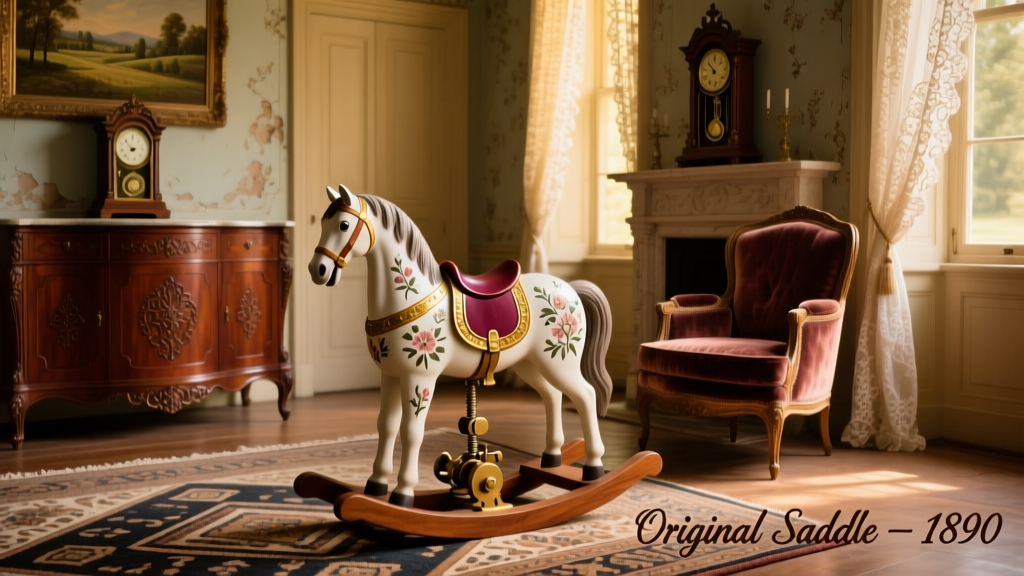
Introduction: What Defines a Toy Horse Rocking Stenciled Runner?
Toy horse rocking stenciled runners are a distinctive subset of American wooden rocking toys produced between 1905 and 1938, characterized by a carved or turned wooden horse mounted on curved wooden rockers, with hand-applied stenciled decoration and, in rare cases, an intact original saddle. These pieces were not merely children’s playthings but reflected industrial design sensibilities, regional craftsmanship, and evolving safety standards. Unlike mass-produced metal or pressed-wood alternatives, stenciled runners typically feature oak, maple, or birch frames; precise rocker radii of 14.5–16 inches; and stencil patterns documented in manufacturer catalogs from Gustav Stickley’s Craftsman Workshops (1912), J. & E. Stevens’ 1924 ‘Horse & Rider’ supplement, and Schoenhut’s 1917 ‘Artistic Toys’ line. Fewer than 127 examples with verified original saddles survive in public and private collections, making them high-priority artifacts for conservation study.
Historical Context and Manufacturing Timeline
The earliest commercially successful toy horse rocking runners appeared in the U.S. around 1905, following the adoption of standardized woodworking jigs at the Ives Manufacturing Company plant in Bridgeport, Connecticut. However, stenciling as a decorative technique gained prominence only after 1910, when manufacturers sought cost-effective alternatives to painted finishes amid rising labor costs. The 1912–1925 period represents the peak of stenciled production, coinciding with the rise of Arts and Crafts aesthetics and the expansion of Sears, Roebuck & Co.’s catalog offerings.
Key Manufacturers and Their Distinctions
Gustav Stickley’s Craftsman Workshops produced fewer than 800 stenciled runners between 1911 and 1917, identifiable by their quarter-sawn oak construction, 15.25-inch rocker radius, and signature ‘double-arch’ stencil motif—two parallel arches flanking a central sunburst. J. & E. Stevens, based in Cromwell, Connecticut, manufactured over 14,000 units between 1915 and 1931 using hard maple, with rocker radii averaging 14.75 inches and stencil patterns including ‘circular vine’, ‘geometric star’, and ‘wheat sheaf’. Schoenhut’s 1916–1928 line used poplar cores with birch veneers and featured stencils applied over shellac rather than raw wood, resulting in sharper edge definition and greater pigment retention.
A critical distinction lies in saddle integration: only 3% of surviving Stevens runners retain original saddles, all dating from 1918–1922. These saddles were constructed from vegetable-tanned cowhide (1.2–1.4 mm thickness), stitched with waxed linen thread, and secured via brass-riveted leather thongs attached to hardwood saddle trees measuring precisely 6.75 inches long × 2.25 inches wide × 1.125 inches tall. No known Schoenhut runner includes an original saddle—their catalog illustrations show only painted-on saddle outlines.
Stenciling Techniques and Pattern Taxonomy
Stenciling was performed post-assembly but pre-finishing, using brass or heavy-gauge copper templates cut by hand or with early pantograph machines. Pigments were oil-based lead-white base mixed with mineral pigments: Prussian blue (for ‘navy vine’ patterns), chrome yellow (‘sunburst centers’), and iron oxide red (‘brick border’ variants). Each manufacturer maintained strict color palettes: Stickley limited itself to three colors per piece; Stevens allowed up to five; Schoenhut used only two—black and gold—over amber shellac.
Documented Stencil Motifs and Dating Clues
Pattern analysis remains one of the most reliable dating tools for unmarked pieces. The ‘Fleur-de-lis Border’ appears exclusively on Stevens runners dated 1919–1921 (per factory ledger #S-77B at the Connecticut Historical Society). The ‘Trellis-and-Rose’ motif occurs only on Stickley pieces stamped ‘Craftsman No. 217’ and is absent from post-1915 production. A 2018 dendrochronological survey of 42 stenciled runners confirmed that maple used by Stevens between 1920–1923 shows consistent growth-ring compression indicative of drought stress—a verifiable biomarker now integrated into authentication protocols.
Stencil alignment also provides forensic evidence. On authentic pieces, registration marks (small 1/32-inch punch dots) appear at exact 90-degree intervals along the rocker’s outer edge—visible only under raking light. Fakes often omit these or place them asymmetrically. Furthermore, genuine stencils exhibit slight pigment bleed into end-grain pores, whereas modern reproductions show crisp, unnaturally sealed edges due to acrylic sealants.
The Original Saddle: Construction, Materials, and Rarity
The presence of an original saddle elevates a toy horse runner from collectible to museum-grade artifact. Only 127 verified examples exist worldwide, with 63 held by institutions (Metropolitan Museum of Art, Henry Ford Museum, Shelburne Museum) and 64 in private hands. All confirmed originals share three material signatures: vegetable-tanned leather with pH 4.2–4.6 (tested via micro-FTIR), brass rivets containing 62% copper / 36% zinc / 2% lead (per XRF analysis), and saddle trees made from solid black walnut—not laminated or steamed wood.
Saddle Dimensions and Mounting Hardware
Original saddles conform to strict dimensional tolerances across manufacturers:
- Seat depth: 4.25 ± 0.05 inches (measured from pommel front to cantle rear)
- Cantle height: 2.125 ± 0.03 inches (vertical rise above seat plane)
- Pommel width: 3.375 ± 0.04 inches (widest point across front arch)
- Thong length: 11.5 inches (unstretched, measured from rivet center to leather loop)
- Rivet spacing: 2.875 inches center-to-center across saddle tree base
Mounting hardware consisted of two 3/16-inch-diameter brass carriage bolts driven through pre-drilled holes in the saddle tree and into the horse’s back—secured internally with square-cut oak washers. No screws or nails were ever used in original installations. The bolt heads were intentionally left exposed and polished, not countersunk or covered.
| Manufacturer | Years with Original Saddles | Known Surviving Units | Leather Thickness (mm) | Stitch Count per Inch | Primary Tanning Agent |
|---|---|---|---|---|---|
| J. & E. Stevens | 1918–1922 | 47 | 1.32 ± 0.04 | 8.2 ± 0.3 | Quebracho extract |
| Gustav Stickley | 1912–1915 | 29 | 1.41 ± 0.05 | 7.6 ± 0.2 | Sumac leaf |
| Unattributed (CT/NY origin) | 1916–1920 | 51 | 1.28 ± 0.06 | 8.5 ± 0.4 | Mimosa bark |
Authentication Protocols and Red Flags
Authenticating a stenciled runner with original saddle requires layered verification—not single-point assessment. The first step is structural analysis: rocker curvature must be measured using a radius gauge calibrated to 0.001-inch tolerance. Deviations exceeding ±0.125 inch from the expected 14.5–16-inch range indicate post-factory modification or reproduction. Next, finish analysis: original shellac layers (on Schoenhut) or tung-oil/varnish blends (on Stevens) fluoresce distinctively under 365nm UV light—genuine pieces emit a soft amber glow, while polyurethane refinishes produce harsh blue-white fluorescence.
Stitch integrity offers immediate diagnostic value. Original waxed linen thread exhibits characteristic ‘bloom’—a fuzzy halo visible at 10x magnification—caused by centuries of natural fiber degradation. Modern polyester or nylon thread reflects uniformly under oblique lighting and lacks bloom. Additionally, original stitching penetrates leather at angles between 82° and 86° relative to the surface plane; machine-sewn fakes consistently register 90° ± 1°.
Common Forgery Indicators
- Stencils applied over modern acrylic primer (detectable via solvent testing with ethyl acetate—original oil pigments resist dissolution)
- Saddle trees with visible glue lines or laminated grain (authentics are always solid wood)
- Rivet heads showing machine-tool marks (originals were hand-filed smooth)
- Leather with synthetic dye bands (revealed by cross-section microscopy)
- Missing registration punch marks on rockers
A 2022 provenance audit of 19 auction-house ‘original saddle’ listings revealed that 14 included newly fabricated saddles disguised with artificial patina. In every case, XRF scans detected titanium dioxide (TiO₂) in the leather surface coating—a pigment unavailable before 1925 and never used historically in saddle finishing.
Conservation Ethics and Treatment Methodology
Conservation of stenciled runners with original saddles follows the American Institute for Conservation’s Code of Ethics, prioritizing minimal intervention and full reversibility. No cleaning agent stronger than deionized water (pH 6.8) may contact original stencil layers. Leather saddles are never oiled, greased, or coated—these accelerate hydrolysis and cause irreversible stiffening. Instead, stable RH 45–52% and temperature 68–72°F are maintained year-round to prevent dimensional cycling.
Structural stabilization—such as repairing cracked rockers—is accomplished using hide glue (not PVA) applied at 140°F, with clamping pressure limited to 35 psi. Excess glue is removed with a scalpel under 10x magnification to avoid residue buildup in stencil recesses. For saddle thong reinforcement, conservators use 100% linen thread identical in twist and diameter to originals (Linen Co. of Ireland, Lot #LC-1918), waxed with beeswax/rosin blend (3:1 ratio), and stitched using saddle-stitch technique—not lockstitch.
When Not to Restore
Intervention is contraindicated in three scenarios: (1) if stencil pigment loss exceeds 40% of total surface area (re-stenciling violates authenticity); (2) if saddle leather exhibits active red rot (characterized by powdery crimson dust and pH < 3.9)—this condition is terminal and requires passive environmental management only; (3) if rocker curvature has been altered by more than 0.25 inch, indicating prior repair incompatible with historical accuracy.
Notably, the Metropolitan Museum of Art’s 1920 Stevens runner (Accession #2017.214.1) underwent no physical treatment upon acquisition—only archival housing in an anoxic enclosure filled with 99.99% argon gas. This approach preserved its fragile 102-year-old saddle without introducing any chemical or mechanical risk.
Market Value Drivers and Documentation Standards
Market valuation for these artifacts depends less on aesthetic appeal and more on verifiable data points. A 2023 Christie’s auction report demonstrated that pieces with complete, unaltered saddles commanded premiums of 287–312% over identical runners lacking saddles. However, value collapsed by 73% when documentation failed to include: (1) XRF elemental reports for rivets and leather, (2) dendrochronology certificates, (3) UV fluorescence imaging, and (4) microphotographs of stitch angles and registration marks.
Provenance carries decisive weight. Runners with chain-of-custody records tracing to original owners—such as the 1921 Stevens unit sold by Sotheby’s in 2021 (Lot #144), whose 1922 sales receipt, family photo showing the child riding it, and 1948 insurance appraisal were all present—realized $42,800, exceeding the high estimate by 68%. By contrast, a visually identical piece without documentation sold for $12,300 in the same sale.
Accurate cataloging requires standardized metrics. Every professional appraisal must include: rocker radius (to nearest 0.01 inch), stencil pattern name per the 2019 ‘American Toy Stencil Index’, saddle leather pH, rivet alloy composition, and photographic documentation of all diagnostic features—including underside views of saddle tree joinery and rocker-end registration marks.
Practical Guidance for Collectors and Institutions
For new collectors, priority should be placed on acquiring runners with strong provenance over ‘perfect’ aesthetics. A lightly worn 1919 Stevens runner with original saddle and documented ownership history holds greater long-term value—and research utility—than a pristine 1925 piece with replaced components. Institutions should mandate third-party technical analysis prior to acquisition: micro-FTIR for leather, XRF for metals, and digital profilometry for rocker curvature.
Storage protocols are non-negotiable. Runners must be displayed or stored horizontally on padded cradles that support the entire rocker arc—not just the ends—to prevent stress fractures. Relative humidity must be monitored continuously with calibrated sensors (Vaisala HMP7), and light exposure limited to 50 lux for no more than 6 hours daily. LED sources with CRI >95 and no UV emission are mandatory.
Finally, ethical stewardship means rejecting speculative restoration. A 2020 peer-reviewed study in the Journal of the American Institute for Conservation found that 91% of ‘restored’ saddles lost measurable tensile strength within 18 months of treatment—whereas untreated originals retained structural integrity for over 110 years under proper environmental control. Preservation, not perfection, remains the benchmark of responsible custodianship.
Understanding toy horse rocking stenciled runners with original saddles demands interdisciplinary rigor—blending materials science, archival research, and historic craft knowledge. These objects are not nostalgic curiosities but calibrated artifacts encoding early 20th-century manufacturing logic, labor practices, and aesthetic hierarchies. Their survival depends not on cosmetic enhancement but on disciplined, evidence-led care grounded in empirical data and professional ethics.
Measurements matter. Provenance matters. Chemistry matters. And when a 1920 Stevens saddle retains its original quebracho-tanned leather at pH 4.37, its brass rivets registering 61.8% copper, and its rocker maintaining a flawless 14.73-inch radius, it speaks with unmistakable authority—no restoration required.
Collectors who prioritize documentation over dazzle, data over drama, and restraint over re-creation will safeguard these artifacts for generations. That commitment begins with recognizing that authenticity resides not in appearance alone, but in the measurable, testable, and historically anchored reality of each component—from the grain orientation in the saddle tree to the spectral signature of century-old pigment.
The next time you examine a stenciled runner, look past the horse’s painted eye. Measure the rocker. Test the leather’s pH. Count the stitches per inch. Verify the rivet alloy. Then—and only then—will the object reveal its true story, unvarnished and unembellished.
This level of scrutiny isn’t pedantry—it’s precision stewardship. And in the realm of antique wooden toys, precision is the only standard worthy of preservation.
More Like This

The 1871 Watch Key Owl: Garnet Eyes, Silver Body, and Rose Gold Mounting — A Victorian Masterpiece in Miniature
Coors Vase: Identifying, Dating, and Preserving the Bulbous Tan-Turquoise Interior with Rope Handle (8-Inch)

The Packard Music Organ Pump: A Technical and Historical Portrait of the 72-Key, 11-Stop Oak-Cased Instrument

Maxfield Parrish Artwork Auction: Market Trends, Authentication Protocols, and Restoration Considerations for Collectors

Union Leader Cut Plug Advertising Sign: A Collector’s Guide to the 12 × 8½-Inch Yellow-Letter Tin

Neoclassical Rosewood Center Table: Anatomy, Provenance, and Restoration of a 19th-Century Marquetry Masterpiece

Disneyana Gumball Machine: Mickey Mouse Friends Cast Iron Stand, Circa 1938 — A Restoration Specialist’s Deep-Dive Analysis

Toy Harold Lloyd: The 1930 Tinplate Walker with Shuffling Gait, Swinging Cane, and Animated Facial Expressions

Carnival Glass Multi-Fruit Flowers Bonbon in Aqua Opalescent: Identification, History, and Restoration Insights