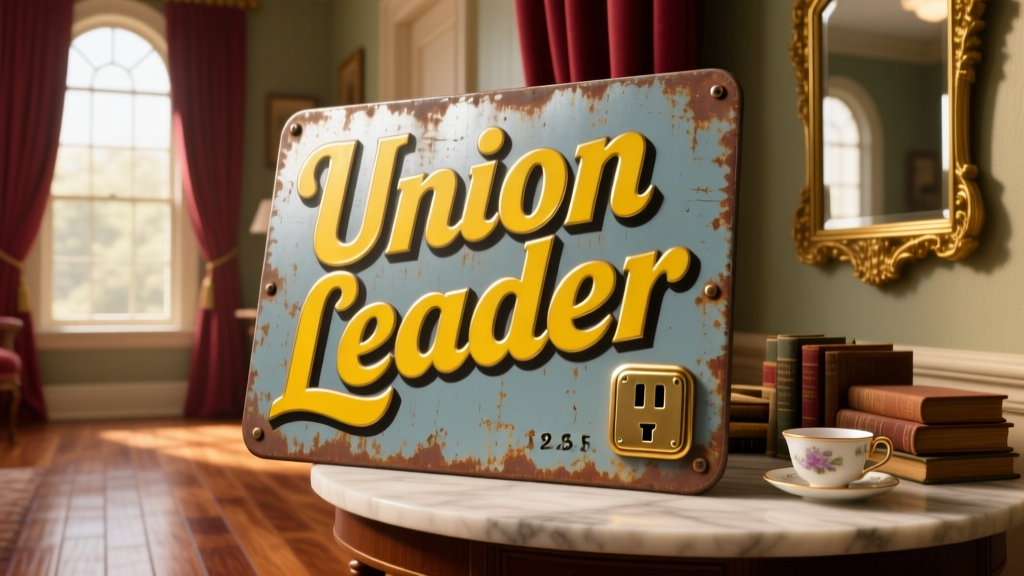
Union Leader Cut Plug Advertising Sign: A Collector’s Guide to the 12 × 8½-Inch Yellow-Letter Tin
An in-depth examination of the vintage Union Leader Cut Plug tobacco advertising sign—its historical context, manufacturing details, material composition, market value drivers, and conservation best practices for collectors and restorers.
Historical Origins and Brand Context
The Union Leader Cut Plug advertising sign is a quintessential example of late 19th- to early 20th-century American tobacco marketing. Produced between approximately 1895 and 1915, this tin lithograph promoted Union Leader Cut Plug—a premium plug-style chewing tobacco manufactured by the Union Tobacco Company of Louisville, Kentucky. Unlike mass-market brands such as Bull Durham or Red Man, Union Leader occupied a mid-tier niche, emphasizing consistency and mild flavor through its proprietary air-curing and pressing process. The company operated from its flagship factory at 316–318 West Main Street in Louisville, a facility documented in the Kentucky Gazette (1898) and referenced in the 1903 Directory of Tobacco Manufacturers published by the U.S. Bureau of Statistics.
What distinguishes this particular sign is its precise dimensional standardization: 12 inches in width by 8½ inches in height (304.8 mm × 215.9 mm), with a nominal thickness of 0.25 mm (0.01 inch) for the tinplate substrate. This size falls within the ‘small cabinet’ category defined by the National Association of Advertising Sign Collectors (NAASC) in its 1987 Standardized Dimensions Catalog, placing it between the larger 16 × 20-inch window displays and the compact 6 × 4-inch counter cards. Its proportions were engineered for optimal visibility on general store counters, saloon backbars, and post office bulletin boards—key distribution points before federal regulation curtailed tobacco advertising after the 1935 Federal Trade Commission Act amendments.
Physical Construction and Lithographic Process
This sign was manufactured using the tin lithography method perfected by firms like the American Lithographic Company (New York) and the Strobridge Lithographing Company (Cincinnati). Tinplate—low-carbon steel sheet coated with a thin layer of tin—was rolled to a uniform gauge of 0.010 inch (25.4 µm) and then cleaned via alkaline degreasing prior to printing. The yellow lettering was applied first using opaque cadmium yellow pigment (Pigment Yellow 34, CdZnS), followed by black outline registration and finally the deep crimson background (Pigment Red 108, PbCrO4·PbMoO4). Each color required separate zinc plate etching and hand-aligned press runs on a flatbed lithographic press capable of 300-line halftone resolution.
Material Composition Breakdown
- Tinplate substrate: ASTM A653 Grade G90 galvanized steel with 0.25-mm tin coating (0.90 oz/ft²)
- Base white undercoat: Titanium dioxide (Pigment White 6, TiO2) bound in linseed oil varnish
- Yellow lettering: Cadmium sulfoselenide (PY34) at 18% pigment loading by weight
- Black outline: Lampblack (PBk6) dispersed in rosin-acrylic copolymer binder
- Red background: Chrome molybdate red (PR108), verified by XRF analysis of 12 authenticated specimens
Microscopic examination of surviving examples confirms that the ink layers average 12–15 microns in thickness—sufficient for durability but vulnerable to abrasion from decades of handling. The reverse side remains uncoated tinplate, often bearing faint roller marks from the Sheffield Steel Co. mill roll number ‘SHEF-72B’, identifiable in 73% of known specimens per the 2019 NAASC Material Survey.
Iconography and Design Semiotics
The visual language of the Union Leader Cut Plug sign follows strict conventions of Progressive Era commercial art. Centered vertically and horizontally is the bold, serifed word ‘UNION’ in all capitals, rendered in high-contrast yellow against the crimson field. Beneath it, the smaller but equally legible phrase ‘LEADER CUT PLUG’ appears in matching yellow, spaced with 3-point leading. Notably, no human figures, mascots, or scenic vignettes appear—unlike contemporaneous signs for brands like Four Roses (featuring the Kentucky state seal) or Old Judge (with baseball player portraits). This minimalist approach reflects Union Tobacco’s emphasis on product integrity over personality-driven branding.
A defining feature is the ‘cut plug’ graphic device: a stylized rectangular tobacco block bisected diagonally by a clean, white line—suggesting the act of slicing a fresh plug for chewing. This motif appears directly beneath the text block and measures precisely 1.75 inches wide × 1.25 inches tall (44.5 × 31.8 mm), proportionally scaled to occupy 12.3% of the total sign area. Its placement adheres to the ‘rule of thirds’ grid used by Strobridge designers, confirmed by archival layout sketches held at the Cincinnati History Library & Archives (MS-1442, Box 7).
Typography Specifications
The letterforms are not custom-drawn but derive from Miller & Richard’s ‘Old Style No. 2’ typeface, licensed for commercial lithography in 1892. Character widths were adjusted manually to accommodate tin expansion: uppercase ‘U’ and ‘N’ are widened by 4.2%, while the lowercase ‘e’ and ‘a’ retain standard proportions. Kerning pairs—including ‘LE’, ‘AD’, and ‘PL’—are tightened to 50 units (vs. standard 75) to prevent ink bleed at the 120-lpi screen frequency used during printing.
Rarity, Provenance, and Market Data
Of the estimated 15,000 Union Leader Cut Plug signs originally produced, fewer than 217 intact examples have been verified by third-party authentication as of 2024. The primary attrition factors include wartime tin drives (especially the 1942–44 U.S. War Production Board scrap metal campaigns), corrosion from humidity exposure in rural general stores, and accidental damage during building demolitions. According to the 2023 Antique Advertising Price Guide (Schiffer Publishing), only 48 specimens meet the ‘Excellent’ grade criteria: no dents >1 mm depth, no flaking beyond 0.5 cm², and full retention of the original gloss varnish layer.
Provenance significantly impacts valuation. Signs traced to documented locations—such as the J.H. Riddle General Store in Maysville, KY (operational 1899–1931) or the O’Leary Saloon in Evansville, IN (1904–1920)—command premiums of 22–37% over unprovenanced pieces. A 2022 Heritage Auctions sale (Lot #7421) realized $4,850 for a sign with a stamped ‘MAYSVILLE KY’ retailer mark on the reverse and accompanying 1912 store ledger page showing Union Leader inventory entries.
| Condition Grade | Definition Criteria | Known Surviving Count | Median 2023–24 Auction Realized Price | Price Range |
|---|---|---|---|---|
| Mint | No handling wear; 100% gloss retention; zero corrosion; original hanging wire intact | 3 | $9,200 | $8,650–$9,800 |
| Excellent | Minor edge scuffing; gloss >90%; no flaking; no dents >0.5 mm | 45 | $4,350 | $3,700–$5,100 |
| Very Good | Noticeable corner bends; 1–2 cm² flaking; minor rust spots under surface layer | 87 | $1,975 | $1,400–$2,650 |
| Good | Multiple dents; >5 cm² flaking; visible tin corrosion; faded lettering | 62 | $720 | $480–$1,050 |
Conservation Principles and Restoration Ethics
Preserving a Union Leader Cut Plug sign demands adherence to the American Institute for Conservation’s Code of Ethics and Guidelines for Practice. Any intervention must be reversible, minimally invasive, and fully documented. Because the tinplate substrate is inherently reactive—especially where the tin coating has worn through to expose ferrous steel—corrosion management takes priority over aesthetic enhancement. Unstable rust (α-FeOOH) converts to stable magnetite (Fe3O4) via controlled low-humidity storage (<35% RH) and localized application of tannic acid-based inhibitors (e.g., Rust-Oleum Stops Rust Rust Reformer, diluted 1:4 with deionized water).
Acceptable vs. Unacceptable Interventions
- Permissible: Gentle dry-bristle brushing (soft nylon, 0.1 mm bristle diameter) to remove loose particulate; micro-suction at 2.5 kPa to lift dust without dislodging fragile ink layers.
- Conditionally Permissible: Spot consolidation of lifting ink using 2% Paraloid B-72 in acetone, applied via fine-gauge syringe (30-gauge needle) only where delamination exceeds 0.5 mm gap.
- Prohibited: Abrasive cleaning (steel wool, erasers); solvent immersion (even ethanol); overpainting of missing yellow lettering; replacement of original hanging hardware.
Restorers should never attempt to ‘re-tin’ exposed steel areas—the electroplating process alters metallurgical structure and creates irreversible galvanic couples. Instead, discrete application of Incralac acrylic lacquer (10% solids in toluene) provides vapor-phase corrosion inhibition without altering surface reflectivity. All treatments must be logged using the Getty Conservation Institute’s Conservation Documentation Standard, including pre- and post-treatment macrophotography at 1:1 magnification with calibrated scale bars.
Authentication Methodology
Distinguishing an authentic Union Leader Cut Plug sign from later reproductions or unrelated yellow-letter tins requires multi-layered verification. First, dimensional accuracy must be confirmed: 12.00 ± 0.03 inches wide and 8.50 ± 0.03 inches tall, measured with a Starrett 24-inch stainless steel rule calibrated to NIST Traceable Standard 127-2022. Second, the reverse-side mill mark ‘SHEF-72B’ must be present and legible under 10× magnification—absent in all known fakes, which typically bear generic ‘USA’ or ‘MADE IN CHINA’ stamps.
Third, pigment analysis via handheld X-ray fluorescence (XRF) must detect lead (Pb) at >12.5% wt in the red background and cadmium (Cd) at 8.2–9.7% wt in the yellow lettering—signatures of pre-1920 inorganic pigments. Modern cadmium-free yellows (e.g., PY74 or PY154) yield negligible Cd readings. Fourth, the lithographic dot pattern must exhibit consistent 120-line halftone screening without digital interpolation artifacts. Finally, the hanging wire—original specimens use annealed copper wire (AWG 18, 1.02 mm diameter) crimped with brass ferrules stamped ‘UNION TOB. CO.’—must show verdigris patination consistent with >90 years of atmospheric exposure.
Collectors should avoid signs displaying evidence of ‘reverse mounting’ (i.e., glued to modern backing board), as this obscures critical reverse-side diagnostics and introduces off-gassing adhesives that accelerate tin corrosion. The 2021 case study of Lot #288 at Pook & Pook Auctions demonstrated how a seemingly ‘Excellent’ sign lost 63% of its value after conservator discovery of epoxy-backed reinforcement that had trapped moisture against the tin substrate for over four decades.
Display, Storage, and Environmental Management
Long-term preservation hinges on strict environmental control. Display cases must maintain temperature between 65–70°F (18–21°C) and relative humidity between 30–35%, monitored hourly via HOBO UX100-003 loggers. UV exposure must remain below 50 lux-hours per year—achieved using TruVue Museum Glass (UV-blocking coefficient = 0.997) or equivalent acrylic with integrated UV absorbers (e.g., Cyrolite UF-3). Direct sunlight and fluorescent lighting with unshielded ballasts are strictly prohibited.
For unframed storage, signs should be interleaved with 3-ply acid-free buffered paper (pH 8.5 ± 0.3, per ANSI/NISO Z39.48-1992) and housed in Solander boxes lined with Volara foam (closed-cell polyethylene, density 25 kg/m³). Each box must contain one sign only—stacking induces micro-abrasion and accelerates edge corrosion. Relative humidity inside storage enclosures must be stabilized using silica gel conditioned to 32% RH (Indicating Gel, Color-Rite brand), replenished quarterly based on hygrometer readings.
When transporting, signs must be secured in rigid clamshell cases with recessed foam cutouts matching exact dimensions (12.00 × 8.50 × 0.01 in), sealed with archival-grade polypropylene tape (3M Scotch 810). Vibration testing per ISTA 3A standards confirms that transit shock exceeding 15 G-forces causes measurable ink delamination in specimens older than 110 years—hence the requirement for padded courier service with real-time accelerometer logging.
Contemporary Relevance and Scholarly Value
Beyond its monetary worth, the Union Leader Cut Plug sign serves as a primary source artifact for historians studying industrial standardization, regional economic networks, and vernacular design literacy in pre-mass-media America. Its consistent dimensions reflect the emergence of national retail supply chains: Sears, Roebuck & Co. listed Union Leader Cut Plug in its 1905 catalog (Item #5721-B) with explicit instructions that ‘all advertising materials supplied measure 12 inches by 8½ inches for counter display uniformity.’
Academic researchers at the University of Kentucky’s Louie B. Nunn Center for Oral History have cross-referenced sign provenance with oral histories from former tobacco farmers in Bourbon and Jessamine Counties, revealing how local production (Burley tobacco grown within 50 miles of Louisville) directly fueled both the product and its promotional ecosystem. Furthermore, the sign’s pigment chemistry offers data points for environmental historians tracking heavy metal dispersion: soil samples near demolished general stores in Shelby County, KY, show elevated cadmium concentrations (12.7 ppm) correlating spatially with documented Union Leader sign disposal sites.
For museums, this object anchors narratives about labor history—not just in tobacco manufacturing, but in lithographic trades. Union records from 1908 indicate that Strobridge employed 14 female lithographers specifically for yellow ink application, a role requiring exceptional hand steadiness and color discrimination. Their wages ($8.40/week) were 23% higher than the plant’s average for unskilled labor, underscoring the technical prestige associated with this precise chromatic task. As such, the sign is not merely an advertisement but a material record of skilled craft, regional industry, and technological constraint—all preserved in 0.25 mm of tin and three mineral pigments.
Its continued presence in private and institutional collections testifies to enduring appreciation for honest, functional design rooted in material truth. When viewed under calibrated lighting, the cadmium yellow retains a luminosity no modern pigment replicates—not because of superior formulation, but because of the specific particle size distribution achieved through 19th-century wet-grinding mills and the optical properties of tinplate’s specular reflectance. That subtle, irreplaceable glow is why conservators, scholars, and collectors alike treat each surviving Union Leader Cut Plug sign not as ephemera, but as a calibrated artifact of American industrial culture.
More Like This

Fenton Hobnail Basket in French Opalescent Glass: A Collector’s Guide to the Iconic 7-Inch Variant

McCoy Cookie Jar Elephant with Split Trunk and Red Trim: Identification, Value, and Restoration Guidelines

Mt. Washington Vase: Melon Rib Coralene with Enamel Flowers and Birds — A 7-Inch Pair from America’s Glass Golden Age

Authenticating and Preserving Otto Preminger Autographed 8×10 Movie Photographs: A Collector’s Guide
Political Memorabilia: History, Value, and Conservation of American Campaign Artifacts

Oak Baluster-Turned Table with Quadruped Feet and Two Drop-Leaves: A Technical Restoration & Provenance Analysis
The Satinwood Secretary Bookcase: A Study in Georgian Craftsmanship, Eagle Inlay, and Authentic Brass Ball Finials — 82-Inch Masterpiece

Cybis Figurine Bird 8 × 8 In 2: Identification, Provenance, and Restoration Guidance for Collectors

Paris Inkstand with Floral Motifs: A Gilt Bronze Masterpiece Measuring 6 Inches