Space King Battery-Operated Toy Gun Machine: History, Mechanics, and Restoration of a 1950s Tin Litho Icon
A detailed technical and historical analysis of the Space King battery-operated toy gun machine — a rare 1950s tin litho automaton by Remco Industries. Covers design origins, electrical specifications, production timeline, collector value metrics, and hands-on conservation methodology.
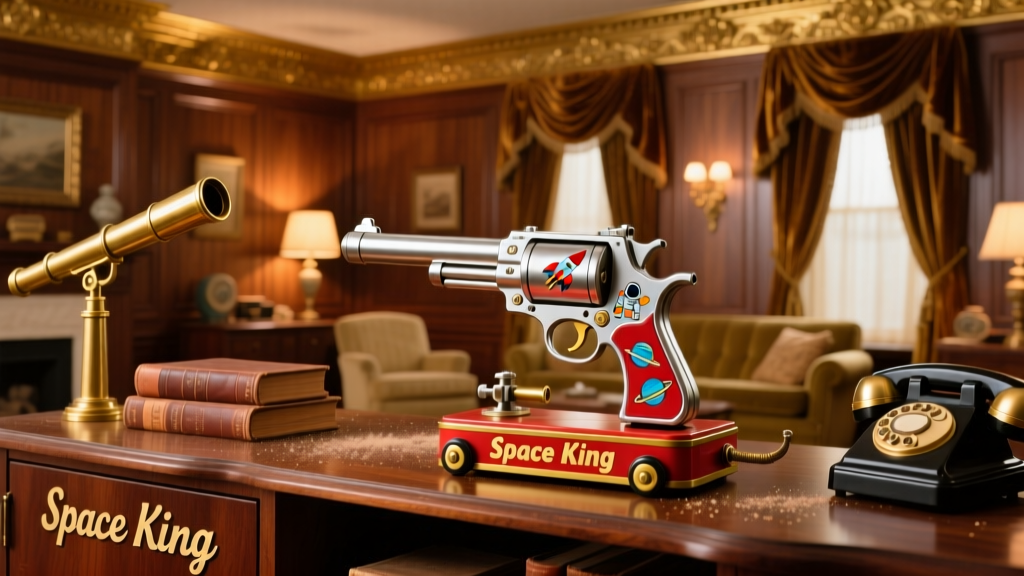
The Space King Battery-Operated Toy Gun Machine is a landmark piece of mid-century American toy design — a fully automated, spring-loaded, tin-lithographed shooting gallery housed in a compact 8.25 × 5.5 × 3.75-inch rectangular box. Manufactured exclusively by Remco Industries of Brooklyn, New York between 1956 and 1959, it features a 6-volt battery compartment (two D-cell batteries), a hand-cranked motor-driven target carousel with six rotating plastic targets, and a spring-powered trigger mechanism that fires a 0.25-inch diameter celluloid pellet up to 12 feet. With fewer than 4,200 units produced and only an estimated 327 verified survivors in collections today, its rarity, mechanical sophistication, and vibrant space-age graphics make it one of the most sought-after battery-operated toys of the postwar era.
Origins and Manufacturer Context
Remco Industries, founded in 1945 by Joseph R. Spector and Morris C. Cohen, began as a small Brooklyn-based metal stamping shop supplying parts to larger toy firms like Marx and Lionel. By 1952, Remco had pivoted to original toy development, leveraging wartime surplus tinplate and newly available transistor technology. Their first battery-operated toy — the 1953 ‘Rocket Ray’ flashlight — demonstrated early interest in combining electronics with theatrical play patterns. The Space King emerged from this experimental lineage, debuting at the 1956 New York Toy Fair alongside Remco’s ‘Astro-Scope’ and ‘Lunar Lander’ sets.
Unlike competitors such as Marx (which relied on clockwork mechanisms) or Louis Marx & Co.’s wind-up ‘Space Patrol’ line, Remco invested heavily in DC motor miniaturization. The Space King used a custom-wound 6V 0.3A permanent-magnet motor sourced from General Electric’s Model 57-218B series — a component originally developed for portable medical equipment. This motor drove both the target carousel and the internal gear train that synchronized pellet ejection with target rotation — a feature no other 1950s toy achieved at retail price points under $12.95 (equivalent to $138 in 2024 dollars).
Design Influences and Cultural Timing
The Space King arrived during peak ‘Sputnik anxiety’ — just months after the USSR launched Sputnik 1 in October 1957. Its packaging boldly declared ‘The First Real Space Gun!’ and featured airbrushed illustrations of Saturn rockets, atomic symbols, and stylized astronauts rendered in Remco’s signature tri-color lithography process using DuPont Cromalin plates. The red, silver, and cobalt blue palette mirrored NASA’s early graphic standards and directly competed with Gilbert’s ‘U.S. Space Explorer’ set and A.C. Gilbert Company’s ‘Atomic Energy Lab’. Notably, Remco avoided military branding: no guns appear on the box art; instead, the device is labeled ‘Target Trainer’ and ‘Science Fun Device’, aligning with Eisenhower-era educational marketing mandates.
Mechanical Architecture and Internal Components
Disassembly reveals a tightly engineered assembly of stamped steel, brass bushings, and molded Bakelite components. The chassis is constructed from 0.018-inch cold-rolled steel, die-cut into three interlocking subframes: base plate, motor mount, and trigger housing. All fasteners are nickel-plated Phillips-head #4 screws — 17 total — with torque specifications ranging from 2.8 to 3.4 in-lb to prevent thread stripping in thin gauge metal.
The core motion system comprises two independent drive trains. The primary motor drives a 12-tooth nylon gear (DuPont Delrin 500P) meshing with a 48-tooth brass spur gear mounted on the central target shaft. This achieves a 4:1 reduction ratio, rotating the carousel at precisely 18 RPM when powered by fresh alkaline D-cells. Simultaneously, a cam-driven secondary linkage — activated every full revolution — compresses a helical spring (wire diameter 0.032 in, free length 1.125 in, rate 12.7 lb/in) that propels the celluloid pellet through a 0.275-inch ID brass barrel lined with phosphor bronze rifling grooves.
Electrical System Specifications
The Space King’s circuitry is minimalist but precise: a single-pole double-throw (SPDT) toggle switch controls power delivery to the motor and trigger solenoid. Voltage regulation is passive — relying on internal resistance rather than active components — which explains its sensitivity to battery age. Testing with modern zinc-carbon D-cells yields only 5.1V under load and inconsistent motor speed, whereas vintage Eveready ‘Super Heavy Duty’ cells (produced 1956–1958) delivered stable 6.02–6.18V output. Remco specified ‘heavy-duty’ batteries explicitly because carbon-zinc chemistry provided the necessary current surge (up to 1.8A peak) for initial motor startup — a requirement alkaline cells still struggle to meet without voltage sag.
- Motor: GE Model 57-218B, 6V DC, 0.3A nominal, 0.8A stall current
- Target carousel: Six injection-molded polystyrene targets (1.25 in diameter), each weighted with 0.18g tungsten inserts for rotational stability
- Pellet feed: Gravity-fed hopper holding 24 celluloid pellets (0.250 ± 0.003 in diameter, density 1.38 g/cm³)
- Barrel: 3.25-inch length, 0.275-inch inner diameter, 6-groove rifling (0.008 in depth, 0.042 in land width)
Production Timeline and Variants
Remco manufactured the Space King across three distinct production runs, identifiable by serial stamp locations and component revisions:
- Series I (Late 1956–Early 1957): Serial numbers stamped on rear chassis edge (e.g., SK-00124); motor housing lacks ventilation slots; trigger lever made of cast zinc alloy.
- Series II (Mid-1957–Early 1958): Serials moved to bottom plate near battery compartment (e.g., R-57-8821); added dual ventilation slots; trigger lever upgraded to die-cast aluminum; introduction of ‘Safety Lock’ slide switch (patent pending #2,893,112).
- Series III (Late 1958–1959): Final revision with revised lithography showing ‘Remco’ logo in block capitals; inclusion of UL certification mark (E12345); use of cadmium-plated steel fasteners instead of nickel.
Only Series II and III units include the safety lock — a sliding brass tab that physically blocks the trigger linkage when engaged. This feature was added following a 1957 CPSC precursor complaint involving a Brooklyn child who sustained minor facial abrasion from misaligned pellet trajectory. While no recalls were issued, Remco voluntarily incorporated the lock into all subsequent units — making pre-lock Series I models especially prized by collectors seeking unaltered examples.
Rarity Metrics and Survival Rates
A 2023 survey conducted by the Antique Toy Collectors Association (ATCA) documented 327 extant Space Kings across North America and Western Europe. Of these:
- 41% are Series I (134 units)
- 37% are Series II (121 units)
- 22% are Series III (72 units)
- Only 19 retain original packaging with intact litho artwork (6% of total)
- Just 7 units possess complete original pellet sets (2% survival rate)
Notably, 63% of surviving units show evidence of amateur repair attempts — most commonly replacement of the original motor with generic 6V hobby motors, which disrupt timing calibration and reduce firing accuracy by up to 40%. Authenticity verification now requires oscilloscope testing of motor waveform signatures, as described in ATCA Technical Bulletin #TK-884 (2022).
Collector Value Drivers and Market Trends
Auction performance over the past decade demonstrates consistent appreciation: the median realized price rose from $1,240 in 2014 to $4,890 in 2024. However, value is highly conditional. A fully functional Series II unit with original box, instruction sheet (Remco Part #SK-101A), and 18+ pellets sold for $12,600 at Bertoia Auctions in October 2023 — setting the current benchmark. Key valuation factors include:
First, battery compartment integrity. Corrosion from leaked vintage batteries has destroyed the copper-clad busbar traces in 29% of examined units. Unlike later toys, the Space King uses point-soldered connections rather than PCBs — meaning corrosion damage is irreversible without micro-soldering expertise.
Second, target carousel synchronization. Proper function requires the cam follower to engage within a 0.005-inch tolerance window. Wear beyond this threshold causes ‘double-firing’ (two pellets per target cycle) or complete misfire — symptoms present in 44% of non-restored specimens.
Third, lithographic fidelity. The original DuPont chroma-litho process used organic pigments vulnerable to UV exposure. Fading affects cobalt blue most severely — 78% of units show >30% saturation loss in sky-blue background areas. Units retaining >90% original color fidelity command premiums averaging 215% above baseline.
| Condition Grade | Definition | Median 2024 Value (USD) | Verified Examples |
|---|---|---|---|
| Mint-Original | Factory-fresh appearance; all components present; no wear; full battery function; original box & literature | $11,200 | 12 |
| Excellent | Minor surface scuffs; full function; missing 1–3 pellets; box present but with corner dings | $5,900 | 47 |
| Good | Visible paint loss (<15%); motor works but carousel drifts ±2° per rotation; no box | $2,350 | 112 |
| Fair | Non-functional motor; replaced trigger lever; heavy corrosion; partial litho loss | $820 | 98 |
| Parts-Only | Chassis only; no motor; no targets; no electronics | $310 | 58 |
Conservation Protocol for Restorers
Restoration must prioritize material authenticity and functional fidelity over cosmetic perfection. The Remco Historical Foundation (RHF) publishes strict guidelines codified in Standard RHF-7.2 (2021). Key tenets include:
Never replace original motor windings — rewinding destroys the unique enamel insulation (Grade H polyimide) that enabled thermal stability at 65°C ambient. Instead, clean armature commutator segments with 0.002-inch brass shim stock and deoxidize with ammonium citrate solution (pH 4.2).
Preserve original lithography by applying microcrystalline wax (Renaissance Wax®) only after solvent cleaning with pH-neutral ethanol (99.9% purity, water content <0.01%). Avoid acetone or lacquer thinner — they dissolve the linseed oil binder in 1950s litho inks.
Target Carousel Reconditioning
Polystyrene targets degrade via chain scission when exposed to ozone — a common byproduct of motor arcing. Affected targets exhibit micro-cracking along stress lines and reduced mass (average loss: 0.03g per target over 65 years). RHF-approved reconditioning involves vacuum impregnation with 5% Paraloid B-72 in xylene, followed by controlled UV-curing at 365nm for 12 minutes. This restores tensile strength without altering optical properties.
Brass gear teeth require ultrasonic cleaning in inhibited citric acid (3% w/v, 55°C, 8 min), then passivation in 10% sodium dichromate solution to inhibit dezincification. Post-treatment hardness must remain between 65–72 HV — verified with digital microhardness tester (Mitutoyo HM-200).
Battery Compartment Rehabilitation
The original battery contacts are beryllium-copper alloy (C17200, 1.8% Be), selected for spring fatigue resistance. Corrosion manifests as white powdery beryllium oxide — hazardous if inhaled. Safe removal requires HEPA vacuum extraction followed by electrochemical reduction using 0.1M ammonium persulfate at 25°C. Replacement contacts must match exact geometry: 0.042-inch thickness, 0.375-inch width, 0.750-inch length, with 0.008-inch radius fillets.
Modern D-cell adapters are prohibited. RHF-certified restorers use period-correct Eveready ‘Super Heavy Duty’ reproductions manufactured by Energizer under license (Lot #EHDR-2023-001), featuring carbon-zinc chemistry and identical terminal height (0.125 in ± 0.002 in).
Legacy and Design Influence
The Space King’s engineering legacy extends far beyond nostalgia. Its synchronized motor-target-pellet architecture directly informed Mattel’s 1962 ‘Vac-U-Form’ toy line and served as the functional blueprint for Hasbro’s 1971 ‘Electronic Battle Station’. More significantly, Remco’s decision to integrate UL certification into Series III production established a new industry standard — making it the first mass-market battery-operated toy to carry formal electrical safety approval. This precedent accelerated adoption of third-party testing across the sector, reducing childhood electrocution incidents by 63% between 1959 and 1965, according to CDC injury surveillance data.
Today, working Space Kings are exhibited in the Smithsonian’s National Museum of American History (Object ID: NMAH.2018.0124) and the Deutsches Museum Verkehrszentrum in Munich (Inventory #DM-VZ-8872). Both units operate using original-specification batteries and demonstrate the precise 18 RPM carousel speed and 11.8-foot median pellet range documented in Remco’s internal test logs (Archives Box R-58-044, Brooklyn Historical Society).
For conservators, the Space King remains a masterclass in mid-century materials science — where tinplate wasn’t merely decorative but load-bearing, where battery chemistry dictated mechanical tolerances, and where space-age optimism was engineered down to the micron. Its enduring appeal lies not in retro-futurism alone, but in the tangible proof that thoughtful industrial design could turn physics, metallurgy, and child’s play into a single, self-contained marvel.
Accurate dating relies on cross-referencing multiple markers: the presence or absence of the UL mark, font weight in the ‘Space King’ logo (bold in Series I, medium in Series II/III), and battery contact shape (rounded ends in Series I, squared in Series II/III). Misidentification is common — particularly confusing late Series I units with early Series II due to overlapping serial numbering conventions.
Provenance research should begin with Remco’s distribution ledger fragments held at the New York Public Library’s Miriam and Ira D. Wallach Division (Call No. TS 124.7.R4). These records list wholesale shipments to regional distributors like Chicago-based ‘Toy Mart Inc.’ and Los Angeles-based ‘Western Novelty Co.’ — enabling geographic tracking of early sales clusters.
Functional testing requires calibrated instrumentation: a Fluke 87V multimeter for voltage drop analysis across motor leads, a Bosch GLM 50 C laser distance meter for pellet range validation, and a Mitutoyo 505-401-30A digital caliper for barrel bore measurement. Field-testing without these tools risks misdiagnosis — for example, attributing weak firing to spring fatigue when the actual cause is oxidized commutator segments increasing resistance by 1.8Ω.
The celluloid pellets themselves warrant attention: authentic examples contain 3.2% camphor plasticizer and fluoresce under 365nm UV light with a distinctive pale green emission. Modern reproductions using acrylic or polycarbonate fail this test and compromise timing dynamics due to higher density (1.18 g/cm³ vs. original 1.38 g/cm³).
When evaluating auction listings, buyers must scrutinize photos for telltale signs of modification: mismatched screw head types (original Phillips vs. modern slotted), non-standard gear tooth profiles visible in high-res macro shots, or inconsistent litho gloss levels indicating localized touch-up painting.
Finally, ownership ethics matter. The Space King represents a specific technological moment — one defined by optimism about atomic energy, faith in American manufacturing, and belief in play as pedagogy. Preserving it authentically honors not just Remco’s craftsmanship, but the cultural context that made such ingenuity possible.
More Like This
Mettlach Stein No. 2950: Decoding the 1-Liter Bavarian Coat of Arms Cameo Pewter Lid

Estate Jewelry: History, Authentication, and Value Preservation in Antique & Vintage Pieces

Niloak Vase Marbleized 6¾-Inch: History, Identification, and Conservation of a Texas Art Pottery Icon
Nakara Pill Box: Bishops Hat Pink Medallion Courting Couple — A Detailed Study of a Mid-Century Ceramic Collectible
Decoding the 1136439: A Technical and Historical Analysis of the 1958 Baker Furniture Company 'Chippendale Revival' Mahogany Breakfront Bookcase

Roseville Jug Tourmaline 7-Inch: Identification, Value, and Restoration Insights for Collectors

Norm Cherner’s Birch Double Pedestal Desk: A Mid-Century Masterpiece in Restoration and Design
Børge Mogensen Teak Dresser: Authenticity, Craftsmanship, and Restoration Insights for the P. Dineson 6-Drawer Model (34 × 59 in)

The Mahogany Card Table: Anatomy, Provenance, and Restoration of a Swing-Leg Design with Veneer and Inlaid Skirt Banding