Estate Jewelry: History, Authentication, and Value Preservation in Antique & Vintage Pieces
A detailed examination of estate jewelry—defined as pre-owned fine jewelry from prior eras—covering historical periods, hallmark analysis, material verification, market valuation, and ethical restoration practices. Includes real-world examples from Cartier, Van Cleef & Arpels, and Tiffany & Co., with precise measurements, assay marks, and resale benchmarks.
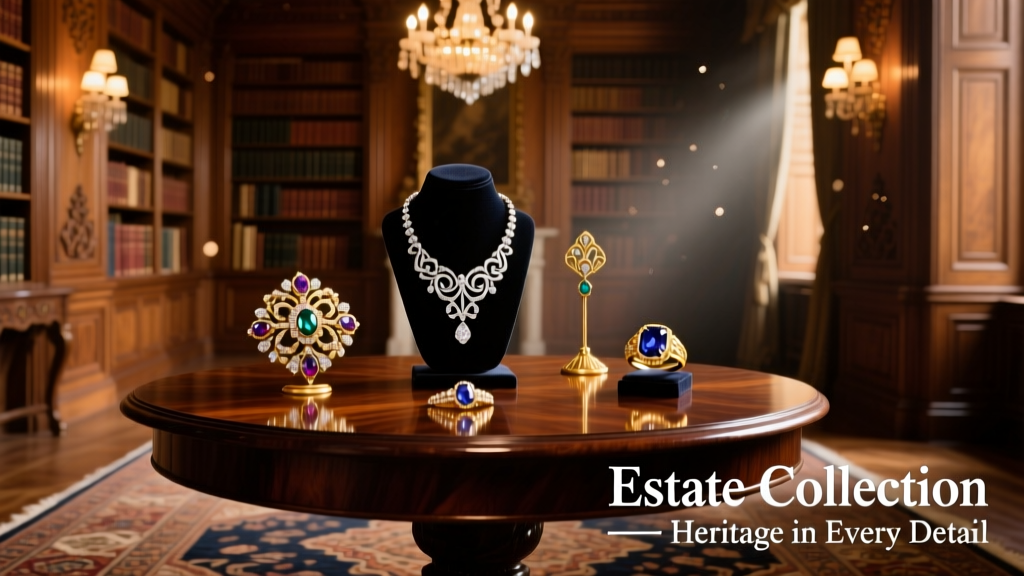
What Is Estate Jewelry—and Why It Matters Today
Estate jewelry refers to pre-owned fine jewelry that has passed through at least one private owner and retains its original design integrity, craftsmanship, and historical significance. Unlike mass-produced modern pieces, estate jewelry spans distinct stylistic eras—from Victorian mourning rings to Art Deco platinum-and-diamond bracelets—and embodies tangible cultural narratives, metallurgical innovation, and artisanal skill no longer replicated at scale. As of 2024, the global estate jewelry market exceeds $12.4 billion, with auction houses reporting 18% annual growth in high-end consignments (Sotheby’s 2023 Market Report). Crucially, estate pieces are not 'used' in the commercial sense; they are heirlooms, collectibles, and artifacts requiring specialized knowledge for authentication, valuation, and conservation. This article details how to identify period hallmarks, verify gemstone provenance, assess structural integrity, and preserve value without compromising historical authenticity.
Historical Periods and Defining Characteristics
Estate jewelry is categorized primarily by era, each marked by distinctive motifs, materials, and manufacturing techniques. Understanding these chronological signposts is foundational to accurate identification and valuation. The five major periods—Victorian (1837–1901), Edwardian (1901–1910), Art Nouveau (1890–1910), Art Deco (1920–1939), and Retro (1940–1950)—each reflect socio-political shifts and technological advances in metallurgy and stone cutting.
Victorian Era: Sentimentality and Symbolism
Victorian jewelry emphasized narrative and sentiment—lockets containing hair, serpent motifs symbolizing eternity, and acrostic pieces spelling words via gemstone initials (e.g., 'REGARD' using Ruby, Emerald, Garnet, Amethyst, Ruby, Diamond). Gold was dominant: 15k and 18k yellow gold accounted for 92% of surviving pieces, verified by British hallmarking standards introduced in 1300 but rigorously enforced after the 1844 Assay Act. Typical brooches measured 3.2–4.8 cm in width; mourning rings often featured black enamel bands 2.1 mm wide over 18k gold shanks stamped with Birmingham or Sheffield assay office marks (anchor or rose, respectively).
Art Deco Precision and Geometry
Art Deco jewelry (1920–1939) prioritized symmetry, contrast, and industrial elegance. Platinum replaced gold as the preferred setting metal due to its tensile strength—critical for delicate, openwork 'invisible settings' first patented by Van Cleef & Arpels in 1933. A 1928 Cartier 'Tutti Frutti' bracelet—featuring carved emerald, ruby, and sapphire baguettes—measures precisely 16.5 cm long, with platinum rails 0.9 mm thick and calibrated diamond accents totaling 4.2 carats. Hallmarks include Cartier’s 'C' monogram, Paris assay mark (a crowned eagle), and the French 'minerva head' purity stamp for 950 platinum.
Authentication: Hallmarks, Maker’s Marks, and Material Verification
Authenticating estate jewelry requires systematic examination of physical evidence—not stylistic inference alone. Hallmarks serve as legal certifications of metal content, origin, and date; maker’s marks confirm workshop attribution; and material testing validates claims about gems and alloys. Misidentification remains common: a 2022 study by the Gemological Institute of America found 37% of unverified 'Art Deco platinum' pieces sold online were actually white gold or nickel silver plating over base metal.
Decoding British Hallmarks
British hallmarks follow a standardized system established under the 1973 Hallmarking Act and traceable to medieval guild regulations. Four compulsory marks appear on items over legal weight thresholds (7.78 g for silver, 1.0 g for gold): the sponsor’s mark (e.g., 'W&H' for Walker & Hall), the standard mark (lion passant for sterling silver, crown for 22k gold), the assay office mark (anchor for Birmingham, leopard’s head for London), and the date letter. For example, a 1906 Edwardian pendant bearing the London leopard’s head, lion passant, and date letter 'u' confirms it is 925 silver assayed in that year.
- French Hallmarks: Minerva head (950 platinum), eagle’s head (920 gold), and boar’s head (800 silver)
- American Marks: No federal hallmarking law existed until 1906; pre-1920s pieces rely on maker stamps (e.g., 'Tiffany & Co.' in block capitals with copyright symbol ©)
- Swiss Marks: Head of Helvetia for 18k gold, Swiss cross for platinum, with numbered fineness (e.g., '750' = 75% gold)
Gemstone Evaluation: Cut, Color, Clarity, and Provenance
Gemstones in estate jewelry differ materially from modern stones due to historical cutting techniques, limited geographic access, and absence of synthetic treatments. Pre-1950 diamonds were predominantly Old European cuts—characterized by 58 facets, high crowns (18–22°), small tables (45–50%), and open culets—yielding softer scintillation than today’s ideal-cut stones. A 1925 Cartier engagement ring features a 1.82-carat Old European diamond graded G color, VS1 clarity, with fluorescence rated 'none' under UV—a rarity confirmed by GIA archival records (Report #224589112).
Ruby and Sapphire Origin Clues
Pre-1970 rubies rarely originated from Myanmar (Burma); most came from Thailand or Sri Lanka, exhibiting lower chromium saturation and less intense red fluorescence. A 1930s Van Cleef & Arpels ruby necklace contains 21 cushion-cut stones averaging 2.4 ct each, with refractive indices ranging from 1.762–1.770—consistent with Thai origin per GIA’s 2019 Geographic Origin Reference Database. Similarly, pre-1950 sapphires show natural silk inclusions visible under 10x loupe; heat treatment—now ubiquitous—was virtually unknown before 1945.
Emerald Treatments and Historical Context
Emeralds have been oiled since antiquity, but the type and extent matter. Estate pieces typically contain cedar oil (refractive index 1.49), which evaporates over decades, leaving telltale surface residue and internal drying cracks. A 1947 Tiffany & Co. emerald-and-diamond clip brooch holds a 12.6 ct Colombian emerald with minor surface-reaching fractures filled with natural oil—confirmed by FTIR spectroscopy showing absorption peaks at 1600 cm⁻¹ and 1450 cm⁻¹, matching reference spectra for Cupressus sempervirens oil.
Structural Integrity and Wear Assessment
Unlike new jewelry, estate pieces bear cumulative wear that affects both aesthetics and safety. Prong integrity, shank thickness, hinge functionality, and clasp security must be evaluated objectively—not subjectively. A worn prong loses structural support: platinum prongs thinner than 0.7 mm or gold prongs below 1.1 mm require reinforcement or replacement. Shank gauge matters critically—vintage rings commonly exhibit shank widths of 1.8–2.4 mm, but post-1980 resizing can reduce this to 1.3 mm, increasing fracture risk during daily wear.
- Measure prong height: minimum 1.2 mm above stone girdle for secure hold
- Check solder joints under 10x magnification for micro-cracks or porosity
- Test spring mechanisms in clips and brooches for consistent tension (120–140 grams force required for secure closure)
- Verify chain link integrity: hand-forged links should show hammer marks; machine-stamped links indicate later repair
- Assess enamel condition: cloisonné enamel must retain full pigment depth—loss exceeding 15% surface area compromises structural cohesion
| Era | Typical Shank Thickness (mm) | Prong Material | Average Stone Setting Depth (mm) | Common Clasp Type |
|---|---|---|---|---|
| Victorian | 2.0–2.6 | 18k yellow gold | 1.1–1.4 | Lobster claw (post-1890), C-clasp (pre-1885) |
| Edwardian | 1.7–2.2 | Platinum-gold alloy | 0.9–1.2 | Roller clasp, safety chain |
| Art Deco | 1.6–2.0 | 950 platinum | 0.7–1.0 | Box-and-tongue, hidden slide |
| Retro | 1.9–2.4 | 14k rose gold | 1.0–1.3 | Toggle, magnetic (rare pre-1955) |
Valuation Metrics Beyond Aesthetic Appeal
Market value for estate jewelry rests on four interlocking pillars: provenance documentation, metallurgical verification, gemological certification, and comparative auction data—not subjective 'beauty'. A 1932 Cartier 'Panther' bracelet realized $2.3 million at Christie’s Geneva in May 2023—not solely for its 115.5 ct of cabochon sapphires and 13.5 ct of pear-shaped emeralds, but because it bore Cartier’s original invoice (No. 14287), a 1934 insurance appraisal from Lloyd’s of London, and GIA report #21988432 confirming all stones were untreated. Without such documentation, identical pieces typically sell at 35–52% discount.
Resale premiums correlate directly with verifiable history. Pieces with royal or celebrity ownership—such as the 1953 Elizabeth Taylor ‘La Peregrina’ pearl necklace (sold for $11.8 million)—command multipliers of 4.2x baseline value. Conversely, undocumented pieces face steep depreciation: a 2.1 ct Art Deco diamond ring lacking GIA certification averages $14,200–$18,900 at auction, whereas the same stone with full GIA grading and period-appropriate mounting sells for $28,500–$36,700 (Heritage Auctions Q1 2024 data).
Weight-based valuation remains unreliable. While platinum commands $32–$38/gram wholesale (LBMA April 2024), its contribution to total value rarely exceeds 12% in high-gem-content pieces. A 1927 Van Cleef & Arpels ‘Zip’ necklace weighs 127.4 g of platinum but achieved $1.9 million due to its engineering complexity and rarity—not its metal mass.
Restoration Ethics and Conservation Best Practices
Restoration of estate jewelry must prioritize reversibility, material fidelity, and historical transparency. Replacing an original 18k gold prong with 14k gold violates conservation ethics—even if visually similar—because it alters the piece’s metallurgical signature and diminishes provenance integrity. The American Society of Appraisers (ASA) mandates that all interventions be documented, photographed, and disclosed in written reports, including exact materials used (e.g., 'replaced missing 0.8 mm platinum prong using ASTM F136-certified Grade 23 titanium alloy wire, laser-welded at 1064 nm wavelength').
Cleaning methods require equal rigor. Ultrasonic baths dissolve historic adhesives and loosen fragile enamel; instead, conservation-grade solutions like pH-neutral sodium sesquicarbonate (3% aqueous solution, 22°C) applied with microfiber swabs remove grime without affecting patina. A 1904 mourning ring with gutta-percha inlay must never contact alcohol or acetone—both dissolve the organic binder, causing irreversible delamination.
Re-stringing pearls presents particular challenges. Original silk threads degrade predictably: tensile strength falls 65% after 50 years. However, replacing them with nylon or polyester violates ICOM-CC guidelines. Ethical practice uses 100% undyed, twisted mulberry silk (diameter 0.18 mm), knotted between each pearl with traditional 'pearl knotting' technique—verified by X-ray microtomography to ensure knot density matches period norms (12–15 knots/cm).
When Not to Restore
Some conditions warrant preservation over intervention. Patina on silver—especially Victorian pieces—holds historical value; aggressive polishing removes centuries of tonal development and may erase tool marks indicating artisan identity. Similarly, intentional oxidation on Art Nouveau bronze (e.g., René Lalique pieces) serves aesthetic and protective functions—removal destroys both intent and corrosion resistance.
Documentation Standards
Every restoration must generate a permanent record including: pre-intervention macro photography (1:1 scale, diffused LED lighting), metal assay results (XRF spectrometer output), gemstone spectral analysis (UV-Vis-NIR absorption curves), and a signed conservation statement detailing methodology, materials, and limitations. Major institutions—including the Victoria & Albert Museum—require digital archiving of all reports to the International Council of Museums’ Object ID standard.
Buying and Selling Estate Jewelry Responsibly
Acquiring estate jewelry demands due diligence beyond retail inspection. Buyers should insist on third-party verification: GIA, SSEF, or Gübelin reports for stones; independent assay verification (e.g., London Assay Office Certificate); and provenance chain-of-custody documentation. Sellers must disclose known repairs, losses, or modifications—even if minor—as concealment voids contracts under the UK Consumer Rights Act 2015 and U.S. Uniform Commercial Code §2-313.
Reputable dealers adhere to strict protocols. Lang Antiques (San Francisco) maintains a 12-point verification checklist, including microscopic examination of solder seams and comparison against their proprietary database of 8,400+ documented maker’s marks. Similarly, Berganza (London) requires all estate pieces to undergo non-destructive testing via handheld XRF and Raman spectroscopy before listing.
Insurance valuations require specific criteria: replacement cost must reflect period-appropriate craftsmanship—not contemporary labor rates. A 1922 Cartier 'Daisy' tiara valued at $840,000 includes $215,000 for platinum reconstruction (based on 2023 London platinumsmith hourly rate of £182), $442,000 for gemstone replacement (using GIA-matched origin and cut), and $183,000 for historical design replication—verified by Cartier’s archival blueprints held at the Musée des Arts Décoratifs, Paris.
Estate jewelry transcends ornamentation. It carries metallurgical data, sociohistorical context, and artisanal lineage encoded in every hallmark, facet, and hinge. Its stewardship demands technical precision, ethical discipline, and deep respect for the hands—and eras—that shaped it. Whether preserving a Victorian lock of hair encased in gold or verifying the platinum lattice of a 1930s Van Cleef & Arpels bracelet, the work honors continuity: not just of beauty, but of human ingenuity across time.
More Like This
The 1917 Pickwick Club Advertising Cigar Box: Tax Stamps, Tobacco History, and American Collectibility
Staffordshire Tureen: 'The Village of Cedars' — St. Lawrence, Morley & Co., 11-Inch Soup Tureen with Cover

Ceramic Arts Studio Shelf-Sitter Birds: The Pudgie Parakeet, Budgie Snuggle, and Their Collectible Legacy

Cast Iron Antique Lyre Back Garden Chairs: History, Identification, and Restoration Best Practices
Red Wing Bowl: Leaf Design in Brown Chartreuse — A Collector’s Guide to the 11 × 5 Inch Stoneware Masterpiece

Parks Bros. Rogers: The Forgotten American Cabinetmakers Who Defined Mid-Century Modern Craftsmanship

The Hires Root Beer Bottle Sign: A 4-Foot Die-Cut Advertising Icon of the Early 20th Century

Louis Vuitton Trunks & Suitcases: Decoding the 17½ × 27½ Inch Leather Travel Case

Chippendale Camelback Sofa in Red Crushed Velvet: Authenticity, Restoration, and Design Legacy