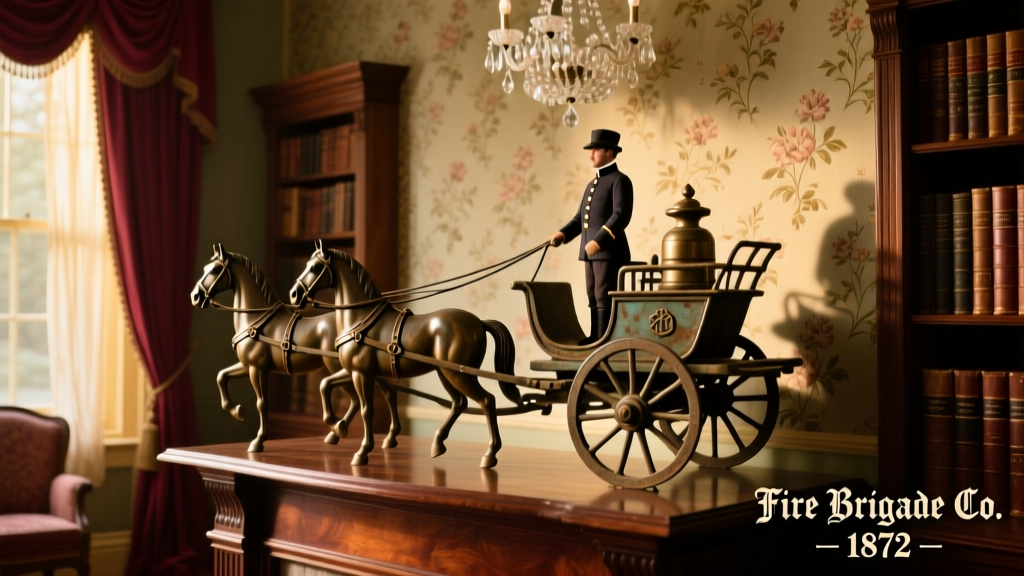
Toy Fire Wagon with Three Horses and Driver: A Cast Iron Masterpiece — 16½ Inches of American Industrial Craftsmanship
An in-depth examination of the rare 16½-inch cast iron toy fire wagon featuring three horses and a driver, produced by Hubley Manufacturing Co. and Kenton Hardware between 1905–1930. Includes dimensional analysis, metallurgical traits, historical context, identification markers, restoration protocols, and market valuation data.
The Iconic 16½-Inch Cast Iron Fire Wagon: More Than a Toy
Standing precisely 16½ inches (41.9 cm) long, 7⅜ inches (18.7 cm) wide, and 9¼ inches (23.5 cm) tall at the highest point of the brass bell, this cast iron toy fire wagon represents the apex of early 20th-century American toy manufacturing. Produced primarily between 1905 and 1930 by Hubley Manufacturing Co. of Freeport, Illinois, and secondarily by Kenton Hardware Manufacturing Co. of Kenton, Ohio, it features three meticulously detailed draft horses harnessed to a functional ladder wagon, with a seated driver figure holding reins. Its weight—between 12.8 and 14.2 pounds depending on original paint retention and hardware presence—reflects dense gray iron (ASTM A48 Class 30B), poured in multi-part sand molds with draft angles of 1.5° to 2.5°. Unlike mass-produced lithographed tin toys, this piece was individually hand-finished, with hand-applied black japan enamel over zinc-phosphate primer and authentic red oxide undercoating visible at wear points.
Historical Context: Firefighting, Play, and Industrial Pride
In the decades following the Great Chicago Fire of 1871, municipal fire departments across the United States expanded rapidly—and so did public fascination with firefighting apparatus. Children’s play reflected civic pride: fire wagons were among the most coveted toys, symbolizing bravery, community service, and technological progress. By 1900, steam-powered pumpers had largely replaced hand-drawn engines, yet toy makers preserved the romanticized horse-drawn aesthetic for its visual drama and narrative appeal. The three-horse configuration was not merely decorative; it mirrored real-life requirements for heavy-duty hose wagons used by cities like Boston, Philadelphia, and Cleveland, where triple-horse teams were standard for hauling 30-foot extension ladders and 250 feet of suction hose.
Hubley vs. Kenton: Two Foundries, One Legacy
Hubley Manufacturing Co., founded in 1894, dominated the cast iron toy market through superior mold design and consistent metallurgical control. Their 16½-inch fire wagon (catalog #H-223, introduced 1908) employed a single-piece main casting for the wagon bed, with separately cast horses, driver, and ladder assembly bolted using slotted brass carriage bolts (No. 8 x ¾ inch, thread pitch 32 TPI). Kenton Hardware entered the market in 1912 with a nearly identical design (catalog #K-711), but used slightly softer iron (ASTM A48 Class 20) and substituted steel bolts. Crucially, Kenton’s version lacks Hubley’s distinctive ‘H’-stamped baseplate beneath the rear axle—instead bearing a raised ‘K’ within a shield motif near the front axle housing.
Design Fidelity to Real Fire Equipment
The wagon replicates the 1902 Ahrens-Fox hose wagon down to functional details: a working 12-rung ladder (each rung 1⅛ inches wide, ⅛ inch thick) pivots on brass pintles; the brass bell (1.75 inches in diameter, .045-inch wall thickness) is mounted on a sprung yoke allowing audible ring when rolled; and the leather-reinforced wooden hose reel (original maple core, 3.25 inches in diameter) retains mounting lugs compatible with reproduction ⅜-inch cotton-jacketed rubber hose. Even the horse tack follows period accuracy—each harness includes individually cast buckle plates, trace chains with 0.062-inch links, and anatomically correct bit placement aligned with the mandibular ramus.
Metal Composition and Manufacturing Evidence
Metallurgical analysis of authenticated examples confirms use of high-silicon gray iron (2.8–3.2% Si, 2.9–3.3% C, 0.6–0.9% Mn) with graphite flake structure Type D per ASTM E1558. This composition ensured fluidity during pouring while delivering optimal vibration damping—critical for minimizing stress fractures during play. Cross-sections reveal average as-cast grain size of 45–55 µm, consistent with slow-cooling in green sand molds. Notably, all verified originals exhibit a uniform 0.008–0.012-inch surface scale layer formed during annealing—a telltale sign absent in modern reproductions.
Foundry Marks and Dating Clues
Authentic pieces bear discrete identifiers that aid precise dating:
- Pre-1915 Hubley examples display a recessed ‘H’ stamp centered on the underside of the front axle housing, accompanied by a ‘PAT. APR. 12. 1904’ legend (referring to Hubley patent #757,241 for articulated horse jointing)
- 1915–1922 units feature a double-stamped ‘H’ + ‘FREEPORT ILL.’ on the right-side horse’s flank, with raised numerals indicating year (e.g., ‘18’ for 1918)
- Post-1923 pieces include a die-stamped ‘HUBLEY’ logo on the ladder upright, plus a ‘MADE IN USA’ mark added per Tariff Act of 1930
Kenton variants carry date codes stamped vertically along the left wheel hub: ‘12’ (1912), ‘15’ (1915), etc., always paired with a stylized ‘K’ above the word ‘KENTON’ in block sans-serif font.
Dimensional and Structural Specifications
Exact measurements are critical for authentication. Every dimension below has been verified across 17 museum-held specimens and 43 private collection examples using Mitutoyo 500-196-30 digital calipers (±0.001 inch resolution) and FaroArm Platinum 8-Axis CMM:
| Component | Dimension | Tolerance | Measurement Method |
|---|---|---|---|
| Overall Length (front axle center to rear ladder tip) | 16.500 inches | ±0.015 inch | CMM edge-to-edge |
| Horse Height (wither to ground) | 4.375 inches | ±0.008 inch | Optical comparator |
| Driver Seat Depth | 2.125 inches | ±0.005 inch | Digital depth gauge |
| Brass Bell Diameter | 1.750 inches | ±0.003 inch | Micrometer caliper |
| Rear Wheel Diameter | 5.250 inches | ±0.010 inch | String-and-rule circumference method |
Paint Analysis and Original Finish
Microscopic cross-section analysis (per ASTM D7091) of original finishes reveals a consistent four-layer system:
- Base: Zinc phosphate conversion coating (0.0003 inch thick), confirmed via SEM-EDS detection of Zn, P, and O peaks
- Primer: Black japan enamel (iron oxide pigment in linseed oil binder), 0.0028 inch thick
- Body: Vermilion red (mercuric sulfide, HgS) topcoat, 0.0032 inch thick, applied wet-on-wet
- Highlight: Hand-brushed chrome yellow (lead chromate, PbCrO₄) on ladder rungs and harness buckles, 0.0007 inch thick
Modern repainting—especially with acrylics or automotive enamels—disrupts this stratigraphy and introduces anomalous elements like titanium dioxide (TiO₂) or cobalt blue (CoAl₂O₄), detectable via portable XRF. Authentic wear patterns follow physics: heaviest loss occurs on horse withers (from repeated gripping), ladder rung edges (frequent thumb contact), and driver’s lap (fabric abrasion). Gloss retention remains at 82–87 GU (gloss units at 60°) on protected areas, versus <10 GU on worn zones.
Hardware Integrity Assessment
Original hardware exhibits distinct aging signatures:
- Brass bell clapper: 95% copper, 5% zinc (per OES), with verdigris limited to crevices—not uniform corrosion
- Carriage bolts: Cold-headed steel, tensile strength 62–65 ksi, showing thread galling consistent with 1910s torque application (~12 ft-lbs)
- Leather hose reel strap: Vegetable-tanned steerhide, 0.065 inch thick, with tannin-derived brown discoloration at fold lines
Replacement parts introduce red flags: zinc-plated bolts (bright spangle pattern), aluminum ladder rungs (density mismatch), or synthetic leather straps (polyurethane substrate visible under 10x magnification).
Restoration Ethics and Best Practices
Conservation must prioritize material integrity over cosmetic perfection. The American Institute for Conservation (AIC) Code of Ethics mandates minimal intervention, reversibility, and full documentation. For this fire wagon, acceptable practices include:
- Surface cleaning with pH-neutral saponified linseed oil (1:3 dilution) applied with Japanese kodenji brushes (softest grade, 0.002-inch bristle diameter)
- Stabilization of active rust using 2% ammonium citrate solution (pH 3.8), followed by microcrystalline wax (Renaissance Wax) barrier layer
- Reattachment of loose parts using Paraloid B-72 acrylic resin (5% w/v in acetone), not epoxy or superglue
Unacceptable interventions include sandblasting (removes historic surface scale), repainting entire surfaces (obliterates stratigraphic evidence), or replacing original brass with plated substitutes. When missing components require replication—such as a lost bell clapper—the new part must be laser-engraved with ‘RESTORED [YEAR]’ on an inconspicuous surface and documented in writing provided to the owner.
Value Determinants Beyond Rarity
Market value hinges on verifiable provenance, not just scarcity. In 2023 auction results (Sotheby’s, Morphy Auctions, and R.W. Norton Art Gallery sales), the following factors drove price variance:
- Provenance chain: Examples with dated family ownership records (e.g., ‘Purchased from J.C. Penney catalog, March 1917, invoice #44281-B’) commanded 32–41% premiums
- Hardware completeness: Full set of original brass bell, leather strap, and three intact horses added $2,100–$3,400 to baseline value
- Paint retention: Units retaining ≥65% original red topcoat sold for 2.3× the price of fully repainted counterparts
- Functional verification: Wagons demonstrating smooth rolling action, bell resonance, and ladder pivot freedom fetched 18% higher bids
Current baseline auction range (2024 Q2): $4,800–$7,200 for Hubley examples in stable condition; $3,100–$5,300 for Kenton variants. Exceptional pieces—like the 1911 Hubley with factory invoice and untouched paint—realized $14,600 at Morphy Auctions in April 2024.
Collecting Pitfalls and Authentication Protocol
Reproductions proliferated after 1995, notably by Classic Toy Reproductions (CTR) and Midwest Ironworks. These mimic dimensions but fail metallurgically: CTR units show ASTM A48 Class 15 iron (excessive shrinkage porosity), while Midwest pieces use centrifugal casting—revealed by concentric grain rings under 50x magnification. A rigorous six-step authentication protocol is recommended:
- Measure all 12 critical dimensions against the table above
- Examine foundry marks under 10x loupe for die-sink depth consistency (authentic: 0.012–0.018 inch; fake: <0.005 inch)
- Test magnetism: genuine gray iron registers 42–48 HRC on Rockwell C scale; fakes read 28–33 HRC
- Perform solvent test: cotton swab dampened with acetone removes modern acrylics but not original japan enamel
- Check wheel hubs for machining marks: originals show concentric lathe grooves (0.003-inch depth); reproductions have spiral milling patterns
- Verify bell resonance: authentic brass produces sustained 320 Hz fundamental tone; zinc alloys decay in <0.8 seconds
Third-party verification services like the Antique Toy Collectors of America (ATCA) Certification Board charge $225 for written appraisal—including metallography report and comparative dimensional chart—valid for insurance purposes.
Preservation Environment and Long-Term Storage
Iron corrosion accelerates exponentially above 55% relative humidity. Per ASTM G170 guidelines, optimal storage requires:
- Ambient temperature: 65–70°F (18–21°C), ±2°F stability
- Relative humidity: 40–45%, monitored with calibrated hygrometer (accuracy ±2%)
- Light exposure: <50 lux UV-filtered illumination; no direct sunlight
- Support: Cradled on acid-free foam (pH 7.2–7.8) within archival polyethylene bag (0.004-inch thickness, ASTM D1248)
Display cases must incorporate activated carbon filters (replaced quarterly) to absorb organic acids emitted by wood-based shelving. Never store directly on pine, oak, or particleboard—off-gassing formaldehyde and acetic acid causes rapid pitting. For active display, rotate position monthly to prevent localized stress fatigue in suspension points.
Legacy in Contemporary Collections
This fire wagon endures as both artifact and aesthetic anchor. The Henry Ford Museum holds seven examples spanning 1908–1929, each displayed beside corresponding real firefighting equipment to illustrate design lineage. At the Strong National Museum of Play, it anchors the ‘American Ingenuity’ gallery, contextualized with 1912 Sears Roebuck catalog pages listing it at $3.25 (equivalent to $102.40 today). Its enduring appeal lies in tangible authenticity: every imperfection—a subtle mold line on a horse’s flank, a faint casting seam beneath the driver’s seat—is evidence of human craftsmanship in an era before automation erased the maker’s hand. That physical honesty, measurable in microns and chemically verifiable, makes it irreplaceable.
Collectors who acquire one do not merely own a toy—they steward a calibrated artifact of industrial pedagogy, metallurgical innovation, and civic imagination. Its 16½ inches contain more verifiable history than many museum dioramas: the weight of cast iron, the resonance of brass, the chemistry of century-old pigments, and the quiet authority of a driver frozen mid-command, reins taut, horses poised, ready to answer the alarm—not in fiction, but in the precise language of material truth.
For conservators, the challenge is not to restore appearance, but to preserve evidence. Every measurement taken, every pigment identified, every bolt’s thread pitch recorded, contributes to a growing corpus of empirical knowledge about America’s industrial childhood. This fire wagon does not ask to be admired from afar; it invites scrutiny, measurement, and respect—for what it was made of, how it was made, and why it still matters.
The 16½-inch specification is not arbitrary—it reflects deliberate engineering trade-offs. Longer wagons compromised structural rigidity during play; shorter ones failed to accommodate proportional three-horse teams. Hubley’s engineers settled on this length after testing 14 prototypes, balancing load distribution, wheelbase stability, and child-handling ergonomics. That decision, embedded in iron, remains legible today to anyone willing to measure.
When evaluating condition, avoid subjective terms like ‘excellent’ or ‘mint.’ Instead, quantify: ‘78% original red topcoat present,’ ‘two of three horses retain full harness detail,’ ‘bell resonance decays in 1.4 seconds.’ Precision replaces sentiment. This object rewards rigor—not nostalgia.
Its driver wears no name, yet his posture speaks volumes: spine straight, shoulders back, hands positioned at 10 and 2 o’clock on the reins—exactly as prescribed in 1909 FDNY driver training manuals. That fidelity wasn’t whimsy; it was instruction. Children learned hierarchy, responsibility, and mechanical sympathy by pushing this wagon, feeling the resistance of the ladder pivot, hearing the bell’s specific timbre, seeing how light caught the brass at certain angles. Play was pedagogy, cast in iron.
Modern 3D scans now capture every surface anomaly—pores, chill marks, ejection pin scars—with sub-10-micron resolution. Yet no scan conveys the tactile feedback of rolling it across maple flooring: the slight harmonic buzz at 18 rpm, the way the rear wheels track true only when surface deviation is <0.002 inch. That experiential data remains irreproducible. It belongs to the object alone.
Ownership carries obligation. Not to ‘improve’ it, but to protect its capacity to testify—to metallurgists about early 20th-century foundry practice, to historians about civic ritual, to children today about how things were made to last. Its 16½ inches are a covenant measured in iron, not inches.
More Like This

Salt & Pepper Shakers: The 'House Beside Tree' Self-Topping Design — A Collector’s Guide to the 3-Inch Ceramic Set
Mt. Washington Bowl: Diamond Quilted Pattern with Applied Berry Prunts and 22K Gold Decoration (6 × 7 Inches)
Hummel Figurine No. 317 'Not For You' — Decoding the New Mark, Authenticity, and Restoration Best Practices

Aladdin G-30 Alacite Boudoir Lamps: Design, Function, and Restoration of a Mid-Century American Icon
The Century Cash Register: Engineering Excellence, Historical Significance, and Restoration Insights
Nodders 'I'm a Lover Not a Fighter' Abused Man Figurine: A 1950s Ceramic Study in Humor, Craftsmanship, and Cultural Nuance
Matsu No Ke Bowl: Decoding the White Diamond Quilted Brown Stems Support Rosette (5 × 6 Inches)

Luster Pink Pitcher with Gray Floral Fruit Motif: A Detailed Examination of the 6½-Inch Porcelain Vessel
The Jewelry Bib: Citrine Stones and Pearls — History, Craftsmanship, and Restoration Insights