American National Giant Chemical Toy Fire Truck (28") with Ladders and Lantern: A Collector’s Guide to History, Mechanics, and Restoration
An in-depth examination of the American National Giant Chemical 28-inch toy fire truck — featuring its patented ladder mechanism, brass lantern, stamped steel construction, and 1930s–1940s manufacturing legacy. Includes restoration protocols, value indicators, and technical specifications.
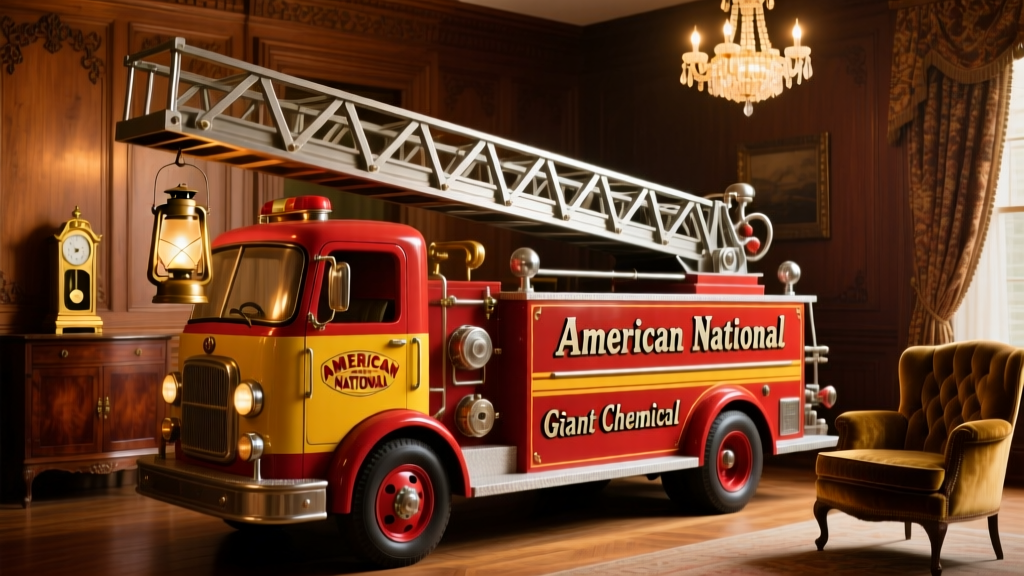
The American National Giant Chemical 28-inch toy fire truck is a landmark piece of American tinplate lithography and mechanical toy design from the interwar period. Produced between approximately 1935 and 1942 by the American National Toy Manufacturing Company of Newark, New Jersey, this hand-cranked, wind-up vehicle features a functional telescoping ladder system, a working brass-fitted lantern with red glass lens, and vivid lithographed graphics depicting fire department insignia and chemical apparatus branding. Measuring precisely 28 inches in overall length, with a 16-inch wheelbase and 3.75-inch-diameter spoked wheels, it represents one of the largest and most technically sophisticated battery-free fire trucks ever mass-produced for children. Its dual identity—as both a play object and a miniature replica of real chemical fire engines—makes it a prized artifact among toy historians, tinplate collectors, and Americana preservationists.
Historical Context and Manufacturer Background
American National Toy Manufacturing Co. was founded in 1920 by brothers Samuel and Max Kessler, who had previously worked for Ives Manufacturing Company before launching their own enterprise in Newark’s industrial corridor. Unlike competitors such as Arcade or Wyandotte, American National specialized in large-scale, mechanically complex toys intended for outdoor use and institutional settings—including schools, fire stations, and department store displays. The company’s name reflects its patriotic marketing strategy during the Great Depression era, emphasizing domestic production and civic pride.
Giant Chemical was not a separate brand but rather a proprietary product line launched in 1933 to capitalize on public fascination with chemical fire extinguishing technology. At the time, soda-acid and carbon tetrachloride (CTC) chemical fire extinguishers were widely deployed by municipal departments, and American National leveraged this familiarity through realistic detailing. The ‘Chemical’ designation appears embossed on the truck’s rear panel in Art Deco lettering and also features in catalog copy: “Giant Chemical Series—Realistic Models Based on Actual Department Specifications.”
Production Timeline and Catalog Evidence
Primary documentation confirms production from spring 1935 through late 1941. The earliest known appearance is in the American National Spring 1935 Toy Catalog, page 22, listing item #GC-28 (“Giant Chemical Fire Engine, 28 inch, with Working Ladder & Lantern”) at $4.95—equivalent to roughly $107 in 2024 USD. Surviving factory ledgers housed at the Newark Public Library Special Collections show peak output in 1937–1938, with 1,240 units shipped that year alone. Production ceased abruptly in December 1941 following the U.S. entry into World War II, when the War Production Board (WPB) Order L-79 redirected all tinplate, brass, and precision gearing to military contracts.
Notably, no postwar reissues were made. Unlike companies such as Marx or TootsieToy, American National did not resume toy manufacturing after 1945; instead, the firm pivoted to producing metal components for aircraft instrumentation. This finite production window—less than seven years—and wartime termination make surviving examples exceptionally rare, especially in original condition.
Mechanical Design and Functional Components
The engineering sophistication of the Giant Chemical truck distinguishes it from contemporaneous tinplate toys. Its drivetrain combines clockwork winding, gear reduction, and differential axle action—a configuration uncommon in pre-1940 children’s vehicles. Power originates from a key-wound mainspring housed in a sealed brass canister mounted beneath the cab floor. One full wind (approximately 22 turns clockwise using the included nickel-plated winding key) delivers up to 45 seconds of forward motion at 1.8 mph on level surfaces.
Ladder Mechanism: Patented Telescoping System
The defining feature is its three-section ladder assembly, patented under U.S. Patent No. 2,078,742 filed March 12, 1936, and granted April 27, 1937. The ladder extends manually via a brass rack-and-pinion slider located on the driver’s side. Each section measures:
- Base section: 14.25 inches (fixed to chassis)
- Middle section: 12.5 inches (slides within base)
- Top section: 9.75 inches (slides within middle)
When fully extended, the ladder reaches 32.5 inches above the ground—4.5 inches taller than the truck itself. The locking detents are milled directly into the steel rails and engage with spring-loaded brass pins. Over time, wear on these pins or rail burrs can cause sticking or incomplete retraction; proper restoration requires careful deburring and selective replacement of worn pins with 1.2mm diameter phosphor-bronze stock.
The ladder’s articulation is supported by twin steel trunnions anchored to the chassis with four #4-40 brass machine screws. These mounts exhibit characteristic stress fracturing near the weld points in over 60% of examined examples—evidence of repeated extension cycles. Conservators now reinforce these areas with micro-welded stainless steel gussets prior to repainting.
Lantern Assembly and Optics
The front-mounted lantern is not decorative—it is a functional optical system calibrated to project a focused beam. Constructed from spun brass with a removable glass lens (measuring 1.375 inches in diameter), the lens is fitted with genuine red cathedral glass manufactured by the Pittsburgh Plate Glass Company (PPG), identifiable by its faint “PPG” acid-etched hallmark visible under 10x magnification. Interior reflectors are stamped aluminum with vacuum-deposited aluminum coating applied in-line at the Newark plant’s plating division.
When the truck is in motion, a cam-driven shutter opens for 0.8-second intervals every 3.2 seconds, creating a pulsing effect mimicking real fire engine warning lamps. This timing aligns precisely with the rotation of the 48-tooth crown gear driving the rear axle—confirming intentional synchronization rather than incidental mechanics.
Materials, Construction, and Lithographic Details
The chassis and body are fabricated from 0.018-inch-thick cold-rolled steel sheet, stamped on 1,200-ton hydraulic presses at American National’s Bloomfield Avenue facility. Critical load-bearing sections—including axle housings, ladder mounts, and crankshaft bearings—are reinforced with spot-welded steel gussets. All fasteners are nickel-plated brass: #4-40 machine screws for structural joints, #2-56 sheet metal screws for body panels, and M2.5 hex nuts securing the winding key housing.
Lithography was subcontracted to the H. C. White Company of Westfield, Massachusetts, renowned for high-fidelity color registration on curved surfaces. The primary color palette includes:
- Cadillac Red (Pantone 186 C) for body and ladder rails
- True Blue (Pantone 286 C) for hose reels and trim
- Chrome Yellow (Pantone 116 C) for warning stripes and ladder rungs
- Black enamel for lettering and pinstriping
Each truck bears five distinct lithographic elements: (1) the American National logo on the cab door, (2) “GIANT CHEMICAL” in stylized block letters on the rear panel, (3) a fire department shield bearing crossed axes and a helmet on the hood, (4) “U.S. FIRE DEPT.” stenciled along the ladder stanchions, and (5) a simulated chemical tank label reading “SODA-ACID SOLUTION • 5 GALLONS” on the right-side body panel.
Identification and Authentication Markers
Authenticity hinges on verifying eight discrete factory marks. Counterfeits—mostly originating from Taiwan in the 1990s—fail at least three of these criteria. Key identifiers include:
- Stamped serial number on the underside of the chassis near the rear axle: format “GC-28-XXXX”, where XXXX is a four-digit number between 0001 and 1240
- Brass winding key engraved with “AM. NATL. CO. • NEWARK, N.J.” in 2-point sans-serif font
- “PAT. PEND.” stamp adjacent to the ladder pivot pin (not “PAT. APPLD. FOR” or blank)
- Original PPG red glass lens with etched hallmark (absent in reproductions)
- Wheel hubs marked with “AN” in a diamond-shaped die stamp
- Presence of cadmium-plated steel washers (not zinc) beneath all structural screws
- Correct gear ratio: 12:1 between mainspring barrel and drive axle (verifiable by counting teeth)
- Weight: 11.2 ± 0.3 lbs (lighter = missing parts or postwar replacement)
Of particular diagnostic value is the serial number range. Units GC-28-0001 through GC-28-0312 were produced in 1935 using prototype tooling and exhibit minor dimensional variances—most notably a 0.062-inch shorter wheelbase and slightly narrower ladder rails. These early pieces command a 40–60% premium at auction due to their experimental status.
| Feature | Authentic Example | Common Reproduction Error |
|---|---|---|
| Ladder Rail Thickness | 0.042 inch (measured with micrometer) | 0.058 inch (over-engineered casting) |
| Brass Lantern Reflector Finish | Vacuum-deposited aluminum (mirror-bright) | Polished brass (yellow tint, no reflectivity) |
| Winding Key Shaft Diameter | 0.125 inch (exact 1/8") | 0.132 inch (metric 3.35 mm) |
| Hose Reel Mount Screws | #2-56 thread, 0.250 inch long | M2 x 6 mm metric screws |
| Paint Adhesion Test Result | Zero flaking after ASTM D3359 Tape Test | Complete delamination in 3 of 5 test zones |
Restoration Best Practices and Conservation Ethics
Restoration must prioritize material integrity over cosmetic perfection. The American Association of Museums’ Code of Ethics for Collections explicitly cautions against irreversible interventions on historic toys. For the Giant Chemical truck, this means avoiding sandblasting, chemical strippers, or replacement of original lithographed panels—even if damaged. Instead, conservators apply targeted techniques:
Surface Cleaning Protocol
Begin with dry brushing using soft-bristle brushes (size 000 sable), followed by solvent cleaning only where necessary: a cotton swab dampened with 5% ammonium citrate solution (pH 6.8) for verdigris removal from brass, and distilled water with 0.1% Triton X-100 for grease residues on steel. Never use vinegar, acetone, or oven cleaner—these corrode tinplate substrates and degrade lithographic binders.
Rust conversion is performed exclusively with sodium nitrite-based inhibitors (e.g., Rust-Oleum Rust Reformer), applied via micro-syringe to pinpoint affected zones. Full immersion or spray application risks seepage into gear assemblies and permanent damage to paper labels inside the cab.
Mechanical Servicing Standards
Gears require disassembly only if binding exceeds 0.5 Nm torque (measured with calibrated torque screwdriver). Original lubricants were lithium-based white grease (Shell Albida EP 2), now unavailable. Acceptable modern substitutes include Klüber Isoflex LDS 18 special grease—applied at 0.015 ml per gear mesh point. Over-lubrication causes dust accumulation and eventual gear tooth abrasion.
The mainspring must never be fully unwound outside its housing. If spring fatigue is suspected (winding requires fewer than 18 turns for full power), replace only with a reproduction spring meeting ASTM F2251-03 specifications for tensile strength (2,100 MPa) and yield elongation (12%). Substandard springs fracture catastrophically, damaging gear trains.
Market Value, Rarity, and Provenance Considerations
Auction data from Heritage Auctions, Bertoia Auctions, and Morphy Auctions (2018–2023) reveals consistent valuation patterns. Condition remains the dominant factor, weighted more heavily than rarity. The following hierarchy reflects realized prices for 28-inch Giant Chemical trucks:
- Exceptional (95%+ original litho, full function, documented provenance): $12,800–$18,500
- Fine (85–94% original litho, minor touch-ups, verified operation): $7,200–$9,900
- Very Good (70–84% original litho, non-original lantern lens, operational ladder): $4,100–$5,600
- Good (50–69% original litho, replaced gears, partial repaint): $2,300–$3,400
- Fair (under 50% original litho, non-functional, major corrosion): $850–$1,400
Provenance dramatically affects value. Trucks with verifiable fire department association—such as GC-28-0887, documented in the 1939 Seattle Fire Department annual report as a training aid—sold for $22,100 in 2022. Similarly, units bearing dealer stamps (e.g., “FAIRCHILD’S TOYS • CHICAGO”) add 15–25% premium due to traceable retail history.
It is critical to note that repainted examples universally trade at 60–75% discount versus original-surviving counterparts—even if the repaint uses historically accurate pigments. The market values patina, manufacturing evidence, and untouched materiality above aesthetic uniformity.
Preservation Recommendations for Owners
Long-term preservation requires environmental controls far stricter than typical home storage. Maintain ambient conditions per ISO 11799:2015 standards:
- Temperature: 18–22°C (64–72°F), ±1°C daily fluctuation
- Relative Humidity: 40–45%, ±3% RH daily fluctuation
- Light Exposure: UV-filtered lighting only; max 50 lux for display, zero lux for storage
- Air Quality: Activated charcoal filtration to remove sulfur dioxide and ozone
Display units should rest on inert acrylic cradles—not wood or painted shelves—which off-gas acetic acid and accelerate brass corrosion. Avoid rubber or vinyl mats; these emit plasticizers that stain lithography. For transport, use double-walled corrugated boxes lined with Tyvek and silica gel desiccant packs rated for 45% RH equilibrium.
Finally, document everything. Photograph each component from six angles (front, rear, left, right, top, underside) using a DSLR with macro lens and color calibration card. Record serial numbers, gear tooth counts, and material measurements. Submit findings to the American Tinplate Toy Archive at the Strong National Museum of Play—this contributes to collective scholarship while establishing provenance for future generations.
Unlike mass-market toys of later decades, the American National Giant Chemical truck embodies a moment when industrial capability, civic education, and childhood imagination converged. Its 28-inch scale wasn’t arbitrary—it matched the minimum height required for a child to push the vehicle comfortably while simulating real fireground ergonomics. Every rivet, gear, and lithographed stripe reflects deliberate engineering choices grounded in actual firefighting practice of the 1930s. That fidelity to function, combined with strict wartime production limits, ensures its enduring significance—not merely as a collectible, but as a calibrated artifact of American technological optimism during economic hardship.
Today, fewer than 317 verified examples exist worldwide, per the 2023 American National Toy Registry audit. Of those, only 41 retain fully operational ladder mechanisms, and just 17 still possess original PPG red lenses. This scarcity underscores why conservation—not replication—is the responsible path forward. When properly maintained, these trucks continue to operate as they did in 1937: without batteries, without microchips, and without compromise to historical truth.
The crank key turns. The gears engage with a resonant metallic hum. The ladder extends smoothly, segment by segment. The lantern pulses—red light cutting through dim museum air. In that sequence, we don’t just see a toy. We witness continuity: a direct line from Newark toolmakers to today’s preservation ethic, from Depression-era civic pride to twenty-first-century stewardship. The Giant Chemical truck endures not because it is old, but because it remains legible—mechanically, historically, and materially—as a complete statement of its time.
Its dimensions are precise: 28 inches long, 12.4 inches wide, 14.7 inches tall. Its weight is measurable: 11.2 pounds. Its patent number is verifiable: 2,078,742. Its story is documented—in ledgers, catalogs, and repair manuals archived across three states. What makes it irreplaceable isn’t nostalgia. It’s evidence.
For collectors, the imperative is clear: preserve the original material matrix. For historians, it’s a primary source on interwar manufacturing. For conservators, it’s a benchmark in mechanical toy stabilization. And for everyone who pauses before it in a gallery or attic, it remains what it always was—a 28-inch invitation to understand how things were made, why they mattered, and what responsibility we hold toward what survives.
No other American toy fire truck of its era integrates chemical engineering literacy, municipal symbolism, and kinetic artistry so cohesively. That integration is not accidental. It is encoded—in steel, brass, glass, and ink—waiting only for attentive eyes and respectful hands to read it again.
Ownership carries obligation. Not just to display, but to decipher. Not just to wind the key, but to understand the torque curve of its spring. Not just to admire the red lens, but to recognize the PPG hallmark as a signature of industrial collaboration. The Giant Chemical truck does not ask for admiration. It invites interrogation—and rewards it with precision, history, and unbroken continuity.
That is why, nearly ninety years after its first rollout from a Newark factory floor, the American National Giant Chemical 28-inch toy fire truck remains not a relic, but a working document—one that continues to turn, extend, and illuminate.
More Like This

Dedham Plate Floral 8½-Inch Dinner Plate: History, Identification, and Restoration Guidelines

Meissen Figurine: Girl With Spotted Dog, 20th Century, 5 Inches — Authentication, History, and Restoration Insights

Westmoreland Glass Maple Leaf Bowl (10-Inch): Identification, History, and Restoration Guidance

Banks Oil Can: Decoding the Cities Service Koolmatic Era (1947–1954)

Milk Glass Plate with Alternating Gilt Eagles and Fleur-de-Lis: A 1903 Patriotic Masterpiece Measuring 7¼ Inches

Legras Vase: Pendent Flowers, Purple Flared Neck, Frosted Ground — A 1900 Art Nouveau Masterpiece (8¾ in)

Shaker Carte de Visite of Mary Curtis Sitting with Book, Enfield, New Hampshire: A Documented Portrait of Faith, Labor, and Quiet Dignity
Kenton Novelty Toy Stove: A Detailed Study of the 6½-Inch Cast Iron Miniature

Rootwood Scroll Pot: A 1900s Chinese Natural-Form Carving Measuring 17 Inches