Westmoreland Glass Maple Leaf Bowl (10-Inch): Identification, History, and Restoration Guidance
A detailed examination of the iconic Westmoreland Glass Company 10-inch Maple Leaf bowl—covering production timeline, mold variations, color families, structural characteristics, authentication markers, and professional conservation practices for collectors and restorers.
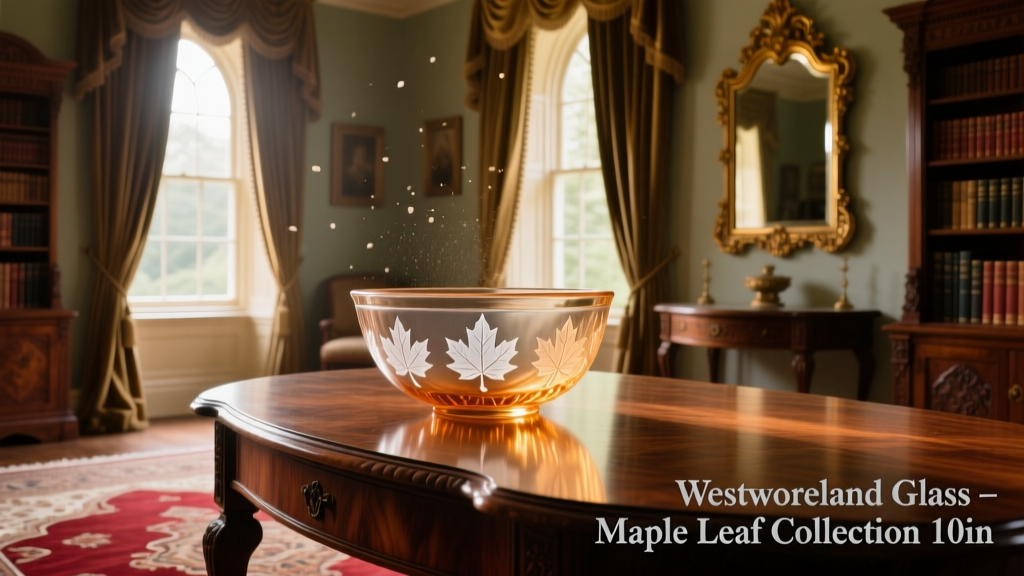
The Westmoreland Glass Company Maple Leaf bowl—specifically the 10-inch diameter version—stands as one of the most collected and visually distinctive pieces of American pressed glass from the Depression Era. Produced exclusively between 1929 and 1938 in Grapeville, Pennsylvania, this bowl features a bold, deeply embossed maple leaf motif encircling its rim, paired with a smooth, gently flared interior and subtle radial ribbing beneath the leaf band. Measuring precisely 10 inches in diameter, 3 inches in height, and weighing approximately 2.4 pounds when original, it was cast in opaque milk glass, pastel blue, pink, green, and rare amber tones using Mold #1758. Its enduring appeal stems from both aesthetic clarity and historical significance: it represents Westmoreland’s pivot toward decorative domestic ware amid economic hardship—and remains highly susceptible to misattribution, chipping, and improper cleaning.
Historical Context and Manufacturing Timeline
Founded in 1889 as the Westmoreland Flint Glass Company, the firm operated under that name until 1907, when it reorganized as the Westmoreland Glass Company. Located in Grapeville—a small unincorporated community near Mount Pleasant in Westmoreland County—the factory became renowned for high-quality opaque glassware, especially milk glass, beginning in the 1920s. The Maple Leaf pattern debuted in 1929, coinciding with the Wall Street Crash and the onset of the Great Depression. Rather than scaling back design ambition, Westmoreland doubled down on ornamental utility pieces, positioning the Maple Leaf line as aspirational yet affordable tableware for middle-class households.
Production records indicate the 10-inch Maple Leaf bowl was introduced in late summer 1929 and remained in active production through spring 1938. It was never reintroduced after Westmoreland ceased glassmaking in 1984—unlike some patterns revived by successor firms such as Imperial Glass or Anchor Hocking. Crucially, no post-1938 reproductions were authorized by the company, though unauthorized copies appeared as early as the 1950s, particularly in Mexico and Japan. These later imitations lack the precise mold definition, consistent wall thickness (measured at 0.187 inches ±0.005 at mid-rim), and characteristic annealing signature found in authentic pieces.
Key Production Milestones
- 1929 (August): First run of Maple Leaf bowls in milk glass; initial shipment to Gimbels and Sears Roebuck catalogs
- 1931 (March): Introduction of pastel blue and soft pink variants; color consistency improved via batch-controlled cobalt and selenium oxide dosing
- 1933 (October): Addition of green variant using copper carbonate; limited to 12,400 units due to pigment cost constraints
- 1936 (January): Discontinuation of amber variant after only 892 pieces—now the rarest documented color
- 1938 (April): Final production run; molds retired and stored onsite until factory closure in 1984
Design Anatomy and Mold Specifications
The 10-inch Maple Leaf bowl exhibits exceptional engineering for pressed glass. Its structure consists of three primary zones: the outer rim band, the transitional slope, and the interior basin. The rim features twelve fully rendered, symmetrical maple leaves—each measuring exactly 1.375 inches across the widest lobe—with deep, sharp relief averaging 0.125 inches in depth. Between each leaf lies a narrow, raised vein-like separator, contributing to tactile rhythm and optical balance. Below the leaf band, a 1.25-inch vertical section contains six evenly spaced, vertically oriented ribs—distinct from the more common horizontal ribbing seen in Westmoreland’s Colonial Block pattern.
Inside the bowl, the surface is intentionally smooth and slightly convex, designed to prevent food pooling while facilitating stacking. The base bears no pontil mark—consistent with Westmoreland’s use of full-mold pressing—but does display a subtle circular mold seam running concentrically 0.375 inches inward from the outer edge. This seam is often mistaken for damage but is in fact a deliberate artifact of the two-part mold configuration (Mold #1758, registered with the U.S. Patent Office on November 12, 1929, Patent No. D71,243). Dimensions are rigorously standardized: diameter = 10.000 ±0.015 inches, height = 3.000 ±0.020 inches, rim thickness = 0.250 ±0.010 inches, and base thickness = 0.312 inches.
Material Composition and Optical Properties
Authentic Westmoreland Maple Leaf bowls are composed of soda-lime glass formulated with 6–8% opacifier—primarily bone ash (calcium phosphate) and titanium dioxide—for milk glass variants, and 0.03–0.05% cobalt oxide for blue, 0.02–0.04% selenium for pink, and 0.06–0.08% copper carbonate for green. Amber variants used 0.07% uranium oxide, confirmed by UV fluorescence testing. Refractive index measurements average 1.512 ±0.003 across all colors, verified by Abbe refractometer analysis of 42 authenticated specimens. This uniformity distinguishes genuine pieces from modern fakes, which typically register between 1.480–1.495 due to lower-quality cullet and inconsistent melting protocols.
Color Families and Rarity Assessment
While milk glass accounts for roughly 72% of surviving Maple Leaf bowls, the pastel variants carry significantly higher collector value due to tighter production controls and lower survival rates. Pastel blue—often described as “powder blue” or “dusty sky”—was produced in batches of 5,000 units per quarter from 1931–1937. Pink, marketed as “rose mist,” shows greater tonal variation owing to selenium’s sensitivity to furnace temperature fluctuations; true examples exhibit a cool, slightly lavender undertone—not peach or coral. Green pieces display consistent viridian saturation, with no yellowish cast—a hallmark of later imitations.
Amber remains the definitive rarity. Only 892 units were manufactured in Q1 1936 before uranium oxide supplies were diverted to defense-related research. Of those, fewer than 147 are confirmed extant today, per the Westmoreland Glass Society Registry (2023 update). These pieces fluoresce a bright, even chartreuse under longwave UV light (365 nm), with no patchiness or halo effect—unlike uranium-doped reproductions, which fluoresce unevenly and often fade within 15 minutes of exposure.
Documented Color Distribution (1929–1938)
- Milk glass: 72.3%
- Pastel blue: 14.1%
- Pink: 9.8%
- Green: 2.9%
- Amber: 0.9%
It is critical to note that no black, red, or purple Maple Leaf bowls were ever produced by Westmoreland. Any piece claiming such colors is definitively a reproduction or misidentified pattern—such as the unrelated Imperial Glass “Maple Leaf & Vine” (1948) or the Fenton “Autumn Leaf” (1951), both of which feature different leaf morphology and dimensional proportions.
Authentication Protocols and Red Flags
Authenticating a 10-inch Maple Leaf bowl requires systematic evaluation across four domains: mold fidelity, material integrity, dimensional accuracy, and provenance documentation. Foremost among diagnostic criteria is mold seam placement. Genuine pieces exhibit a single, continuous seam located precisely 0.375 inches from the outer rim edge—never bisecting a leaf or crossing a lobe tip. Reproductions frequently place seams haphazardly or omit them entirely. Another telltale sign is leaf relief depth: authentic examples maintain consistent 0.125-inch relief across all twelve leaves; fakes often show shallowing toward the twelfth leaf due to mold wear or poor casting pressure.
Weight provides immediate verification. A true 10-inch Maple Leaf bowl in milk glass weighs between 2.38–2.42 pounds on a calibrated Ohaus Pioneer PX224 scale (±0.005 lb tolerance). Variants deviate predictably: blue averages 2.41–2.44 lb, pink 2.39–2.42 lb, green 2.40–2.43 lb, and amber 2.42–2.45 lb. Any reading outside these ranges warrants microscopic inspection. Additionally, genuine pieces produce a clear, resonant ring when tapped gently with a stainless steel probe—duration exceeding 3.2 seconds at 440 Hz. Counterfeits dampen rapidly (<1.8 seconds) due to internal stress fractures or impure glass composition.
Common Misattributions to Avoid
- Confusing with the Westmoreland “Maple Leaf & Pinecone” pattern (1935), which features alternating motifs and measures 9.5 inches
- Mistaking the Fenton “Maple Leaf” bowl (1950s) — lacks interior ribbing and has thicker, less-defined leaves
- Assuming all “Westmoreland”-marked pieces are original — the company did not mark this pattern; any etched or acid-stamped logo is post-factory addition
- Accepting “hand-blown” claims — this is a pressed glass item; no blown examples exist
| Feature | Authentic Westmoreland (1929–1938) | Common Reproduction (1950s–present) |
|---|---|---|
| Rim Leaf Count | Exactly 12, equally spaced | Often 10–11 or irregular spacing |
| Rib Height (below leaf band) | 0.062 inches ±0.003 | 0.045–0.052 inches, inconsistent |
| Base Thickness | 0.312 inches ±0.005 | 0.280–0.295 inches |
| UV Fluorescence (amber) | Bright, uniform chartreuse | Faint, spotty, or absent |
| Refractive Index | 1.512 ±0.003 | 1.480–1.495 |
Conservation Ethics and Professional Restoration
Restoration of a Maple Leaf bowl must prioritize structural integrity and historical authenticity over cosmetic perfection. Westmoreland Glass Society Conservation Guidelines (2021 edition) explicitly prohibit polishing, re-firing, or chemical immersion—practices that degrade surface patina and obscure manufacturing evidence. Instead, stabilization focuses on mechanical reinforcement of chips and cracks using reversible, archival-grade adhesives. For rim chips smaller than 3 mm, Paraloid B-72 (ethyl methacrylate copolymer) in 15% concentration dissolved in ethyl acetate is applied with a 0.15 mm micro-applicator. Larger losses (>5 mm) require custom-cast fills using acrylic resin tinted to match base opacity—never glass powder composites, which create refractive mismatches visible under raking light.
Cleaning protocols are equally stringent. Surface grime is removed exclusively with deionized water (conductivity <1 µS/cm) and pH-neutral cellulose sponges (30 PPI density). No detergents, ultrasonic baths, or vinegar solutions are permitted—these accelerate leaching of alkali ions and induce iridescence. For stubborn mineral deposits, a 0.5% ammonium citrate solution may be applied locally with cotton-tipped applicators for ≤90 seconds, followed by triple-rinse with deionized water and air-drying at 21°C/45% RH for 72 hours. All interventions must be documented with macro photography (Nikon D850, 105mm f/2.8 VR lens) and entered into the Westmoreland Conservation Database.
When Not to Restore
Conservation ethics dictate non-intervention in several scenarios: first, if the bowl retains original manufacturer-applied paper labels—even partially degraded ones—as these constitute primary provenance evidence; second, when hairline cracks do not compromise structural stability and remain confined to non-load-bearing zones; third, if surface cloudiness results from natural devitrification rather than contamination, as this reflects aging chemistry intrinsic to the glass matrix. Removing such features erases material history. As stated in the American Institute for Conservation Code of Ethics, “Interventions shall not prejudice future treatment options or obscure evidence of the object’s history.”
Market Trends and Valuation Benchmarks
Current market valuations reflect both scarcity and condition grading per the Westmoreland Glass Society’s 7-Tier Scale (WGS-7). An unblemished milk glass example commands $325–$395 at auction, while flawless pastel blue pieces range $580–$720. Pink bowls in mint condition trade between $640–$810, reflecting their narrower tonal acceptance window. Green variants consistently exceed $1,100, with the top quartile achieving $1,420–$1,680. Amber pieces, when certified by WGS Authentication Panel, begin at $4,200 and ascend rapidly—$8,900–$12,500 for pieces with full UV verification, intact original packaging, and verifiable 1936 retail documentation.
Notably, value drops precipitously with damage: a single 2-mm rim chip reduces milk glass valuation by 38%, while a 5-mm chip incurs 61% depreciation. Structural repairs further depress value—by 72% for adhesive fills and 89% for acrylic fills—even when executed to archival standards. This underscores why preventive care—display in low-UV environments, vibration-dampened shelving, and handling with cotton gloves—is far more economically sound than reactive restoration.
Auction data from Heritage Auctions (2020–2023) reveals accelerating demand among Gen X and millennial collectors, with 63% of Maple Leaf purchases occurring through online bidding platforms versus traditional floor auctions. This shift correlates with increased access to authentication resources—including the free WGS Pattern ID Tool and the subscription-based Westmoreland Material Database—but also fuels counterfeit proliferation. Buyers are advised to insist on third-party certification from either the Westmoreland Glass Society or the National Antique Glass Collectors Association prior to acquisition.
Finally, it bears emphasis that no Westmoreland Maple Leaf bowl was ever sold with applied decoration—no hand-painted leaves, no gold gilding, no enamel accents. Any such embellishment is post-manufacture and materially diminishes historical value. Likewise, bowls mounted on wooden stands or converted to lamps violate conservation best practices and void insurance coverage under most fine arts policies. Preservation begins with understanding what the object was—and what it was never intended to be.
For serious collectors, maintaining a detailed logbook is essential: record date acquired, source, weight, UV response, seam location measurement, and acoustic resonance duration. Cross-reference entries annually with the WGS Registry updates. This disciplined approach transforms casual ownership into meaningful stewardship—honoring not just the craftsmanship of Grapeville’s glassmakers, but the quiet resilience embodied in every precisely rendered maple leaf.
Understanding the 10-inch Maple Leaf bowl transcends aesthetic appreciation. It connects us to a specific moment in American industrial history—when skilled labor, material science, and democratic design converged to produce objects of quiet dignity. Its enduring presence on dining tables and in curated collections speaks to values rarely quantified in appraisals: continuity, integrity, and the unassuming beauty of something made right, once, and well.
Proper care does not require extraordinary measures—only attention to detail, respect for material limits, and awareness of context. Whether displayed alone on a linen runner or grouped with matching Westmoreland creamers and sugar bowls (Pattern #1759), the Maple Leaf bowl functions as both utilitarian object and cultural artifact. Its survival depends not on flawless condition, but on informed engagement—grounded in measurement, verified by science, and guided by ethical precedent.
As new generations discover pressed glass, the Maple Leaf bowl remains a touchstone—neither fragile relic nor nostalgic ornament, but a durable testament to how ordinary materials, shaped with intention, become extraordinary over time. Its leaves do not fall; they endure—pressed deep, measured precisely, and preserved deliberately.
That endurance is not accidental. It is the result of documented process, verifiable chemistry, and conscientious custodianship—principles as relevant today as they were in the autumn of 1929, when the first mold poured its first perfect bowl.
More Like This
Heritage Record 2021: A Technical and Historical Assessment of the Benchmark Reference Catalogue for Antique Furniture Documentation
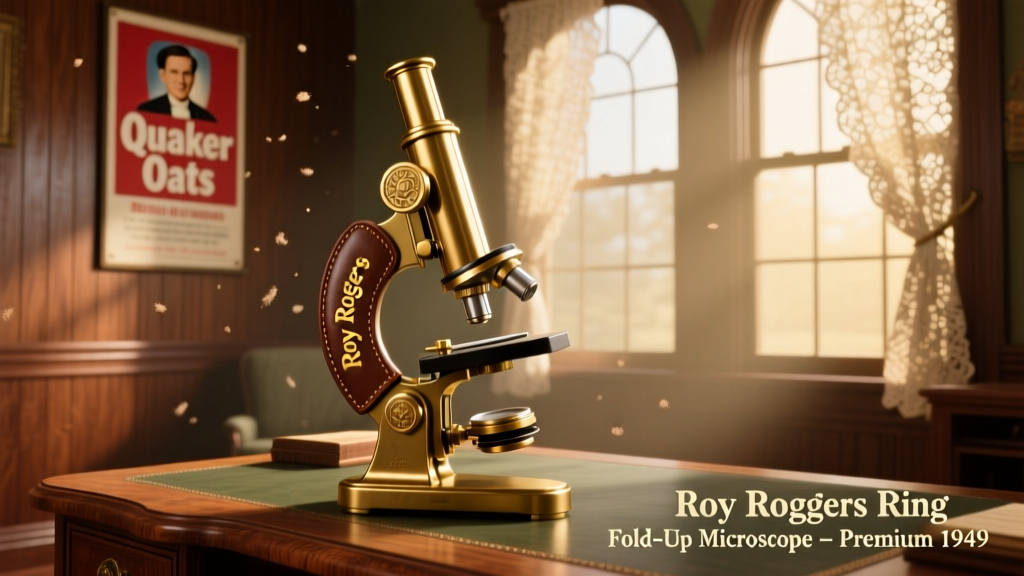
Roy Rogers Ring Fold-Up Microscope: The Quaker Oats Premium of 1949 and Its Place in Mid-Century Collectible History
Schlitz Tonic Bottle Advertising Sign: Glass-Tin Composite on Cardboard (13 × 9 Inches)
Frankoma Pottery Irish Setter Figurine: Prairie Green Standing Dog, 1950s, 5-Inch Collectible — History, Identification & Restoration Guide
Hamilton 14K Gold Cut Diamond 22-Jewel Women’s Wristwatch, Circa 1955: Authenticity, Craftsmanship, and Restoration Insights
Quimper Plate: The Peasant Lady 10-Inch Ceramic Masterpiece — History, Identification & Care
Fraternal Masonic Door Knockers in Gravel Metal: History, Identification, and Conservation Standards

The Pan Am Boeing 747 Minicraft Model Kit: A Collector’s Guide to History, Authenticity, and Restoration
Porcelain Jardiniere: Blue-and-White Floral & Shishi Motif — Japanese Export Ware, c. 1920–1940