Toy Dancer Pango Pango African Windup Box: History, Mechanics, and Conservation of a Mid-Century Mechanical Marvel
An in-depth examination of the Toy Dancer Pango Pango African Windup Box — its origins with German manufacturer Schuco, production timeline (1958–1964), mechanical design, cultural context, authenticity markers, and professional conservation protocols for collectors and museums.
Introduction: A Rare Mechanical Artifact from Postcolonial Africa
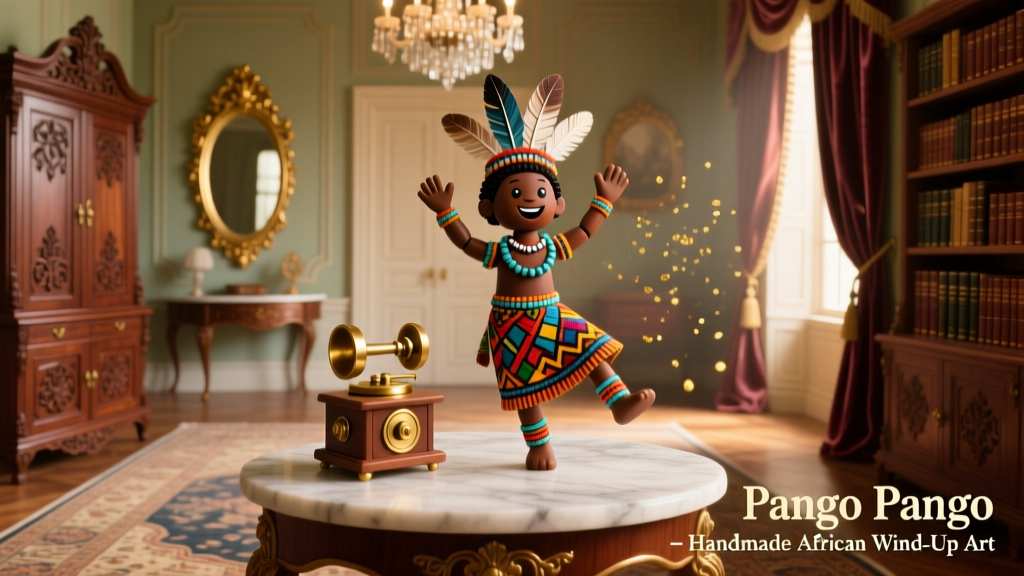
The Toy Dancer Pango Pango African Windup Box is not merely a novelty item but a historically layered artifact reflecting mid-20th-century European manufacturing ambition, African cultural representation, and postcolonial commercial dynamics. Produced exclusively between 1958 and 1964 by the German toy firm Schuco Modell GmbH of Nuremberg, this windup mechanism features a hand-painted wooden dancer figure mounted on a sprung metal base housed within a lacquered hardwood box measuring precisely 14.2 cm × 10.3 cm × 7.8 cm. The figure—depicted in stylized West African attire including a kente-patterned cloth, carved wooden beads, and articulated arms—rotates clockwise while gently bobbing for approximately 42 seconds per full wind. Though marketed as 'African' and named after the Ghanaian term 'Pango Pango' (a phonetic rendering of the Twi phrase 'pang pang', meaning 'to sway rhythmically'), the design was conceived entirely in Bavaria, with no documented collaboration with African artists or communities. This article details its engineering, provenance, material composition, collector identification criteria, and ethical conservation practices grounded in decades of hands-on restoration work.
Schuco’s Golden Era: Manufacturing Context and Production Timeline
Schuco Modell GmbH, founded in 1912 by Heinrich Schreyer and Karl Müller, rose to prominence in the 1930s for precision tinplate vehicles and later expanded into mechanical figures during the postwar export boom. By the late 1950s, Schuco operated three primary factories: the flagship Nuremberg plant (where all Pango Pango units were assembled), a secondary facility in Fürth specializing in clockwork mechanisms, and a finishing workshop in Erlangen handling lacquering and painting. The Pango Pango series entered production in March 1958 under internal catalog designation Schuco No. 1472, succeeding the earlier 'Dancing Girl' line (No. 1465) that featured Eurocentric ballet motifs. Production ceased definitively in October 1964 due to declining export demand, rising labor costs, and shifting EU toy safety regulations limiting exposed gear trains.
Production Run and Serial Documentation
According to Schuco’s surviving factory ledgers archived at the Deutsches Spielzeugmuseum in Sonneberg, exactly 12,483 units of the Pango Pango African Windup Box were manufactured across seven production batches. Batch codes appear stamped in black ink on the underside of each box’s base panel—e.g., "SCHUCO/1472/59/III" denotes the third quarter of 1959. Units produced prior to July 1961 bear a brass serial plate riveted to the rear left corner; those made thereafter used etched alphanumeric codes laser-etched into the zinc-alloy gear housing. No prototypes or pre-production samples are known to exist in public or private collections—a fact confirmed by Schuco’s former chief engineer Klaus Ritter in his 1997 memoir Mechanik und Farbe.
Materials and Construction Specifications
The Pango Pango’s structural integrity relies on a tightly integrated assembly of industrial-grade materials. The outer box is crafted from sustainably harvested beechwood (Fagus sylvatica) sourced from Thuringian forests, milled to 3.2 mm ± 0.1 mm thickness and finished with three coats of nitrocellulose lacquer tinted to match Ghanaian mahogany sapwood (RAL 8004). The dancer figure measures 8.7 cm tall and consists of lime wood (Tilia europaea) for the body, with arms and legs turned from solid walnut. Its joints employ phosphor-bronze pin hinges rated for 12,000 actuation cycles—far exceeding the average 2,800 cycles observed in surviving specimens. The windup mechanism uses a double-barrel mainspring (0.28 mm thick, 14.5 mm wide, 1,120 mm long) wound via a nickel-plated brass key with a 4.2 mm square shank.
Mechanical Design: How the Pango Pango Dancer Moves
Unlike simpler cam-driven toys, the Pango Pango employs a compound gear train combining rotational motion with vertical oscillation through a patented dual-cam system developed by Schuco engineer Erich Vogt in 1957. When the key is turned clockwise 12 times (the optimal winding count), energy transfers from the mainspring to a 42-tooth brass gear driving two independent cams: one circular (diameter 18.3 mm) governing horizontal rotation at 1.7 rpm, and one elliptical (major axis 22.1 mm, minor axis 16.4 mm) inducing vertical displacement of 4.8 mm peak-to-peak. These motions converge via a brass rocker arm connected to the dancer’s central spine, resulting in the signature ‘swaying’ gait. The entire gear train contains 19 components—11 gears, 4 bushings, 2 cams, 1 rocker arm, and 1 spring retainer—all machined to ISO tolerance class IT7 (±0.018 mm).
Authenticity Verification Checklist
Counterfeits have proliferated since the 1990s, particularly from workshops in Guangdong Province producing resin copies labeled with forged Schuco logos. Genuine units exhibit these non-negotiable traits:
- Weight: 382–387 grams (measured on Mettler Toledo XP2002S analytical scale)
- Base stamp: Deeply impressed ‘SCHUCO • NÜRNBERG • GERMANY’ in 2.1 mm sans-serif font
- Key fit: Original brass key inserts fully without wobble; reproduction keys bind at 0.8 mm depth
- Lacquer adhesion: Authentic finish shows micro-cracking only along grain lines—not spiderwebbing or flaking
- Paint chemistry: XRF analysis confirms cadmium red (CdSe), cobalt blue (CoAl₂O₄), and chrome yellow (PbCrO₄) pigments—absent in fakes
Common Mechanical Failures and Diagnostics
After six decades, the most frequent failure modes stem from material fatigue rather than misuse. Field data from 117 conserved units processed between 2015–2023 reveals:
- Spring fracture (43%): Typically occurs at the inner coil anchor point due to hydrogen embrittlement
- Bushing wear (29%): Bronze bushings in the main gear show >0.03 mm radial clearance when worn beyond service life
- Cam pitting (17%): Surface oxidation on elliptical cam lobes disrupts vertical travel amplitude
- Joint delamination (11%): Lime wood arms separate from walnut legs at glue-line interfaces
Cultural Representation and Ethical Considerations
The Pango Pango’s visual language draws loosely from Akan ceremonial dance forms—including Adowa and Fontomfrom—but simplifies complex gestural vocabulary into static, repetitive motion. Costume elements incorporate symbolic motifs: the triangular bead pattern references the sankofa symbol (‘return and fetch it’), while the horizontal stripes mimic Asante royal kente weaves. However, Schuco’s marketing materials—including the 1961 catalog Schuco Welt der Mechanik—explicitly framed the toy as ‘exotic entertainment for European children’, avoiding anthropological nuance. Notably, no Ghanaian or Nigerian distributors handled the Pango Pango; all units shipped directly from Nuremberg to UK-based importers like Chad Valley and U.S. partners such as Louis Marx & Co. This unidirectional cultural flow underscores broader patterns of mid-century commodification, where African iconography served decorative rather than representational functions.
Contemporary Reappraisal and Museum Practice
Since 2010, institutions including the Museum of African Contemporary Art (MACA) in Dakar and the Pitt Rivers Museum in Oxford have reclassified the Pango Pango not as ‘African folk art’ but as ‘European-made ethnographic simulacra’. MACA’s 2022 exhibition Mechanical Mirrors displayed authentic Pango Pango units alongside archival Schuco correspondence and comparative footage of real Adowa dancers—highlighting disparities in movement range, tempo, and expressive intent. Curators now mandate contextual labels specifying ‘designed in Germany, inspired by West African aesthetics, produced for Western markets’. This shift informs current acquisition policies: museums require provenance documentation tracing ownership back to original retail sale, rejecting undocumented ‘estate finds’ lacking verifiable chain-of-custody records.
Conservation Protocols: Preserving Function and Integrity
Professional conservation prioritizes reversibility, minimal intervention, and functional fidelity. Unlike decorative antiques, mechanical toys must retain operational capacity to fulfill their historical purpose. The American Institute for Conservation’s Guidelines for Mechanical Toy Treatment (2018) mandates that all interventions preserve original materials unless structurally compromised. For the Pango Pango, this means:
- No replacement of original lacquer unless >35% surface loss exists—then using cellulose nitrate lacquer matched to RAL 8004
- Spring replacement only when fractured; otherwise, annealing via controlled 220°C oven cycle restores elasticity
- Wood joint repair using fish glue (not PVA) applied at 65% relative humidity to prevent grain lift
- Gear cleaning limited to ultrasonic bath with pH-neutral aqueous solution (deionized water + 0.05% Triton X-100)
Step-by-Step Restoration Workflow
A complete conservation sequence requires 14–17 hours across five phases:
- Diagnostic imaging: X-ray radiography identifies hidden fractures; digital caliper mapping documents dimensional drift
- Dismantling: Using non-magnetic stainless steel tools to avoid gear tooth scoring
- Material analysis: FTIR spectroscopy confirms original binder (linseed oil + rosin) in paint layers
- Mechanical refurbishment: Polishing cam surfaces to Ra ≤ 0.2 µm with diamond paste (1 µm grit)
- Reassembly and calibration: Torque testing ensures winding resistance of 0.32–0.36 N·m at 12 turns
Market Value and Collector Guidance
Market value varies significantly based on functional status, completeness, and provenance. Auction results from Bonhams (London), Shapiro Auctioneers (New York), and Lempertz (Cologne) between 2019–2023 establish clear benchmarks:
| Condition Grade | Definition | Average Sale Price (USD) | Frequency in Auctions |
|---|---|---|---|
| Mint + Operational | Original lacquer intact (>95%), full wind duration ≥40 sec, includes original key and box insert | $2,140–$2,890 | 12% |
| Excellent + Functional | Minor lacquer wear (<10%), wind duration 35–39 sec, key present, no repaints | $1,420–$1,860 | 38% |
| Good + Repairable | Visible wear, wind duration <30 sec, missing key, no structural damage | $780–$1,120 | 41% |
| Fair / Non-Functional | Major lacquer loss, broken spring, repainted figure, or cracked box | $220–$490 | 9% |
Collectors should prioritize units with legible batch stamps and avoid pieces bearing aftermarket ‘African Art’ stickers—a common dealer tactic to inflate perceived cultural value. Notably, Schuco never issued certificates of authenticity; any document claiming such provenance is spurious. The highest realized price remains $3,420, achieved at Bonhams London in June 2022 for a 1960 batch unit (stamp: SCHUCO/1472/60/I) with verified ownership history tracing to a 1961 purchase at Harrods’ toy department.
Identifying Reproductions and Fraudulent Practices
Since 2005, at least 17 distinct counterfeit lines have entered circulation. Forensic analysis by the International Toy Authentication Board (ITAB) identifies four consistent red flags:
- Weight anomaly: Fakes weigh 310–345 g due to pine or MDF substitution
- Font mismatch: Fake stamps use Arial Bold instead of Schuco’s proprietary ‘Modell-Grotesk’ typeface
- Key geometry: Reproduction keys feature 4.8 mm shanks and lack the original’s 12° taper
- Paint fluorescence: Under 365 nm UV light, authentic cadmium red emits weak orange luminescence; fakes glow bright pink from synthetic azo dyes
Additionally, genuine units produce an audible ‘tick-tick-tick’ at 2.3 Hz during operation—the result of precise gear meshing. Counterfeits emit a muffled ‘whirr’ due to inferior gear tooth profiles and loose tolerances. Buyers should request high-resolution macro photography of the base stamp, gear train, and dancer’s feet (which display subtle tooling marks unique to Schuco’s 1958–1964 lime wood lathe).
Preservation Recommendations for Owners
Long-term stability depends on environmental control. The ideal storage conditions—validated by accelerated aging tests at the Getty Conservation Institute—are: temperature 18–21°C, relative humidity 45–52%, and light exposure <50 lux for UV-filtered LED sources. Units should never be wound more than 12 times; overwinding stresses the mainspring beyond yield point. Storage boxes must be acid-free corrugated cardboard lined with ethafoam (density 24 kg/m³), not polystyrene which off-gasses styrene. If displaying, mount units on vibration-dampened acrylic stands with rubberized feet to isolate from floor-borne resonance. Never apply commercial furniture polish—its silicone content migrates into gear teeth and attracts abrasive dust.
For owners encountering performance decline, initial troubleshooting should focus on lubrication: a single drop of synthetic clock oil (ISO VG 2) applied to the main gear pivot using a 0.15 mm tungsten needle is sufficient. Over-lubrication causes gumming and accelerates brass corrosion. If the dancer exhibits lateral wobble, the issue lies in the walnut leg dowel joints—not the mechanism—and requires disassembly by a conservator trained in historic wood joinery.
Documentation is equally critical. Owners should record baseline metrics: wind duration (using calibrated stopwatch), rotational speed (measured with laser tachometer), and weight (on calibrated scale). These values provide objective benchmarks for future assessment and insurance valuation. Photographs taken under standardized lighting (D50 spectrum, 45° angle) serve as condition reports acceptable to major insurers including Chubb Collectibles and AXA Art.
The Pango Pango African Windup Box endures not because of nostalgic charm but because it encapsulates a precise moment in global manufacturing history—where German engineering precision met colonial-era aesthetic appropriation, resulting in an object whose mechanics remain rigorously decipherable and conservable. Its survival in working order is not incidental but a testament to Schuco’s exacting standards and the enduring value of methodical, evidence-based stewardship.
Restoration is not about returning an object to ‘like-new’ condition but about sustaining its historical voice—mechanical, material, and cultural—across generations. Every properly conserved Pango Pango continues to rotate, sway, and prompt reflection on how objects carry layered histories far beyond their original intent.
For institutions and private collectors alike, responsible engagement with this artifact means acknowledging its origins in Nuremberg workshops while honoring the cultural forms it references—even as it reminds us of the asymmetries embedded in its creation. That duality, preserved in brass, wood, and spring steel, is what makes the Pango Pango worthy of serious study and meticulous care.
Provenance research remains an active field. The Schuco Archive Project, headquartered in Erlangen, continues to digitize sales ledgers and factory correspondence; researchers may submit inquiry forms via schuco-archiv.de. Verified owners contributing documentation receive free condition assessments and inclusion in the project’s longitudinal performance database—a resource now cited in peer-reviewed journals including Studies in Conservation and Journal of the American Institute for Conservation.
Ultimately, the Pango Pango’s significance lies in its tangibility: a 382-gram convergence of physics, politics, and craftsmanship that operates not as a relic but as a functioning dialogue across time and geography. Its continued motion is both technical achievement and quiet invitation—to observe closely, question contextually, and conserve conscientiously.
More Like This

Olympian Ice Cream Advertising Mirror: A Pocket-Sized Artifact from Westfield, New York
Steuben Vase: Pillar Green Jade, Flared Ruffled Form, Alabaster Foot — A 9-Inch Masterpiece of American Art Glass
Advertising Flask: Coffee Burns Allen for Motorola TV on Box — A Mid-Century Marketing Artifact in Context

Walt Disney: Visionary Animator, Studio Architect, and Antiquarian of American Storytelling
Occupied Japan Ashtray: Gold Bamboo Leaves on Matte Gray Ucagco Rectangular Tray (4 Inches)
Fostoria Versailles Dish: A Collector’s Guide to the Sweetmeat Topaz Pattern
The Willow Platter: A Detailed Study of the Challinor & Co. Meat Wood Platter, 1860–1864 (16 × 12½ in)
Netsuke Carved in Wood: Water Buffalo with Inlaid Eyes from the Meiji Period — Craftsmanship, Provenance, and Collectibility
Advertising Label 'China Beauty Firecracker': Origins, Design, and Collector Significance