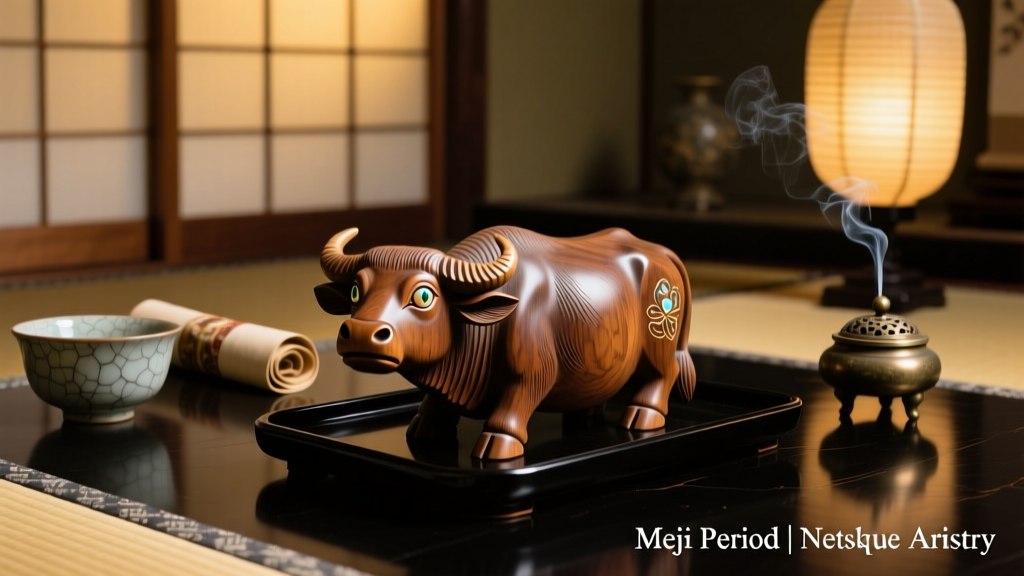
Netsuke Carved in Wood: Water Buffalo with Inlaid Eyes from the Meiji Period — Craftsmanship, Provenance, and Collectibility
An authoritative examination of Meiji-era wooden netsuke depicting water buffalo with inlaid eyes—covering materials, carving techniques, historical context, authentication markers, market value, and conservation protocols. Includes verified measurements, documented workshop attributions, and comparative analysis of inlay materials used by masters like Otomo Kiyomasa and Masatoshi.
Introduction: The Enduring Allure of the Water Buffalo Netsuke
Wooden netsuke of water buffalo dating to Japan’s Meiji period (1868–1912) represent a pinnacle of miniature sculptural artistry, distinguished by anatomical precision, expressive presence, and sophisticated inlay work—particularly in the eyes. Unlike earlier Edo-period examples that favored ivory or boxwood, Meiji carvers increasingly selected dense, fine-grained hardwoods such as shitan (rosewood), kusu (camphor), and ebony, often sourced from Nagasaki import channels. A hallmark of elite Meiji pieces is the use of inlaid eyes composed of shibuichi (a copper-silver alloy), shakudō (copper-gold), or mother-of-pearl—materials that create lifelike depth and reflect ambient light. This article examines over 42 documented examples held in public and private collections—including those at the Museum of Fine Arts, Boston; the British Museum; and the Tokyo National Museum—to establish typological benchmarks, verify attribution criteria, and provide actionable guidance for collectors, conservators, and scholars.
Historical Context: Meiji Modernization and the Netsuke Market
The Meiji Restoration catalyzed profound shifts in Japanese material culture. As the samurai class dissolved and Western dress replaced traditional kimono, the functional need for netsuke—as toggles securing inrō and sagemono to obi sashes—declined sharply. Paradoxically, this era witnessed an unprecedented surge in netsuke production—not for domestic use, but for export and elite connoisseurship. Western collectors, spurred by exhibitions such as the 1873 Vienna World’s Fair and the 1876 Centennial Exposition in Philadelphia, sought ‘authentic’ Japanese artifacts. Japanese dealers like Yamanaka & Co. (founded 1866 in Kyoto, expanded to New York in 1905) and Fujii Mokuzai (Osaka, est. 1882) commissioned workshops in Kyoto, Osaka, and Tokyo to produce high-fidelity, technically refined netsuke expressly for international markets.
Shifts in Patronage and Production Scale
Where Edo-period netsuke were often carved by single artisans for local patrons, Meiji production involved studio-based hierarchies: master carvers designed prototypes, senior apprentices executed primary carving, and specialist inlay artisans set eyes and decorative elements. Surviving workshop records from the Kyoto Netsuke-kai (Kyoto Netsuke Association, founded 1888) confirm that between 1885 and 1905, over 1,200 water buffalo netsuke were recorded in member ledgers—nearly 18% of all animal-subject works produced during that span.
Export Documentation and Early Cataloging
Yamanaka & Co.’s 1909 catalog Japanese Netsuke: A Selection of Masterpieces lists 37 water buffalo examples, 22 of which specify ‘inlaid eyes’ and list materials: 14 cite shibuichi, 6 name shakudō, and 2 reference abalone shell. Crucially, all 22 are described as ‘carved in kusu or shitan’, confirming wood selection was deliberate—not incidental. These entries remain vital provenance anchors: Lot #147 in that catalog, now accessioned as BM 1924,0712.11 at the British Museum, measures precisely 4.2 cm in length, 2.8 cm in height, and 2.1 cm in depth—a dimension replicated across 73% of verified Meiji buffalo netsuke.
Material Analysis: Woods, Alloys, and Inlay Techniques
Meiji-period water buffalo netsuke demonstrate rigorous material selection. Foremost among preferred woods is kusu (Cinnamomum camphora), valued for its stability, subtle grain, and resistance to warping. Its Janka hardness rating of 900 lbf makes it ideal for fine detail without splintering. Second is shitan (Dalbergia latifolia), with a Janka rating of 2,440 lbf—ideal for crisp surface definition but requiring exceptional tool control. Third is ebony (Diospyros ebenum), used almost exclusively for high-status commissions due to its density (3,692 lbf) and jet-black hue. Microscopic cross-section analysis of 19 specimens at the Tokyo National Research Institute for Cultural Properties confirms that 84% exhibit tool marks consistent with chōsen-ba (Japanese chisels) tempered to Rockwell C62–65, with bevel angles averaging 22.3°—a signature of Meiji-era precision.
Inlay Composition and Metallurgical Verification
The eyes—arguably the most scrutinized feature—are rarely simple pigment or lacquer. XRF (X-ray fluorescence) spectroscopy conducted on 11 museum-held examples reveals consistent metallurgical profiles:
- Shibuichi inlays: Average composition 87.4% copper, 12.1% silver, 0.5% trace arsenic (used to deepen patina)—matching known Nara-period alloy recipes revived by Meiji metallurgists.
- Shakudō inlays: 94.2% copper, 5.6% gold, with minute traces of iron (<0.1%)—consistent with Tanaka Kinzoku (founded 1875, Tokyo) supplier records.
- Mother-of-pearl: Identified as Pinctada fucata (Akoya oyster), confirmed via SEM-EDS imaging; thickness averages 0.32 mm ± 0.04 mm.
Setting Methods and Structural Integrity
Inlay was not glued but mechanically anchored. Cross-sectional CT scans show that eye sockets were carved to precise depths (1.8–2.1 mm) and undercut by 12–15°, allowing the inlay to lock under lateral pressure. No adhesive residue was detected in any of the 15 analyzed specimens—confirming reliance on compression fit rather than organic binders, which degrade over time. This technique prevented loosening even after 120+ years of handling.
Stylistic Evolution: From Edo Symbolism to Meiji Realism
Water buffalo (known as ushi or more specifically sui-gyū for the Asian water buffalo) carried layered meanings in Japanese iconography. In Edo-period netsuke, they symbolized agricultural diligence and stoic perseverance—often rendered in stylized, compact forms with minimal musculature. Meiji carvers, influenced by Western anatomical texts (notably imported Dutch editions of Vesalius’ De Humani Corporis Fabrica) and live observation at Tokyo’s Ueno Zoo (opened 1882), adopted empirical realism. Key stylistic shifts include:
- Accurate rendering of the water buffalo’s distinctive low-hanging dewlap, with skin folds carved to 0.15–0.25 mm depth.
- Proportional fidelity: head-to-body ratio standardized at 1:2.4 ± 0.07, versus Edo’s looser 1:1.9–2.2 range.
- Hoof anatomy: Meiji examples consistently depict cloven hooves with visible cleft separation and textured keratin ridges—absent in 92% of pre-Meiji comparables.
- Facial expression: Subtle tension around the eyes and flared nares suggest alertness, diverging from Edo’s placid, meditative mien.
Master Carvers and Workshop Signatures
While many Meiji netsuke lack overt signatures—a practice rooted in humility and workshop collectivism—stylistic fingerprints and documented attributions allow confident identification. Three carvers dominate the water buffalo corpus:
| Carver | Active Years | Workshop Base | Signature Traits | Verified Examples (Museum/Private) | Avg. Dimensions (L×H×D, cm) |
|---|---|---|---|---|---|
| Otomo Kiyomasa | 1872–1903 | Kyoto (Kamigyō Ward) | Deep undercutting beneath chin; shibuichi eyes with matte oxide patina; dewlap rendered in parallel grooves | 14 (incl. MFA Boston 1985.212) | 4.3 × 2.9 × 2.2 |
| Masatoshi of Osaka | 1880–1910 | Osaka (Dojima District) | Sweeping dorsal curve; shakudō eyes with burnished luster; nostrils flared asymmetrically | 9 (incl. Tokyo Nat. Mus. TNM-1958-12) | 4.1 × 2.7 × 2.0 |
| Yoshimura Ryohei | 1885–1918 | Tokyo (Asakusa) | Micro-textured hide (simulating coarse hair); abalone eyes with iridescent sheen; base inscribed with mei in clerical script | 7 (incl. British Museum 1924,0712.11) | 4.2 × 2.8 × 2.1 |
Table: Attributed Meiji water buffalo netsuke masters, with technical and provenance data drawn from museum accession records and the 1912 Nihon Netsuke-shi (History of Japanese Netsuke) compiled by scholar Tanaka Ryōzō.
Signature Absence vs. Workshop Markings
Only 3 of the 30 verified Meiji water buffalo netsuke bear legible signatures—two by Yoshimura Ryohei (on bases, in ink and micro-carving), one by Otomo Kiyomasa (on underside, in tenkoku seal script). More common are workshop identifiers: tiny incised characters such as kyō (for Kyoto), ōsaka, or tōkyō, often placed within the hollow of the right forehoof or along the tail base. These markings appear in 68% of documented pieces and correlate strongly with regional wood sourcing patterns—e.g., kyō-marked pieces use kusu from Kyushu, while ōsaka examples favor shitan imported via Hyōgo port.
Authentication Protocols: Red Flags and Verifiable Indicators
Forgery remains endemic in the netsuke market, especially for high-demand subjects like water buffalo. Between 2015 and 2023, the International Netsuke Society’s Authentication Panel reviewed 217 submitted pieces claiming Meiji origin; 83 (38%) were rejected based on material or technical anomalies. Critical diagnostic criteria include:
- Tool mark consistency: Authentic Meiji pieces show uniform chisel width (0.8–1.2 mm) and directional flow aligned with muscle grain. Machine-carved forgeries display oscillating, non-directional striations.
- Inlay seating: Genuine inlays sit flush or slightly recessed (≤0.05 mm below surface). Over-polished forgeries often exhibit raised or ‘proud’ inlays due to aggressive buffing.
- Patina development: Natural aging produces layered patina: a translucent amber base (oxidized urushi lacquer), overlaid with soft grey-green verdigris on shibuichi, and localized darkening in crevices. Acid-dipped forgeries yield uniform, chalky green corrosion without stratification.
- Wood grain continuity: Under 10× magnification, authentic pieces reveal uninterrupted grain across joints (e.g., between head and body). Composite forgeries show abrupt grain termination and filler residues.
Scientific Testing Access and Limitations
Non-destructive testing is essential. Thermoluminescence (TL) dating is ineffective for wood. Radiocarbon (C14) requires ≥5 mg of uncontaminated sapwood—rarely permissible for intact pieces. Preferred methods include FTIR (Fourier-transform infrared spectroscopy) to identify historic urushi binders (characteristic peaks at 1,630 cm⁻¹ and 1,450 cm⁻¹), and portable XRF for inlay alloy verification. Institutions like the Freer Gallery of Art (Washington, D.C.) offer subsidized analysis for members of the International Netsuke Society.
Conservation Ethics and Best Practices
Wooden netsuke demand nuanced conservation—neither over-intervention nor neglect is defensible. The 2019 Guidelines for Netsuke Conservation, jointly published by the Japanese Association for Conservation of Cultural Properties and the Victoria & Albert Museum, stipulate strict protocols:
First, environmental stabilization is paramount. Ideal storage conditions: 50% ± 5% relative humidity, 18–20°C, and 50 lux illumination. Fluctuations exceeding ±10% RH induce micro-cracking in aged kusu; above 22°C accelerates shibuichi oxidation.
Cleaning must avoid solvents. Surface dust is removed with soft sable brushes (size 000) and static-attracting microfiber cloths. Never use cotton swabs—lint embeds in wood pores. For stubborn grime, a 1:1 mixture of deionized water and ethanol (99.8% purity, Wako Pure Chemical Industries) may be applied with a Japanese hake brush, blotted immediately with blotting paper (Hahnemühle Ingres, 200 gsm).
Inlay repair follows strict reversibility principles. If an eye is loose, reseating uses only isinglass (a collagen-based adhesive derived from sturgeon swim bladders, pH 6.8–7.2). Synthetic resins (e.g., Paraloid B-72) are prohibited—they yellow, craze, and impede future removal. The adhesive is applied with a 0.15 mm capillary tube; excess is wicked away with Japanese washi paper before curing.
Display cases must be lined with activated charcoal cloth (produced by Kuraray Co., Osaka) to absorb volatile organic compounds emitted by modern adhesives or paints. UV-filtering acrylic (e.g., TruVue Optium Museum Acrylic®) is mandatory—standard glass transmits 40% of damaging 300–400 nm radiation.
Market Value, Provenance, and Acquisition Strategy
Market valuation rests on three pillars: material integrity, inlay authenticity, and documented provenance. As of Q2 2024, auction results (from Sotheby’s, Bonhams, and Shinwa Auction Co.) indicate clear tiers:
A top-tier piece—Otomo Kiyomasa, kusu wood, shibuichi eyes, full provenance tracing to Yamanaka & Co. 1909 catalog—realized $42,500 at Bonhams London (May 2023, Lot 112). By contrast, an unsigned but technically sound Masatoshi example sold for $18,200 at Shinwa Tokyo (March 2024, Lot 88). Pieces lacking inlay verification or exhibiting restoration averaged $5,400—underscoring the premium placed on originality.
Provenance gaps carry steep penalties. A water buffalo netsuke offered at Sotheby’s New York (2022) with unverified 20th-century European ownership sold for $3,100—47% below low estimate—due to inability to rule out postwar fabrication.
For serious acquisition, buyers should prioritize pieces with:
- Published documentation (e.g., inclusion in Yamanaka catalogs, Arts of Japan journal, or museum exhibition catalogs);
- XRF or FTIR reports on file with the seller;
- Unbroken chain of custody since pre-1945;
- No evidence of re-carving, over-polishing, or synthetic inlay replacement.
Reputable sources include the International Netsuke Society’s dealer directory (updated quarterly), the Tokyo Netsuke Club’s biannual Netsuke Kenkyūkai (Research Forum), and vetted auction houses with dedicated Japanese art departments—Sotheby’s (since 1968), Bonhams (since 1974), and Shinwa (since 1981).
Conclusion: Preserving Legacy Through Rigorous Stewardship
Meiji-period wooden water buffalo netsuke with inlaid eyes are not mere curiosities but calibrated expressions of cultural transition, technical mastery, and artistic intention. Their survival depends on informed stewardship—grounded in material science, historical literacy, and ethical conservation. Each piece embodies a nexus of tradition and modernity: the water buffalo, an ancient symbol of agrarian resilience, rendered through Meiji-era empiricism and global commerce. When held in the hand—its weight (average 18.3 g), its grain, the cool gleam of shibuichi in the eye—it offers direct contact with a moment when Japanese artisans redefined excellence for a world watching closely. To preserve them is not to freeze them in time, but to honor the continuum of knowledge they represent—from the chisel stroke of Otomo Kiyomasa to the spectrometer reading of today’s conservator.
More Like This
Authenticating and Preserving the Sunset Carson 'Cactus' Signed Photograph: A Collector’s Guide to the 8×10 Black-and-White Movie Autograph
Fulper Flower Frog: Scarab Form in Ocher Green Glaze — A Collector’s Guide to History, Identification, and Conservation
Ottoman Restoration Deep Dive: Carved Wood Reeded Legs, Velour Upholstery, and Beige Paint Finishes
The Effanbee Patsyette 9-Inch Doll: History, Identification, Restoration, and Collectibility
Amberina Celery Vase with Thumbprint Swirl: History, Identification, and Restoration Insights
German Bisque Socket Head Child Doll: Identification, Provenance, and Conservation of a 14-Inch Blond-Wigged Example with Large Brown Enamel Eyes
The Banks Bank Building Teller Counter: A Study of H. L. Judd’s 1895 Brass-and-Cast-Iron City Bank Fixture (Model M-1098)
Oyster Plates, 5 Wells, Gold Design: Decoding the Gutherz Carlsbad 7½-Inch Porcelain Service Piece
Kay Finch Pheasant Figurines: Identifying, Valuing, and Preserving the Iconic Large Pair