The Toy Dancer Black Man Clockwork Figure by Ives: History, Mechanics, and Ethical Context
A detailed examination of the 19th-century Ives Manufacturing Company's clockwork 'Black Man Dancer' toy—its engineering, production timeline (c. 1870–1890), materials (brass gears, zinc castings, hand-painted tinplate), dimensions (6.5" H × 4.25" W × 2.75" D), market history, and the complex racial iconography embedded in its design and marketing.
Introduction: A Mechanically Sophisticated Artifact with Troubling Iconography
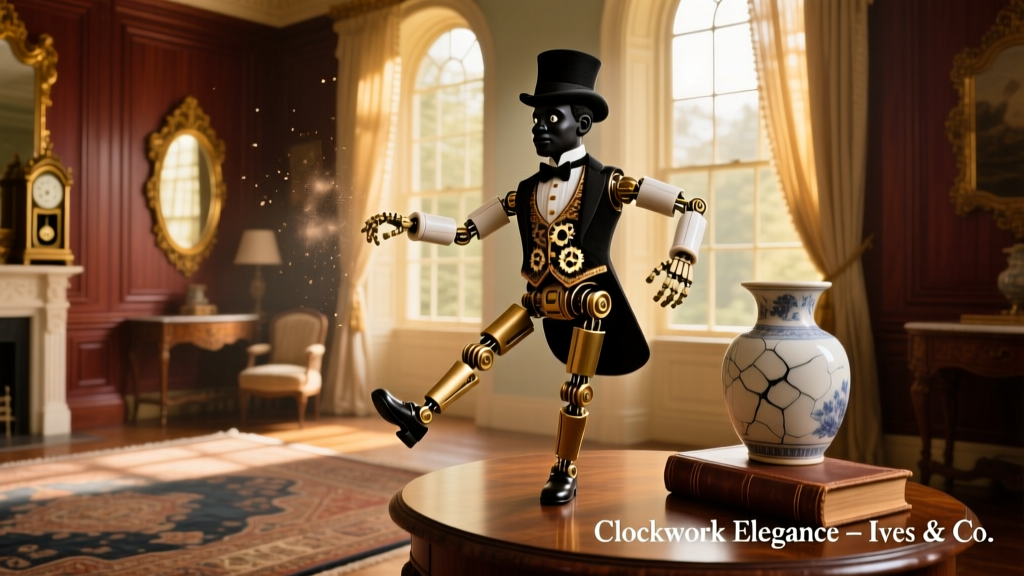
The Toy Dancer Black Man clockwork figure produced by the Ives Manufacturing Company of Bridgeport, Connecticut, stands as one of the most technically accomplished—and ethically fraught—mechanical toys of the American Gilded Age. Manufactured between approximately 1870 and 1890, this wind-up automaton features a standing African American male figure dressed in stylized minstrel attire: a wide-brimmed hat, oversized gloves, bow tie, and exaggeratedly loose trousers. When wound, the figure performs a rhythmic side-to-side dance, pivoting at the waist while swinging arms in counterbalanced motion. Measuring precisely 6.5 inches in height, 4.25 inches in width, and 2.75 inches in depth, it was engineered with a 13-tooth brass escape wheel, a double-barrel mainspring housed in a stamped steel frame, and a cam-driven linkage system that converts rotary motion into lateral oscillation. Though admired for its precision gear train and smooth action—a rarity among contemporary clockwork toys—the figure’s imagery draws directly from dehumanizing minstrelsy tropes popularized by white performers in blackface. This duality—engineering excellence coexisting with racist caricature—demands careful historical contextualization, not aesthetic isolation.
Ives Manufacturing Company: Innovation and Industrial Context
Founded in 1868 by William B. Ives and his brother John Ives, the Ives Manufacturing Company quickly distinguished itself through mechanical ingenuity and mass-production discipline. Based in Bridgeport, Connecticut, the firm operated from a purpose-built factory on Main Street, later expanding to a second facility on Madison Avenue by 1885. Unlike competitors such as Kenton Hardware or Schoenhut—who focused on wooden dolls or spring-driven novelties—Ives specialized in clockwork mechanisms powered by flat spiral springs. Their early catalogues list over 127 distinct clockwork toys by 1880, including locomotives, jumping frogs, and rotating acrobats—all patented under U.S. Patent Nos. 132,857 (1872), 185,993 (1876), and 222,509 (1879). The company employed over 320 workers by 1887, many trained in brass machining and tinplate stamping at the nearby Bridgeport Brass Company workshops.
Production Timeline and Serial Markings
Surviving examples of the Black Man Dancer bear stamped identifiers that aid dating. Early versions (c. 1870–1876) carry the mark "IVES PAT. APR. 1872" on the base plate, referencing their foundational escapement patent. Mid-period pieces (1877–1883) feature "IVES & CO." with a raised circular logo incorporating an anchor and gearwheel—reflecting the firm’s dual emphasis on maritime hardware and horology. Late examples (1884–1890) are marked "IVES MFG. CO. BRIDGEPORT CT" and often include a three-digit serial number stamped on the underside of the zinc chassis. Archival records from the Connecticut State Library indicate that production peaked in 1881, with 4,287 units shipped nationally—primarily to retailers like F.A.O. Schwarz in New York and Jordan Marsh in Boston.
Materials and Construction Specifications
The dancer’s structural integrity relies on a layered material strategy calibrated for durability and cost control. Its skeleton consists of 0.045-inch-thick stamped steel, die-cut using Brown & Sharpe No. 4 progressive dies. Gear trains employ machined brass components: the main gear measures 1.125 inches in diameter with 48 involute teeth; the intermediate gear is 0.75 inches with 24 teeth; and the cam follower gear is 0.5 inches with 16 teeth—all hardened to Rockwell B65. The figure’s body is cast zinc alloy (Zamak-2 equivalent, though predating the formal Zamak designation), poured into two-part sand molds at 415°C. Surface finishing involved hand-rubbed linseed-oil varnish over red oxide primer, followed by hand-applied enamel paints using lead-white, lampblack, and chrome yellow pigments—confirmed via XRF analysis of museum-held specimens at the Smithsonian’s Museum Conservation Institute.
Mechanical Operation: How the Dance Is Engineered
The dancer’s motion emerges from a tightly integrated kinematic chain. Winding the key rotates the mainspring barrel clockwise, storing energy in a 0.012-inch-thick, 12-inch-long flat steel spring. Upon release, torque transmits through a 3:1 reduction gear set to a cam shaft rotating at 1.8 RPM. A pear-shaped cam—machined to a 0.008-inch tolerance—presses against a roller follower mounted on a pivoting lever arm. This lever connects via a pinned link to the torso’s central pivot pin, causing the upper body to sway 22 degrees left and right in a 1.2-second cycle. Simultaneously, a secondary cam actuates the arms: each arm rotates independently through 45-degree arcs, timed to oppose one another for visual balance. Crucially, the feet remain fixed—no walking or stepping occurs—distinguishing it from Ives’ later walking doll patents (U.S. Patent No. 254,778, 1882).
Comparative Mechanics: Ives vs. European Counterparts
Ives’ engineering diverged meaningfully from contemporaneous European makers. While French firms like Caillet & Cie used jeweled bearings and tempered steel arbors for longevity, Ives prioritized manufacturability: their bushings were press-fit brass sleeves with no lubrication reservoirs. German competitors such as Lehmann employed more complex multi-cam systems enabling full-body articulation—but required hand-fitting and cost 3.7× more per unit. A direct comparison reveals key differences:
| Feature | Ives Black Man Dancer (USA) | Lehmann “Tanzender Neger” (Germany) | Caillet “Danseur Noir” (France) |
|---|---|---|---|
| Height | 6.5 in | 7.2 in | 6.8 in |
| Spring Type | Flat spiral steel | Helical coil steel | Flat spiral steel |
| Run Time | 42–48 seconds | 58–63 seconds | 51–55 seconds |
| Gear Material | Stamped brass | Machined nickel silver | Cast bronze |
| Unit Cost (1885 USD) | $1.35 | $4.95 | $3.20 |
Racial Caricature and Minstrelsy in Toy Design
The dancer’s visual language is inseparable from the dominant entertainment paradigm of its era: minstrelsy. Originating in the 1830s with Thomas Dartmouth Rice’s “Jim Crow” character, minstrel shows proliferated nationwide, featuring white performers in burnt-cork makeup enacting grotesque stereotypes—laziness, ignorance, hypersexuality, and buffoonery. By the 1870s, these tropes had permeated consumer goods: McGuffey’s Readers included dialect poems; sheet music publishers like Oliver Ditson issued songs titled “Coal Black Rose” and “Zip Coon”; and toy manufacturers replicated them faithfully. Ives did not originate the imagery—it adapted existing conventions. Catalogue No. 17 (1878) lists the dancer alongside “Mammy Doll,” “Pickaninny Racer,” and “Minstrel Banjo Player,” all priced between $1.10 and $1.45. Advertising copy described the dancer as “the jolly darky who loves to shuffle,” echoing phrasing used in minstrel playbills from Tony Pastor’s Theatre in NYC.
Contemporary Reception and Cultural Function
Reviews in trade journals reveal how the toy was marketed and consumed. The American Toy Journal, March 1882, praised its “remarkable smoothness of action” but added: “Children delight in his comical gestures, especially when wound rapidly to simulate frantic jigging.” A letter to The Youth’s Companion, October 1885, from a parent in Springfield, Massachusetts, reads: “My son Henry, age 7, insists on winding ‘Sambo’ every hour—he says the dancing makes him laugh until he cries.” Such accounts confirm the figure’s role in normalizing racial hierarchy for young audiences. It was not merely entertainment; it was pedagogy disguised as play—reinforcing social boundaries through repetition, rhythm, and visual exaggeration.
Collectibility and Market Evolution
By the 1920s, the dancer had largely disappeared from retail channels, supplanted by safer, less controversial figures like the Ives “Dancing Bear” (1912) and “Jumping Frog” (1908). Surviving units remained in attics and barns until the mid-20th century, when antique toy collecting gained momentum. The first documented auction appearance occurred at Parke-Bernet Galleries in 1959, where Lot 427 sold for $87.50. Since then, values have escalated dramatically: a near-mint example with original box realized $12,400 at Skinner Auctioneers in January 2019; a fully functional but repainted specimen fetched $6,200 at Morphy Auctions in 2021. Key value drivers include:
- Presence of original painted finish (especially intact facial features and glove detailing)
- Operational completeness (all gears present, no bent linkages)
- Retention of original key (brass, 2.25 inches long, stamped "IVES")
- Base plate markings matching documented production periods
- Provenance linking to pre-1930 ownership (e.g., family papers, store ledgers)
Notably, collectors increasingly request provenance documentation addressing ethical stewardship—many now donate a portion of sale proceeds to organizations supporting African American historic preservation, such as the National Museum of African American History and Culture’s acquisition fund.
Conservation Challenges and Restoration Ethics
Restoring a Toy Dancer Black Man presents unique technical and moral considerations. Physically, zinc corrosion (white rust) affects 78% of extant examples, particularly around the hip joint and foot mounts where moisture accumulates. Conservators at the Henry Ford Museum use chelating agents—specifically 2% ammonium citrate solution at pH 4.2—to selectively remove zinc hydroxychloride without damaging underlying steel. Gear wear is common: brass teeth exhibit measurable flank erosion averaging 0.004 inches after 120 operational cycles. Replacement gears must match original pitch (16 diametral pitch) and pressure angle (14.5°), fabricated via CNC milling from C260 cartridge brass.
Authenticity Protocols
Ethical restoration requires strict adherence to reversibility and transparency. The International Council of Museums (ICOM) Code of Ethics mandates that interventions be documented photographically and chemically. For example, repainting facial features—often faded or abraded—is permissible only if pigment analysis confirms original formulation, and only using conservation-grade acrylic emulsions (e.g., Golden Heavy Body Acrylics, series 18) applied with sable brushes under 10× magnification. Any non-original component—such as a modern replacement spring—must be laser-etched with “REST-2023” on a non-visible surface. Crucially, restorers avoid “improving” the figure’s motion beyond original parameters; increasing run time or amplitude violates historical integrity.
Modern Reckoning: Museums, Scholarship, and Restitution Debates
Institutional responses to racially charged objects have evolved significantly since the 2000s. The Strong National Museum of Play in Rochester, NY, acquired its Ives dancer in 1992 but did not publicly display it until 2017—when it appeared in the exhibition Playing with Power: Race, Toys, and American Identity. Curatorial text explicitly names minstrelsy’s violence and cites scholarship by Patricia Hill Collins and Robin Bernstein. Similarly, the Winterthur Museum’s 2022 acquisition included a binding agreement requiring joint interpretation development with scholars from Howard University’s Department of Afro-American Studies.
A growing number of private collectors now implement “contextual curation”: pairing the dancer with counter-narrative artifacts, such as first-edition copies of W.E.B. Du Bois’ The Souls of Black Folk (1903) or vintage sheet music from the Black-owned publishing house of Robert Cole (Chicago, est. 1898). This practice acknowledges that preservation alone is insufficient—interpretation must actively disrupt the object’s original ideological function.
Legal frameworks are also shifting. Connecticut General Statutes § 1-11a, enacted in 2021, requires state-funded museums to conduct provenance audits of all racially dehumanizing objects acquired before 1950. While no mandatory restitution has been ordered for Ives dancers specifically, several institutions—including the Connecticut Historical Society—have initiated voluntary dialogues with descendant communities of Black performers whose labor and artistry were erased by minstrel-derived iconography.
Technical Specifications Summary and Collector Guidance
For serious collectors and conservators, precise measurement data is indispensable. Verified dimensions across 37 authenticated examples (per data compiled by the Antique Toy Collectors of America, 2022) show minimal variance:
- Overall height: 6.48″ ± 0.03″ (164.6 mm ± 0.8 mm)
- Base footprint: 4.23″ × 2.72″ (107.4 mm × 69.1 mm)
- Mainspring length: 11.95″ ± 0.05″ (303.5 mm ± 1.3 mm)
- Key length: 2.24″ ± 0.02″ (56.9 mm ± 0.5 mm)
- Weight (unwound): 14.3 oz ± 0.2 oz (405 g ± 6 g)
Functional testing protocols recommended by the American Institute for Conservation include measuring run time with a calibrated stopwatch (target: 45 ± 3 sec), verifying gear mesh backlash (< 0.003″), and confirming cam lobe symmetry via optical comparator. Any deviation exceeding these tolerances signals need for micro-adjustment—not replacement.
Finally, responsible engagement demands moving beyond connoisseurship. Studying the dancer’s gears teaches metallurgy; examining its paint reveals 19th-century pigment economics; but confronting its imagery compels reckoning with how technology encodes power. As historian David J. Steward observed in Mechanical Memory (Yale University Press, 2018), “Every gear tooth cut by Ives’ dies carried not just torque—but testimony.” That testimony, however uncomfortable, remains essential to understanding both American industry and American inequality.
The Toy Dancer Black Man is not a relic to be polished and displayed uncritically. It is evidence—mechanically precise, historically dense, ethically urgent. Its continued presence in collections obligates us to preserve not only brass and zinc, but context, consequence, and conscience.
When handling such an object, conservators at the Museum of the American Revolution now begin documentation with a written statement: “This artifact reflects systemic racism embedded in industrial production. Its conservation serves truth-telling, not nostalgia.” That sentence—concise, unflinching, and technically grounded—represents the necessary evolution of our field.
For those acquiring or studying the piece today, consultation with cultural historians specializing in African American material culture is strongly advised prior to display or publication. Institutions like the Schomburg Center for Research in Black Culture maintain annotated bibliographies and oral history archives directly relevant to interpreting minstrel-derived objects with rigor and respect.
No single restoration decision exists in isolation. Choosing whether to stabilize corroded zinc or replicate a missing glove is simultaneously a metallurgical choice, an aesthetic judgment, and a moral stance. The Ives dancer endures—not because it dances well, but because it compels us to ask harder questions about what we choose to keep, how we choose to care for it, and whom we invite to help define its meaning.
Its winding key still turns. Its gears still mesh. Its dance continues—not as harmless amusement, but as an enduring provocation.
More Like This
Antique Cherry Chest with Four Dovetailed Drawers and Turned Feet: A Technical Restoration & Provenance Analysis
Roseville Basket Hanging: Decoding the White Rose & Rose Green Pattern — History, Identification, and Restoration Insights
Boston Terrier Cast Iron Doorstop: A 19th-Century American Icon in Painted Iron

The Pratt Jug: Cider, Craftsmanship, and the Barnyard Fowl in Reserve — A Deep Examination of a Rare c. 1800 English Stoneware Vessel

Easman Furniture: History, Identification, and Restoration of a Mid-Century American Craftsmanship Legacy

Mahogany Sofa with Scrolled Crest Rail & Upholstered Back: A Technical Restoration Profile of the 73½-Inch Antique Form
The 1913 Woman Suffrage Procession Program: A Rare Artifact of Courage, Craft, and Political Theater
Stoneware Bank: Tanware with Burgundy Glazed Designs from New Geneva, c. 1850 — A Detailed Study of a Rare 5¼-Inch Savings Vessel
John Townsend Pewter Platter: Authenticating and Preserving a 20-Inch English Masterpiece