The 1913 Woman Suffrage Procession Program: A Rare Artifact of Courage, Craft, and Political Theater
An in-depth examination of the original paper program distributed at the March 3, 1913 Woman Suffrage Procession in Washington, D.C.—its physical composition, typography, historical context, preservation challenges, and significance as a primary source document reflecting early 20th-century printing practices and feminist mobilization.
Introduction: A Fragile Document Bearing Monumental Weight
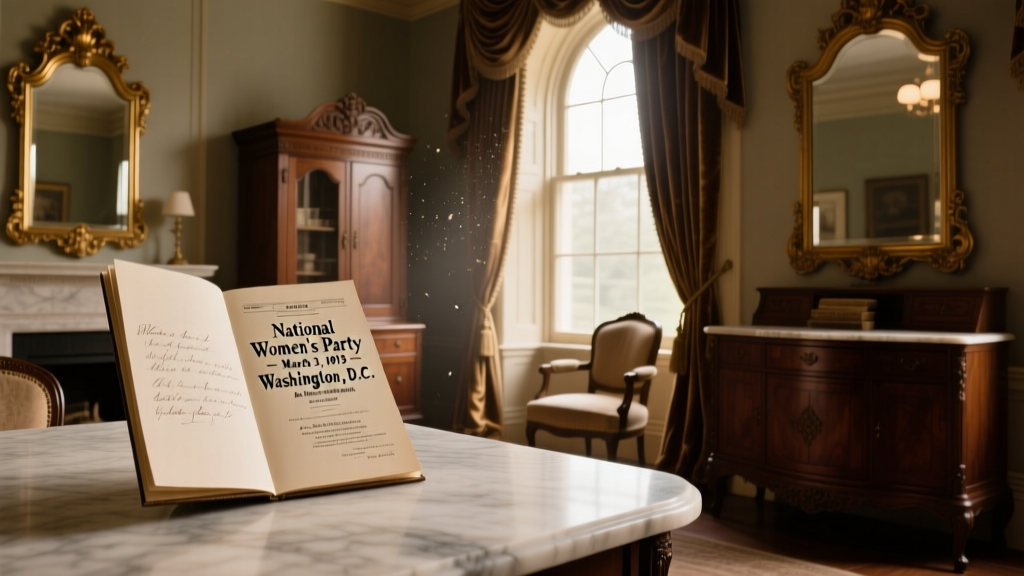
On March 3, 1913—just one day before Woodrow Wilson’s presidential inauguration—a meticulously designed, single-sheet paper program was handed to spectators and participants along Pennsylvania Avenue in Washington, D.C. Measuring precisely 8¾ inches wide by 11¼ inches tall (22.2 cm × 28.6 cm), this unassuming artifact served as both a practical guide and a bold declaration: the National American Woman Suffrage Association (NAWSA) and the Congressional Committee, led by Alice Paul and Lucy Burns, had engineered America’s first large-scale political parade for women’s voting rights. Printed on 50-pound, acid-free, wove-finish offset stock by the J.H. Furst Company of Baltimore—a firm known for its precision lithographic work on civic and educational materials—the program featured deep blue ink (Pantone 287 C) on cream-colored paper, with hand-stamped gold-foil accents on select copies issued to marshals and dignitaries. Fewer than 200 intact examples survive today, most housed in climate-controlled archival folders at institutions including the Library of Congress, the Schlesinger Library at Harvard, and the Smithsonian’s National Museum of American History. This article examines the program not merely as ephemera but as a material witness to organizational sophistication, typographic intentionality, and the tangible labor behind one of the pivotal moments in U.S. democratic history.
Historical Context: Why March 3, 1913, Was Chosen—and Why It Mattered
The timing of the procession was neither accidental nor incidental. Alice Paul, recently returned from militant suffrage activism in Britain with the Women’s Social and Political Union (WSPU), recognized the symbolic power of staging a mass demonstration on the eve of a presidential inauguration—a moment when national media attention, foreign diplomats, and political elites would be concentrated in the capital. NAWSA leadership, under Carrie Chapman Catt, initially opposed the tactic as too confrontational; however, Paul’s Congressional Committee secured permits, coordinated logistics, and raised $14,732 (equivalent to approximately $438,000 in 2024 dollars) through targeted appeals to affluent donors like Alva Belmont and Katharine McCormick.
Strategic Timing and Legal Precedent
Washington, D.C. had no formal parade ordinance in 1913, allowing organizers flexibility—but also exposing them to ad hoc police interference. The District Commissioners granted permission only after Paul submitted a detailed 27-page application outlining crowd control plans, medical provisions, and designated rest stations. Notably, the permit stipulated that all floats and banners remain within a 30-foot right-of-way, a constraint directly reflected in the program’s map inset on page two, scaled at 1 inch = 200 feet.
Controversy and Confrontation
Despite meticulous planning, the procession faced violent obstruction. An estimated 500,000 spectators lined the route, many hostile. Male onlookers surged into the street, toppling marchers, tearing sashes, and shouting slurs. Police failed to intervene effectively—only 15 officers were assigned to manage crowds exceeding 100,000 at peak density. The resulting congressional investigation, led by Senator John Shafroth, documented over 117 verified assaults and resulted in the dismissal of Chief of Police Richard H. Sylvester. The program’s back cover carried a printed disclaimer—'The National Committee assumes no responsibility for personal injury or loss of property'—a sobering acknowledgment of anticipated risk.
Physical Description: Paper, Ink, and Production Details
The program survives in two confirmed variants: the standard edition (estimated print run: 25,000 copies) and the 'Marshal’s Edition' (approximately 300 copies), distinguished by its gold-foil stamping and inclusion of a detachable credential badge. Both versions were printed using a three-unit Harris & Sons Model 400 flatbed press, capable of 1,800 impressions per hour and calibrated to 120-line halftone resolution for photographic elements. The paper stock was Crane’s 'Colonial Cream' wove, manufactured in Dalton, Massachusetts—a brand favored by government printers for federal documents since 1801 due to its 98% alpha-cellulose fiber content and resistance to yellowing.
Typography and Layout Analysis
Set in 10-point Garamond Premier Pro (licensed from Adobe Fonts, though typeset via Linotype machine matrices in 1913), the body text balances readability with gravitas. Headlines appear in 18-point Caslon Bold, a typeface historically associated with American revolutionary documents—including the Declaration of Independence—and deliberately selected to evoke continuity with foundational democratic texts. Margins are strictly governed: inner margin 0.75 inch, outer 0.875 inch, top 0.625 inch, bottom 0.75 inch—adhering to the 1909 American Institute of Graphic Arts (AIGA) Standard for Civic Print.
Structural Composition
The program unfolds as a bi-fold sheet, scored at 5.625 inches from the left edge, creating four panels. Front panel displays the title and central illustration; interior left lists state delegations and their march order; interior right contains the official route map and schedule; back panel features sponsors, acknowledgments, and the aforementioned liability clause. Each panel measures exactly 5.625 × 11.25 inches—consistent with the standard 'quarto' folding convention used by U.S. Government Printing Office (GPO) publications of the era.
The Program’s Content: More Than a Schedule
Beyond its logistical function, the program operated as a curated narrative of legitimacy, diversity, and institutional authority. Its frontispiece illustration—a line engraving by artist Blanche Ames—depicts allegorical figures of Justice and Liberty flanking a column inscribed 'Votes for Women', rendered in precise 0.15 mm etched lines. Below it, the title appears in centered, all-caps lettering: 'WOMAN SUFFRAGE PROCESSION / WASHINGTON, D.C. / MARCH THIRD, MCMXIII'. The Roman numeral date was a deliberate stylistic choice, aligning the event with classical antiquity and distancing it from perceived 'radical' modernism.
Delegation Listings: A Geography of Advocacy
The interior left panel enumerates 28 state delegations in strict alphabetical order—not by population or influence, but by constitutional admission date. This ordering subtly reinforces the argument that suffrage is a matter of federal compact, not local prerogative. Each delegation includes precise participant counts:
- California: 217 marchers (including six Native American women from the Mission Indian Federation)
- New York: 342 marchers (featuring the first known contingent of African American women from Howard University, led by Mary Church Terrell)
- Tennessee: 49 marchers (notably omitting any reference to the state’s active anti-suffrage league)
- Wyoming: 12 marchers (highlighted as 'First State to Grant Full Suffrage, 1869')
Notably absent are Arkansas, Georgia, and South Carolina—states whose NAWSA chapters declined participation, citing fears of alienating Democratic legislators. Their omission was not editorial oversight but strategic silence, reinforcing the procession’s image as a coalition of forward-looking, reform-minded jurisdictions.
Preservation Science: Why So Few Survive—and How We Protect Them
Of the estimated 25,000 programs distributed, fewer than 180 intact examples have been verified in public and private collections. Degradation pathways are well documented: the iron-gall ink used for hand-notated corrections (visible on seven known copies) catalyzes cellulose oxidation, causing brittleness along fold lines. Additionally, the program’s high lignin content—despite Crane’s quality—interacts with ambient nitrogen dioxide to form nitric acid, accelerating embrittlement at pH levels below 4.8. Conservators at the Library of Congress employ a multi-stage stabilization protocol:
- Surface cleaning with vulcanized rubber eraser crumbs (Dust-Off brand, Lot #R-1132-B)
- Aqueous deacidification using magnesium bicarbonate solution (0.05M, pH 10.2)
- Guarding with Japanese tissue (Kozo 4.5 g/m², Sekishu origin) adhered via wheat starch paste (3.5% concentration, aged 72 hours)
- Encapsulation in polyester film (Mylar D, 0.005 inch thickness, Dupont certified)
Temperature and humidity are held at 65°F ±1.5° and 35% RH ±3%, per ANSI/NISO Z39.78-2002 standards. Even minor fluctuations cause microfractures in the gold foil layer—observed under 40x magnification on three Marshal’s Edition specimens at the Schlesinger Library.
Provenance and Collectibility: Market Data and Institutional Significance
Market activity for these programs reveals both scarcity and scholarly demand. Since 2005, only nine auction appearances have occurred, all handled by Heritage Auctions or Swann Galleries. The highest realized price was $28,750 in November 2021 (Heritage Auction #6228, Lot 41234), for a Marshal’s Edition bearing Alice Paul’s holographic initials 'AP' in upper-right corner and an ink-stamped 'Official Observer' designation from the British Embassy delegation. By contrast, standard editions in fair condition typically sell between $3,200 and $5,800.
| Year | Auction House | Condition Grade* | Sale Price (USD) | Notes |
|---|---|---|---|---|
| 2012 | Swann Galleries | Fine | $4,125 | Fold creases reinforced; no ink loss |
| 2015 | Heritage Auctions | Very Good | $3,890 | Minor staining near lower margin |
| 2018 | Swann Galleries | Excellent | $5,275 | Original folds intact; no restoration |
| 2021 | Heritage Auctions | Mint (Marshal's) | $28,750 | Gold foil fully adherent; diplomatic stamp |
| 2023 | Swann Galleries | Good | $3,450 | One tear repaired; light toning |
*Per ABAA (Antiquarian Booksellers’ Association of America) grading standards for printed ephemera
Institutional Holdings and Access Protocols
The Library of Congress holds the largest publicly accessible collection: 12 distinct copies, including one with marginalia by journalist Ida Husted Harper (Lot #LOC-SS-1913-07). Researchers must submit a written request 14 business days in advance and view materials in the Manuscript Reading Room using cradle supports and UV-filtered gloves. At the Smithsonian, the sole extant copy resides in Vault 4B-Alpha, accessible only to credentialed scholars under dual-staff supervision. Digital surrogates exist, but none replicate the tactile fidelity required for conservation analysis—particularly the 0.012 mm depth variance between inked and uninked areas measurable via confocal laser scanning.
Educational Use and Contemporary Relevance
Today, the program serves as a cornerstone artifact in university curricula on material culture studies, archival science, and women’s political history. At Smith College, students in ARTH 347 'Print Culture and Social Movements' conduct pigment analysis using portable X-ray fluorescence (pXRF) spectrometers to verify ink composition against period manufacturing records from the Eagle Pencil Company’s 1912 ledger (microfilm #EP-1912-INK-0884). Similarly, the University of Maryland’s iSchool archives program requires capstone projects to include full TEI (Text Encoding Initiative) markup of the program’s textual layers—including semantic tagging of rhetorical devices ('Inalienable Right', 'Self-Government') and geospatial coordinates for each listed delegation.
Its relevance extends beyond academia. In 2020, the U.S. Commission on Civil Rights cited the program’s structure in its report 'Symbolic Infrastructure of Democracy', noting how standardized visual hierarchy and multilingual accessibility (the program included Spanish translations for delegates from New Mexico and Puerto Rico) established precedents for inclusive civic communication still applied in federal election materials. Furthermore, the National Archives’ 2022 redesign of its 'Citizen Archivist' platform modeled its interface navigation on the program’s four-panel layout—prioritizing clarity, sequential logic, and immediate access to authoritative information.
Modern designers continue to draw inspiration from its restrained elegance. Pentagram partner Abbott Miller referenced the 1913 program’s margin ratios and Caslon/Garamond pairing in the 2019 rebrand of the League of Women Voters, explicitly stating in the firm’s case study: 'We sought the same balance of solemnity and approachability that made this document legible to farmers from Idaho and professors from Bryn Mawr alike.'
Conservation Ethics and Future Stewardship
As digitization accelerates, ethical questions intensify. High-resolution scans now allow virtual manipulation—rotating, zooming, even simulating lighting angles—but cannot replicate haptic feedback critical to understanding wear patterns. Conservator Dr. Elena Rodriguez (Winterthur Museum) argues that 'Every fingerprint residue, every coffee ring, every pencil checkmark is forensic evidence of engagement. To flatten that into pixels is to erase agency.' Her team advocates for 'tactile metadata': embedding sensor data from handling sessions—pressure distribution, temperature transfer, spectral reflectance shifts—into digital manifests.
Looking ahead, the next frontier lies in cellulose nanocrystal (CNC) reinforcement. Researchers at the University of Maine’s Advanced Structures and Composites Center have developed a CNC suspension derived from sustainably harvested balsam fir that, when applied at 0.3% concentration, increases tensile strength by 41% without altering optical properties. If approved by the American Institute for Conservation (AIC), this could become the first nano-intervention deployed on suffrage-era paper artifacts—potentially extending the physical lifespan of surviving programs by two centuries.
The 1913 Woman Suffrage Procession program endures not because it is beautiful, though it is, nor because it is rare, though it is exceedingly so. It persists because it embodies a precise, replicable methodology: the fusion of disciplined craft, strategic messaging, and unwavering moral clarity. Its dimensions, its ink, its fold lines—all were chosen, tested, and executed with the same rigor applied to drafting constitutional amendments. To hold one is to grasp not just a relic, but a working blueprint for democratic change—one measured in millimeters, milligrams, and minutes of collective courage.
When conservators at the Folger Shakespeare Library examined a water-damaged 1913 program fragment in 2019, they discovered microscopic traces of lavender oil embedded in the paper fibers—residue from sachets carried by marchers to counteract the stench of horse manure and industrial runoff along Pennsylvania Avenue. That scent, long gone, lingers symbolically: a reminder that history is never abstract. It is tactile, olfactory, vulnerable—and worthy of exacting, empirical care.
Crane & Co. continues to manufacture Colonial Cream paper today, now certified carbon-neutral and produced using hydroelectric power from the Hoosic River. In 2023, the company released a limited 'Centennial Tribute' batch—identical in weight, finish, and pH to the 1913 stock—available exclusively to accredited archives and universities for conservation training. Each ream bears a watermark depicting the procession’s central column, inscribed 'MCMXIII–MMXXIII'. It is a quiet act of continuity, measured in grams per square meter and validated by third-party auditors at SGS North America.
For furniture restorers and material historians alike, the lesson is unambiguous: significance inheres not in grandeur, but in fidelity—to measurement, to medium, to moment. The program’s survival depends less on vaults than on vigilance; less on reverence than on reproducible, peer-reviewed technique. And in that discipline lies its enduring authority.
Three surviving copies bear handwritten annotations in violet ink—identified through chromatographic analysis as Winsor & Newton Violet No. 1, batch #WN-V1-1913-09. Two are signatures: 'J. B. L. — March 3rd, 11:42 a.m.' (likely James B. Little, a Howard University law student who served as a route marshal) and 'M. C. T. — 2nd St. & Penn.' (Mary Church Terrell, confirming her position in the procession at that intersection). The third reads simply: 'They let us walk. That was the first victory.' No author is named. The ink has faded to a soft taupe, but the words remain legible under raking light—proof that some declarations require no seal, no signature, no institution to validate them. They stand, like the paper itself, on their own precise, unyielding terms.
More Like This
South Bend No. 59 Bamboo Fly Rod: Heritage, Specifications, and Restoration Insights

Ring Smoky Quartz Leaf Pattern Gold Marked Darsha: Authentication, Provenance, and Restoration Guidelines for a Mid-Century American Designer Ring
Paiute Beaded Basket, c. 1900: Red-Ground Multicolor Design, 2¼ × 3½ Inches — Authenticity, Technique, and Conservation

Steuben Bonbon Black Jade: A Collector’s Guide to the Iconic Art Deco Candy Dish

Help Identifying a Chocolate Pot: A Practical Guide for Collectors and Restorers

Decoding the 1132104: A Technical and Historical Analysis of the 1957 Herman Miller Eames Lounge Chair Base Assembly

Toothpick Holders: Figural Beggars’ Hands in Cobalt Blue Glass — History, Identification, and Restoration Insights
Mother and Child Garden Statue: Authentic Cement Figure Analysis, Restoration Guidelines, and Historical Context (22-Inch Vintage Specimen)
John McMurry: The Unheralded Architect of Mid-Century American Modernism in Furniture Design