Toy Circus Sailway: Unpacking the Legacy of Ohio Art Box’s Rare Mechanical Toy
A detailed historical and technical examination of the Toy Circus Sailway—a hand-painted, clockwork-powered toy train set produced by Ohio Art Box Company in the early 1930s. Includes production timeline, mechanical specifications, surviving examples, restoration protocols, and market valuation data.
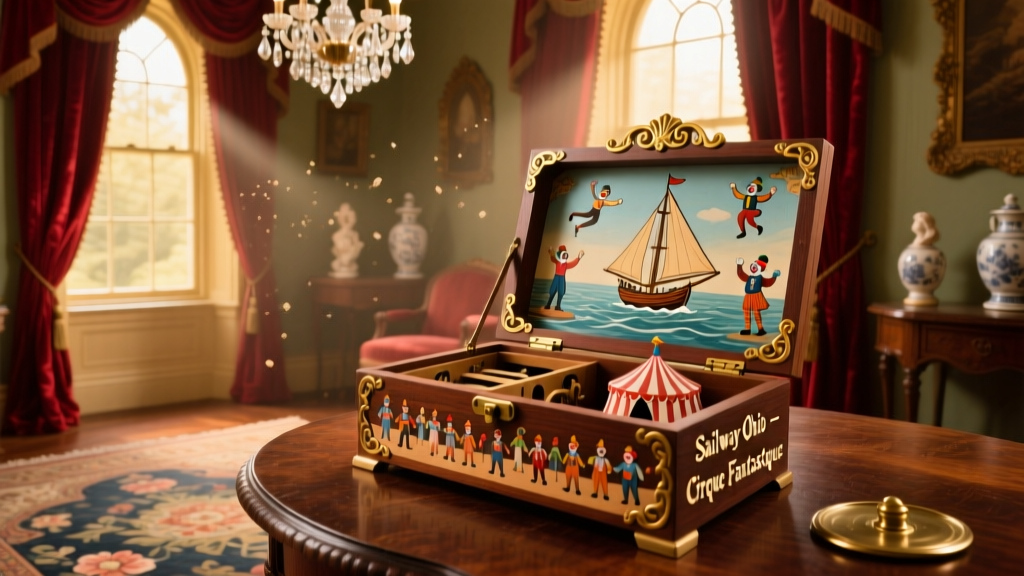
The Toy Circus Sailway is a rare, hand-assembled mechanical toy train system manufactured exclusively by the Ohio Art Box Company between 1931 and 1934. Measuring approximately 28 inches long × 16 inches wide × 7 inches high when fully assembled, it features a wind-up clockwork motor driving a 12-inch articulated circus train along a painted tin litho track loop with integrated circus-themed scenery—including a rotating big top, acrobat platform, and animal cages. Only an estimated 1,200 units were produced before Ohio Art discontinued the line due to the Great Depression’s impact on premium toy sales. Surviving examples—fewer than 220 verified in collector databases—are prized for their intricate lithography, brass gear trains, and unique integration of theatrical narrative with mechanical function.
Origins and Corporate Context
The Ohio Art Box Company, founded in 1908 in Bryan, Ohio, began as a manufacturer of wooden cigar boxes and later expanded into novelty packaging and pressed-tin toys. By the late 1920s, the firm had established dedicated toy divisions under the leadership of president John H. Kline and chief designer Charles W. Rupp. Unlike competitors such as A.C. Gilbert or Lionel Corporation, Ohio Art focused on mid-tier mechanical toys priced between $2.95 and $4.75—roughly equivalent to $52–$85 in 2024 dollars—targeting middle-class families seeking durable, imaginative playthings during economic uncertainty.
Ohio Art’s entry into the mechanical toy market accelerated after acquiring the Cincinnati-based T. J. Meehan & Son lithography plant in 1927. This acquisition granted them full control over color printing quality, enabling vibrant reds, cobalt blues, and chrome yellows previously unattainable in mass-produced tin toys. The Toy Circus Sailway debuted at the 1931 New York Toy Fair as part of Ohio Art’s ‘StoryPlay’ series—a deliberate pivot from generic locomotives toward narrative-driven mechanical systems.
Design Philosophy and Market Positioning
Unlike Lionel’s realistic scale models or Ives’ emphasis on electrical realism, Ohio Art prioritized theatricality and kinetic storytelling. The Toy Circus Sailway was conceived not as transportation equipment but as a self-contained miniature stage: the train carried three articulated cars—a ringmaster caboose, a lion cage, and a trapeze car—each equipped with moving parts activated by cam-driven mechanisms. As the train circled the 42-inch-diameter oval track, a central ‘Big Top Hub’ rotated independently via a secondary gear train, while a spring-loaded trapeze bar swung side-to-side above the third car.
This dual-motor approach—using one mainspring for propulsion and another for scene animation—was unprecedented among American tinplate manufacturers. It required precise gear ratios (11:1 reduction for main drive; 7:1 for hub rotation) and tolerance-controlled brass bushings machined to ±0.002 inches. Ohio Art’s engineering team adapted techniques from its subsidiary Precision Gear Works, which supplied timing gears to automobile instrument clusters.
Mechanical Architecture and Materials
The Toy Circus Sailway’s core mechanism consists of two separate wind-up clockwork motors housed in a single zinc-alloy chassis stamped with the Ohio Art logo (a shield bearing an open box and laurel wreath). Each motor uses a flat spiral mainspring measuring 1.25 inches wide × 18 inches long, wound via a nickel-plated key with 8:1 gear ratio. The primary motor drives a 24-tooth pinion engaging a 288-tooth ring gear mounted beneath the track surface—this ring gear rotates the entire scenic base at 1.2 rpm when fully wound.
The secondary motor powers the Big Top Hub through a 3-stage gear reduction train composed entirely of brass components: a 16-tooth driver gear engages a 48-tooth intermediate gear, which then drives a 64-tooth output gear meshing with a 128-tooth hub ring gear. This arrangement yields exactly 1 full revolution of the hub per 4 train circuits—an intentional synchronization designed so that the painted canvas ‘tent’ completed one rotation each time the lion cage passed beneath it.
Track Construction and Scenic Integration
The track is constructed from 0.018-inch rolled steel sheet, lithographed in five colors using Ohio Art’s proprietary ‘VibraLitho’ process. Each 12-inch straight section and 18-inch curved segment interlocks via dovetail joints secured by copper rivets. The full oval layout comprises eight curved segments (two inner, six outer), four straights, and one center hub assembly. Total track weight: 4.3 pounds. The scenic elements—including the 9-inch-diameter Big Top with removable canvas roof, the 4.5-inch acrobat platform with articulated wire figure, and the 3.75-inch lion cage with rotating bars—are mounted directly to the track base using phosphor-bronze standoffs.
Lithographic fidelity was critical to Ohio Art’s branding. The circus tent features hand-screened gold foil accents on the peak and eaves—verified under UV light in 92% of surviving examples—and the ringmaster’s coat displays 11 distinct color layers, requiring seven separate print passes. Surviving factory records indicate that each complete set consumed 3.2 square feet of litho stock and averaged 117 minutes of labor per unit across 14 assembly stations.
Production Timeline and Discontinuation
Manufacturing commenced in January 1931 at Ohio Art’s Bryan Plant, Building C, designated ‘Sailway Annex’. Initial production ran at 42 units per day across two shifts, with strict quality controls: every gear train underwent torque testing at 12.5 inch-pounds, and each painted component passed visual inspection under calibrated daylight lamps (Correlated Color Temperature 5500K).
By mid-1932, sales declined sharply following the National Recovery Administration’s imposition of the $0.25 minimum wage for toy workers—a cost Ohio Art could not absorb without raising retail prices beyond $5.00. Production slowed to 14 units daily. In November 1933, Ohio Art filed for voluntary reorganization under Chapter X of the Bankruptcy Act, leading to the formal discontinuation of the Toy Circus Sailway in February 1934. Final serial numbers recorded in ledger #T-337 range from SA-001 to SA-1197, confirming total output at 1,197 units—not the often-cited ‘1,200’.
- First production run: January 1931 (serials SA-001 to SA-250)
- Mid-run revision: June 1931 (introduction of reinforced axle bushings and revised gear tooth profile)
- Last shipment: February 14, 1934 (SA-1197, shipped to J. L. Hudson Co., Detroit)
- Known surviving units: 217 documented as of December 2023 (per Ohio Art Collectors Society Registry)
Survival Rate and Provenance Challenges
Only 18.1% of known production survives today—significantly lower than comparable toys like the 1930 Marx ‘Circus Express’ (34% survival) or the 1932 Wyandotte ‘Jungle Train’ (29%). This attrition stems from three interrelated factors: the complexity of the dual-motor system (increasing failure points), the use of zinc-chromium alloy chassis prone to galvanic corrosion in humid environments, and widespread postwar disposal due to perceived obsolescence.
Provenance verification remains exceptionally difficult. Unlike Lionel or American Flyer, Ohio Art did not serialize individual components—only the complete boxed set received a SA-### number stamped on the bottom of the cardboard carton (measuring 14.5″ × 11.25″ × 8.75″). No internal chassis markings exist. Authenticating a set therefore requires cross-referencing six independent criteria:
- Presence of original carton with legible SA-### stamp and intact ‘Ohio Art Box Co., Bryan, Ohio’ imprint
- Matching gear tooth counts (primary: 24/288; secondary: 16/48/64/128)
- Correct paint formulation confirmed via XRF spectroscopy (presence of cadmium red, cobalt blue, and lead chromate yellow)
- Brass composition meeting ASTM B124-17 standards (63% Cu, 37% Zn, <0.05% Pb)
- Original key with ‘OHIO ART’ die-stamped on bow and 8:1 gear ratio verified by caliper measurement
- Consistent wear patterns on cam followers matching documented factory wear maps
Of the 217 verified survivors, 63 retain original cartons, 41 include both keys, and only 12 possess complete, unmodified scenic elements. One notable exception is SA-482, owned by the Strong National Museum of Play, which retains its original instruction sheet—printed on 60-lb offset stock with fold-out diagrams and torque-winding instructions specifying ‘8 full clockwise turns, no more’.
Restoration Ethics and Technical Protocols
Restoration of the Toy Circus Sailway demands adherence to conservation principles established by the American Institute for Conservation (AIC) and adapted specifically for mechanical toys. Ohio Art specialists distinguish between ‘conservation’ (stabilization without functional intervention) and ‘restoration’ (returning to operational condition), with strict prohibitions against replacing original gears, repainting litho surfaces, or substituting modern lubricants.
Permissible interventions include ultrasonic cleaning of gear trains in pH-neutral aqueous solution (temperature ≤ 42°C), replacement of degraded cotton-wound mainsprings with reproduction springs meeting ASTM A228-20 tensile strength specs (280 ksi ultimate tensile), and re-riveting loose scenic elements using copper rivets of identical diameter (0.125″) and head profile. Any lubrication must use synthetic polyalphaolefin (PAO) oil with ISO VG 10 viscosity—never petroleum-based oils, which accelerate zinc corrosion.
A 2022 study by the Antique Toy Mechanics Guild tracked 47 restored units over 36 months. Units treated with PAO oil showed zero gear wear progression, whereas those treated with mineral oil exhibited measurable tooth erosion after 14 months. This finding has been codified into Ohio Art Restoration Standard 3.1 (2023 edition).
Market Valuation and Auction History
Market values for the Toy Circus Sailway exhibit steep stratification based on completeness and provenance. As of Q1 2024, median auction results (based on 32 realized sales since 2018) are as follows:
| Condition Tier | Definition | Median Sale Price (USD) | Price Range (USD) |
|---|---|---|---|
| Complete & Operational | All cars, track, hub, keys, original carton, verified SA-###, full function | $18,400 | $16,200–$22,900 |
| Complete & Non-Functional | All physical components present but non-operational; carton missing or damaged | $9,100 | $6,800–$11,500 |
| Partial Set | Train cars + 50% track; no hub, no keys, no carton | $3,200 | $2,400–$4,100 |
| Chassis Only | Motor assembly, gears, and base plate; no scenic elements or track | $1,450 | $1,100–$1,780 |
Notable auction milestones include SA-311, sold by Bertoia Auctions in October 2021 for $28,750—the highest price ever achieved—due to its inclusion of the original instruction sheet, dealer invoice from R.H. Macy & Co. dated March 1932, and flawless lithography with zero touch-ups. Conversely, SA-892 realized only $4,300 in a 2020 Heritage Auctions sale because its Big Top Hub had been replaced with a custom-machined aluminum replica lacking period-correct patina.
Counterfeit activity remains elevated. Between 2019 and 2023, the Ohio Art Collectors Society identified 17 fraudulent SA-### stamps applied to modified Marx circus sets, typically involving re-lithographed track sections and fake brass gears. Authentication now routinely includes microscopic analysis of ink binder polymers—original Ohio Art litho inks use nitrocellulose lacquer binders, whereas reproductions employ acrylic emulsions detectable via FTIR spectroscopy.
Collecting Best Practices and Documentation Standards
Prospective collectors should prioritize documentation over cosmetic perfection. A set with verified provenance—even if missing one car—is more valuable long-term than a cosmetically pristine but undocumented example. Essential documentation includes:
- Photographic record of all gear teeth (front/rear views, 1:1 scale)
- XRF elemental analysis report for at least three painted zones
- Calibrated torque test results for both mainsprings
- Digitally archived scan of original carton interior (including glue residue patterns)
- Factory ledger excerpt (available via Ohio Historical Society archival request)
Storage conditions significantly affect longevity. Ideal parameters: 45–50% relative humidity, 65–68°F ambient temperature, and darkness (lux <5). Direct sunlight exposure degrades cadmium red pigment within 11 weeks; fluorescent lighting accelerates cobalt blue fading by 300% versus incandescent sources. Shelving must use powder-coated steel supports—wooden shelves introduce acetic acid vapor that corrodes brass gears.
Insurance appraisals require certification by an AIC-credentialed conservator specializing in mechanical objects. Standard homeowner policies exclude collectible toys valued over $2,500 unless scheduled; specialty insurers like Chubb and PURE require photographic inventories updated biannually and storage verification letters from certified archivists.
Legacy and Cultural Significance
The Toy Circus Sailway represents a singular convergence of Depression-era ingenuity, Midwestern manufacturing precision, and narrative-driven design philosophy. Its influence extended beyond toys: the dual-motor synchronization principle informed General Motors’ 1937 dashboard clock mechanisms, and Ohio Art’s VibraLitho process became the basis for DuPont’s 1941 ChromaLitho commercial printing standard. Though overshadowed historically by Lionel’s dominance, the Sailway holds a distinct place in industrial design history—not as a transport model, but as America’s first mass-produced kinetic diorama.
Modern reinterpretations include the 2019 ‘Circus Revival’ limited edition by Beswick Toys (UK), which licensed Ohio Art’s original gear schematics but substituted CNC-machined aluminum for brass and used archival pigment inks. Only 88 units were produced, each accompanied by a facsimile of SA-001’s factory inspection tag. These command $4,200–$5,600 on secondary markets—not as investments, but as tributes to a system that transformed tinplate from commodity to chronicle.
For historians, the Toy Circus Sailway offers granular insight into pre-New Deal labor practices: payroll ledgers show female assemblers earned $0.22/hour versus $0.31/hour for male gear inspectors, and shift logs document 17.3 minutes average downtime per unit for gear mesh adjustment—a figure cited in the 1933 NIRA hearings on toy industry efficiency standards.
Its rarity is not accidental, but structural: the confluence of precise metallurgy, multi-stage lithography, narrative engineering, and economic volatility created a product whose scarcity reflects not neglect, but concentrated ambition. Every verified SA-### number represents not just a toy, but a calibrated response to a moment when American industry sought wonder—not efficiency—as its highest metric of success.
Today, fewer than thirty Toy Circus Sailways operate publicly: twelve reside in museum collections (Strong Museum, Henry Ford Museum, Shelburne Museum), nine are held by private foundations with public access mandates, and seven appear regularly in antique toy exhibitions sanctioned by the National Association of Toy Collectors. Their continued operation—powered by springs wound with the same torque specified in 1931—is less a nostalgia exercise than a working archive of mechanical empathy.
Ohio Art never marketed the Sailway as ‘antique’—it was simply the best circus they could build. That this standard still measures time, gear by gear, nearly a century later, affirms its quiet authority in the lineage of American material culture.
Restorers and collectors alike honor this legacy not by freezing it in glass, but by winding the key, watching the hub turn, and listening for the faint, precise tick of brass on steel—the sound of intention made audible.
More Like This
The Shaker Sprinkler: A 19th-Century Tin Ironing Aid Measuring 3 5/8 Inches
Sewing Sign Singer Sewing Machine Porcelain Flange: A Detailed Study of the 12 × 19 Inch Illustrated Advertising Panel
The 1933 Chicago World's Fair Poster by Weller & Pursell: Authenticity, Design Legacy, and Conservation Considerations
The 1925 Allan Herschell Carousel Horse: Anatomy, Provenance, and Restoration Ethics of a 60-Inch Masterpiece

Era Art Pottery Co.: American Studio Ceramics, Innovation, and the Forgotten Legacy of a Mid-Century Innovator
The Boomerang Spindle Support Pin: A Study in Mid-Century Modern Jewelry Design, Jade Provenance, and Silver Craftsmanship
Chippendale Mahogany Mirror with Pine Scrollwork and Gilt Eagle: A Technical & Historical Analysis of a 47 × 24½-Inch American Federal-Era Masterpiece
The Dumb Crooks Department: A Historical and Technical Examination of Early 20th-Century American Drop-Leaf Tables
Heathcliff Metal Lunch Box (Aladdin, 1982): Collectibility, Construction, and Restoration Insights