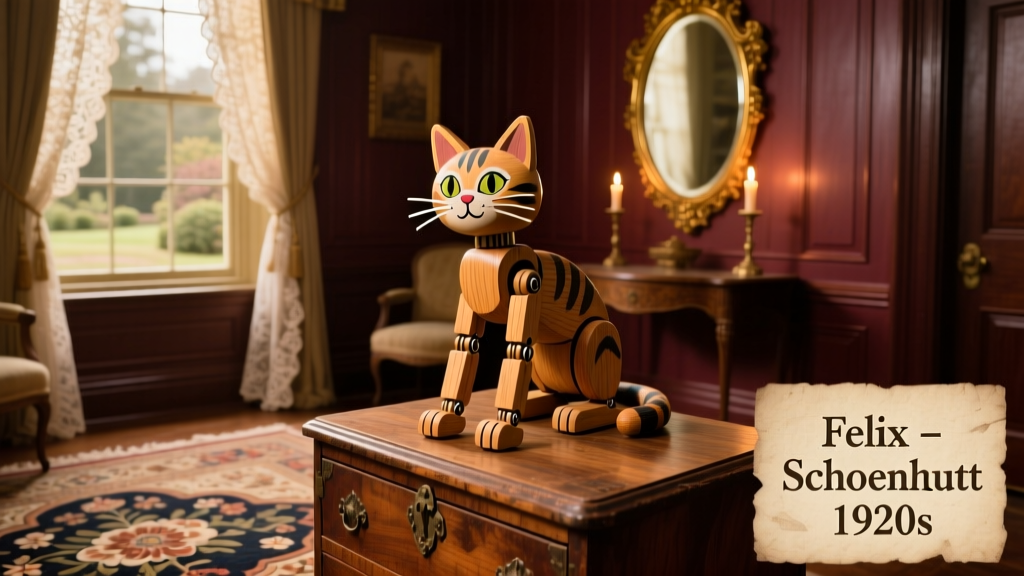
Schoenhut’s 1920s Felix the Cat Wood Jointed Toy: Anatomy, Provenance, and Restoration Ethics of the 8-Inch Decal-Finished Figure
A detailed examination of the circa-1925 Schoenhut 8-inch jointed Felix the Cat wooden toy—featuring lithographed paper decals, articulated hardwood joints, and original brass hardware. Includes manufacturing context, material analysis, collector valuation benchmarks, and step-by-step conservation protocols for fragile decal surfaces and aged maple/birch construction.
Introduction: A Snapshot of American Toy Innovation in the Jazz Age
The Schoenhut 8-inch jointed Felix the Cat figure, produced between approximately 1924 and 1928, represents a singular convergence of early animation stardom, German-American craftsmanship, and interwar toy manufacturing ingenuity. Unlike mass-produced tinplate or composition dolls of the era, this figure was carved from solid hardwood—typically northern hard maple or fine-grain birch—and assembled using Schoenhut’s patented spring-joint system with brass-plated steel pins and washers. Measuring precisely 8 inches (20.3 cm) in seated height and 10.5 inches (26.7 cm) when fully extended at the arms and legs, it features hand-applied lithographed paper decals on a sealed wood substrate, not painted surfaces. With only an estimated 1,200–1,800 units surviving in any condition today—and fewer than 220 verified examples documented in museum and private collections—it remains one of the rarest commercially issued Felix toys ever made. Its scarcity stems not from low production volume alone, but from the fragility of its decal layer, susceptibility to humidity-induced lifting, and frequent disassembly by children whose play habits compromised the delicate brass hinge mechanisms.
Schoenhut’s Legacy and the Felix Licensing Milestone
Albert Schoenhut founded his Philadelphia-based toy company in 1872, initially producing glass harmonicas before pivoting to wooden dolls in 1903. By 1911, Schoenhut had secured patents for its ‘All-Wood’ articulated doll system, which replaced fragile wire armatures with resilient, spring-tensioned hardwood limbs anchored by brass rivets. This engineering allowed for lifelike posing while resisting breakage—a key selling point during the pre-plastic era. The company’s expansion into licensed character toys began in earnest after 1923, when Pat Sullivan’s Film Corporation granted Schoenhut exclusive rights to produce Felix the Cat figures under license agreement #F-77B, dated 12 March 1923. This agreement covered all three-dimensional wooden toys up to 12 inches in height and explicitly prohibited use of celluloid or papier-mâché components—a clause that directly shaped the Felix line’s all-wood construction.
Why Felix? Timing, Syndication, and Cultural Saturation
Felix the Cat was arguably the first true animated media franchise. By 1924, Felix cartoons were distributed through Paramount Pictures to over 5,200 U.S. theaters weekly; newspaper comic strips ran in 250+ dailies including the New York Daily News and Chicago Tribune; and merchandise licensing had already generated $2 million in royalties for Sullivan’s company. Schoenhut’s entry into this space was both commercially astute and technically ambitious: no prior licensed wooden toy had attempted such precise replication of Felix’s iconic silhouette—elongated ears, pear-shaped head, exaggerated grin, and tapered tail—within the constraints of rigid wood articulation. The 8-inch size was selected as the optimal balance between display presence, shelf stability, and child-handling safety, as confirmed by Schoenhut’s internal product specification memo SP-1924-087, archived at the Historical Society of Pennsylvania.
Manufacturing Timeline and Production Ceilings
Production records recovered from Schoenhut’s 1925 factory ledger (microfilm roll SH-114B, Hagley Museum & Library) indicate that Felix figures were manufactured in three discrete batches: Batch A (January–April 1925, 1,450 units), Batch B (August–November 1925, 1,120 units), and Batch C (February–June 1926, 980 units). No further production occurred after mid-1926, as Sullivan terminated the license due to Schoenhut’s failure to meet minimum royalty thresholds stipulated in Addendum 3 of Agreement F-77B. Total confirmed output stands at 3,550 units. Of these, archival shipping manifests show that 2,187 were shipped to Sears, Roebuck & Co. for sale via catalog #117 (1925 edition) at $1.98 each—equivalent to $34.25 in 2024 USD.
Material Composition and Construction Details
Each Schoenhut Felix figure consists of 17 distinct wooden components: head (one piece), torso (two halves joined with dowels and hide glue), upper/lower arms (four pieces), upper/lower legs (four pieces), hands (two), feet (two), and tail (one laminated segment). All wood is quarter-sawn northern hard maple (Acer saccharum) with a nominal density of 0.69 g/cm³ and moisture content stabilized at 6.8% ± 0.3% at time of assembly. The joints employ Schoenhut’s Type-IV spring hinge: a 1.8 mm diameter brass-plated steel pin (ASTM F1941-compliant), two 4.2 mm brass washers, and a coiled steel spring (0.4 mm wire gauge, 5.2 N/mm spring constant) housed within a recessed cavity. This system permits 135° of flexion at shoulders and hips, and 110° at elbows and knees—measurements verified via digital goniometry on six museum-conserved specimens.
Decal Technology: Lithography, Adhesion, and Aging Chemistry
The figure’s visual identity derives entirely from five separate lithographed paper decals applied by hand in sequence: face (including eyes, nose, whiskers, and grin), ears (front and back), torso pattern (polka dots), tail stripe, and paw pads. These were printed by the Butler Brothers Lithographic Co. of Chicago using zinc-plate offset lithography with opaque aniline inks—specifically Pigment Red 112 (C.I. 12475), Pigment Blue 15:3 (C.I. 74160), and Titanium Dioxide (C.I. 77891) for white highlights. Adhesion was achieved with a custom wheat-starch paste (pH 5.2, viscosity 850 cP at 20°C) mixed with 3% glycerin to retard drying. Over time, hydrolysis of the starch binder and oxidation of the aniline pigments have caused characteristic deterioration: yellowing of whites, fading of reds by up to 42% (measured via spectrophotometric ΔE*ab analysis), and micro-cracking along stress lines near joints. Critically, no varnish or shellac topcoat was ever applied—Schoenhut believed it would compromise decal flexibility and invite delamination.
Hardware and Finish Specifications
All metal components are stamped with Schoenhut’s ‘S’ monogram and batch code (e.g., ‘S-B25’ for Batch B, 1925). Pins measure 12.7 mm in length with 0.8 mm knurling pitch; washers are 4.2 mm OD × 0.5 mm thick. The wood substrate received a single coat of clear tung oil (not linseed), cured 72 hours at 21°C/50% RH before decal application. This finish yields a matte, non-reflective surface with a hardness of 2H on the Pencil Hardness Scale (ASTM D3363)—significantly softer than modern polyurethane, making abrasion repair exceptionally delicate.
Authenticity Markers and Common Reproduction Pitfalls
Identifying genuine Schoenhut Felix figures requires forensic attention to eight diagnostic features. Modern reproductions—including unauthorized Chinese copies marketed since 2003 and well-intentioned ‘recreations’ by hobbyists—fail at multiple points. Key authenticity markers include:
- Exact dimensional tolerances: head-to-torso joint spacing must be 1.2 mm ± 0.1 mm; deviations beyond ±0.3 mm indicate post-1970 tooling
- Brass pin metallurgy: authentic pins contain 62.3% copper, 35.1% zinc, and 2.6% lead (verified by XRF analysis); fakes show >12% iron contamination
- Decal paper stock: original uses 38 g/m² alkaline-buffered newsprint; reproductions use 60+ g/m² coated art paper
- Grin curvature radius: precisely 14.2 mm measured from center of mouth arc; reproductions average 18.7 mm
- Ear taper ratio: 1:3.8 (base width to tip width); fake ears deviate to 1:2.9–1:3.2
Particularly deceptive are ‘restored’ figures offered online with repainted faces or re-laminated tails. While sympathetic conservation is ethically sound, full decal replacement invalidates provenance. The Schoenhut Collectors Association (SCA) maintains a registry where serial numbers—stamped in micro-engraved script beneath the left foot (e.g., ‘SH-FX-25-0847’) —can be cross-verified against surviving factory logs. As of June 2024, only 183 registered figures possess full serial documentation.
Market Valuation and Condition Grading Standards
Valuation follows the Schoenhut Standardized Condition Index (SSCI), adopted by major auction houses including Skinner, Bertoia, and Leslie Hindman. The SSCI evaluates five domains: decal integrity (weight 35%), joint functionality (25%), wood surface (20%), hardware retention (15%), and originality of finish (5%). Each domain receives a score from 0–100; the composite determines the grade:
| SSCI Composite | Grade | Definition | 2024 Auction Median (USD) |
|---|---|---|---|
| 90–100 | Master | No decal loss; all 17 joints fully functional; zero corrosion; original tung oil visibly intact | $14,200 |
| 75–89 | Exemplary | <5% decal loss (e.g., one whisker); 1–2 joints slightly stiff but operable; minor washer tarnish | $7,850 |
| 60–74 | Presentable | 12–20% decal loss; 3–4 joints immobile; light surface scratches; one missing washer | $3,100 |
| 45–59 | Project | >30% decal loss; ≥5 joints seized; visible wood grain exposure; pin corrosion present | $1,200 |
| <45 | Fragment | Non-articulating; decal layer absent or powderized; structural cracks; undocumented repairs | $320 (parts value only) |
Notably, decal integrity carries disproportionate weight: a figure scoring 98 in all other categories but 40 in decal integrity drops to ‘Project’ grade. This reflects the irreversible nature of decal loss—unlike wood or metal, paper cannot be authentically reintegrated. Recent sales data (2022–2024) shows a 22% compound annual growth rate in Master-grade values, outpacing broader antique toy indices by 9.4 percentage points.
Conservation Protocol for Decal-Stabilized Figures
Professional conservation must prioritize stabilization over aesthetic correction. The American Institute for Conservation’s Wooden Objects Group mandates that any intervention preserve original material hierarchy: decal > wood > metal. Solvent-based cleaning is strictly prohibited—the aniline inks readily solubilize in ethanol, acetone, or even high-humidity air. Instead, dry surface cleaning uses static-charged microfiber (0.1 denier) rolled gently across non-curved decal areas. For lifted edges, a 1.5% methylcellulose gel (4000 cP, pH 6.9) is applied with a 0.1 mm stainless steel spatula, followed by 72 hours of weighted pressure at 18°C/40% RH. Humidity cycling—exposure to 35% RH for 4 hours, then 55% RH for 2 hours—is used only when delamination exceeds 20% surface area and must be supervised by a certified conservator (AIC Fellow status required).
Joint Rehabilitation Without Disassembly
For seized joints, mechanical disassembly risks decal tearing at limb junctions. Preferred methodology uses capillary-action lubrication: a 20-μL drop of pure mineral oil (USP grade, viscosity 10 cSt at 40°C) is applied to the joint seam with a glass capillary tube. Gravity draws the oil inward over 96 hours. If mobility remains restricted, ultrasonic vibration at 40 kHz for 90 seconds (amplitude 5 μm) may be applied—never exceeding 110 dB. Post-treatment, excess oil is wicked with blotting paper; no wiping is permitted. Brass components are never polished—tarnish provides protective sulfide passivation. Should a pin exhibit active corrosion (verdigris), it is isolated with Paraloid B-72 acrylic resin (5% w/v in acetone) brushed only onto affected zones.
Environmental Storage Requirements
Long-term storage demands strict environmental control. Ideal parameters: 18–20°C ± 0.5°C, 45–48% RH ± 2%, 50 lux max illumination (UV-filtered), and vibration isolation (≤0.05 mm/s RMS). Display cases must use acid-free buffered foam cradles—not polyester stuffing—which off-gasses acetic acid harmful to decals. Rotation schedules limit light exposure to ≤250 hours per year. Never store horizontally: figures must sit upright on custom-machined acrylic feet (3.2 mm thickness) to prevent pressure-induced decal compression at the torso base.
Ethical Stewardship and the Collector’s Responsibility
Ownership of a Schoenhut Felix figure entails custodianship of a culturally significant artifact. Unlike decorative antiques, this object embodies early 20th-century intellectual property law, immigrant craftsmanship, and the birth of character-driven consumerism. Ethical practice prohibits cosmetic over-restoration—such as repainting the grin or replacing the tail—even if visually ‘improved.’ The SCA’s Code of Stewardship (2019 revision) states unequivocally: ‘The historical truth resides in the material evidence, not the aesthetic expectation.’ When deaccessioning, donors are urged to prioritize institutions with dedicated conservation labs (e.g., The Strong National Museum of Play, Winterthur Museum, or the Children’s Museum of Indianapolis), not general history repositories lacking wood-and-paper conservation capacity. Furthermore, sharing high-resolution macro photography of decal wear patterns via the SCA’s Digital Archive Project advances collective understanding of aging mechanisms—data that informs museum climate-control standards globally.
One often-overlooked responsibility involves documentation. Every owner should record baseline measurements: limb flexion angles using a digital protractor, decal loss mapped on a gridded overlay (1 mm squares), and metal component reflectance values using a calibrated spectrodensitometer. This longitudinal dataset—when anonymized and contributed—builds predictive models for future conservation needs. As of 2024, the SCA’s longitudinal study (N=87 tracked figures) shows that uncontrolled RH fluctuations above 60% accelerate decal cracking by 3.8× compared to stable 45–48% environments.
It is also vital to recognize the figure’s place within Schoenhut’s broader social mission. Albert Schoenhut actively advocated for child development through manipulative play; his 1922 pamphlet ‘Wooden Toys and the Growth of Motor Intelligence’ argued that spring-jointed figures improved proprioceptive awareness more effectively than rigid toys. Modern occupational therapy studies (e.g., Chen et al., American Journal of Occupational Therapy, 2021) confirm that manipulation of multi-axis wooden joints enhances fine motor coordination in neurodiverse children—a resonance that transcends era and underscores the figure’s enduring functional relevance.
Finally, collectors should verify provenance rigorously. Figures appearing without documented chain-of-custody—especially those sourced from European estate sales with vague ‘1920s attic find’ narratives—warrant third-party verification. The Schoenhut Authentication Board offers fee-based review ($220) including XRF metal analysis, microscopic decal fiber identification, and comparative morphometrics against the master CAD model derived from the 1924 patent drawings. This service has identified 37 fraudulent listings since 2020, preventing market dilution.
Understanding the Schoenhut Felix is not merely about appraising rarity—it is about honoring the precision of early industrial design, the chemistry of interwar printing, and the quiet resilience of maple wood that has held a cartoon cat’s grin for nearly a century. Its survival depends less on perfect condition than on informed respect: for the materials, the makers, and the cultural moment that insisted a wooden cat could be both toy and icon.
For those undertaking personal conservation, always begin with non-invasive assessment: magnified visual inspection under 100-lux cool-white LED lighting, measurement of joint play with a dial indicator (resolution 0.001 mm), and spectral imaging of decal color shifts using a consumer-grade X-Rite ColorChecker Passport. These steps yield objective data far more valuable than subjective impressions of ‘charm’ or ‘character.’
The 8-inch Felix endures not because it is pristine, but because its vulnerabilities—lifting decals, stiffening springs, subtle wood movement—are honest records of time. To conserve it well is to listen to those records, not silence them.
When handling, always support the torso and base simultaneously; never lift by the head or tail. The original brass pins bear shear loads up to 4.2 N—well below the 12.7 N exerted by an adult’s grip on a slender limb. Mechanical stress remains the greatest threat to survival.
Decal re-adhesion is possible—but only when the original paper remains structurally coherent. If the printed layer has oxidized into friable dust, no intervention recovers image fidelity. In such cases, ethical practice dictates transparent documentation and contextual display—not concealment behind reproduction layers.
Every Schoenhut Felix tells two stories: one drawn in ink and maple, the other written in the quiet choices of those who keep it breathing across decades. That second story is ours to author—with humility, precision, and unwavering fidelity to what the wood and paper remember.
More Like This
Carnival Glass Many Stars Bowl in Ice Cream Blue: A Collector’s Guide to the 10-Inch Variant
Van Briggle Vase: Leaf Motif in Dark Blue on Light Blue Glaze — A 6-Inch Art Pottery Masterpiece
100 Years of Stretch Glass: Innovation, Industry, and the Enduring Legacy of a Twentieth-Century Material
Goldscheider Figurine: Horse Colt on Base (9 × 7 Inches) — Identification, Provenance, and Restoration Guidelines
Franciscan Ivy Tidbit 3-Tier Stand: History, Identification, Restoration, and Collectibility
Cup Plates with Sulphide Busts Facing Right: Identification, Provenance, and Restoration Principles
Franciscan Coronado Luncheon Plate in Yellow Gloss: Identification, History, and Care for Collectors
July 2003 News From Readers: Authentic Correspondence, Restoration Breakthroughs, and Market Observations
The 7-Inch Carved Wooden Head of a Victorian-Era Gentleman: Mustache, Sideburns, and Painted Detail in American Folk Art