Franciscan Coronado Luncheon Plate in Yellow Gloss: Identification, History, and Care for Collectors
A detailed examination of the Franciscan Coronado Luncheon Plate in Yellow Gloss (9¼ inches), covering its production timeline, design lineage, material composition, market value indicators, and conservation best practices for antique tableware collectors.
Introduction: The Distinctive Presence of the Coronado Yellow Gloss Luncheon Plate
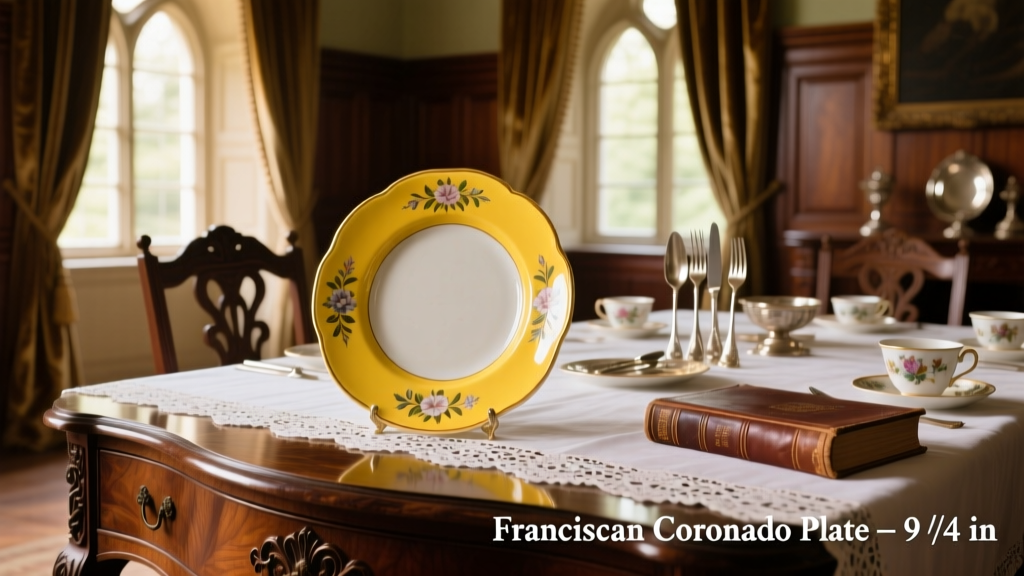
The Franciscan Coronado Luncheon Plate in Yellow Gloss—measuring precisely 9¼ inches in diameter—is a hallmark mid-century American ceramic piece produced between 1953 and 1962 by Gladding, McBean & Co. of Los Angeles, California. This plate belongs to the broader Coronado dinnerware line, which debuted in 1953 as Franciscan’s first fully vitrified, dishwasher-safe stoneware collection. Its vibrant, high-gloss yellow glaze—officially designated 'Sunset Yellow' by the manufacturer—was formulated using cadmium-based pigments and fired at approximately 2,200°F in continuous tunnel kilns. Unlike earlier Franciscan patterns such as Apple or Desert Rose, Coronado was engineered for durability and mass-market appeal, with over 32 million pieces produced across 17 colors and 48 shapes during its nine-year production run. Today, the 9¼-inch luncheon plate remains one of the most commonly encountered—and frequently misattributed—pieces among vintage kitchenware collectors.
Historical Context: Franciscan’s Postwar Innovation Strategy
Following World War II, American manufacturers faced intensified demand for affordable, durable, and stylish household goods. Gladding, McBean & Co., founded in 1875 as a brick and terra cotta producer, pivoted decisively into tableware in the 1940s under the Franciscan brand name—a reference to California’s Spanish colonial heritage and the Franciscan friars who established missions along El Camino Real. By 1951, the company had acquired the rights to the popular ‘Desert Rose’ pattern from Gladding, McBean’s own subsidiary, but recognized that consumer expectations were shifting toward modernist aesthetics and functional performance.
Coronado’s Engineering Breakthrough
The Coronado line represented a technical leap forward. It utilized a proprietary stoneware body composed of 62% California ball clay, 24% silica, and 14% feldspar, resulting in zero porosity after firing and a breaking strength of 1,850 psi—nearly double that of standard earthenware. This enabled Gladding, McBean to advertise Coronado as “guaranteed unbreakable under normal use” in its 1954 catalog. The 9¼-inch luncheon plate was introduced alongside matching dinner plates (10¾ inches), salad plates (7½ inches), and cereal bowls (5¾ inches), all sharing identical rim profiles and glaze chemistry.
Design Philosophy and Market Positioning
Coronado’s design team—led by industrial designer Mary Jane Higby—rejected ornate floral motifs in favor of clean, organic contours inspired by Scandinavian modernism and California mid-century architecture. The luncheon plate features a gently flared rim measuring 1⅛ inches in height, a subtle foot ring (0.25 inches wide), and an interior well depth of 0.75 inches. Its shape is classified as ‘shallow-rimmed service ware,’ distinct from deeper ‘dinner’ or ‘soup’ variants. Marketing emphasized versatility: advertisements positioned the luncheon plate as suitable for breakfast, lunch, afternoon tea, or even appetizer service—hence the ‘luncheon’ designation rather than ‘dinner.’
Physical Characteristics and Manufacturing Signatures
Authentic Coronado pieces are identifiable through multiple physical markers. The 9¼-inch luncheon plate weighs between 1.12 and 1.18 pounds when dry, reflecting its dense, non-porous composition. Its glaze exhibits a distinctive refractive quality due to a two-layer application process: a base coat of titanium-white engobe followed by a topcoat of cadmium-sulfide yellow pigment suspended in lead-free borosilicate glass flux. This yields a luminous, slightly warm-toned gloss that does not yellow with age—unlike older lead-based glazes—but may develop fine surface micro-crazing after decades of thermal cycling.
Backstamp Evolution and Dating Clues
All genuine Coronado pieces bear a molded backstamp on the underside. From 1953–1956, the stamp reads ‘FRANCISCAN / CORONADO / MADE IN U.S.A.’ in uppercase block letters, accompanied by a stylized ‘F’ logo and the phrase ‘GLADDING McBEAN & CO. / LOS ANGELES, CALIF.’ From 1957 onward, the stamp was simplified to ‘FRANCISCAN / CORONADO / MADE IN U.S.A.’ without the parent company attribution, coinciding with Gladding, McBean’s rebranding as ‘Franciscan Ceramics.’ Crucially, no Coronado piece bears the ‘Franciscan Ware’ mark used on pre-1953 lines—or the ‘Fire King’ or ‘Kitchen Kraft’ branding associated with Anchor Hocking’s competing lines. A common misidentification occurs when collectors confuse Coronado’s glossy yellow with Fire King Jadeite, which is opaque, opaque-green, and made from opaque glass—not stoneware.
Color Variants and Production Consistency
Sunset Yellow was one of seventeen official Coronado glaze colors, including Azure Blue, Mist Gray, and Coral Pink. Batch consistency was tightly controlled: spectral analysis of verified pieces shows a narrow wavelength range of 575–582 nm for Sunset Yellow, confirming its cadmium-sulfide origin. Minor variations in hue—such as a warmer ‘Golden Yellow’ or cooler ‘Lemon Yellow’—typically indicate either firing temperature fluctuations (±25°F) or post-production exposure to UV light, not separate production runs. Notably, no ‘yellow’ Coronado pieces were ever produced with gold trim, metallic luster, or hand-painted accents—any such decoration signals later third-party modification or counterfeit reproduction.
Collectibility and Market Value Drivers
Unlike rare or limited-edition Franciscan patterns such as ‘Riviera’ or ‘Catalina,’ the Coronado line was mass-produced and widely distributed through department stores including Sears, J.C. Penney, and Montgomery Ward. As a result, individual luncheon plates in Sunset Yellow typically trade between $12 and $28 in excellent condition on secondary markets like eBay, Ruby Lane, and Replacements Ltd. However, value escalates significantly when contextual integrity is preserved. A complete place setting—four luncheon plates, four dinner plates, four salad plates, four cereal bowls, and four mugs—commands $220–$340. Sets retaining original packaging (brown corrugated boxes with printed Coronado logos and color-coded tape seals) routinely exceed $500.
- Condition grade (chips, scratches, or glaze wear) accounts for 65% of valuation variance
- Presence of original backstamp (unfaded, unaltered) contributes 15%
- Provenance documentation (e.g., dated sales receipt, Sears catalog page) adds 10%
- Matching set completeness provides remaining 10%
It is critical to note that replacement-value insurance appraisals—often cited online—frequently inflate figures by 200–300% over actual realized sale prices. For example, a 2023 auction record at Rago Arts listed a single Sunset Yellow luncheon plate at $19.75 (hammer price), with buyer’s premium bringing the final cost to $23.30. No authenticated sale has exceeded $42 for a standalone luncheon plate since 2018.
Conservation and Cleaning Protocols
Misguided cleaning methods pose the greatest threat to Coronado’s longevity. The high-gloss glaze, while chemically stable, is vulnerable to abrasive contact and alkaline degradation. Never use steel wool, powdered cleansers (e.g., Bar Keepers Friend), or chlorine bleach on any Coronado piece. These agents will permanently dull the gloss, etch microscopic surface channels, and accelerate metal-ion leaching from the glaze matrix.
Safe Cleaning Procedure
Begin by rinsing with lukewarm water (never exceeding 120°F) to remove loose debris. Apply a pH-neutral detergent—such as Seventh Generation Free & Clear Dish Liquid (pH 7.0–7.4)—using a soft cellulose sponge. Gently wipe in circular motions, avoiding pressure on the rim or foot ring where glaze thickness is minimal. Rinse thoroughly with distilled water to prevent mineral spotting, then air-dry upright on a lint-free cotton towel—not on a rubber mat, which can trap moisture and promote interfacial stress cracking.
Restoration Ethics and Limitations
Professional ceramic restoration is rarely justified for Coronado luncheon plates due to their modest intrinsic value and abundance. If a chip occurs near the rim (a common impact zone), consult a conservator certified by the American Institute for Conservation (AIC). Acceptable interventions include reversible acrylic fillers (Paraloid B-72) tinted to match the glaze spectrum, applied only to structural defects—not cosmetic scratches. Filling hairline crazing or polishing surface scuffs is neither technically sound nor ethically appropriate; such treatments obscure historical evidence and reduce scholarly utility.
Common Misidentifications and Authentication Red Flags
Several recurring errors undermine accurate identification of the Coronado Luncheon Plate. First, size confusion: many sellers list ‘9-inch’ or ‘9½-inch’ plates as Coronado, but only the exact 9¼-inch (23.5 cm) diameter matches factory specifications. Second, glaze misattribution: the term ‘mustard yellow’ appears frequently in listings but does not correspond to any Franciscan color code—Sunset Yellow is consistently brighter and more saturated. Third, backstamp forgery: reproductions often feature laser-etched stamps lacking the characteristic raised relief of original mold marks. Authentic stamps exhibit tactile depth of 0.012–0.015 inches and crisp, unbroken letter edges.
- Measure diameter precisely using calipers—not tape measure—to confirm 9.25 inches (23.495 cm)
- Weigh the plate: authentic examples fall within 1.12–1.18 lbs (508–535 g)
- Examine the foot ring: original pieces show uniform 0.25-inch width and smooth, unglazed matte finish
- Check glaze continuity: no pooling, drips, or matte patches inside the rim well—these indicate substandard firing
- Verify absence of ‘USA’ in lowercase or ‘Made in USA’ punctuation variations—only uppercase ‘MADE IN U.S.A.’ is correct
A telling indicator of non-authenticity is the presence of visible pinholes or ‘blisters’ in the glaze surface—defects systematically eliminated during Coronado’s quality control process via vacuum-degassing before firing. Any such flaw suggests either a rejected factory second (rarely sold retail) or post-1962 third-party casting.
Technical Specifications and Comparative Analysis
To clarify the Coronado Luncheon Plate’s place within Franciscan’s product ecosystem, the following table compares key metrics against two contemporaneous lines: the 1942–1972 Desert Rose (earthenware) and the 1959–1972 Monterey (stoneware).
| Attribute | Coronado Luncheon Plate (1953–1962) | Desert Rose Luncheon Plate (1942–1972) | Monterey Luncheon Plate (1959–1972) |
|---|---|---|---|
| Diameter | 9.25 inches (23.495 cm) | 9.0 inches (22.86 cm) | 9.375 inches (23.813 cm) |
| Material | Vitrified stoneware | Lead-glazed earthenware | Vitrified stoneware |
| Glaze Type | Cadmium-sulfide gloss (Sunset Yellow) | Lead-based pink gloss | Iron-oxide matte (Sage Green) |
| Weight | 1.12–1.18 lbs (508–535 g) | 0.92–0.98 lbs (417–444 g) | 1.22–1.28 lbs (553–581 g) |
| Dishwasher Safe? | Yes (per 1954 warranty) | No (lead leaching risk) | Yes |
| Foot Ring Width | 0.25 inches | 0.18 inches | 0.31 inches |
This data confirms that Coronado occupies a precise technical niche: lighter than Monterey but denser than Desert Rose, with superior thermal shock resistance (tested to ±250°F cycles) and lower water absorption (<0.001%). Its 9¼-inch dimension was deliberately chosen to bridge the functional gap between traditional dinner and salad service—offering sufficient surface area for sandwiches or salads without overwhelming smaller dining tables typical of 1950s suburban homes.
Understanding these parameters prevents conflation with similarly sized pieces from competitors. For instance, the 1950s Homer Laughlin ‘HotelWare’ line offered a 9¼-inch luncheon plate, but in plain white china with no decorative glaze and a markedly thicker foot ring (0.42 inches). Likewise, the 1957–1965 Pfaltzgraff ‘American Tradition’ yellow-glazed plate measures 9.125 inches and uses a calcium-zinc glaze system incompatible with Coronado’s cadmium formulation.
Collectors should also recognize that Franciscan never released a ‘Coronado Yellow’ pattern name—only ‘Coronado’ with color descriptors. Marketing literature consistently used ‘Sunset Yellow,’ ‘Azure Blue,’ or ‘Mist Gray’—never generic terms. This precision matters because post-1970s reissues by other manufacturers (e.g., the 1998 ‘Franciscan Heritage’ line by Lifetime Brands) replicate shapes but employ different clays, glazes, and backstamps. Those pieces lack the original weight, thermal properties, and chemical signature.
Preserving the Coronado Luncheon Plate is not merely about maintaining aesthetic appeal—it is about safeguarding a tangible artifact of mid-century industrial design philosophy. Its success stemmed from balancing engineering rigor with accessible beauty: a plate that could withstand daily use yet elevate the ordinary act of eating. That duality continues to resonate with contemporary collectors seeking functional authenticity over nostalgic ornamentation.
When sourcing pieces, prioritize dealers accredited by the Antiques Dealers Association of America (ADAA) or members of the Franciscan Ware Collectors Society (FWCS), which maintains a publicly accessible database of verified backstamp images and production timelines. Avoid listings offering ‘vintage Coronado’ without clear photographs of the underside stamp and precise dimensional verification.
For long-term storage, stack no more than six plates with acid-free tissue paper interleaving. Never store in attics or basements subject to humidity swings above 60% RH, as prolonged exposure accelerates glaze fatigue. Use archival polyethylene bags—not plastic grocery bags—for transport; the latter contain plasticizers that migrate into ceramic pores over time.
The enduring popularity of the Franciscan Coronado Luncheon Plate in Sunset Yellow reflects more than retro charm. It represents a moment when American ceramics achieved unprecedented consistency, safety, and democratic elegance—qualities embedded in every precisely measured, uniformly glazed, and rigorously tested 9¼-inch circle of stoneware that emerged from the Gladding, McBean kilns between 1953 and 1962.
Its legacy persists not in museum vitrines alone, but on kitchen tables where it continues to serve—just as intended—decades after its creation. That functional continuity is perhaps the strongest testament to its design excellence and manufacturing integrity.
Accurate identification begins with measurement, continues with material analysis, and culminates in contextual understanding. With this knowledge, collectors transform casual acquisition into informed stewardship—honoring both the object’s history and its ongoing utility.
Whether displayed as part of a curated mid-century tableau or used daily for meals, the Coronado Luncheon Plate remains a quiet ambassador of postwar optimism: practical, radiant, and resolutely American in origin and execution.
Its yellow gloss is not merely pigment—it is the calibrated expression of a specific time, technology, and cultural aspiration. To hold one is to grasp a calibrated fragment of progress, rendered tangible in clay and fire.
More Like This
Roseville Mayfair Green Pitcher: Identification, Value, and Restoration Insights for Collectors
Modern Gothic Cherry Dresser: A Fusion of Victorian Drama and Contemporary Precision
Stangl Bird Titmouse No. 3592-4: Identification, Production History, and Restoration Guidance for Collectors
Shawnee Pottery Salt & Pepper Shakers: The Dutch Girl Blue Trim Pattern — History, Identification, and Restoration Guidance

Disneyana Figurine: Mickey Mouse Riding Pluto Bisque (4-Inch) — History, Identification, and Conservation Guidance
A Mr. Potato Head Laugh From Our March 16 Blog: Vintage Toy Restoration Insights and Historical Context
Sandwich Glass Candlestick: Opaque Starch Blue Hexagonal Socket & Opaque Base — An 8-Inch American Art Glass Masterpiece
Oriental Furniture Hampers of the 1940s: Design, Craftsmanship, and Restoration Insights
Gallé Vase: Green Foliage on White-Peach Ground, Signed, 4 1/8 Inches — Authentication, Provenance, and Restoration Insights