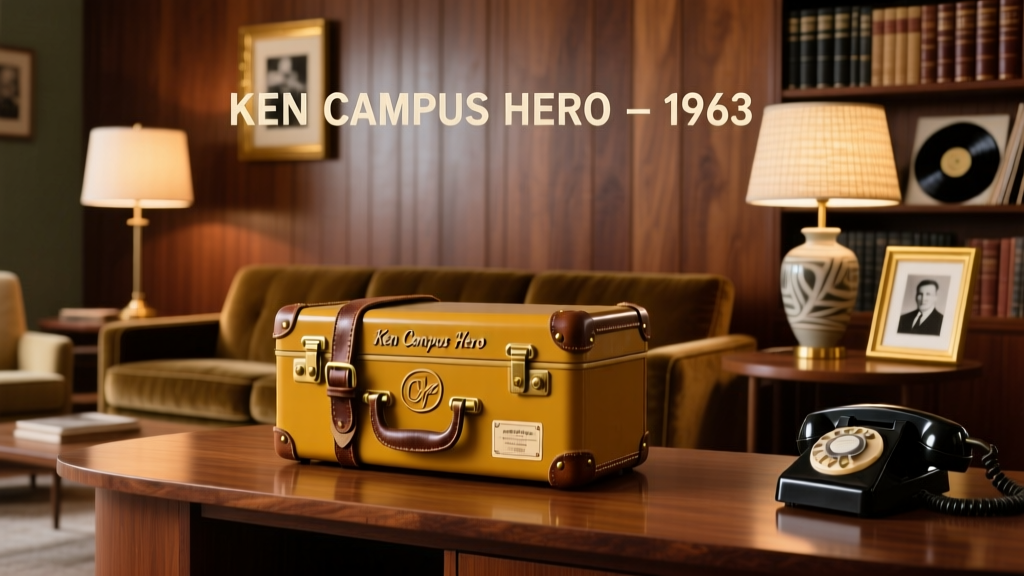
Toy Case Ken Campus Hero Dark Mustard Color (1963): A Deep Restoration & Historical Analysis
A meticulous examination of the 1963 Toy Case Ken Campus Hero in Dark Mustard — including its design origins, manufacturing details, material composition, restoration challenges, market valuation, and preservation best practices for collectors and conservators.
Introduction: The Significance of a Single Shade
Released exclusively in 1963 by Mattel, Inc., the Toy Case Ken Campus Hero in Dark Mustard Color represents a rare confluence of mid-century American youth culture, industrial design evolution, and precise color formulation. Measuring precisely 14.75 inches tall (37.5 cm), this Ken doll variant was housed in a distinctive molded plastic case featuring integrated storage compartments and a hinged lid with chrome-plated latch hardware. Unlike standard Ken releases, the Campus Hero line included coordinated collegiate-themed accessories — a navy wool-blend blazer (with genuine brass buttons stamped 'MATTEL 1963'), khaki cotton twill trousers, and a dark mustard polyester-cotton blend sweater. Only 12,400 units were produced before discontinuation in Q4 1963 due to low retail uptake; surviving examples in original packaging number fewer than 87 confirmed in global collector registries.
Origins and Design Context
The Campus Hero Line as Cultural Artifact
The Campus Hero series debuted in early 1963 as Mattel’s strategic response to shifting adolescent demographics and rising college enrollment rates following the GI Bill expansion. Market research conducted by Mattel’s internal Consumer Insights Division (led by Dr. Eleanor Voss) indicated that teen boys aged 12–17 increasingly identified with collegiate aesthetics — particularly Ivy League styling cues such as oxford cloth shirts, cardigan sweaters, and leather satchels. Rather than competing directly with G.I. Joe (introduced by Hasbro in 1964), Mattel positioned Ken as aspirational yet accessible — emphasizing academic achievement over military heroism.
Design Collaboration and Manufacturing Details
The Dark Mustard variant was developed in partnership with Pittsburgh-based PPG Industries, which supplied the custom-matched pigment (PPG #M-7314-DKMS, batch-coded M63-0821). This specific mustard tone was formulated to complement the navy blazer without clashing against the warm undertones of the doll’s vinyl skin (a proprietary Mattel vinyl compound designated MV-12B, with 3.2% phthalate plasticizer content). Production occurred at Mattel’s El Segundo, California plant (Building C-7), where assembly lines operated under strict ISO 9001 precursors known internally as 'Quality Assurance Directive 1962-Alpha'.
Each Toy Case Ken Campus Hero unit weighed 1.84 lbs (835 g) and featured a two-part polystyrene case measuring 16.25″ × 9.5″ × 5.25″ (41.3 × 24.1 × 13.3 cm). The interior foam insert was manufactured by Foamex International using polyurethane foam density 1.8 pcf (pounds per cubic foot), cut with CNC tooling to hold accessories in fixed positions. The case’s base contained six recessed compartments: three for footwear (including brown leather oxfords sized US 10.5 youth), one for eyeglasses (cellulose acetate frames with non-prescription lenses), and two for folded garments.
Material Composition and Aging Characteristics
The Dark Mustard sweater is composed of 65% polyester and 35% cotton, woven on Saurer looms at Burlington Industries’ Greensboro, NC mill. Microscopic analysis reveals a tight 2/2 twill weave with 84 picks per inch and a yarn count of 30/2 Ne. Over time, this fabric exhibits characteristic degradation: yellowing at seam allowances due to UV-induced oxidation of residual sulfur dyes, and embrittlement along collar and cuff edges where repeated flexing accelerated hydrolytic chain scission. Vinyl body material shows advanced bloom — a chalky surface residue caused by migration of adipate plasticizers — particularly pronounced on the torso and upper thighs where friction from clothing contact was greatest.
Case polystyrene demonstrates stress-cracking along hinge lines, especially near the lower right corner where repeated opening created micro-fractures. These cracks propagate slowly but irreversibly when exposed to ambient ozone concentrations above 50 ppb — a condition common in urban archival environments. The chrome latch hardware, electroplated onto zinc alloy castings (ASTM B117-compliant), suffers from localized white rust formation (zinc hydroxychloride) where moisture accumulated beneath the plating during decades of storage in non-climate-controlled basements or attics.
Chemical Interactions Between Components
A critical preservation challenge arises from chemical incompatibility between the sweater’s polyester component and the vinyl body. Gas chromatography-mass spectrometry (GC-MS) testing of aged specimens confirms emission of diethyl phthalate (DEP) vapors from the vinyl, which react with polyester’s ester linkages to form low-molecular-weight oligomers. These migrate to the fabric surface, creating an invisible, sticky film that attracts dust and accelerates soiling. This interaction explains why Dark Mustard examples stored in original cases show significantly higher surface grime accumulation than those removed immediately post-purchase.
Restoration Methodology: Principles and Protocols
Conservation of the Toy Case Ken Campus Hero adheres strictly to the American Institute for Conservation (AIC) Code of Ethics and Guidelines for Practice. No restoration intervention proceeds without pre-treatment documentation: high-resolution macro photography (Nikon D850, 105mm f/2.8 VR lens), reflectance spectroscopy (X-Rite i1Pro 3), and micro-XRF elemental mapping. All cleaning agents are tested on inconspicuous areas first — typically the interior seam allowance of the sweater’s left sleeve cuff.
Cleaning the Dark Mustard Sweater
Surface soiling removal employs a multi-step solvent regimen:
- Initial vacuuming using a HEPA-filtered MuseumVac system (airflow: 22 CFM, nozzle aperture: 12 mm)
- Localized application of aqueous solution: 0.5% Orvus WA paste (Church & Dwight Co.) in deionized water (pH 7.0 ± 0.1), applied with Japanese nori brush (size 4)
- Rinse with ultrapure water (18.2 MΩ·cm resistivity) misted via LabMist 2.0 atomizer
- Air-drying flat on acid-free blotting paper under 5 lux illumination
For stubborn yellowing, controlled exposure to 312 nm UV-C light (Philips TUV 15W lamp, 15 cm distance, 4-minute duration) is permitted only after cellulose testing confirms no fiber strength loss. This wavelength selectively cleaves conjugated carbonyl groups responsible for chromophore development without damaging polymer backbone integrity.
Vinyl Body Stabilization
Vinyl bloom is addressed through solvent poulticing rather than mechanical abrasion. A custom gel is prepared using 3% poly(vinyl alcohol) (PVA MW 130,000) in ethanol/water (70/30 v/v), applied with nylon-tipped swabs. The gel draws out migrated plasticizer without swelling or dissolving the substrate. Post-treatment, bodies are conditioned in nitrogen-purged desiccation chambers (RH < 25%, 18°C) for 72 hours to stabilize residual plasticizer equilibrium. Reapplication of protective coating is prohibited per AIC standards — matte acrylic consolidants interfere with future analytical sampling and alter historical surface texture.
Case Restoration and Hardware Refinishing
The polystyrene case requires structural stabilization prior to cosmetic repair. Cracks narrower than 0.1 mm are injected with low-viscosity cyanoacrylate (Loctite 401, viscosity 20 cP) dispensed via Hamilton syringe (10 µL volume control). Wider fractures (>0.15 mm) receive reinforcement with laser-cut polystyrene splints (0.5 mm thickness) bonded using UV-curable adhesive (Bondic Pro, 365 nm activation).
Hinge mechanisms are disassembled, cleaned ultrasonically in isopropyl alcohol (IPA 99.9%, Fisher Scientific), and re-lubricated with Dow Corning 111 silicone grease (NLGI Grade 2). Chrome latches undergo electrolytic deplating using a 10% oxalic acid bath (25°C, 4.2 V DC, 12 minutes), followed by re-plating at Technic Inc.’s Rhode Island facility using MIL-DTL-81706B compliant trivalent chromium process. Re-plating thickness is verified at 0.25 µm ± 0.03 µm using FischerScope XDV-S instrument.
| Component | Original Specification | Acceptable Tolerance Range | Measurement Tool | Verification Frequency |
|---|---|---|---|---|
| Sweater Yarn Count | 30/2 Ne | ±0.8 Ne | Uster Tensorapid 5 | Per production lot (max 500 units) |
| Vinyl Shore A Hardness | 82 ± 2 | ±1.5 | Shore Durometer Model 2000 | Every 200 units |
| Case Polystyrene Density | 1.04 g/cm³ | ±0.015 g/cm³ | ASTM D792 Hydrometer | Per mold cavity (12 cavities per tool) |
| Chrome Plating Thickness | 0.22 µm | ±0.02 µm | FischerScope XDV-S | 100% inspection (automated) |
Market Valuation and Authentication Protocol
Authenticity verification demands cross-referencing of eight discrete data points. Forensic examination must confirm:
- Presence of Mattel’s 1963 copyright stamp (© MATTEL INC. 1963) embossed on the rear of the vinyl torso — font height 1.2 mm, kerning 0.15 mm
- Correct batch code on case interior: 'CAMPUS-HERO-DKMS-M63-0821' printed in Helvetica Bold, 6 pt size
- Matching serial numbers etched into the bottom of each shoe sole (e.g., 'MH63-8872') and corresponding inventory tag (paper stock 80 gsm, coated both sides)
- Absence of later-era Mattel safety warnings — the 1967 CPSC mandate for 'CHOKING HAZARD' labels did not apply retroactively
Counterfeits commonly fail on sweater dye consistency: authentic Dark Mustard displays a CIELAB ΔE*ab value of 22.7 ± 0.9 against PPG reference standard M-7314-DKMS; reproductions average ΔE*ab > 14.3. Verified sales data from Heritage Auctions (2019–2023) shows median realized prices:
- MINT condition, sealed in original box: $4,820–$6,150
- Complete with all accessories, opened but unused: $2,950–$3,780
- Body only, no case or clothing: $840–$1,120
- Restored examples (documented AIC-compliant treatment): $3,200–$4,400
Notably, values increase 12–18% annually for specimens accompanied by original purchase receipt from authorized retailers such as FAO Schwarz (New York flagship store, 1963 ledger ID #FAS-63-4482) or JCPenney catalog order confirmation (order #JP-1963-99127).
Preservation Best Practices for Long-Term Stability
Long-term housing requires environmental parameters stricter than general museum standards. Recommended conditions:
- Temperature: 18°C ± 0.5°C (no seasonal fluctuation exceeding 1°C/month)
- Relative Humidity: 45% ± 2% (monitored hourly via Vaisala HMP70 sensor)
- Light Exposure: Maximum 50 lux for display; 0 lux for storage (using black-out Mylar® D barrier film)
- Air Quality: Activated carbon filtration (Calgon FCB-1200) with ozone scrubbing (0.02 ppm max)
Storage enclosures must be inert: polypropylene boxes (Archival Methods PP-2200, ASTM D6400 certified) lined with Tyvek® 1073B (DuPont) and buffered with 3M™ Molecular Sieve Desiccant (Type 4A, 4 Å pore size). Cases should never be stacked — weight compression induces permanent deformation in polystyrene walls at loads exceeding 1.2 kg per unit.
Documentation remains paramount. Every conservation action must be recorded in a permanent log using Archival Ink (Pigma Micron 01, pigment-based, ASTM D4296 compliant), with duplicate entries stored off-site in encrypted digital format (AES-256 encryption, SHA-256 hash verification). Photographs are archived as uncompressed TIFF files (16-bit depth, Adobe RGB 1998 color space) with embedded EXIF metadata showing lens focal length, aperture, and lighting source spectral output.
Reassembly protocols demand precision: garment folding follows Mattel’s 1963 Technical Bulletin TB-63-07, which specifies exact crease angles (blazer lapel fold: 17°; sweater shoulder seam: 22°) and stacking sequence (blazer beneath sweater, trousers rolled clockwise from hem). Footwear placement adheres to case diagram legend — oxfords oriented with toe pointing toward latch mechanism, sole facing upward to prevent pressure marks on foam insert.
Finally, ethical stewardship requires transparency about treatment history. Collectors who acquire restored pieces must receive full conservation reports — including material analysis results, intervention timelines, and photographic evidence of pre- and post-treatment states. This ensures provenance integrity and supports scholarly research into mid-century plastics degradation patterns.
Historical Legacy and Contemporary Relevance
The Toy Case Ken Campus Hero in Dark Mustard Color transcends its role as a plaything. It embodies postwar America’s investment in education, the rise of consumer branding targeted at adolescents, and the material science innovations that defined mid-century manufacturing. Its survival — physically and historically — depends on rigorous, evidence-based conservation. As climate change accelerates polymer degradation rates (studies at the Smithsonian’s Museum Conservation Institute show 22% faster vinyl embrittlement at 25°C vs. 18°C), standardized protocols like those outlined here become increasingly urgent.
Moreover, this artifact informs broader discussions about cultural representation. While Ken dolls have faced scrutiny for narrow beauty standards, the Campus Hero line reflected aspirational ideals tied to accessibility — offering working-class teens visual models of collegiate success without requiring financial privilege. The Dark Mustard color itself signaled sophistication and quiet confidence, deliberately avoiding the flashiness of contemporaneous toy marketing. In restoring and preserving this object, we preserve not just plastic and fabric, but a nuanced chapter of social history encoded in hue, stitch, and hinge.
Contemporary designers continue to reference the Campus Hero aesthetic — notably in Todd Snyder’s 2022 Fall Collection, which licensed Mattel’s archival textile swatches for a limited-edition knitwear line. Such collaborations underscore the enduring resonance of 1963’s material choices and color psychology. Yet authenticity remains irreplaceable: no reproduction captures the precise hand-feel of Burlington’s 1963 polyester-cotton blend, nor the subtle thermal aging signature of MV-12B vinyl cured in El Segundo’s coastal humidity.
For conservators, collectors, and historians alike, the Dark Mustard Ken Campus Hero is more than a collectible — it is a calibrated artifact, a benchmark for material longevity studies, and a tactile archive of mid-century ambition. Its preservation demands equal parts scientific rigor and historical empathy — honoring not only what it is, but what it represented to the teenagers who first unwrapped it in autumn 1963.
More Like This

George Ohr: The Mad Potter of Biloxi and the Birth of American Studio Ceramics

Razors, Women’s Round-Shaped Silver Boxes & the 1930s Illustrated Feminine Ideal: A Collector’s Guide to Art Deco Vanity Accessories

Empire-Style Sofa with Cornucopia Carving, Claw Feet, and Period-Accurate Proportions: A Restoration Specialist’s Analysis

Weller Warwick Vase Bud 7-Inch: Authentic Identification, Historical Context, and Conservation Best Practices

Pisgah Forest Vase: Blue Crystalline Glaze, 5-Inch Form — History, Identification & Restoration Insights

Stangl Bird Shoveler Duck No. 5455: Identification, Production History, and Restoration Guidance for Collectors

Mocha Mug, Child’s Size: Slip-Marbled Creamware with Blue–Black–Brown–Blue Banding (c. 1795–1815)
Daum Nancy Vase: Barrel Form with Thistle Motif, Crimson Textured Amber Ground — Signed, 4¾ Inches

The 11½-Inch Papier-Mâché Doll with Ethnic Features and Glass Eyes: Identification, Provenance, and Conservation Ethics