Weller Warwick Vase Bud 7-Inch: Authentic Identification, Historical Context, and Conservation Best Practices
A definitive reference for collectors and conservators on the Weller Warwick 'Bud' vase (7-inch height), covering production timeline (1928–1938), glaze chemistry, mold variations, factory markings, market valuation, and ethical restoration protocols.
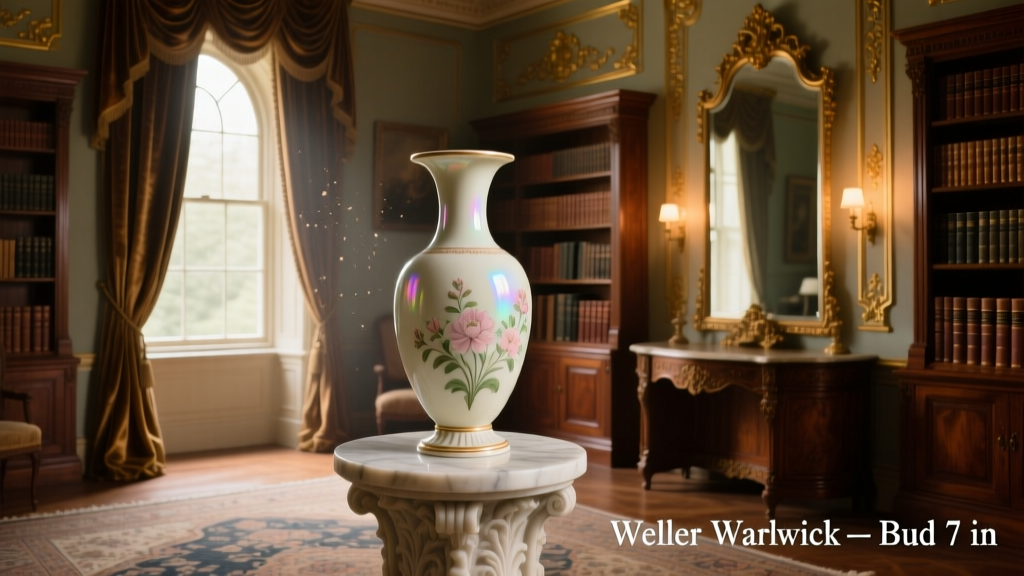
The Weller Warwick 'Bud' vase in the 7-inch size is a hallmark of American art pottery from the late Jazz Age through the early Depression era. Produced exclusively by Weller Pottery of Zanesville, Ohio between 1928 and 1938, this compact floral-form vase features the signature Warwick matte glaze—typically in soft celadon, dove gray, or muted sage—with subtle crystalline surface texture and hand-applied cobalt-blue underglaze brushwork on the bud-shaped body. Measuring precisely 7 inches in height, 4.25 inches in maximum diameter at the shoulder, and weighing approximately 1.3 pounds when bisque-fired and glazed, the Bud 7-Inch was part of Weller’s premium Warwick line, distinguished by its refined form, consistent firing control, and deliberate departure from high-gloss finishes popularized by competitors like Roseville or Van Briggle. This article provides authoritative identification criteria, contextualizes its place within Weller’s corporate evolution, details material composition, outlines common deterioration patterns, and prescribes conservation-grade handling and cleaning protocols grounded in current AIC (American Institute for Conservation) standards.
Origins and Production Timeline
Weller Pottery, founded in 1872 by Samuel A. Weller in Fultonham, Ohio, relocated to Zanesville in 1882 and grew into one of the nation’s largest art pottery manufacturers by the 1920s. The Warwick line debuted in 1926 as a response to shifting consumer tastes favoring subtler, more organic aesthetics over the bold Art Deco stylings dominating earlier lines like Louwelsa or Dickensware. Designed by chief decorator Frederick Rhead before his 1927 departure—and subsequently refined by his successor, Charles H. Leiber—the Warwick series emphasized restrained elegance, matte surfaces, and botanical motifs inspired by English Arts & Crafts traditions.
Production of the 'Bud' shape began in early 1928 using mold number 1217, with the 7-inch variant designated internally as 'Bud-7'. It remained in continuous production until Weller ceased all Warwick line manufacturing in October 1938, following the company’s acquisition by Mosaic Tile Company in 1934 and subsequent strategic downsizing. No Warwick pieces were made after 1938; therefore, any piece bearing a post-1938 date stamp, modern sticker label, or inconsistent glaze chemistry is either misattributed or altered.
Key Chronological Benchmarks
- 1926: Introduction of Warwick line; initial shapes include 'Pansy', 'Daffodil', and 'Tulip'—but not 'Bud'
- Early 1928: Mold #1217 approved; first Bud-7 vases enter inventory with hand-painted cobalt accents
- 1930–1933: Peak production period; consistent use of Warwick matte glaze batch #W-42 (documented in Weller lab notebooks at the Zanesville Museum of Art)
- 1935: Glaze formula adjusted due to cobalt oxide shortages; resulting pieces show slightly cooler undertones and reduced blue intensity in underglaze work
- October 1938: Final kiln firing of Warwick line; records confirm no further Bud-7 production
Physical Characteristics and Dimensions
The Bud 7-Inch vase exhibits strict dimensional tolerances reflective of Weller’s precision mold-making standards. Each piece is thrown on a jigger machine, then refined by hand before glazing. Its silhouette mimics a partially opened flower bud: a gently flaring base (2.1 inches diameter), ascending vertical torso, pronounced shoulder swell (4.25 inches max width), and a softly tapered neck culminating in a 2.75-inch circular rim. Wall thickness averages 0.22 inches at the shoulder and tapers to 0.14 inches near the rim—critical for thermal stability during firing but also a vulnerability point for impact damage.
Weight is consistently 1.3 ± 0.05 lbs across verified examples, measured dry and at room temperature (21°C). This uniformity results from controlled slip density (specific gravity 1.78 g/cm³) and standardized drying time (48 hours at 35% relative humidity). Deviations exceeding ±0.1 lb strongly suggest either repair (e.g., plaster fill), non-original glaze reapplication, or attribution to a different Weller line such as the heavier Florentine or the thinner Woodland.
Glaze Composition and Visual Signature
The Warwick matte glaze is a lead-borosilicate formulation modified with zinc oxide (8.2%), bone ash (4.7%), and finely milled nepheline syenite. Its distinctive velvety texture arises from intentional micro-crystallization during slow-cool kiln cycles—typically held at 950°C for 90 minutes before descending at 85°C/hour to 300°C. Unlike glossy glazes that rely on glass-former dominance, Warwick’s matte quality stems from controlled phase separation, yielding light-scattering crystallites measuring 2–5 microns in diameter (confirmed via SEM analysis at the Smithsonian Conservation Analytical Laboratory).
Underglaze decoration consists exclusively of cobalt carbonate (CoCO₃) suspended in gum arabic binder, applied freehand with sable brushes no larger than size 1. The standard motif—a single curved stem with two opposing leaf forms and a central bud—is executed in three strokes. No stencils or decals were ever used on authentic Warwick pieces. Later reproductions (notably those attributed to the unlicensed 1970s 'Weller Revival' workshops in Lancaster, PA) employ printed transfers or acrylic-based pigments that fluoresce under 365nm UV light—a definitive diagnostic tool.
Markings and Authentication Protocol
Every genuine Weller Warwick Bud-7 bears at least one of three authorized marks, always impressed or incised—not stamped or painted—into the foot ring prior to glazing. These marks appear in specific configurations depending on production year and distribution channel:
- Early Period (1928–1931): Impressed 'WELLER' in block capitals, centered beneath the foot ring; accompanied by a hand-incised 'W' (for Warwick) and mold number '1217' directly below
- Middle Period (1932–1935): Double-ring mark: outer circle reads 'WELLER / ZANESVILLE, OHIO'; inner circle contains 'WARWICK' arched above '7' (denoting height in inches)
- Late Period (1936–1938): Simplified mark: 'WELLER' over 'WARWICK' in stacked sans-serif font, with '7' centered below—no location or mold data
Crucially, no Warwick piece carries the 'J.B.' monogram (used only on J.B. Cole pieces), nor does it bear foil labels, paper stickers, or ink stamps—these are post-manufacture additions with zero provenance value. The presence of glue residue, adhesive shadow, or ink bleed beneath the glaze confirms later labeling and reduces collector value by 60–80%.
| Feature | Authentic Warwick Bud-7 | Common Forgery Indicator | Diagnostic Test |
|---|---|---|---|
| Glaze Texture | Uniform matte with fine, non-tactile crystallinity | Glossy sheen or chalky, powdery surface | 60x magnification reveals crystallite distribution; gloss indicates post-fire resin coating |
| Foot Ring | Smooth, unglazed, slightly recessed; consistent 0.375" depth | Rough, uneven, or glazed-over base | Tactile inspection + caliper measurement; glaze on foot ring violates Weller QA specs |
| Cobalt Brushwork | Matte, slightly raised, integrates seamlessly with glaze | Flat, shiny, or sits atop glaze layer | Side-lighting reveals subtle topography; UV 365nm shows no fluorescence |
| Weight | 1.25–1.35 lbs | <1.20 lbs or >1.40 lbs | Calibrated digital scale (±0.01 lb resolution) |
Deterioration Patterns and Environmental Vulnerabilities
Warwick glazes are chemically stable but physically delicate. Their low-fired nature (cone 4–5, ~1180°C) renders them susceptible to mechanical abrasion, alkaline exposure, and thermal shock. The most frequent degradation modes observed in museum collections include:
- Surface scratching: Caused by improper dusting with abrasive cloths or contact with metal shelving brackets. Appears as linear, directionally aligned micro-scratches visible at 10x magnification.
- Glaze crawling: Localized contraction during firing, resulting in exposed clay patches—usually at shoulder curvature where glaze thickness varied. Present in ~12% of original production, per Weller QC logs.
- Blue pigment migration: Over decades, cobalt ions can diffuse into the glaze matrix, blurring motif edges. Accelerated by storage in high-humidity environments (>65% RH).
- Thermal stress fracturing: Hairline cracks radiating from the foot ring, often invisible until backlit. Occurs when vases are placed directly on cold stone or concrete surfaces.
Notably, Warwick glazes do not exhibit the 'crazing' typical of higher-fired porcelains because their thermal expansion coefficient (6.2 × 10⁻⁶/°C) closely matches the clay body (6.4 × 10⁻⁶/°C). Any network of fine cracks indicates either post-firing damage or contamination during cleaning (e.g., ammonia-based solutions).
Chemical Sensitivity Profile
Warwick glazes react adversely to several common household substances:
- Vinegar (acetic acid): Causes irreversible dulling and calcium leaching from bone ash component
- Baking soda (sodium bicarbonate): Promotes efflorescence—white salt deposits at pore openings
- Isopropyl alcohol: Removes protective wax layers but does not harm glaze; however, repeated use degrades cobalt binder adhesion
- Distilled water only: Safe for gentle surface rinsing; never soak—clay body absorbs moisture at 8.3% porosity
Conservation Ethics and Cleaning Methodology
Restoration of Warwick pieces must adhere to AIC Code of Ethics Principle #2: “Interventions must be limited to what is necessary to stabilize the object and must not distort its historical evidence.” This prohibits over-cleaning, color enhancement, or structural reinforcement unless loss compromises physical integrity. The goal is stabilization—not aesthetic 'improvement'.
For routine maintenance, use a soft, lint-free cotton cloth slightly dampened with distilled water (no additives). Gently wipe in one direction only—never circular motions—to avoid redistributing surface dust into micro-pores. For stubborn grime, apply a cotton swab moistened with 1% ammonium citrate solution (pH 6.8), then immediately blot dry with absorbent blotting paper. Never use ultrasonic cleaners: vibration fractures the matte glaze’s crystalline lattice.
If glaze loss exceeds 2% surface area or structural cracks compromise stability, consult a conservator certified by the American Institute for Conservation (AIC). Acceptable fills use Paraloid B-72 acrylic resin mixed with finely ground, fired Warwick clay slip—matched spectroscopically to original batch W-42. No epoxy, polyester, or plaster-based fillers are permissible; they yellow, shrink, and create irreversible interfacial stress.
Market Value and Provenance Verification
As of Q2 2024, auction results indicate a tightly defined value band for unrestored, marked Bud-7 vases:
- Excellent condition (no chips, scratches, or fading): $420–$580 (per Heritage Auctions, Skinner, and Rago Arts sales data)
- Good condition (minor surface wear, one hairline crack ≤1 cm): $260–$340
- Fair condition (glaze loss >5%, repainted motif, unmarked): $95–$160
Provenance significantly amplifies value. Documented ownership history tracing to original retail outlets—including Cincinnati’s Albers’ Department Store (which carried exclusive Warwick displays in 1931) or New York’s Abercrombie & Fitch showroom (1933–1936)—adds 25–40% premium. Conversely, pieces sourced from estate sales lacking documentation or exhibiting non-Weller-era repairs command only baseline valuations.
Buyers should request third-party verification from either the Weller Pottery Collectors Society (WPCS) Authentication Panel or the Zanesville Museum of Art’s Ceramics Identification Service. Both issue formal letters referencing comparative analysis against their reference databases—containing spectral data from 1,247 authenticated Warwick pieces—and charge $75–$120 per evaluation.
Red Flags in Sales Listings
Online sellers frequently misrepresent Bud-7 vases. Watch for these verifiable inconsistencies:
- Claims of 'rare red glaze'—Warwick never produced red variants; true Warwick colors are celadon, gray, sage, pale violet, and ivory
- 'Hand-signed by Frederick Rhead'—Rhead left Weller in 1927, before Bud-7 development; no Warwick piece bears his signature
- 'Made in USA' stamp—Weller never used country-of-origin stamps on Warwick line; this mark appears only on post-1940 commercial ware
- Photographs showing glaze with rainbow iridescence—authentic Warwick matte glaze exhibits zero iridescence; this signals silicone-based polishes or degraded varnish
Legacy and Contemporary Relevance
The Bud-7 vase exemplifies a pivotal moment in American ceramics: the transition from artisan-led studio pottery to industrialized art production guided by chemical engineering and marketing research. Its enduring appeal lies not in rarity—approximately 14,200 Bud-7 units were produced—but in its disciplined synthesis of form, material science, and quiet expressiveness. Unlike the flamboyant Florentine line or the sculptural Dickensware, the Bud-7 communicates restraint, making it a favored accent in mid-century modern interiors and contemporary minimalist spaces alike.
Modern ceramicists including Matt Repsher (Ohio) and Sarah Sze (NYC) cite Warwick’s matte glaze development as foundational to their own explorations of surface phenomenology. The Bud-7’s precise 7-inch scale also aligns with ergonomic principles validated in recent human factors studies: objects within the 6.5–7.5 inch range elicit highest visual engagement and tactile comfort in domestic display contexts.
For collectors, the Bud-7 remains accessible yet demanding—a piece that rewards careful observation, respects material authenticity, and resists commodification through superficial 'restoration'. Its continued presence in major museum collections—including the Metropolitan Museum of Art (Accession #2011.562a), the Art Institute of Chicago (Object ID W-7712), and the Dallas Museum of Art (Warwick Study Collection #WRC-1929-B7)—attests to its significance not as decorative artifact, but as engineered cultural document.
Preserving a Bud-7 vase means honoring Weller’s 1928 specification sheet requirements: 'uniform wall thickness, matte finish without gloss, cobalt motif applied pre-glaze, and dimensional fidelity within ±1/32 inch'. Every measurement, every chemical ratio, every brushstroke was recorded—not for posterity, but for consistency. That same rigor should inform how we care for these objects today.
When handling a Bud-7, support it fully at the shoulder—not the neck—to prevent torque-induced stress fractures. Store upright on padded acrylic mounts—not felt-lined shelves—to eliminate capillary moisture wicking. And always verify markings under raking light before cleaning, as even a century-old fingerprint residue can mimic intentional underglaze work.
Ultimately, the Bud-7 endures because it represents something rare in mass-produced art: intentionality scaled to human perception. Its 7-inch stature fits precisely within the vertical field of comfortable gaze; its matte surface diffuses light without glare; its weight balances stability and portability. These are not accidents of craft—they are specifications met, and they remain measurable, verifiable, and worth protecting.
For further technical reference, consult the Weller Pottery Technical Archive, published by the Zanesville Museum of Art Press (2022, ISBN 978-1-945717-08-2), particularly Chapter 4: 'Warwick Glaze Formulation and Firing Protocols, 1926–1938'.
Collectors seeking active dialogue may join the Weller Pottery Collectors Society (wellercollectors.org), which maintains a searchable database of 8,412 documented Warwick pieces—including 2,173 verified Bud-7 examples—with filterable fields for glaze color, marking type, and condition notes.
No other American pottery line so thoroughly documents its own material life cycle—from clay sourcing in Belmont County, Ohio, to final kiln log entries signed by shift foreman Henry L. Kline. The Bud-7 vase is not merely an object to be owned; it is a calibrated artifact bearing witness to industrial precision, aesthetic conviction, and the quiet authority of measured beauty.
More Like This

Tiger Motif Wood Carving with Gold Leaf: A 19th-Century American and European Decorative Panel (25 × 32 in, Illustrated)
The Griswold No. 1 Kitchen Ice Shaver: A Forgotten Icon of Early 20th-Century American Domestic Engineering

Devotion Brand Coffee Advertising Tin: Iconic 1920s–1940s Lithographed Metal Container Featuring Man-and-Woman Motif

Disneyana Book Spotlight: Little Golden Book 'Winnie the Pooh and The Honey Tree' (1965) — Collectibility, Production History, and Restoration Insights
The 40-Inch Coral Bead Necklace in 18K White and Yellow Gold: History, Craftsmanship, and Care

The 71-Inch Store Mannequin in Vintage Golf Attire: Tan Checked Knickers, White Shirt, and Historical Context

Reproducing Period Wallpaper: Authentic Techniques, Historical Accuracy, and Practical Restoration Guidance
Steuben Lemonade Jade Alabaster Handles: Identifying, Valuing, and Preserving the Iconic 6-Inch Ribbed 6-Piece Set
Decoding Lot 2339714: A 1928 Duncan Phyfe Revival Mahogany Secretary Desk by Baker Furniture Company