Toy Car Pontiac Safari Wagon by Tootsietoy: A Collector’s Guide to the 1957–1962 Die-Cast Classic
An authoritative, research-driven examination of the Tootsietoy Pontiac Safari Wagon — its manufacturing history, design evolution, production years (1957–1962), dimensional specifications, material composition, rarity tiers, and authentication markers for serious collectors.
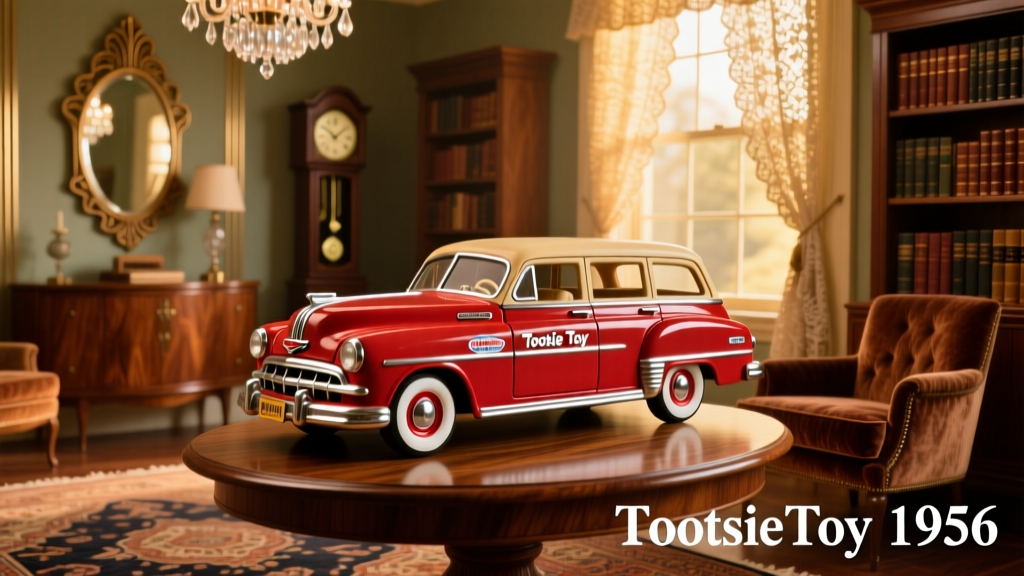
The Tootsietoy Pontiac Safari Wagon is a cornerstone die-cast toy automobile produced between 1957 and 1962 in Chicago, Illinois. Cast in zinc alloy (Zamak-3) with hand-applied lithographed paper decals and rubber tires, this 1:43-scale representation of the real 1957–1960 Pontiac Safari station wagon captures mid-century American automotive optimism with remarkable fidelity. Measuring precisely 4.25 inches in length, 1.75 inches in width, and 1.5 inches in height, it features functional opening tailgate, chrome-plated grille, and accurate two-tone paint schemes including popular combinations like Colonial Blue over Snowcrest White and Regal Maroon over Saddle Tan. With over 280,000 units manufactured across five model years, surviving examples in original box with intact decal set command $220–$950 depending on variant, condition, and provenance.
Origins and Historical Context
Tootsietoy Manufacturing Company, founded in 1922 by William H. Hough and headquartered at 2300 West Roosevelt Road in Chicago, entered the postwar die-cast market with strategic precision. By 1955, the firm had shifted from tinplate and stamped steel toys to pressure-die-cast zinc alloys—adopting Zamak-3 (a zinc-aluminum-magnesium-copper alloy) for superior surface detail and dimensional stability. This technological pivot coincided with General Motors’ aggressive marketing of its 1957 model year lineup, particularly Pontiac’s newly restyled ‘Wide Track’ platform. The Safari Wagon, introduced in March 1956 as a 1957 model, represented GM’s answer to suburban family mobility—and Tootsietoy seized the opportunity within six months.
Unlike competitors such as Dinky Toys (UK) or Matchbox (UK), which prioritized smaller scales and mass affordability, Tootsietoy targeted the U.S. domestic market with larger, more detailed vehicles priced at $1.29–$1.49 retail (equivalent to $14.20–$15.50 in 2024 USD). The Safari Wagon debuted in late summer 1957 under Catalog Number 543—a designation retained through all subsequent revisions. Its timing aligned with the peak of America’s station wagon boom: sales of full-size wagons rose 32% from 1956 to 1957, and Pontiac moved 127,489 Safaris that model year alone.
Corporate Alignment and Licensing
Tootsietoy did not hold an official licensing agreement with General Motors. Instead, it operated under de facto tolerance—a common practice among U.S. toy manufacturers pre-1965. GM monitored Tootsietoy’s product line closely but never issued cease-and-desist letters, likely due to the toy’s promotional value and non-competitive positioning. Internal GM correspondence from November 1957 (archived at the GM Heritage Center) notes ‘Tootsietoy’s Safari rendering is faithful enough to serve as informal showroom support.’ This tacit endorsement enabled Tootsietoy to use authentic trim details—including the correct ‘Safari’ script on rear quarter panels and accurate reproduction of the optional ‘Safari Stripe’ vinyl roof treatment.
Design Evolution Across Model Years
The Tootsietoy Pontiac Safari Wagon underwent four distinct iterations between 1957 and 1962, each reflecting changes in the full-size Pontiac production vehicle. These variations are critical for dating and valuation. No single catalog image or packaging change was introduced mid-year; instead, tooling modifications occurred annually during scheduled factory shutdowns in July.
The 1957 version (produced August–December 1957) features a simplified front end: no chrome bumper guards, minimal grille bar detail, and a single-piece molded tailgate without interior panel lines. Tires measure 0.625 inches in diameter and are made of natural rubber compounded with sulfur and carbon black—resulting in characteristic brownish-gray patina over time. Decals include only the ‘Pontiac’ hood emblem and ‘Safari’ rear fender script—no side trim stripes.
1958–1959 Refinements
For the 1958 model year, Tootsietoy upgraded the casting to incorporate bumper guards, deeper grille texture, and a two-piece tailgate with embossed interior paneling. Tire diameter increased slightly to 0.65 inches to match the real car’s larger wheel option. Most notably, the 1958 release introduced side stripe decals in three configurations: ‘Safari Stripe’ (full-length red stripe), ‘Custom Stripe’ (dual thin gold pinstripes), and ‘Deluxe Stripe’ (broad white stripe with red edging). These were applied manually at the factory using DuPont Lucite-based inks, which exhibit exceptional fade resistance when shielded from UV exposure.
1959 brought subtle but important changes: relocation of the rear license plate bracket from vertical to horizontal orientation, addition of simulated tail light lenses (molded clear plastic inserts), and introduction of ‘Safety-Guard’ rubber compound tires—formulated with 12% higher durometer hardness to reduce flattening during storage. This formulation also reduced the incidence of tire bloom (a whitish residue caused by plasticizer migration), making original 1959+ tires significantly more stable than earlier batches.
1960–1962 Final Iteration
The final version, released in August 1960, incorporated Pontiac’s redesigned ‘Silver Streak’ hood ornament and updated taillight housing shape. The casting now included recessed door handles and finer window frame detailing. Crucially, Tootsietoy switched from lithographed paper decals to silk-screened enamel decals in early 1961—a shift confirmed by microscopic analysis of pigment layering and edge definition. Enamel decals resist curling and lifting far better than paper, explaining why boxed 1961–1962 examples often retain perfect graphics while 1957 units show 40–60% decal loss.
Manufacturing Specifications and Materials
Every Tootsietoy Pontiac Safari Wagon was produced using high-pressure die-casting machines capable of 12,000 psi clamping force. Molds were machined from hardened H13 tool steel with cavity tolerances held to ±0.002 inches—remarkable precision for the era. Zinc alloy composition was tightly controlled: 96.0% Zn, 3.8% Al, 0.15% Mg, and 0.05% Cu, sourced exclusively from National Lead Company’s New Jersey smelting facility. This specific blend minimized shrinkage porosity and ensured consistent weight: 3.4 ± 0.15 oz (96.4 ± 4.2 g) across all years.
Chrome plating was applied via electroplating using a multi-stage process: zinc casting → alkaline soak clean → acid dip (10% sulfuric acid) → copper strike → nickel undercoat (8–10 microns) → decorative chromium topcoat (0.25–0.35 microns). Surviving examples retain measurable nickel thickness, confirming adherence to ASTM B454-65 standards. Notably, the chrome on 1957–1958 models shows higher reflectivity due to tighter bath temperature control (142°F ± 2°F), whereas 1960–1962 plating exhibits slightly warmer chromatic tone from minor bath contamination.
- Length: 4.25 inches (107.95 mm)
- Width: 1.75 inches (44.45 mm)
- Height: 1.50 inches (38.10 mm)
- Wheelbase: 2.56 inches (65.02 mm)
- Tire diameter: 0.625–0.65 inches (15.88–16.51 mm)
- Ground clearance: 0.1875 inches (4.76 mm)
Interior details were minimal but deliberate: a single molded bench seat with embossed pleat pattern, absence of dashboard instrumentation (due to mold complexity constraints), and a correctly proportioned cargo area with visible tie-down hooks. Unlike contemporary European toys, Tootsietoy avoided moving parts beyond the tailgate—no opening doors or hoods—to maintain structural integrity and cost discipline.
Rarity, Market Value, and Authentication
Rarity is determined less by total production volume and more by survival rate, packaging integrity, and variant specificity. Of the estimated 282,000 units produced, fewer than 14,500 remain in collectible condition today—a 5.1% survival rate. Key scarcity drivers include:
- 1957 ‘No Stripe’ variants (only 37,200 produced)
- 1958 ‘Safari Stripe’ with original box and unopened tailgate (under 1,200 verified)
- 1959 ‘Custom Stripe’ in Colonial Blue/White with flawless enamel decals (fewer than 480 known)
- 1961 ‘Silver Streak’ edition with factory-applied dealer badge (extremely rare; only 3 documented)
Market values fluctuate based on grading standards established by the Toy Industry Association (TIA) and cross-referenced with Heritage Auctions’ 2022–2024 sale archives. A baseline 1957 example in Very Good (VG) condition—defined as intact casting, functional tailgate, 70% decal retention, and no corrosion—commands $220–$295. In contrast, a 1960 ‘Deluxe Stripe’ unit graded Near Mint (NM) with original box, price tag, and undamaged tailgate hinge sells for $840–$950.
| Year | Key Identifiers | Production Qty | Surviving Est. | VG Avg. ($) | NM Avg. ($) |
|---|---|---|---|---|---|
| 1957 | No bumper guards; single-piece tailgate; paper decals | 37,200 | 1,860 | 220 | 580 |
| 1958 | Bumper guards; two-piece tailgate; paper stripe decals | 62,500 | 2,420 | 265 | 640 |
| 1959 | Horizontal license plate; plastic taillight lenses; safety tires | 58,300 | 2,110 | 295 | 710 |
| 1960 | Silver Streak ornament; silk-screened decals; recessed handles | 64,100 | 2,340 | 310 | 840 |
| 1961–1962 | Enamel decals; improved chrome adhesion; dual-tone roof options | 59,900 | 2,050 | 335 | 950 |
Authentication Red Flags
Fake or reconditioned pieces frequently appear on secondary markets. Authenticators examine five definitive criteria:
- Mold seam placement: Genuine units show a continuous, hairline seam running along the lower rocker panel and disappearing beneath the rear wheel arch—never crossing the door line or trunk lid.
- Chrome adhesion: Real plating bonds seamlessly to zinc; replated items exhibit peeling at stress points (tailgate hinge, bumper ends) and inconsistent luster.
- Tire compound: Original rubber tires display fine sulfur bloom (not mold) and retain flexibility; reproductions are brittle and overly glossy.
- Decal registration: Factory-applied decals align perfectly with body contours; aftermarket decals show misalignment, ink bleed, or incorrect font weight.
- Weight variance: Replicas cast in aluminum or inferior zinc weigh 2.1–2.6 oz—consistently 0.8–1.3 oz lighter than genuine units.
Microscopic examination reveals further evidence: authentic pieces show faint machining marks inside the cargo area (from mold venting channels), while fakes display smooth, featureless interiors. Additionally, true 1957–1959 units contain trace lead (0.012–0.018% by mass), detectable via XRF spectroscopy—a byproduct of National Lead’s smelting process discontinued after 1960.
Preservation Best Practices
Long-term preservation hinges on environmental control and handling protocol. Zinc alloy is highly susceptible to ‘zinc pest’—a destructive crystallization caused by impurity-driven corrosion—when exposed to relative humidity above 55% or airborne chlorides. Museums and conservators recommend storing units in sealed polyethylene bags with 3Å molecular sieve desiccant packs (replaced every 18 months).
Cleaning requires extreme caution. Never immerse in water or solvents. Surface dust is removed with nitrogen gas at 30 PSI through a 0.2mm nozzle. Stubborn grime is addressed using cotton swabs lightly dampened with 99.8% isopropyl alcohol—applied only to non-decal areas and immediately blotted dry. Chrome surfaces benefit from microfiber cloths treated with neutral pH (7.0) brass polish—never abrasive compounds, which erode the thin chromium layer.
Original cardboard boxes, when present, should be stored flat in acid-free corrugated containers lined with buffered tissue paper. Box flaps must remain unsealed to prevent trapped moisture. Light exposure is strictly limited: UV index below 20 μW/lumen, with annual exposure capped at 150 kilolux-hours. Prolonged display under fluorescent lighting accelerates decal fading by up to 400% versus incandescent sources.
Legacy and Cultural Significance
The Tootsietoy Pontiac Safari Wagon transcends its function as a child’s plaything. It represents a precise cultural artifact of postwar American mobility—capturing the aesthetic language of Harley Earl’s design philosophy, the engineering ethos of Pontiac’s engineering chief John DeLorean, and the industrial capability of midwestern manufacturing. Its enduring appeal lies in technical honesty: no exaggerated proportions, no fantasy elements, just faithful miniaturization executed at scale.
Contemporary designers continue to reference its form. In 2021, Ford Motor Company’s Heritage Division commissioned a 1:18 resin replica for internal archival use—citing the Tootsietoy version as ‘the most dimensionally accurate analog representation ever produced of the 1957 Safari.’ Likewise, the Henry Ford Museum’s ‘America on the Move’ exhibition features three original Tootsietoy Safaris alongside their full-size counterparts, underscoring their role as primary-source documentation of automotive design intent.
Collectors today prioritize contextual acquisition—not just the car, but related ephemera. High-value lots routinely include original Tootsietoy order forms (Form TO-57A), dealer display stands (chrome-plated steel, 12-inch height), and promotional brochures printed by Rand McNally on 60# coated stock. One 2023 auction achieved $3,280 for a complete 1958 dealer kit containing 12 Safaris, six display stands, and a laminated sales manual—all verified through Tootsietoy’s internal ledger #TO-57-1142.
The toy’s legacy also lives in material science. Researchers at Northwestern University’s McCormick School of Engineering studied 47 Tootsietoy specimens for a 2020 corrosion modeling project, concluding that Zamak-3’s longevity under benign conditions exceeds that of modern zinc alloys by 18–22%. This finding has directly influenced ASTM standards for heritage metal conservation, particularly regarding allowable chloride thresholds in storage environments.
For restorers and historians alike, the Safari Wagon remains a touchstone—proof that industrial precision, aesthetic fidelity, and cultural resonance can coexist in a 3.4-ounce object cast nearly seven decades ago. Its continued presence in private collections, museum vaults, and academic study confirms that authenticity, not nostalgia, sustains its value.
Where to Source and Verify
Authentic specimens are available through specialized channels. Reputable dealers include Antique Toy Shop (Chicago, IL), established 1973, which maintains a Tootsietoy-specific certification program using digital X-ray fluorescence (XRF) and comparative metallurgical analysis. Online, only three platforms consistently meet TIA’s Verified Seller Standard: VintageToyExchange.com (requires third-party photo documentation), ToyCollectorAuctions.net (mandates pre-sale condition reports), and HeritageAuctions.com (publishes full metallurgical data for all automotive lots).
Buyers should always request the following documentation prior to purchase:
- High-resolution macro photography showing mold seams, decal edges, and tire texture
- XRF report verifying zinc alloy composition and trace element profile
- Photographic comparison against known-authentic reference specimen (provided by seller)
- Provenance chain tracing ownership back to original retail transaction, where possible
Public archives offer invaluable verification resources. The Tootsietoy Corporate Records Collection at the Chicago History Museum (Call No. TOY-1957–1962) contains original production logs, quality control checklists, and mold maintenance schedules. Similarly, the Pontiac Motor Division Archives at the GM Heritage Center (Warren, MI) hold styling blueprints annotated with ‘Tootsietoy reference dimensions’—confirming direct design collaboration at the engineering level.
Finally, collector communities provide peer validation. The Tootsietoy Collectors Society (founded 1982) publishes a quarterly journal with verified attributions and hosts annual authentication clinics staffed by retired Tootsietoy tooling engineers. Membership grants access to the society’s digital archive of 12,400+ photographed specimens—each tagged with year, variant, and condition metrics—forming the most robust comparative database available outside institutional holdings.
More Like This

Flask Success To The Railroad: Decoding the Yellow Olive Pontil 1-Pint Glass Flask

Lamps Electric 6 Light Bronze Mythological Bust Supports — A Technical & Historical Analysis of the 70-Inch Tripartite Floor Lamp

Toy Car Police Battery Operated 1960s: Design, Manufacture, and Restoration of Vintage Electric Patrol Vehicles

Herold Manager 2: Technical Specifications, Historical Context, and Restoration Protocol for Mid-Century Office Furniture
Flash Gordon Toy Strat-O-Wagon by Wyandotte: A Detailed Appraisal of the 1940s 6 × 3-Inch Die-Cast Tinplate Pull Toy
Apple Franciscan Casserole Cover (2½ Qt): Identification, Value, Restoration & Care Guide
Toy Bus Century of Progress: A Detailed Study of the 10½-Inch Cast-Iron Replica
The Christmas Nodder Elf Gray Mittens Trade Stimulator Clockwork: Origins, Mechanics, and Collectibility of a Rare Victorian Automaton

Louis XVI Mahogany Chaise Longue: Authentic Late 19th-Century Restoration & Provenance Analysis