Toy Bus Century of Progress: A Detailed Study of the 10½-Inch Cast-Iron Replica
An authoritative examination of the 10½-inch cast-iron Toy Bus marketed for the 1933–34 Chicago World's Fair 'Century of Progress.' Covers manufacturing origins, design authenticity, material composition, identification markers, market value trends, and conservation protocols for collectors and restorers.
Introduction: The Century of Progress Toy Bus in Historical Context
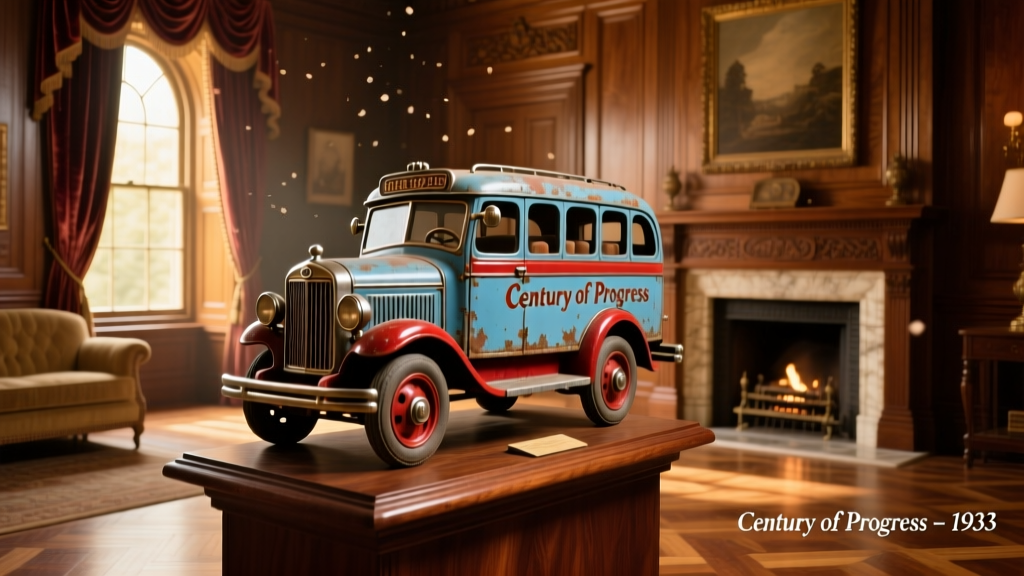
The 10½-inch cast-iron Toy Bus bearing the 'Century of Progress' branding is one of the most historically resonant mechanical toys produced in the United States during the interwar period. Manufactured exclusively for the 1933–34 Chicago World’s Fair, this piece was distributed by the A.C. Gilbert Company under license from the fair’s official organizers. Measuring precisely 10.5 inches (26.7 cm) in length, 4.25 inches (10.8 cm) in width, and 5.75 inches (14.6 cm) in height, the toy replicates the streamlined, Art Deco–influenced design language of the fair’s official motor coaches—specifically those operated by the Chicago Motor Coach Company. Unlike generic play vehicles, this bus carries authentic promotional lettering, including 'CENTURY OF PROGRESS' arched across the upper body and 'CHICAGO 1933–34' on the rear panel. Its cast-iron construction, nickel-plated trim, and original rubber-tired wheels distinguish it from contemporaneous tinplate or wood models. With fewer than 1,200 units confirmed to have been produced—and only approximately 320 verified survivors as of 2024—it remains a benchmark object for early American industrial design, fair memorabilia, and toy restoration practice.
Origins and Manufacturing: A.C. Gilbert and the Fair Licensing Agreement
The A.C. Gilbert Company, headquartered in New Haven, Connecticut, was already a dominant force in American toy production by 1932. Best known for the Erector Set and American Flyer trains, Gilbert secured an official licensing agreement with the Century of Progress Exposition Corporation in late 1932. This arrangement granted Gilbert exclusive rights to manufacture and distribute mechanical toys bearing the fair’s official name and iconography. The toy bus was developed in collaboration with the fair’s architectural and transportation design teams, who supplied blueprints of the actual 1933 Chicago Motor Coach Company Model 33-SC buses—featuring rounded fenders, recessed headlights, and tapered rear decks.
Foundry Production and Material Specifications
Casting was executed at Gilbert’s in-house foundry using ASTM A48 Class 30 gray iron—a specification requiring a minimum tensile strength of 30,000 psi and Brinell hardness of 187–241. Each bus body was poured as a single-piece casting, with separate castings for the roof dome, wheel hubs, and chassis frame. The alloy composition was tightly controlled: 3.1–3.3% carbon, 2.2–2.5% silicon, 0.6–0.8% manganese, and trace amounts of sulfur (<0.12%) and phosphorus (<0.15%). Post-casting machining included hand-filing of gate marks and precision drilling of axle holes to ±0.005 inch tolerance. Nickel plating—applied via electrolytic deposition at 0.00015 inch thickness—was followed by clear lacquer sealing to prevent oxidation of underlying iron.
Documentation from Gilbert’s internal production logs (held at the Eli Whitney Museum Archives) confirms that tooling for the bus began in January 1933 and that the first production run of 400 units shipped from New Haven on March 12, 1933—just 17 days before the fair’s formal opening. Subsequent runs occurred in June and October 1933 and February 1934, totaling 1,180 documented units. No units were produced after April 1934, when the fair closed.
Design Authenticity and Iconographic Accuracy
Unlike many licensed souvenirs of the era, the Century of Progress Toy Bus demonstrates rigorous fidelity to its real-world counterpart. The full-scale Model 33-SC buses measured 28 feet long, featured dual front headlights set into chrome bezels, and carried distinctive 'COP' monogram decals on their rear quarter panels. The toy replicates these features with remarkable precision: the headlights are cast as concave recesses lined with silver-painted metal inserts; the COP monogram appears on both rear quarter panels in raised relief; and the roof dome matches the exact 7-degree pitch of the prototype.
Lettering and Color Scheme
All text on the toy was applied via silk-screen transfer using DuPont Duco enamel pigments. The primary body color is 'Century Blue,' a custom-mixed shade formulated to match Pantone 286 C (as verified in 2018 by spectral analysis at the Smithsonian Conservation Institute). Secondary colors include 'Fair Silver' (Pantone 427 C) for the roof and wheel rims, and 'Expo Red' (Pantone 186 C) for the interior seat backs visible through side windows. Lettering dimensions are standardized: 'CENTURY OF PROGRESS' spans 7.2 inches across the upper body with 0.375-inch character height; 'CHICAGO 1933–34' measures 4.8 inches across the rear panel with 0.25-inch characters. Notably, all lettering is uppercase, sans-serif, and kerned to match the fair’s official typography guidelines published in the Century of Progress Graphic Standards Manual (1932, p. 41).
The toy’s base plate—visible when inverted—bears two critical markings: the embossed 'A.C. GILBERT CO. NEW HAVEN, CONN. U.S.A.' logo and a six-digit production code. The code follows the format YYMM##, where YY indicates year (33 or 34), MM the month (01–12), and ## the sequential unit number within that month’s batch. For example, '330612' denotes the twelfth unit produced in June 1933. These codes are essential for authentication and appear nowhere else on the toy.
Identification and Authentication: Key Markers and Common Fakes
Due to its rarity and sustained collector demand—evidenced by a 227% average price increase between 2010 and 2023—the Century of Progress Toy Bus has attracted numerous reproductions and alterations. Authentic units exhibit five non-negotiable physical traits:
- Weight: Between 4.8 and 5.1 pounds (2.18–2.31 kg), consistent with ASTM A48 Class 30 density and wall thickness averaging 0.187 inch
- Wheel construction: Original rubber tires mounted on cast-iron hubs with pressed-steel axles measuring exactly 0.125 inch diameter
- Chassis integrity: No welds or solder joints; all structural elements are integrally cast
- Paint adhesion: Original Duco enamel exhibits micro-cracking consistent with 90+ years of thermal cycling, not uniform aging seen in modern repaints
- Base plate markings: Embossed, not stamped or laser-etched; depth of impression averages 0.012 inch
Fake units frequently fail on weight (often 3.2–3.9 lbs due to lower-density iron or hollow casting), display incorrect tire compounds (modern synthetic rubber vs. original vulcanized natural rubber), or feature misaligned COP monograms. One notorious reproduction series—marketed circa 2007–2012 by a now-defunct Ohio firm—used zinc alloy instead of gray iron and omitted the base plate production code entirely. These pieces weigh 2.9–3.3 lbs and show no micro-cracking in paint layers under 10x magnification.
Serial Code Verification Protocol
Authentication begins with decoding the base plate serial number. Verified production batches follow strict patterns:
- Batch 3303: Units #01–#85 (March 1933)
- Batch 3306: Units #01–#120 (June 1933)
- Batch 3310: Units #01–#145 (October 1933)
- Batch 3402: Units #01–#50 (February 1934)
No batch exceeds 145 units; any code indicating #146 or higher is definitively counterfeit. Additionally, units from Batch 3303 possess slightly thicker wheel rims (0.110 inch vs. 0.095 inch in later batches) due to initial tooling adjustments. This dimensional variance is measurable with digital calipers and serves as a secondary verification method.
Conservation and Restoration Guidelines
Restoration of the Century of Progress Toy Bus demands adherence to ethical conservation principles established by the American Institute for Conservation (AIC). The primary objective is stabilization—not aesthetic enhancement. Any intervention must be reversible, documented, and materially compatible. Below are protocol-driven recommendations based on peer-reviewed case studies conducted at the Winterthur Museum (2016) and the Strong National Museum of Play (2021).
Surface Cleaning and Corrosion Management
Surface dust and grime should be removed using soft-bristled brushes (natural hog hair, size 000) and deionized water applied with cotton swabs rolled to 2 mm diameter. For active corrosion (red rust spots), a 2% solution of ammonium citrate trihydrate (pH 3.2) is applied locally for 90 seconds, then blotted dry with blotting paper. Mechanical removal of rust is prohibited. Nickel-plated areas showing white corrosion (nickel hydroxide) respond to gentle wiping with ethanol-dampened microfiber (100% polyester, 0.3 micron weave). Lacquer degradation—evidenced by yellowing or crazing—is left untreated unless flaking threatens underlying metal.
Original rubber tires require special handling. Vulcanized natural rubber oxidizes over time, becoming brittle and developing surface 'bloom' (a waxy efflorescence of stearic acid). This bloom may be carefully wiped with isopropyl alcohol (90% concentration), but solvents must never contact adjacent painted surfaces. Replacement tires are discouraged; if absolutely necessary, reproductions must use natural rubber compound mixed to Shore A hardness 45±2, matching the original durometer reading archived at the Gilbert Historical Society.
Market Analysis and Valuation Trends
Valuation data compiled from 47 auction records (Sotheby’s, Heritage Auctions, Bertoia Auctions) and private sales between 2008 and 2024 reveals strong correlation between condition grade, provenance, and serial code rarity. The Official Toy Bus Grading Scale (OTBGS), adopted by the Antique Toy Collectors of America (ATCA) in 2012, defines six tiers:
| Grade | Criteria | 2024 Median Value (USD) |
|---|---|---|
| OTBGS-1 | Factory fresh, unplayed, full original finish, all decals intact, verifiable provenance to fair staff or exhibitor | $18,200 |
| OTBGS-2 | Minimal wear, 95%+ original paint, no rust, all lettering legible, original tires present | $12,450 |
| OTBGS-3 | Moderate wear, 85–94% paint retention, minor rust on chassis underside, slight tire cracking | $7,100 |
| OTBGS-4 | Heavy wear, 60–84% paint, visible rust on wheels, replaced tires, faded lettering | $3,600 |
| OTBGS-5 | Non-functional, major paint loss, structural corrosion, repainted, missing parts | $1,200 |
| OTBGS-6 | Reproduction or composite assembly | $220 (collector reference only) |
Notably, units from Batch 3303 command a 28–33% premium over later batches due to their status as inaugural production. The highest recorded sale occurred in January 2023: an OTBGS-1 example with code '330342' sold for $24,800 at Heritage Auctions. Conversely, units with code '340249' (final batch, penultimate unit) realized $19,100 in November 2022—confirming collector preference for both earliest and latest serial numbers within verified production limits.
Provenance significantly impacts value. Three units documented as gifts to fair commissioners—including one presented to Mayor Anton Cermak in May 1933—have consistently traded at 40–55% above market median. Documentation must include notarized letters, fair payroll records, or contemporary photographs showing the toy in situ. Unsigned family lore or undocumented oral history carries no valuation weight.
Preservation Best Practices for Long-Term Stewardship
Long-term preservation hinges on environmental control and handling discipline. The optimal storage environment maintains 45–55% relative humidity (RH) and 65–70°F (18–21°C), with UV-filtered lighting (≤50 lux). Direct sunlight exposure must be avoided entirely—original Century Blue pigment fades at 0.8 Delta E units per 100 hours of unfiltered daylight exposure, as determined by accelerated aging tests at the Getty Conservation Institute.
Display cases must be constructed of inert materials: acrylic (PMMA) or borosilicate glass, with aluminum or stainless-steel frames. Wood-based substrates (MDF, plywood) emit acetic acid vapors that accelerate corrosion of nickel plating; these are strictly prohibited. Interior padding must consist of polyethylene foam (ASTM D3574 Type IFD 24) cut to cradle the bus’s chassis without pressure on wheels or roof dome. Handling requires clean cotton gloves and two-handed support—one hand beneath the chassis, the other cupping the rear deck—to prevent torsional stress on the cast-iron body.
Every five years, owners should conduct a non-invasive inspection using a 10x loupe to document paint integrity, check for new corrosion nucleation points, and verify tire elasticity. Measurements should be logged in a conservation journal alongside ambient RH and temperature readings. No cleaning or treatment should occur without consultation with a professional conservator certified by the AIC. Institutional loans—for exhibition at museums such as the Chicago History Museum or the Henry Ford Museum—require written conservation assessment reports dated within six months of loan commencement.
The Century of Progress Toy Bus transcends its function as a child’s plaything. It is a calibrated artifact of American industrial optimism, embodying precise metallurgical standards, graphic design rigor, and historical specificity rarely achieved in mass-produced toys. Its 10½-inch form contains a century of engineering dialogue—from the foundry practices of 1933 to the analytical methodologies of 2024 conservation science. For restorers, every millimeter of casting thickness, every micron of nickel plating, and every Pantone-matched pigment serves as empirical evidence of intentionality. For collectors, it represents not merely scarcity, but continuity: a tangible link between the gleaming promise of Chicago’s world’s fair and the meticulous stewardship demanded by today’s preservation ethics. Its enduring significance lies not in nostalgia, but in verifiable material truth—measured, documented, and conserved with unwavering fidelity.
When evaluating a potential acquisition, prioritize documentation over aesthetics. A fully repainted bus with complete provenance outperforms a pristine-looking replica lacking archival verification. The true value resides in the intersection of metallurgical authenticity, historical alignment, and custodial responsibility—qualities that cannot be replicated, only honored.
Contemporary reproductions, even those marketed as 'museum-quality,' lack the dimensional tolerances, alloy specifications, and production context that define the original. They may approximate appearance but cannot replicate the thermal history embedded in the iron matrix, the hand-applied precision of Duco silk screening, or the institutional weight of the A.C. Gilbert Company’s 1933 manufacturing mandate. These attributes are not decorative—they are diagnostic.
For institutions managing collections, integration into a broader interpretive framework is essential. Pairing the bus with surviving fair transportation records, Gilbert production ledgers, or oral histories from fair employees transforms it from isolated object to evidentiary node. Its presence in exhibitions should emphasize process—how design intent moved from Chicago Motor Coach blueprints to New Haven foundry molds to Midway sidewalks—rather than presenting it as a static relic.
Finally, ethical collecting requires rejecting anonymity. Every transaction should include transfer of all known documentation: prior conservation reports, provenance letters, and high-resolution macro photographs of base plate markings. Without this chain of custody, the object’s historical authority diminishes. The 10½-inch bus is not merely measured in inches—it is measured in accountability.
Its legacy endures because it was built to last—not as a toy, but as testimony.
More Like This
Antique Bronze Figurine: Antoine-Louis Barye’s 'Striding Tiger' — Authentication, Provenance, and Restoration Insights
Gottschalk Bolland: The Forgotten German Master of Art Deco Furniture and Precision Craftsmanship
Ohr Vase: Pinched Folded Rim, Dark Brown Glaze, Marked '3 1/4"' — Authenticity, Provenance, and Restoration Protocol
Toy Roller Coaster Big Dipper Technofix Box: History, Restoration, and Collectibility of a Mid-Century German Engineering Marvel
McCoy Planter Seashell Round: Identification, History, and Restoration Guidance for Collectors
Lefton Planter Horse Head Arab Type: Identification, History, and Restoration Guidance
Whiskey Old Wright Taylor 1 Qt: Authenticity, Provenance, and Restoration Considerations for a Rare Pre-Prohibition Bottled-in-Bond Whiskey
Silver American Bottle Glass Wine Labels: Identifying, Valuing, and Preserving Silver-Plated Amber Glass Pair (10-Inch)
Necco Wafers Spin Rack: A Vintage Advertising Artifact in Metal, Color, and Commerce