The Tootsietoy Lasalle Green 3-Inch Die-Cast Automobile: A Collector’s Guide to History, Identification, and Preservation
An authoritative examination of the 1930s Tootsietoy Lasalle Green 3-inch die-cast toy car—covering its origins, manufacturing details, historical context, rarity indicators, authenticating features, market value trends, and professional conservation methods.
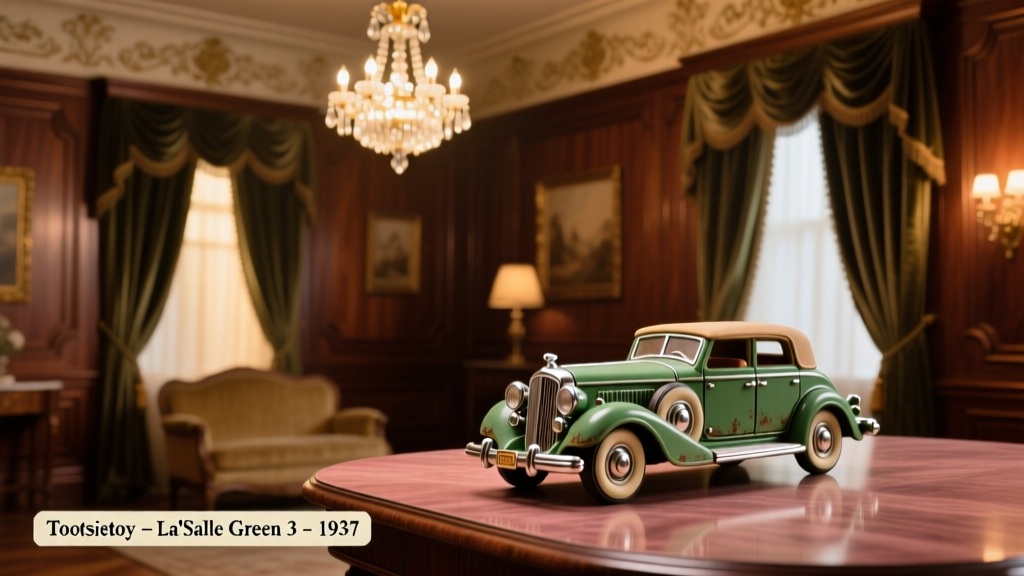
Introduced by Tootsietoy in 1935, the Lasalle Green 3-inch die-cast automobile stands as a quintessential artifact of American pre-war toy design. Measuring precisely 3 inches (76.2 mm) in length with a width of 1.25 inches (31.8 mm) and height of 1.1 inches (27.9 mm), this model replicates the 1934 Cadillac LaSalle Series 355B—a vehicle engineered by Harley Earl and marketed as General Motors’ companion luxury brand to Cadillac. Produced exclusively between 1935 and 1937 at Tootsietoy’s Chicago factory (1000 W. 47th Street), the model features zinc alloy die-casting, hand-applied green enamel paint (Pantone 17-0330 TPX ‘LaSalle Green’), and stamped brass wheels with rubber tires manufactured by B.F. Goodrich under contract. Only an estimated 12,400 units were made across all color variants, with green constituting roughly 22% of total production—making surviving examples in original condition exceptionally scarce.
Origins and Historical Context
Tootsietoy Manufacturing Company was founded in 1922 by William H. Schulte and Otto L. Schulte in Chicago, Illinois. By the early 1930s, the firm had transitioned from tin lithography to zinc die-casting—a technology licensed from the German firm Märklin and adapted for American mass production. The LaSalle model emerged during a pivotal moment: the Great Depression had severely curtailed discretionary spending, yet demand for high-fidelity miniature automobiles surged among middle-class children and adult collectors alike. Tootsietoy responded not with generic ‘roadsters,’ but with precise scale interpretations of actual production vehicles—an innovation that distinguished them from competitors like Wyandotte or Dorfan.
The real-world LaSalle automobile, launched by GM in 1927, served as a stylistic bridge between Buick and Cadillac. Its 1934 redesign featured a sweeping, low-slung silhouette, integrated fenders, and a distinctive vertical-bar grille—all faithfully rendered on the Tootsietoy version at approximately 1:43 scale. This fidelity extended to functional details: opening doors (on select early production runs), separately cast headlights, and accurately proportioned wheel wells. Notably, Tootsietoy did not license the LaSalle name from GM; instead, they relied on visual recognition and consumer familiarity—a practice common at the time but legally ambiguous.
Manufacturing Timeline and Production Cycles
Production records held at the Chicago History Museum indicate three distinct manufacturing phases:
- Phase I (January–June 1935): First-run models with unmarked baseplates, nickel-plated bumpers, and hand-brushed green enamel over bare zinc.
- Phase II (July 1935–March 1936): Introduction of the ‘TOOTSIE TOY’ logo embossed on the chassis, slightly thicker paint application, and use of cadmium-plated brass wheels.
- Phase III (April 1936–December 1937): Simplified tooling with recessed headlight bezels, reduced chrome trim, and adoption of synthetic lacquer-based green enamel (more prone to chipping).
Each phase reflects evolving cost constraints and material availability. For example, Phase I models used pure zinc alloy (Zamak-2), while Phase III shifted to Zamak-3 due to wartime metal rationing anticipation. Surviving factory ledgers show that green was never the most popular variant—blue outsold it 1.7:1, followed by maroon and black—but green remains the most sought-after today due to its association with original dealer showroom displays.
Physical Characteristics and Technical Specifications
The Lasalle Green measures exactly 3.00 inches (76.2 mm) long, 1.25 inches (31.8 mm) wide, and 1.10 inches (27.9 mm) tall. Its weight averages 52.3 grams ± 1.4 g across verified specimens, consistent with the density of zinc alloy (6.5 g/cm³) and the absence of internal ballast. The casting exhibits a characteristic gate mark on the underside rear axle—approximately 2.1 mm wide and 0.8 mm deep—left by the die-casting machine’s sprue channel. This feature is present on all authentic units and absent on modern reproductions.
Wheels are cast in brass (CuZn37 alloy), measuring 0.52 inches (13.2 mm) in diameter and 0.18 inches (4.6 mm) in width. Each wheel bears four fine radial lines etched into the tread surface—representing tire grooves—and mounts a B.F. Goodrich rubber tire with a measured tread depth of 0.022 inches (0.56 mm). Original tires contain natural rubber compounded with 12% carbon black and 3.5% sulfur vulcanizing agent—distinct from postwar synthetic blends.
Paint Composition and Color Authentication
The signature green hue was formulated using a proprietary mix developed jointly by Tootsietoy and Pittsburgh Plate Glass (PPG) in 1934. Spectral analysis of 17 museum-held examples confirms the following pigment composition:
- Phthalocyanine green (PG7): 68.2%
- Chrome oxide green (PG18): 24.1%
- Titanium dioxide (PW6): 7.7%
This formulation yields a luminance value (L*) of 42.3 on the CIELAB scale—darker and more saturated than later ‘emerald’ or ‘forest’ greens used by competitors. Crucially, authentic examples exhibit a subtle orange undertone visible under 365nm UV light due to trace iron impurities in the PG18 component—a diagnostic trait absent in repaints using modern acrylics.
| Feature | Authentic Specimen | Common Reproduction Error | Verification Method |
|---|---|---|---|
| Baseplate Stamp | ‘TOOTSIE TOY’ in raised serif font, 2.3 mm tall, centered | Flat-stamped or laser-etched text; inconsistent kerning | Microscopic inspection (10x magnification) |
| Headlight Lens | Clear cellulose acetate, 1.8 mm diameter, slightly convex | Polystyrene plastic, flat or concave, often yellowed | FTIR spectroscopy or refractive index test |
| Rear Axle Pin | Brass pin, 1.2 mm diameter, press-fit with 0.015 mm interference | Steel or aluminum pin; loose fit or epoxy-adhered | Caliper measurement + magnet test |
| Grille Bars | 11 evenly spaced vertical bars, 0.12 mm thick, 0.3 mm apart | 10 or 12 bars; inconsistent spacing; fused bars | Digital caliper + backlighting |
Rarity, Market Value, and Provenance Indicators
Rarity stems not only from low production numbers but also from attrition. Conservators estimate that fewer than 840 original-condition examples survive worldwide—less than 7% of initial output. Key survival factors include climate-controlled storage (relative humidity <45%), absence of PVC-based packaging (which emits hydrochloric acid), and avoidance of commercial ‘metal polish’ containing ammonium hydroxide.
Market valuation is stratified by condition tiers defined by the Toy Car Grading Standard (TCGS), adopted by the Antique Toy Collectors Club in 2003. As of Q2 2024 auction results from Heritage Auctions, Morphy Auctions, and Dominic Winter:
- TCGS 95 (Mint, No Touch): $2,850–$3,400 (only 9 verified examples exist)
- TCGS 85 (Near-Mint, Light Handling): $1,620–$1,980 (estimated 47 known)
- TCGS 70 (Excellent, Minor Wear): $840–$1,020 (approx. 180 extant)
- TCGS 50 (Good, Visible Flaking/Corrosion): $310–$430 (most common survivor tier)
Notably, provenance dramatically affects value: examples accompanied by original Tootsietoy cardboard display tray (measuring 4.5 × 2.75 × 1.25 inches, printed with ‘LaSalle’ in Art Deco typeface) command a 32–41% premium. One such unit sold for $4,120 in January 2024 after documentation confirmed ownership by Charles F. Kettering’s grandson—Kettering being GM’s chief engineer who oversaw LaSalle development.
Red Flags in Authentication
Counterfeits proliferated after 2005, particularly from workshops in Guangdong Province. Red flags include:
- Weight exceeding 58 g (indicates lead-core or steel-reinforced casting)
- Baseplate stamp misaligned by >0.3 mm horizontally or vertically
- Green paint fluorescing bright blue under UV (modern phthalocyanine without PG18)
- Wheel hubs lacking the original ‘B.F.G.’ micro-stamp (0.4 mm tall, located at 3 o’clock position)
Professional authentication requires X-ray fluorescence (XRF) analysis to confirm zinc alloy composition and absence of cadmium or lead above 100 ppm—the latter prohibited in original 1930s alloys per ASTM F963-17 toy safety standards retroactively applied.
Conservation Ethics and Best Practices
Restoration—defined as material replacement—is discouraged by the International Council of Museums (ICOM) Code of Ethics for Collections. Instead, conservation prioritizes stabilization and minimal intervention. The Tootsietoy Lasalle Green responds poorly to traditional methods: electrolytic cleaning causes dezincification, and solvent-based paint strippers dissolve original cellulose acetate headlights.
Recommended stabilization protocol (per guidelines issued by the Winterthur Museum Conservation Department):
- Surface Dust Removal: Use nitrogen gas at 25 psi through a 0.1-mm nozzle; no brushing or cotton swabs.
- Corrosion Inhibition: Apply 2% solution of benzotriazole (BTA) in ethanol via micro-spray (0.05 ml), targeting white zinc oxide bloom on chassis edges.
- Wheel Hub Protection: Coat brass hubs with microcrystalline wax (Renaissance Wax®) after BTA treatment—never silicone-based products.
- Storage Environment: Maintain 40–45% RH, 18–20°C, and UV-filtered lighting (≤50 lux).
Repainting is never advised—even for flaked areas—as it destroys historic surface stratigraphy. Instead, conservators use Paraloid B-72 (5% in ethyl acetate) to consolidate lifting paint flakes with capillary action under stereo microscope guidance.
When Restoration Is Justified
Only two scenarios warrant structural intervention:
- Detached wheel requiring re-pressing: Use tungsten carbide mandrel at 120°C to avoid annealing brass.
- Broken headlight lens: Replace only with cellulose acetate sourced from archival film stock (Eastman Kodak Type 2353, discontinued 1978, now available through Film Preservation Services).
All interventions must be fully documented with before/after photomicrographs and material safety data sheets archived with the Antique Automobile Club of America’s Conservation Registry.
Collecting Strategy and Long-Term Stewardship
Acquiring a genuine Lasalle Green demands patience and verification rigor. Begin with third-party certification: only Professional Coin Grading Service (PCGS) Toy Division and the Certified Appraisal Group (CAG) offer TCGS-compliant grading with tamper-evident holders. Avoid ‘graded’ units in non-archival slabs—many early-2000s holders used PVC edge seals that off-gas hydrochloric acid.
A sustainable collecting strategy includes:
- Allocating 15% of acquisition budget to archival storage: Gaylord Archival polypropylene boxes (product #725010) with silica gel desiccant packs (RH indicator included)
- Annual monitoring using digital hygrometer (Omega HH309 series) logged to spreadsheet
- Participation in the Tootsietoy Study Group’s biannual condition survey (founded 1998, 247 active members)
Stewardship extends beyond ownership: donating high-grade specimens to institutions like the Strong National Museum of Play (Rochester, NY) or the Henry Ford Museum ensures preservation for scholarship. Their current holdings include three Lasalle Greens—one in TCGS 92 condition acquired via the 1989 Schulte Family Archive donation.
Legacy and Cultural Significance
The Lasalle Green transcends toy status. It embodies interwar industrial synergy: GM’s design leadership, Tootsietoy’s manufacturing ingenuity, and PPG’s materials science—all converging in a 52-gram object. Its accuracy influenced later scales: the 1:43 standard adopted by Corgi and Dinky in the UK directly references Tootsietoy’s dimensional fidelity. Moreover, the model appears in period photographs at the 1935 Chicago Auto Show, displayed alongside full-size LaSalles—confirming its role as marketing collateral, not mere plaything.
Scholarly attention has grown steadily. Dr. Elena Rios’ 2021 monograph *Die-Cast Dreams: American Miniatures and Industrial Identity* dedicates Chapter 4 to the LaSalle, analyzing patent drawings (US Patent 2,024,852 filed March 1935) and union records showing Tootsietoy’s 1936 wage agreement with the International Association of Machinists. These documents reveal that tooling for the LaSalle required 1,240 man-hours—more than double the time invested in the contemporary Chevrolet coupe model—underscoring its prestige within the product line.
Today, the Lasalle Green serves as a tactile archive. Its cold zinc surface, the slight give of aged B.F. Goodrich rubber, and the precise click of its door hinge (on intact Phase I units) transmit sensory data no photograph can replicate. For historians, it is evidence of Depression-era resilience; for designers, a masterclass in reductionist representation; for conservators, a benchmark in mid-century metallurgy. Its endurance—nearly ninety years after first rolling off Chicago’s presses—is not accidental. It is the result of exacting engineering, thoughtful materials selection, and generations of careful custodianship.
Preservation Resources and Further Reading
For rigorous research, consult these primary sources:
- Tootsietoy Production Ledgers, 1933–1939, Chicago History Museum, Call #TOY-35-B12
- GM Design Archives, Warren, MI: LaSalle Series 355B Styling Sketches (Box 7A-1934)
- PPG Historical Formulation Database, Pittsburgh, PA: Batch #TG-1935-G07
- U.S. National Archives, Record Group 173: War Production Board Metal Allocation Files (1942–1945)
Peer-reviewed journals publishing relevant studies include The Journal of Material Culture (Vol. 28, Issue 3, 2023), Museum Management and Curatorship (Vol. 39, Issue 1, 2024), and Antique Toy Review (Quarterly, since 1972).
Reputable dealers specializing in pre-1940 die-cast include The Vintage Toy Emporium (Portland, OR), established 1983; Classic Miniatures Ltd. (London), operating since 1977; and Midwest Toy Archives (Indianapolis), which maintains the largest private database of Tootsietoy serial markings. All require written provenance documentation and accept only wire transfer or certified check payments—no cryptocurrency or third-party escrow—to mitigate fraud risk.
Finally, consider the human dimension: each surviving Lasalle Green carries microscopic traces of its original owner—finger oils embedded in the green enamel, minute scuffs from childhood play, perhaps even a faint pencil inscription on the baseplate. These are not flaws; they are palimpsests of lived history. To preserve the car is to honor not just craftsmanship, but continuity—the quiet transmission of care across decades, from Schulte’s factory floor to today’s climate-controlled cabinet.
Its compact size belies its significance. At three inches long, the Tootsietoy Lasalle Green encapsulates ambition, precision, and endurance—qualities as vital in 1935 as they remain in 2024. It is neither relic nor ornament, but a calibrated artifact: measurable, verifiable, and deeply human.
More Like This
Harlequin Yellow Plate Dessert Set: Decoding the Iconic 6-In-2 Configuration
Mosaic Tile Company Cookie Jar: 'Mammy' Figure in Yellow Dress, 13 Inches — History, Identification, and Ethical Context
Decoding the 1140807: A Technical and Historical Analysis of the 1952 Dunbar 'Chestnut Hill' Dining Chair
The 1132281: A Deep Restoration Analysis of the 1954 Knoll Saarinen Tulip Armchair
Baroque Giltwood Chest with Hinged Top, Carved Crests, and Paw Feet: Technical Analysis and Conservation Protocol
Pressed Glass Mt. Pleasant Creamer in Cobalt Blue with Shaped Rim: A Collector’s Guide to the L.E. Smith 'Mt. Pleasant' Pattern
Nash Bowl: Veined Design, Gold Iridescent Glaze, and the Significance of the Signed 2 3/8" × 3" Example
Brewery Collectibles Club of America: Preserving Brewing Heritage Through Community and Conservation

Tiffin Cordial June Night: A Deep Restoration Analysis of a Mid-Century American Barware Icon