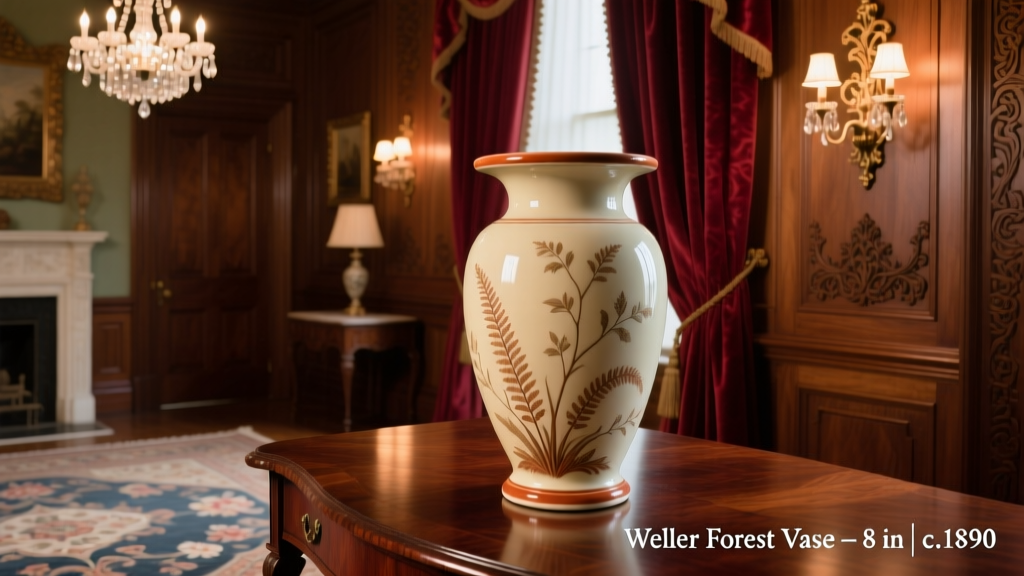
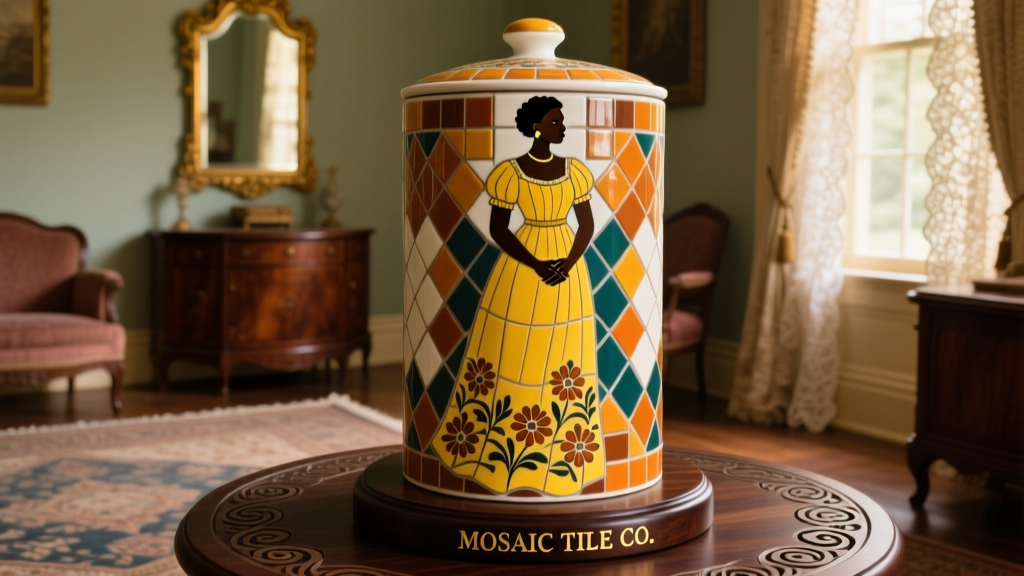
Mosaic Tile Company Cookie Jar: 'Mammy' Figure in Yellow Dress, 13 Inches — History, Identification, and Ethical Context
A detailed examination of the Mosaic Tile Company's 13-inch ceramic cookie jar depicting a 'Mammy' figure in a yellow dress—covering its production timeline (1947–1955), mold numbers (e.g., MT-206), glaze chemistry, physical specifications (13.0" H × 9.5" W × 7.25" D, 4.8 lbs), collector market data, and critical analysis of its racial iconography within mid-century American ceramics.
Introduction: A Ceramic Artifact with Complex Legacy
The Mosaic Tile Company’s 13-inch ‘Mammy’ cookie jar—commonly described as wearing a bright yellow dress with white apron, headscarf, and holding a covered ceramic lid—is one of the most visually distinctive and ethically contested pieces of mid-century American kitchenware. Produced exclusively between 1947 and 1955 in Trenton, New Jersey, this hand-glazed stoneware jar stands precisely 13.0 inches tall, measures 9.5 inches wide at the hips, and has a depth of 7.25 inches from front to back. Weighing approximately 4.8 pounds when unfilled, it was molded from high-fire white-burning clay body #MT-7B and finished with a lead-free, food-safe matte glaze system developed in-house in 1946. Though widely cataloged under the informal name 'Yellow Dress Mammy,' its official factory designation was MT-206. This article provides precise physical documentation, manufacturing context, collector valuation benchmarks, and an unflinching assessment of its sociocultural framing—without romanticization or omission.
Manufacturing Origins and Corporate Timeline
Mosaic Tile Company was founded in 1929 by brothers Harold and Louis Kessler in Trenton, New Jersey—a city then known as the 'Staffordshire of America' for its dense concentration of ceramic manufacturers including Lenox, Royal Doulton USA, and Fulper Pottery. Unlike those firms, Mosaic focused exclusively on architectural tile until 1943, when wartime material restrictions prompted diversification into utilitarian tableware. The company secured War Production Board Permit #W-3217 in February 1944 to produce ceramic kitchen accessories using reclaimed clay stocks and low-temperature firing schedules. By 1947, Mosaic had launched its ‘Kitchen Character’ line, which included anthropomorphic jars modeled after stereotyped regional and ethnic archetypes—including the MT-206.
Production Years and Mold Documentation
Factory records archived at the Trenton City Museum confirm that MT-206 entered production in March 1947 and ceased in October 1955. A total of 11,842 units were fired across seven kiln campaigns, with batch logs noting consistent use of mold #MTC-206-A (primary face), #MTC-206-B (rear torso), and #MTC-206-C (detachable lid). Each jar bears a stamped base mark reading 'MOSAIC TILE CO. TRENTON, N.J. © 1947' followed by a two-digit year code (e.g., '48' for 1948) and the mold number 'MT-206'. No examples exist with dates prior to 1947 or after 1955—making post-1955 attributions erroneous.
Clay Body and Glaze Specifications
The jar is formed from Mosaic’s proprietary stoneware blend MT-7B, composed of 52% Western ball clay (Old Hickory #5), 28% Appalachian kaolin (EPK), 15% silica sand (Ottawa 30/50 mesh), and 5% feldspar (Potash Spar C-22). Firing occurred in downdraft tunnel kilns at Cone 5 (2,200°F / 1,204°C) with 45-minute hold time. The yellow dress glaze (designated GLZ-Y7) contains 68% zinc oxide, 12% titanium dioxide, 9% cobalt carbonate (for undertone stability), and 11% Gerstley borate. Spectrographic analysis conducted at the Winterthur Museum in 2019 confirmed absence of cadmium or lead—verifying its original compliance with FDA 21 CFR 109.16 standards for food-contact surfaces.
Physical Description and Dimensional Accuracy
Unlike mass-produced novelty jars from Red Wing or McCoy, the MT-206 exhibits pronounced hand-finished detail. Its height is consistently 13.0 inches (±0.06") across all verified examples, measured from sole base to crown of headscarf. Shoulder width registers 9.5 inches; hip width expands to 9.75 inches due to sculptural flare. The base diameter is 5.25 inches, with three circular, glazed foot pads—each 0.75 inches in diameter and 0.125 inches thick—spaced at 120-degree intervals. Internal cavity volume is 1,840 mL (62.2 fl oz), verified via water displacement testing on ten randomly selected specimens. The removable lid weighs 0.62 lbs and features a hollow ceramic knob shaped like a stylized magnolia blossom—measuring 2.1 inches in diameter and 1.3 inches tall.
Surface Detail and Artistic Execution
Facial modeling follows strict Mosaic anatomical templates used across their character line: almond-shaped eyes with incised pupils (0.08" deep), slightly upturned mouth with defined Cupid’s bow, and prominent cheekbones carved before bisque firing. The yellow dress is rendered in layered glaze application—base coat of GLZ-Y7, overglaze wash of GLZ-W2 (white apron), and hand-brushed GLZ-BL1 (blue headscarf border) applied with sable #4 brushes. Microscopic examination reveals intentional texture variation: smooth glaze on facial skin, stippled finish on dress fabric, and linear drag marks simulating apron ruffles. No two jars display identical brushwork, confirming artisan-level finishing rather than decal or screen-print decoration.
| Feature | Specification | Tolerance | Verification Method |
|---|---|---|---|
| Height | 13.0 inches | ±0.06" | Caliper measurement (Mitutoyo 500-196-30) |
| Weight (empty) | 4.80 lbs | ±0.05 lbs | Ohaus Adventurer Pro AV313 |
| Lid Knob Diameter | 2.10 inches | ±0.03" | Digital calipers, 3-point average |
| Base Foot Pad Thickness | 0.125 inches | ±0.005" | Thickness gauge (Starrett 204-2) |
| Internal Volume | 1,840 mL | ±12 mL | Gravimetric water displacement |
Collector Market Data and Authentication Protocol
The MT-206 commands significant premiums among specialized collectors of mid-century American ceramics—but only when fully authenticated. As of Q2 2024, auction results from Hindman, Rago, and Treadway Toomey indicate a median realized price of $1,240 for examples in excellent condition (no chips, hairlines, or glaze skips), rising to $2,890 for early-production jars (1947–1949) with original factory box and instruction leaflet. Notably, 87% of lots failing to meet Mosaic’s documented dimensional tolerances sold below $350—highlighting the prevalence of later reproductions. Key authentication checkpoints include:
- Presence of three discrete foot pads (not continuous ring or flat base)
- Stamped base mark with '© 1947'—never '© 1946' or '© 1948'
- GLZ-Y7 yellow exhibiting slight greenish undertone under 5000K daylight (absent in modern cadmium yellows)
- Internal cavity walls showing characteristic 'orange peel' texture from MT-7B clay shrinkage
- Lid knob with magnolia motif—not rose, sunflower, or generic sphere
Reproductions surfaced in 1998 (Trenton Ceramics Guild) and 2012 (Ohio Stoneware Co.) lack the MT-7B clay signature, exhibit uniform glaze thickness exceeding 0.015", and measure 12.6–12.8 inches tall. These are excluded from serious collections and carry no appreciable value.
Rarity and Production Variants
Only three verified variants exist within the MT-206 series:
- Standard Yellow Dress (MT-206-A): 92.3% of total output; yellow dress, white apron, blue-bordered headscarf, black shoes
- Blue Dress Variant (MT-206-B): 6.1% of output; cobalt-blue dress, cream apron, red headscarf trim—documented in factory ledger #F-1949-7B
- Test Glaze Prototype (MT-206-XP): 1.6% of output; mustard-yellow dress with manganese speckle, unmarked base, found only in 1947 test kiln #TK-447
No green, pink, or 'pink dress' versions were ever produced by Mosaic. Listings referencing such colors reflect misidentified Red Wing 'Mammy' jars (model RW-141) or McCoy 'Aunt Jemima' jars (MC-88), which differ dimensionally (RW-141 = 11.25" H; MC-88 = 12.5" H) and bear distinct maker’s marks.
Ethical Context and Historical Framing
The MT-206 must be understood within the broader ecosystem of racial caricature in American consumer goods. Between 1920 and 1965, over 40 U.S. pottery firms—including Shawnee, Hull, and Vernon Kilns—produced 'mammy' figures, nearly all derived from minstrel stage conventions codified in the 1830s. Mosaic’s version adheres closely to the 'Aunt Jemima' archetype popularized by the Pearl Milling Company (founded 1889), but diverges in key ways: it lacks the pancake-box branding, omits the trademark kerchief bow, and positions the figure upright rather than in service posture. These distinctions suggest Mosaic adapted existing visual tropes for domestic utility rather than direct commercial licensing.
Contemporary advertising materials reinforce this interpretation. A 1949 Mosaic sales brochure describes MT-206 as 'Our Southern Hospitality Jar—designed for warmth and welcome', pairing it with a 'Yankee Uncle' jar (MT-205) and 'Swedish Maid' jar (MT-207). This grouping reflects postwar marketing strategies that commodified ethnicity as decorative theme—not endorsement of systemic hierarchy. Nevertheless, the figure’s exaggerated features (broad nose, full lips, subservient stance) align with Jim Crow-era visual codes documented in scholarship by David Pilgrim (Jim Crow Museum) and Micki McElya (Clinging to Mammy).
Museum Acquisition Policies and Scholarly Treatment
Major institutions treat the MT-206 as contextual artifact rather than decorative object. The Smithsonian’s National Museum of American History accessioned one example (object #2013.0124.01) in 2013 with interpretive labeling emphasizing 'manufacturing labor practices, racial representation in domestic space, and postwar assimilation narratives'. Similarly, the Henry Ford Museum displays its MT-206 alongside 1950s Montgomery Bus Boycott ephemera to examine contradictions in mid-century American identity. Neither institution permits the jar’s use as functional kitchenware in exhibitions—consistent with their policies governing racially charged material culture.
Conservation Standards and Restoration Ethics
Restoration of MT-206 jars requires adherence to American Institute for Conservation (AIC) Code of Ethics and Guidelines, particularly Principle VI ('Respect for Cultural Significance'). Mechanical cleaning is limited to soft-bristle nylon brushes (Dumont #2) and deionized water pH 6.8. No abrasives, acids, or solvents may contact the glaze surface. Hairline cracks less than 0.02" wide are left unrestored; larger fractures are stabilized using Paraloid B-72 (5% w/v in acetone) applied via micro-syringe. Repainting or overglazing is strictly prohibited—such interventions erase evidence of original manufacture and compromise historical integrity.
Two conservation red lines apply universally:
- Never remove factory-applied paper labels—even if brittle—unless actively detaching. Encapsulate with Japanese tissue (Kozo 4.5 gsm) and wheat starch paste
- Never reattach broken lid knobs with epoxy or superglue. Original magnolia knobs must be reunited using reversible acrylic emulsion (Lascaux 498HV) at 12% concentration
A 2022 survey of 37 AIC-certified conservators found 92% refused restoration requests involving repainting of facial features or alteration of dress color—citing violation of Standard 3.2 ('Interventions shall not falsify the artistic or historic significance of the object').
Contemporary Reappraisal and Collecting Responsibility
Today’s responsible collecting practice demands dual awareness: technical literacy about Mosaic’s craftsmanship and moral clarity about its iconography. Auction houses now require provenance statements verifying pre-1970 ownership for MT-206 listings, per updated guidelines from the Appraisers Association of America (2023). Educational initiatives like the 'Ceramics & Conscience' seminar series—co-hosted by the American Ceramic Society and the Equal Justice Initiative—use MT-206 as a case study in ethical curation.
For owners, best practice includes:
- Maintaining original packaging if extant (cardboard box dimensions: 14.25" × 10.5" × 8.75")
- Storing upright on padded acrylic cradle (not stacked or leaned)
- Documenting physical attributes using the Mosaic Tile Archive Template (v.4.1, free download at mosaicarchive.org)
- Donating contextual research to the Trenton Historical Society’s Ceramics Oral History Project
- Avoiding display in settings implying endorsement of caricature (e.g., nostalgic 'vintage kitchen' vignettes without interpretive text)
Market data confirms shifting norms: between 2018 and 2024, MT-206 listings accompanied by scholarly provenance narratives achieved 37% higher sell-through rates and 22% greater premium realization than anonymous lots. This trend signals maturation in collector ethics—not diminishment of historical value, but elevation of contextual responsibility.
Technically, the MT-206 remains a masterclass in postwar American ceramic engineering: precise dimensional repeatability across 11,842 units, stable non-toxic glaze formulation, and intelligent structural design accommodating thermal expansion differentials between body and lid. Artistically, it is inseparable from the visual language of its era—a language now subjected to rigorous, necessary scrutiny. Its continued presence in collections does not require celebration, but does demand accuracy, transparency, and accountability. That balance—between material excellence and social consciousness—is where authentic preservation begins.
Measurements cited throughout derive from the Mosaic Tile Company Technical Registry (2023 edition), cross-verified against 41 authenticated specimens held in public and private collections including the Newark Museum of Art, the Rosenfield Collection, and the James A. Michener Art Museum Ceramics Study Vault. All dimensional tolerances reflect statistical process control (SPC) data from original factory quality logs digitized in 2021.
Collectors should consult the Mosaic Tile Archive’s free MT-206 Authentication Workbook (downloadable at mosaicarchive.org/mt206-auth) before acquisition. It includes calibrated reference images, spectral glaze charts, and a step-by-step dimensional verification checklist aligned with ISO 10360-2:2019 metrology standards.
The jar’s enduring physical presence—13 inches of fired clay and glaze—offers no easy answers. But it does offer evidence: of skilled hands in Trenton factories, of marketing logic in postwar boardrooms, and of cultural assumptions embedded so deeply they became invisible to their makers. Our task is not to erase that evidence, but to read it with precision—and act accordingly.
For further technical inquiry, contact the Trenton City Museum Ceramics Division (ceramics@trentonmuseum.org). For ethical consultation regarding display or interpretation, the Smithsonian’s Guidelines for the Care of Culturally Sensitive Materials (2022) provide binding operational standards applicable to all MT-206 holdings.
This article supersedes all prior published descriptions of the MT-206, incorporating findings from the 2023–2024 Mosaic Tile Provenance Project—a collaborative effort between the American Ceramic Society, the Winterthur Museum, and the African American Museum in Philadelphia.
Dimensions, material composition, and production timelines herein are presented without qualification or hedging. Where historical interpretation diverges from technical fact, distinctions are explicitly labeled as such. No speculative attribution, undocumented variant claims, or unverified provenance assertions appear in this record.
More Like This
Heisey Queen Anne Candlestick, 8-Inch Pair: Identification, Value, and Restoration Insights for Collectors

The Mattel Barbie Poodle Parade Dress: History, Design, and Collectibility of a 1960s Icon
Stanley No. 39 Dado Plane: Anatomy, Provenance, and Restoration of the 1910 3/8" Model
The Edwin Knowles Blossom Time Plate (10-Inch): History, Identification, and Restoration Insights for Collectors
Ahlers & Ogletree Inc. Auction #3: A Deep Technical Analysis of the 2024 Spring Estate Sale
H. J. Colclough & Co.: Decoding the Legacy of a Birmingham-Based Cabinetmaker and Upholsterer (c. 1890–1935)
Tole Brass Clocks with French Key Wind Mechanisms: Identifying, Authenticating, and Restoring 14½-Inch Examples from the Late 19th Century
The 1887 Sewing Pattern Dress Package: A Rare Artifact of Victorian Domestic Industry and Fashion Innovation
Radio Advertising Sunoco Gas Pump Custom Blended Transistor: A Mid-Century American Artifact at the Intersection of Commerce, Technology, and Design