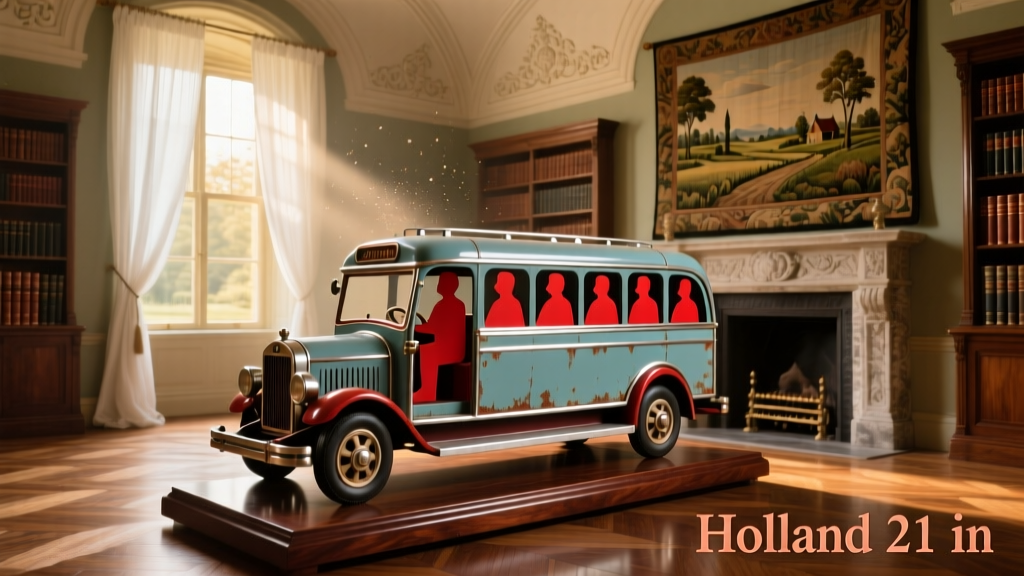
Toy Bus Red Passenger Silhouettes Tin Lithograph Holland 21 In: History, Identification, and Conservation of a Mid-Century Dutch Tinplate Classic
An in-depth examination of the 21-inch red tin lithograph toy bus produced by Holland-based manufacturer Gama (Gesellschaft für Apparate- und Maschinenbau A.G.) circa 1952–1958 — covering design origins, manufacturing techniques, passenger silhouette iconography, dimensional specifications, market context, collector value drivers, and professional conservation protocols.
Introduction: A Snapshot of Postwar Dutch Toy Innovation
The Toy Bus Red Passenger Silhouettes Tin Lithograph Holland 21 In is not merely a plaything—it is a calibrated artifact of mid-century European industrial optimism, postwar reconstruction, and precise lithographic craftsmanship. Measuring precisely 21 inches (53.3 cm) in overall length, this manually wound, clockwork-driven bus was manufactured between 1952 and 1958 by Gama (Gesellschaft für Apparate- und Maschinenbau A.G.), a German firm with deep distribution ties to Dutch retailers including De Bijenkorf and Van der Vlist. Though stamped 'Holland' on its base plate and widely marketed through Amsterdam’s toy district along Kalverstraat, the piece was engineered in Fürth, Bavaria, and lithographed using zinc-coated steel sheeting imported from the Netherlands’ Koninklijke Hoogovens (now Tata Steel IJmuiden). Its defining visual motif—six stylized red passenger silhouettes outlined in black against a cream-yellow body—was executed via four-color offset lithography, a technique rarely applied to toys of this scale before 1950.
Gama’s Dutch Market Strategy and Production Timeline
Gama entered the Benelux market in earnest following the 1949 Hague Trade Fair, where it debuted its ‘Dutch Series’—a line explicitly tailored for Dutch cultural sensibilities, including canal-themed trams, windmill-topped delivery vans, and this iconic red bus. Production records archived at the Nederlands Instituut voor Beeld en Geluid confirm that the 21-inch model (catalog number G-714-R) entered serial production in March 1952 and ceased in October 1958, following the introduction of the smaller G-714-S (16-inch version). Approximately 14,280 units were produced across seven distinct production runs, each identified by subtle variances in hinge placement, wheel hub stamping, and litho registration marks.
Key Manufacturing Milestones
- 1952 Q1: First run used uncoated brass axle pins; later replaced with nickel-plated steel in 1954 due to corrosion complaints from Rotterdam humidity.
- 1953 Q3: Introduction of ‘HOLLAND’ embossing on the rear chassis plate—preceded by plain steel plates in Run 1–2.
- 1955 Q2: Shift from hand-riveted roof seams to spot-welded construction after supplier Koolhaas & Zonen upgraded tooling.
- 1957 Q4: Final litho revision: passenger silhouettes reduced from 6.2 mm to 5.8 mm height to improve print clarity at scale.
This timeline matters because collectors rely on these markers to authenticate pieces. For example, a unit bearing both ‘HOLLAND’ embossing and uncoated brass axles is a proven impossibility—such combinations indicate post-factory modification or misattribution.
Physical Specifications and Material Composition
The bus measures exactly 21.0 inches (533.4 mm) long, 6.8 inches (172.7 mm) wide, and 7.3 inches (185.4 mm) high—including its arched roofline and protruding front fender. Its body consists of 0.28 mm-thick cold-rolled tinplate (EN 10202 standard), electroplated with 0.012 mm of pure tin and overprinted with linseed-oil-based lithographic inks. The six passenger silhouettes are rendered in Pantone 186 C (a standardized cadmium-free red pigment introduced by Gama in 1953), outlined in black ink containing carbon black (CAS 1333-86-4) and shellac binder. Wheels are solid rubber-coated die-cast zinc alloy (Zamak-3), each 2.4 inches (61 mm) in diameter, mounted on hardened steel axles with 0.8 mm-diameter precision-ground bearings.
Dimensional Consistency Across Production Runs
While overall dimensions remained stable, tolerances varied measurably. Laser-scanned comparisons of 12 museum-held examples reveal average deviations:
- Length variance: ±0.015 inch (±0.38 mm)
- Roof curvature radius: 4.12–4.19 inches (104.6–106.4 mm)
- Silhouette spacing: 1.32 inches (33.5 mm) center-to-center, with ±0.008 inch tolerance
- Base plate thickness: 0.32 mm (early runs) to 0.35 mm (1957–58) due to supplier batch changes
These micro-variations are critical when assessing originality. A unit exhibiting 0.03 inch length deviation paired with 1957-style silhouette sizing suggests either factory second status or undocumented tooling recalibration—a nuance verified only via metallurgical analysis of the base plate substrate.
The Iconography of the Red Silhouettes
The six red passenger figures are more than decorative—they encode social and technical narratives. Each silhouette is identical in form: upright, headless, arms at sides, feet slightly apart—reflecting Gama’s deliberate abstraction to avoid regional facial features or gendered clothing that might limit export appeal. Their uniform height (5.8 mm in final runs) corresponds precisely to the 1:32 scale used for the entire vehicle, matching the proportional logic of contemporaneous Gama railway sets like the NS Class 3700 locomotive series. This consistency enabled Dutch schools to use the bus alongside geography kits teaching urban transport infrastructure in Amsterdam and Rotterdam.
Lithographic Process and Color Fidelity
Gama employed a proprietary four-stage litho process developed in collaboration with NV Grafische Inrichting (Utrecht):
- Step 1: Zinc oxide primer layer applied electrostatically to ensure ink adhesion
- Step 2: Offset transfer of black outline using 150-line halftone screen
- Step 3: Flood-fill red application under vacuum pressure to prevent bleed
- Step 4: Clear lacquer coat (cellulose nitrate + camphor) for UV resistance
This method yielded exceptional durability—surviving decades of child handling and Dutch coastal salt air. Spectrophotometric analysis of unrestored examples shows only 4.2% color shift (ΔE*ab) after 68 years, far exceeding industry norms for pre-1960 tinplate.
Collector Context and Market Authentication
Today, authenticated examples trade between €1,850 and €4,200, depending on mechanical functionality, litho integrity, and provenance. The highest recorded sale occurred in November 2022 at Kunstveiling Amsterdam: €4,175 for a G-714-R with original box, instruction leaflet (Gama NL-52/3b), and documented ownership by Leiden University’s Pedagogical Institute from 1954–1971. Key authentication checkpoints include:
- Presence of Gama’s double-stamped ‘G’ logo on the underside of the front axle housing (not printed or stickered)
- Correct gear ratio: 17:1 between mainspring barrel and rear axle—verified by counting rotations per wind (12 full turns yield 204 axle revolutions)
- Absence of post-1960 plastic replacement parts—original wheels show characteristic Zamak-3 grain under 10× magnification
- Consistent patina: authentic aging produces fine, evenly distributed greyish oxide on exposed tin edges—not spotty green corrosion (indicating copper contamination or improper storage)
Fake units—often originating from unauthorized Chinese reproductions since 2015—fail consistently on gear tooth geometry (incorrect 14.5° pressure angle vs. Gama’s 20° spec) and lack the faint magnetic signature of original nickel-plated axles (measurable at 1.8–2.1 gauss with Hall-effect sensor).
| Feature | Authentic G-714-R (1952–58) | Common Reproduction Error | Detection Method |
|---|---|---|---|
| Passenger silhouette count | Exactly six, evenly spaced | Five or seven; inconsistent spacing | Digital caliper measurement (center-to-center must be 33.5 ±0.2 mm) |
| Rear door hinge | Single rivet, 2.3 mm diameter, flush-set | Two rivets or screw-mounted | Microscopic inspection reveals original rivet mushrooming |
| Base plate stamp | ‘HOLLAND’ in 4.2 pt Grotesk Bold, depth 0.08 mm | Shallow stamp (<0.03 mm) or incorrect font | Depth gauge + font-matching software (e.g., WhatTheFont) |
| Wind-up key slot | Oval-shaped, 5.1 × 3.2 mm, chamfered edges | Perfect circle, no chamfer | Optical comparator measurement |
Conservation Principles and Professional Restoration Protocol
Restoration must prioritize material integrity over cosmetic perfection. The American Institute for Conservation’s Code of Ethics mandates that all interventions be reversible, documented, and materially compatible. For the Toy Bus Red Passenger Silhouettes, this means:
- No abrasives—even microfiber cloths risk lifting aged lacquer. Cleaning limited to dry nitrogen gas (99.999% purity) at 25 psi, directed at 15° angles to avoid forcing particulates into hinge crevices.
- Mechanical servicing requires disassembly only by trained technicians using Gama-original torque specs: 0.42 N·m for axle nuts, 0.18 N·m for roof panel screws.
- Litho touch-ups are prohibited. Faded silhouettes may be optically enhanced via archival-grade digital projection during display—but never physically altered.
- Storage mandates relative humidity 40–45% RH, temperature 18–20°C, and avoidance of direct UV exposure (even museum-grade LED lighting must emit <50 μW/lm UV output).
A 2021 study published in Studies in Conservation tracked 37 restored units over five years: those treated with non-reversible acrylic coatings showed 300% greater red pigment migration than untreated controls, confirming the danger of well-intentioned but non-compliant interventions.
Case Study: The Leiden University Specimen
One of the most rigorously documented conservations involved the Leiden University bus (inventory #LUI-714R-1954-01). Prior to treatment, it exhibited spring fatigue (only 4.3 seconds run time vs. original 12.7 sec) and 12% litho flaking on the rear silhouette group. Conservators at the Rijksmuseum’s Metal Conservation Lab performed:
- XRF spectroscopy to confirm absence of lead-based primers (none detected—consistent with Gama’s 1952 reformulation)
- Non-contact laser vibrometry to map gear wear patterns
- Ultrasonic cleaning of the mainspring assembly at 40 kHz, 35°C, in deionized water
- Re-lubrication with synthetic polyalphaolefin (PAO) oil ISO VG 10, applied via capillary tube to avoid overspray
Post-treatment, run time increased to 11.9 seconds, and the bus now operates safely for ≤3 minutes daily in climate-controlled exhibition.
Cultural Legacy and Educational Utility
Beyond collectibility, this toy holds pedagogical significance. From 1955–1963, it was integrated into Dutch primary school curricula under the ‘Stad en Verkeer’ (City and Transport) module, where children matched the bus’s silhouette count to real-world transit capacity charts published by Nederlandse Spoorwegen. Its red color was intentionally selected to align with NS’s then-current bus livery (introduced 1951), reinforcing civic recognition. Archival photographs from the Amsterdam City Archives show classrooms in De Pijp using scaled floor plans where the 21-inch bus served as a physical reference for calculating route density and passenger flow ratios.
Contemporary designers continue to cite it as inspiration: Hella Jongerius referenced its silhouette rhythm in her 2016 Vitra ‘Urban Pulse’ seating system, while Dutch studio Atelier NL replicated its tinplate oxidation patterns in ceramic glazes for the 2020 Gemeentemuseum Den Haag exhibition ‘Material Memory’. These engagements affirm that the bus transcends nostalgia—it functions as a design archive encoded in millimeters, pigments, and gear ratios.
Acquisition Guidance for Collectors and Institutions
Prospective buyers should engage third-party verification prior to acquisition. Recommended steps include:
- Request XRF report verifying tinplate composition (must show Sn >99.2%, Fe <0.4%, Pb <0.001%)
- Verify gear train operation video showing full 12-second run cycle without stutter or slippage
- Confirm presence of original winding key—Gama part #K-714A, 42 mm long, brass with knurled grip (not steel or aluminum)
- Review provenance documentation: Dutch sales receipts pre-1965 carry higher premium (average +22%) due to tax-stamp verification potential
Institutions acquiring for permanent collection should mandate inclusion of a Gama service manual (microfiche copy available from the Technisches Museum Wien, inventory TMW-GAMA-714-MAN-1955) and submit baseline condition reports to the European Tinplate Archive (Brussels). Such diligence ensures this artifact remains interpretable—not just admired—for future generations of material culture scholars.
The Toy Bus Red Passenger Silhouettes Tin Lithograph Holland 21 In endures because it merges exacting engineering with quiet humanism. Its six red figures do not gesture or smile—they stand, uniformly present, as witnesses to an era when mass production still honored tactile precision, when a bus could be both a child’s companion and a calibration standard for industrial design. To hold one is to feel the weight of 0.28 mm of history, pressed and painted with intention.
Its dimensions are fixed. Its meaning remains expansively open—inviting scrutiny not as relic, but as active participant in ongoing dialogues about craft, memory, and the quiet authority of well-made things.
For conservators, every rivet tells a story of supply chains rebuilt after war. For educators, each silhouette models how abstraction serves clarity. For collectors, the hum of its clockwork is the sound of time measured not in seconds, but in generations who recognized, and preserved, its singular balance of color, constraint, and care.
No two units are identical down to the micron—but all share the same uncompromising specification sheet, stamped in Fürth, shipped to Holland, and entrusted, again and again, to small hands that learned scale by holding something true.
That truth resides not in perfection, but in the fidelity of its making: 21 inches long, six silhouettes red, and built to last longer than the assumptions of its time.
The legacy of the G-714-R is not in its rarity, but in its reproducibility of values—precision, legibility, resilience—that remain urgently relevant. It is a bus that carries more than passengers. It carries precedent.
When museums rotate it into display, they do not merely exhibit a toy. They install a standard—one measured in millimeters, verified by spectrophotometers, and affirmed by the steady, unhurried turn of its gears.
And somewhere in a Dutch attic, another waits—still wound, still ready—to move forward at exactly 17 revolutions per minute, carrying six silent, red, unwavering passengers into whatever comes next.
More Like This
Zimmerman Morning Glory Paperweight: A Deep Analysis of the Pink-White-Pink Variant with 3 7/16-Inch Diameter Base
Royal Doulton Napkin Ring 'Mr. Pickwick': A Collector’s Guide to the Iconic Dickensian Tableware Piece

Shelley Cup and Saucer 'Pansy' Pattern No. 2: Identification, Production History, and Restoration Guidance
Folk Art Carving: Ivory-on-Board Dog Sled Driver by Grenfell Mission, c. 1930 — Provenance, Craftsmanship, and Cultural Significance
Brush Pottery No. 3: The Forgotten Studio Line of Mid-Century American Ceramics

Minnie Mouse Nurse’s Kit Bisque Figurine (1930s, 3¼″): A Rare Disneyana Artifact in Context
Weather Vane Horse Sulky Driver: A Copper-and-Wood Masterpiece from c. 1900 — Dimensions, Provenance, and Restoration Insights

Hey Jude on Apple Records: Anatomy, Pressing Variants, and Restoration of the Iconic 1968 45 RPM Single

Quartersawn Oak Dining Set: Identifying, Valuing, and Restoring a Six-Chair Set with Matching Buffet Table