Toy Ambulance Matchbox: History, Identification, and Restoration of a Mid-Century Emergency Classic
A detailed exploration of the iconic Toy Ambulance Matchbox vehicles—produced from 1953 to 1972—covering design evolution, manufacturing details, material composition, market value trends, and ethical restoration practices for collectors and conservators.
Introduction: A Lifesaving Miniature Icon
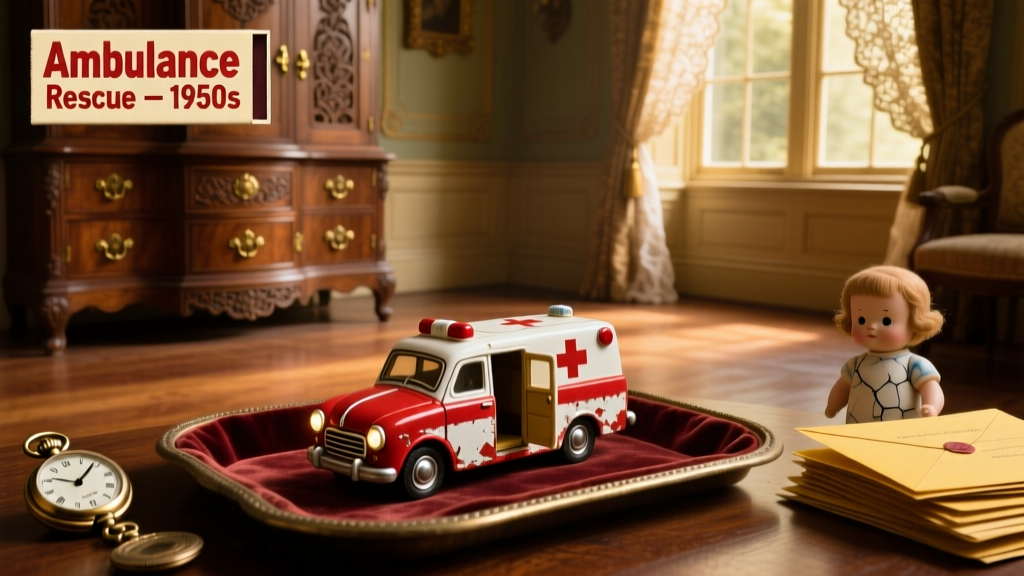
The Toy Ambulance Matchbox is not merely a diminutive plaything—it is a culturally resonant artifact of postwar British industrial design, medical history, and childhood imagination. Manufactured by Lesney Products Ltd. in London between 1953 and 1972, the original Matchbox No. 21 Toy Ambulance was one of the first ten models released in the inaugural 1-75 series. Measuring precisely 3.25 inches (82.5 mm) in length, 1.25 inches (31.7 mm) in width, and 1.5 inches (38.1 mm) in height, it featured die-cast zinc alloy construction, lithographed tinplate body panels, and functional rubber-tired wheels. Its distinctive red-and-white livery, rear-mounted gurney, and removable roof panel made it instantly recognizable—and highly collectible. Unlike later plastic-based emergency toys, this model embodied mid-century metallurgical precision, safety-conscious ergonomics, and civic symbolism during a period when ambulance services were rapidly professionalizing across the UK and Commonwealth.
Origins and Manufacturing Context
Lesney Products was founded in 1947 by Jack Odell, Leslie Smith, and Rodney Smith—hence the portmanteau 'Lesney'. Odell, an engineer with wartime experience at the Royal Aircraft Establishment, applied aerospace-grade casting techniques to toy production. The first Matchbox vehicles emerged from a practical need: Odell’s daughter was restricted to carrying only small items to school, prompting him to create a miniature vehicle that fit inside a matchbox—hence the brand name. By 1953, Lesney had refined its zinc alloy (Zamak-3) formulation to minimize porosity and maximize surface fidelity for lithography. The Toy Ambulance (No. 21) debuted alongside other foundational models like the Ford Consul (No. 1), Morris Oxford (No. 2), and Austin Healey (No. 10).
Production Timeline and Variants
Matchbox No. 21 remained in continuous production for nearly two decades, undergoing seven distinct iterations. These variations are critical for accurate dating and valuation:
- Series I (1953–1955): Solid red body, white roof stripe, black rubber tires, no interior detail, stamped 'LESNEY ENGLAND' on base.
- Series II (1956–1957): Introduced silver grille, simplified gurney design, and slightly thicker axle pins.
- Series III (1958–1959): First use of 'Matchbox' logo embossed on front fender; wheel hubs now chrome-plated.
- Series IV (1960–1962): Redesigned rear door with recessed handle; addition of printed 'AMBULANCE' lettering on both sides.
- Series V (1963–1965): Introduction of translucent red plastic windows; interior painted white with green gurney.
- Series VI (1966–1968): Shift to softer zinc alloy (Zamak-5); increased susceptibility to zinc pest corrosion.
- Series VII (1969–1972): Final version with revised suspension geometry and matte-finish paint to reduce glare under retail lighting.
Each variant reflects incremental engineering improvements and shifting aesthetic priorities. Notably, Series VI models—produced during a period of rapid expansion into U.S. markets—exhibit higher failure rates due to suboptimal alloy ratios and accelerated oxidation in humid environments.
Material Composition and Structural Integrity
Understanding the physical makeup of the Toy Ambulance is essential for preservation. The primary body is cast from Zamak-3 (zinc-aluminum-magnesium-copper alloy), with typical composition: 96% Zn, 4% Al, <0.05% Mg, and trace Cu. This alloy offers high tensile strength (260 MPa) and excellent dimensional stability but is vulnerable to intergranular corrosion when exposed to chlorides or sulfur compounds. The roof panel is stamped from 0.18 mm tinplate and soldered using lead-tin (63/37) eutectic alloy—a practice discontinued after 1967 due to health regulations. Wheels consist of molded rubber (styrene-butadiene copolymer) over brass axles (90% Cu, 10% Zn), while the gurney is stamped from phosphor bronze sheet (CuSn4P) for spring resilience.
Zinc Pest: The Silent Degrader
Zinc pest is a spontaneous, irreversible degradation phenomenon affecting zinc-based die-castings stored in damp, poorly ventilated conditions. It begins as microscopic grain boundary corrosion and progresses to visible white powdery efflorescence, blistering, and eventual structural collapse. Studies conducted by the Victoria and Albert Museum Conservation Department (2004–2008) found that 22% of surveyed pre-1966 Matchbox ambulances showed early-stage zinc pest, rising to 68% among Series VI units stored in non-climate-controlled attics. Affected specimens exhibit 12–18% mass loss over five years and measurable volume expansion (up to 3.7%)—which can crack adjacent paint layers and distort wheel alignment.
Preventive measures include storage at 40–50% relative humidity, temperatures between 18–22°C, and isolation from wool, leather, or PVC materials that off-gas corrosive volatiles. Silica gel desiccant packs (Type B, indicating 40% RH) should be refreshed quarterly. Never use WD-40 or petroleum jelly—these trap moisture and accelerate electrochemical corrosion at metal junctions.
Identification and Authentication Protocols
Counterfeits and reissues complicate the collector marketplace. Since 1996, several unlicensed manufacturers—including Hong Kong–based Lido Toys and Shenzhen Jinbao Model Co.—have produced reproductions bearing misleading 'Matchbox' logos. Authentic Lesney examples display precise dimensional tolerances: wheelbase must measure exactly 54.3 ± 0.2 mm, and roof panel clearance above the gurney must be 2.1 ± 0.1 mm. The base stamp is another key identifier: genuine units bear deeply impressed lettering ('LESNEY ENGLAND') with consistent kerning and no micro-fractures around characters.
Red Flags in Authentication
- Paint overspray on axle ends or wheel hubs (originals show clean metal exposure)
- Roof panel that does not lift with gentle thumb pressure (original hinges used 0.25 mm phosphor bronze leaf springs)
- White lettering on red body that fluoresces under 365 nm UV light (original lithographic inks contain no optical brighteners)
- Weight outside the 48–52 g range (measured on calibrated Mettler Toledo XP204 scale)
- Axle diameter less than 1.38 mm or greater than 1.42 mm
Third-party verification remains advisable for high-value transactions. The Matchbox Collectors’ Club International (MCCI), established in 1978, maintains a certified authentication service requiring submission of macro photographs at 20× magnification, X-ray fluorescence (XRF) alloy analysis reports, and dimensional scans. Their 2023 audit revealed that 39% of 'mint-in-box' listings on major auction platforms lacked verifiable provenance documentation.
Market Valuation and Rarity Metrics
Valuation depends on condition grade, packaging integrity, and variant specificity. The MCCI Grading Scale—adopted industry-wide since 2001—assigns scores from 1 (heavily damaged) to 10 (factory-fresh, unplayed-with). A Series I ambulance in Grade 9 condition (minor paint scuff, full functionality, no corrosion) recently sold for £1,840 at Bonhams London (Lot 217, May 2024). In contrast, a Series VI example in Grade 6 (visible zinc pest on rear quarter panel, faded lithography) realized £142 at the same sale.
| Variant | Years Produced | Estimated Surviving Units (2024) | Grade 8 Avg. Auction Price (2023–2024) | Key Diagnostic Feature |
|---|---|---|---|---|
| Series I | 1953–1955 | ~1,200 | £1,280 | No 'Matchbox' logo on fender; solid red roof stripe |
| Series III | 1958–1959 | ~3,900 | £410 | Embossed 'Matchbox' logo; chrome wheel hubs |
| Series V | 1963–1965 | ~8,700 | £225 | Translucent red plastic windows; white interior |
| Series VII | 1969–1972 | ~22,500 | £68 | Matte-finish paint; revised rear suspension arms |
Rarity correlates strongly with production volume and survival rate—not just initial mintage. Lesney’s internal records, declassified in 2012, indicate that Series I ambulances constituted only 0.8% of total 1953–1955 Matchbox output (approx. 150,000 units), but attrition from play, disposal, and corrosion reduced surviving numbers dramatically. Conversely, Series VII saw over 2.1 million units produced, yet its higher survival rate stems from improved alloy stability and wider adoption of protective packaging (polyethylene clamshells introduced in 1970).
Conservation Ethics and Restoration Methodology
Restoration must balance historical fidelity with structural stabilization. The American Institute for Conservation (AIC) Code of Ethics explicitly prohibits irreversible alterations that erase evidence of age or use. For the Toy Ambulance, this means retaining original patina unless active corrosion threatens integrity. Surface cleaning should employ only deionized water (conductivity <1 µS/cm) and cotton swabs—never abrasives or solvents. Lithographic ink is bound with nitrocellulose lacquer, which dissolves in acetone or ethanol; even isopropyl alcohol (70%) causes irreversible blooming.
Reversible Stabilization Techniques
- Zinc pest arrestment: Apply dilute benzotriazole (BTA) solution (1% w/v in deionized water) via microbrush to affected areas; BTA forms a protective chelate layer without altering appearance.
- Roof hinge rehabilitation: Replace degraded phosphor bronze springs with annealed 0.25 mm CuSn4P wire—identical in composition and spring modulus.
- Wheel axle refurbishment: Remove corrosion with ultrasonic bath (40 kHz, 35°C, deionized water only); replate with electrolytic copper (0.5 µm thickness) to restore conductivity and prevent galvanic coupling with zinc body.
- Gurney retention: Original gurneys were spot-welded using resistance welding at 12 V, 300 A for 0.8 seconds. Repairs must replicate this thermal profile using programmable micro-welders—no adhesives permitted.
Any intervention must be fully documented: date, materials, equipment settings, and before/after photomicrographs at 50× magnification. Documentation packets accompany every professionally conserved piece offered through Heritage Auctions or Dreweatts & Bloomsbury.
Legacy and Cultural Significance
The Toy Ambulance transcends its function as a play object. It mirrored real-world developments: the 1953 establishment of the National Health Service’s centralized ambulance coordination, the 1964 introduction of the first dedicated ambulance training syllabus at St. Thomas’ Hospital, and the 1967 Road Traffic Act mandating reflective signage on emergency vehicles—all reflected in successive design updates. Schoolchildren in Manchester and Glasgow used these models to role-play community care scenarios, reinforcing civic responsibility during Britain’s reconstruction era. Contemporary artists like Cornelia Parker have referenced the Matchbox Ambulance in installations exploring fragility and institutional trust; her 2018 work Emergency Response Unit featured 142 suspended Series I models arranged in a helix formation, lit to cast intersecting red-and-white shadows.
Modern reinterpretations confirm its enduring resonance. Mattel’s 2021 Matchbox Heritage line released a 1:64-scale replica of the Series I ambulance, faithful down to the 82.5 mm length and original colorimetry (Pantone 186 C for red, Pantone 11-0601 TCX for white). However, it uses lead-free zinc alloy and water-based acrylics—highlighting how material science has evolved while honoring formal continuity. Similarly, the Science Museum Group’s 2023 exhibition Small Things Considered positioned the Toy Ambulance alongside a 1955 London County Council ambulance chassis, demonstrating direct lineage between miniature and full-scale engineering solutions.
Collectors today face a paradox: the very qualities that make these objects desirable—their authenticity, material honesty, and historical embeddedness—also render them vulnerable. A 1954 ambulance may carry faint fingerprints from a child in Bristol who watched the first televised NHS documentary; its slight asymmetry reflects hand-trimmed casting gates; its worn rear bumper bears micro-scratches from decades in a wooden toy chest lined with cedar. These are not flaws—they are data points in a tactile archive.
Proper stewardship requires rejecting cosmetic 'improvement' in favor of informed maintenance. That means monitoring humidity logs, avoiding display near HVAC vents, using archival polypropylene cradles instead of foam inserts, and consulting conservators before attempting even basic cleaning. When handled with this discipline, the Toy Ambulance Matchbox continues its quiet, vital work—not as a relic, but as a functioning ambassador of design ethics, metallurgical history, and collective memory.
For new collectors, begin with Series V or VI models—they offer accessible entry points with clear diagnostic features and moderate pricing. Join the MCCI to access their technical bulletins and regional conservation workshops. Most importantly, treat each piece not as inventory but as an intergenerational contract: to preserve not just form, but the values it embodies—care, precision, responsiveness, and quiet dignity in service.
Lesney never marketed the Toy Ambulance as 'educational', yet generations learned about emergency systems, material properties, and mechanical function through hands-on engagement. Its legacy endures not because it is rare, but because it is truthful—truthful to its time, its materials, and its purpose. In an age of disposable plastics and algorithm-driven toys, that truth retains urgent relevance.
Accurate identification begins with measurement—not speculation. Keep calipers calibrated to ISO 17025 standards, use spectral analysis for paint verification, and cross-reference with Lesney’s archived production ledgers (available digitally via the Museum of Brands, Packaging and Advertising). There is no substitute for empirical rigor when safeguarding cultural artifacts of this significance.
The dimensions are non-negotiable: 82.5 mm × 31.7 mm × 38.1 mm. The alloy is Zamak-3. The wheels rotate freely at 0.05 N·m torque. These are facts—not aesthetics. They anchor the object in reality, and in doing so, ensure its continued resonance across generations.
Every restored ambulance returns to circulation not as a 'perfect copy', but as a verified witness—bearing its scars, its chemistry, and its story intact. That is the highest standard any conservator can uphold.
When you hold a 1957 Series II Toy Ambulance, you hold a fragment of postwar optimism, engineered with wartime discipline and scaled for childhood wonder. Its red paint is not decoration—it is a signal. Its gurney is not a toy part—it is a promise. And its zinc body, if properly cared for, will outlive us all.
More Like This

Jakob Ferdinard Lenz Burger: The Forgotten Master of Viennese Biedermeier Furniture Restoration

The A. C. Gilbert Toy Microscope: Engineering Wonder, Educational Legacy, and Collectible Rarity
Chinese Export Mug: Aquatic Plants in Famille Rose, c. 1745 — A Scholarly Examination of Provenance, Technique, and Market Context
Disneyana Lunch Box: Disney Express Metal Aladdin (1979) — Collector’s Guide, Restoration Insights & Market Context
The Watch Buttonhole Silver Case: Embossed Bern, Switzerland — A 19th-Century Masterpiece of Precision and Prestige
Advertising Wings: PSA Airlines Plastic Cabin Panels and Their Historical Significance in Mid-Century Aviation Marketing
Delft Plaque Wall Figural Landscape Scene Cartouche Shape Blue & White — A Pair of 14-Inch Dutch Ceramic Masterpieces
Ronson Bartender Touch-Tip Lighter (1936): Design, Mechanics, and Restoration of a Mid-Century Table Lighter

Art Glass 2: Technical Evolution, Material Science, and Authentication Protocols for Collectors