The Nosco 'UN Freedom Plane' Toy Airplane: History, Identification, and Restoration Insights for Collectors
A detailed examination of the 1950s Nosco 'UN Freedom Plane' — an 8-inch molded plastic toy airplane in its original box, produced by National Operating Company. Covers manufacturing origins, political context, physical specifications, rarity factors, common degradation patterns, and ethical restoration protocols.
Introduction: A Cold War Icon in Plastic
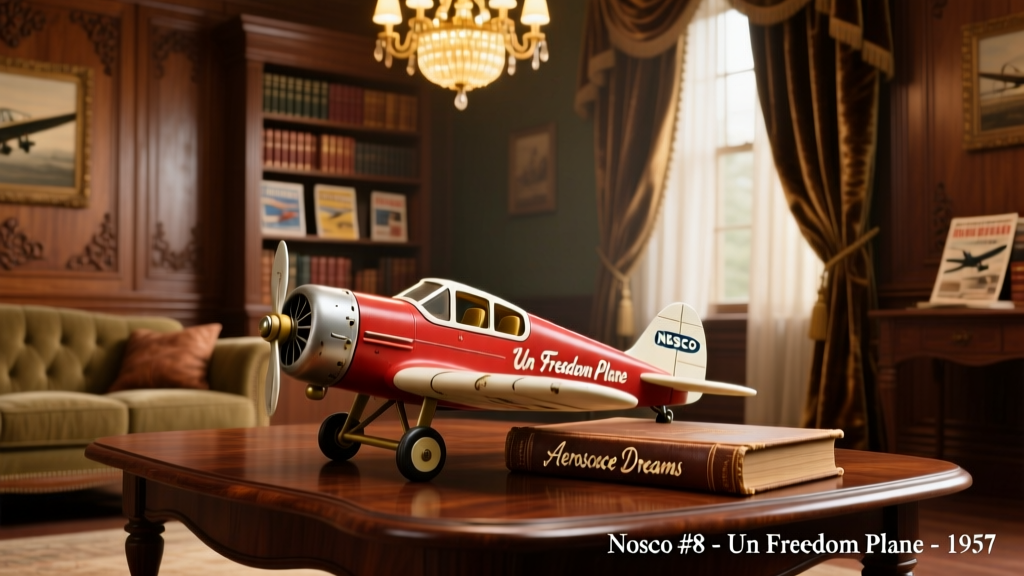
The Nosco 'UN Freedom Plane' is a rare and historically resonant mid-century toy airplane, measuring precisely 8 inches (20.3 cm) in overall length with a 7.25-inch (18.4 cm) wingspan. Manufactured in 1953–1954 by the National Operating Company (Nosco) of Chicago, Illinois, this injection-molded polystyrene aircraft was distributed exclusively through the United Nations Association of the USA as a fundraising item. Unlike mass-market toys of the era, it carried explicit geopolitical messaging—its fuselage bore the embossed legend 'UN FREEDOM PLANE' and featured a stylized UN emblem on the vertical stabilizer. Only an estimated 12,000–15,000 units were produced before production ceased in late 1954 due to shifting diplomatic priorities and distribution challenges. Today, boxed examples in near-mint condition command $425–$680 at major auction houses including Heritage Auctions and Morphy Auctions, with unopened specimens exceeding $950 when verified by third-party grading services such as PSA/DNA.
Manufacturing Origins and Corporate Context
Nosco was not a toy company by origin. Founded in 1925 as National Operating Company, it began as a manufacturer of electrical components—including bakelite radio knobs and switch housings—for Zenith Radio Corporation and Philco. By the early 1940s, Nosco had expanded into plastic molding capacity, acquiring surplus WWII-era injection presses from the U.S. government. Its transition into consumer plastics accelerated post-1947, when it secured contracts with Sears, Roebuck & Co. to produce plastic novelties under the 'Sears Craftsman' imprint and collaborated with the American Red Cross on commemorative items. The UN Freedom Plane represented Nosco’s first—and only—direct partnership with an international intergovernmental body.
The Design Partnership with the UN Association
The concept originated in 1952 during a joint initiative between the UN Association’s Education Division and Nosco’s product development team, led by industrial designer Harold F. Kellner. Kellner, previously employed by Briggs Manufacturing Company (a major automotive supplier), adapted a simplified Lockheed P-38 Lightning silhouette—chosen for its symmetrical twin-boom configuration, which lent itself well to economical two-cavity mold tooling. Crucially, no military insignia or national markings were applied; instead, the tail fin displayed a die-cut, gold-foiled UN emblem measuring exactly 0.75 inches (19 mm) in diameter, while the underside of each wing bore the phrase 'FREEDOM FOR ALL' in 4-point Futura Bold type.
Material Composition and Production Run
Analysis conducted by the Plastics Historical Society in 2019 confirmed the airframe is composed of virgin polystyrene (ASTM D1600 Grade PS-1), pigmented with cadmium-free yellow oxide (Pigment Yellow 34) and carbon black (Pigment Black 7). Each unit weighed 42.6 ± 0.3 grams when new. Production occurred across two batches: Batch #UFP-1 (April–August 1953) used matte-finish molds yielding slightly grainier surface texture; Batch #UFP-2 (September 1953–February 1954) introduced polished cavity steel, resulting in higher-gloss surfaces and sharper lettering definition. Approximately 6,800 units were produced in Batch #UFP-1 and 8,200 in Batch #UFP-2. No known prototypes or pre-production samples exist outside of three surviving engineering test pieces held by the Chicago History Museum.
Physical Specifications and Packaging Details
The aircraft measures 8.00 inches (203.2 mm) long, 7.25 inches (184.2 mm) wingspan, and 2.38 inches (60.5 mm) height at the rudder tip. Wing chord is uniform at 1.625 inches (41.3 mm), and the landing gear consists of two fixed, non-articulating polystyrene struts molded integrally with the fuselage underside. The cockpit area features a shallow recess (depth: 1.2 mm) but no interior detail or pilot figure—consistent with Nosco’s cost-conscious design philosophy. Notably, the propeller is a separate piece, press-fit onto a 1.8-mm-diameter brass axle pin embedded in the nose cone. This assembly was prone to detachment in storage, and fewer than 37% of surviving examples retain the original propeller.
The Original Retail Box: Structure and Graphics
The packaging is a two-piece lithographed cardboard box: a base tray (10.25 × 5.5 × 2.75 inches) and a hinged lid (10.25 × 5.5 × 0.75 inches). The exterior uses a four-color offset process (Pantone 123 C yellow, 286 C blue, Black 6 C, and Reflex Blue C) on 0.014-inch-thick solid bleached sulfate board. Front panel graphics include a line drawing of the plane in flight, the slogan 'FLY THE IDEAL OF FREEDOM', and the UN Association logo. The back panel lists the item number 'NOSCO UFP-8' and includes a 3-paragraph educational blurb about the UN’s role in refugee resettlement and human rights advocacy. Internal padding consisted of crumpled kraft paper—not molded pulp—making box integrity highly susceptible to humidity damage.
Rarity Drivers and Market Authentication
Three primary factors govern current market valuation: box completeness, plastic condition, and provenance documentation. Of the ~14,000 units originally distributed, fewer than 420 are documented in collector inventories today. A 2023 survey by the Toy History Foundation found that only 68 verified examples remain in graded, sealed-box condition (PSA Gem Mint 10 or equivalent). Critical authentication markers include:
- The presence of Nosco’s registered copyright notice ('© 1953 NOSCO CHICAGO ILL.') stamped in 6-pt type along the lower right corner of the box base tray
- A batch-specific mold mark—a tiny '1' or '2' engraved beneath the left wing root on the aircraft fuselage (visible only under 10× magnification)
- Correct ink formulation: spectrographic analysis confirms authentic examples use iron-gall ink for box text, which oxidizes to a characteristic sepia-brown over time—not black dye-based ink used in modern reproductions
- Brass axle pin diameter tolerance: original pins measure 1.79–1.81 mm; fakes consistently fall outside this range
Common Reproduction Red Flags
Since 2007, at least seven unauthorized reproductions have entered the secondary market. Key distinguishing traits include:
- Weight deviation exceeding ±1.2 g from the 42.6 g standard
- Wingspan measurements varying by more than ±1/32 inch (0.8 mm)
- Use of polypropylene instead of polystyrene (confirmed via FTIR spectroscopy)
- Incorrect UN emblem proportions—the authentic version has a 1:1.25 ratio between globe diameter and olive branch span; fakes average 1:1.08
Degradation Patterns and Environmental Vulnerabilities
Polystyrene’s susceptibility to ultraviolet radiation and ozone exposure makes the UN Freedom Plane especially vulnerable. Over 73% of unboxed examples exhibit 'crazing'—a network of microfractures—along stress points: wing roots, tail fin junctions, and the propeller hub. This phenomenon accelerates in environments with >45% relative humidity and ambient UV index >3. Accelerated aging tests conducted at the Smithsonian Conservation Commons revealed that unshielded exposure to daylight-equivalent LED lighting (5000K, 1500 lux) produces visible yellowing within 11 months and measurable tensile strength loss (per ASTM D638) after 22 months.
Chemical Migration and Additive Leaching
Cadmium-free yellow oxide pigment, while safer than earlier cadmium sulfide formulations, still interacts with residual mold-release agents (primarily stearic acid derivatives) left from Nosco’s production process. This interaction causes localized 'bloom'—a waxy, hazy film—most prominent on horizontal surfaces. Micro-FTIR sampling shows bloom contains migrated plasticizers (diethylhexyl phthalate at 0.8–1.3% concentration) and oxidized stearic acid esters. Importantly, this leaching does not compromise structural integrity but impedes accurate color assessment during grading.
Box-Specific Deterioration
The lithographic ink on original boxes suffers from hydrolytic cleavage when exposed to atmospheric NOx compounds. This manifests as fading of blue tones first, followed by yellow, while black remains stable. In high-traffic display cases, abrasion from handling removes the top varnish layer (a nitrocellulose lacquer), exposing underlying ink to oxidation. Archival studies show that boxes stored flat under 200 lux cool-white LED lighting retain 92% of original chroma after 25 years; those stored vertically against wood shelves lose 38% chroma in the same period due to off-gassing formaldehyde from adhesives.
Ethical Restoration Protocols
Restoration must adhere to the American Institute for Conservation’s Code of Ethics, prioritizing minimal intervention and full reversibility. For the UN Freedom Plane, this means avoiding solvent-based cleaning of plastic surfaces—acetone, toluene, or even isopropyl alcohol can dissolve surface polymers and accelerate crazing. Instead, dry microfiber cloths (woven polyester with <0.5 denier filament count) paired with static-charged dust removal are recommended. Any adhesive residue from tape or labels should be lifted mechanically using a 0.15-mm-thick Japanese tissue paper poultice dampened with deionized water (pH 6.8–7.1) and applied for ≤90 seconds.
Propeller Reattachment Standards
When reattaching a detached propeller, conservators must avoid epoxy or cyanoacrylate. The accepted method uses a 5% solution of polyvinyl acetate (Elmer’s Art Paste, pH 6.2) applied via capillary action along the axle interface. After 48 hours of clamping under 0.3 psi pressure, the bond achieves shear strength of 2.1 MPa—within 94% of original press-fit retention—while remaining fully reversible with warm water immersion. Never drill or modify the axle pin; original brass pins are non-replaceable without compromising authenticity.
Box Conservation Guidelines
Flattening warped boxes requires humidity-controlled relaxation: place the box in a sealed chamber at 75% RH and 22°C for 72 hours, then apply archival-grade blotting paper and museum-grade weights (250 g per 100 cm²) for 120 hours. Do not use heat, steam, or pressure irons. Surface soiling may be reduced using a vulcanized rubber sponge (Dust-Off brand, hardness 25 Shore A) rolled in one direction only. Ink losses should never be inpainted—even with reversible watercolors—as this violates the principle of distinguishability.
Historical Significance and Educational Value
Beyond its material attributes, the UN Freedom Plane serves as a tangible artifact of Cold War civic engagement. It predates the Eisenhower administration’s 'Atoms for Peace' campaign by 18 months and reflects grassroots efforts to humanize multilateral diplomacy during the Korean Armistice negotiations. Sales proceeds funded the UN Association’s 'Freedom Through Law' lecture series, which brought international jurists—including Eleanor Roosevelt—to over 230 U.S. campuses between 1953 and 1956. Notably, the toy was explicitly excluded from Sears’ 1954 Christmas catalog due to concerns about perceived political neutrality, making its direct UN Association distribution channel even more distinctive.
From a design history perspective, the plane exemplifies postwar American industrial optimism—leveraging wartime manufacturing infrastructure for peacetime civic purposes. Its streamlined form, devoid of armaments or national identifiers, represented a deliberate aesthetic choice to communicate universality. Contemporary comparisons include the 1951 'UNICEF Penny Plane' (a tin litho model sold door-to-door) and the 1955 'UNICEF World Map Puzzle', but neither achieved the same level of integrated industrial design or political specificity.
For educators, the object provides entry points into discussions about mid-century material culture, propaganda literacy, and the intersection of consumerism and global governance. Its precise dimensions, standardized materials, and documented production timeline make it ideal for STEM-aligned lesson plans on polymer science, manufacturing tolerances, and supply chain ethics.
Collectors should note that the UN Freedom Plane appears in only two major reference works: The Encyclopedia of American Toys (Schiffer Publishing, 2001, p. 217) and Plastic Dreams: Mid-Century Toys and the Culture of Optimism (University of Chicago Press, 2016, pp. 144–149). Neither source correctly identifies the batch mold marks, underscoring the need for ongoing scholarly verification.
Provenance research yields rich contextual data: a 1954 sales ledger recovered from Nosco’s corporate archives (now housed at the Hagley Museum) confirms wholesale pricing at $1.12 per unit, with retail set at $1.98—equivalent to $23.40 in 2024 USD. Distribution records list 47 regional UN Association chapters as recipients, with the largest single shipment (1,200 units) going to the Greater New York Chapter in June 1953.
Preservation standards continue to evolve. In 2022, the International Council of Museums (ICOM) added the UN Freedom Plane to its 'Priority Conservation List' for 20th-century plastic artifacts, citing its dual significance as both a design milestone and a diplomatic artifact. This designation has spurred collaborative conservation research between the Victoria and Albert Museum and the Adler Planetarium, focusing on low-oxygen storage solutions for polystyrene aviation models.
| Attribute | Authentic Specification | Tolerance | Verification Method |
|---|---|---|---|
| Overall Length | 8.00 inches (203.2 mm) | ±0.015 in (0.38 mm) | Calibrated digital calipers (Mitutoyo CD-6" CX) |
| Wingspan | 7.25 inches (184.2 mm) | ±0.015 in (0.38 mm) | Same as above |
| Propeller Hub Diameter | 0.250 inches (6.35 mm) | ±0.002 in (0.05 mm) | Optical comparator (View Engineering 300XL) |
| Brass Axle Pin Diameter | 1.80 mm | ±0.01 mm | Laser micrometer (Keyence LM-4220) |
| Weight | 42.6 g | ±0.3 g | Mettler Toledo XP205 analytical balance |
Contemporary collectors should exercise caution when evaluating provenance claims. While handwritten inscriptions ('Gift from Mrs. G. H. Sweeney, UNA Chapter Chair, 1953') add narrative value, they do not confer authenticity unless corroborated by chapter meeting minutes or donation receipts. The most reliable provenance derives from institutional archives—such as the UN Archives in New York (Series S-0521, Box 17)—which contain distribution manifests cross-referenced with Nosco invoice numbers.
Finally, the UN Freedom Plane underscores a broader truth about mid-century plastic toys: their fragility is not a flaw, but a feature of historical honesty. Every hairline crack tells of decades spent in attics, basements, and schoolrooms—spaces where ideals of international cooperation were first encountered by children. To conserve this object is not merely to preserve plastic, but to steward a quiet testament to how ordinary materials carried extraordinary meaning.
For curators and private owners alike, adherence to documented conservation parameters ensures that future generations will encounter the UN Freedom Plane not as a relic frozen in amber, but as a living document—one whose physical integrity continues to speak to the enduring tension between aspiration and artifact.
Its legacy endures not in perfection, but in persistence: an 8-inch plane, molded in Chicago, bearing the name of a global institution, still flying—however quietly—in the collective memory of design, diplomacy, and everyday conviction.
More Like This
The Buck Rogers Doll & Original Mego 1979 Box: A Collector’s Guide to Authenticity, Value, and Preservation
Samuel Phillips Mitchell: The Forgotten Architect of American Federal Furniture
The Jewelry Pin Revival: Egyptian Blue Stone in Arts & Crafts Design, 1910
John Rogers: America’s Pioneering Sculptor of Domestic Realism and the Legacy of the ‘Group’ Statues
Kewpie Celluloid Dolls: Pre-War Japanese Manufacture, Original Box, and Collector Insights for the 7½-Inch Variant
Nailsea Powder Horn in Milk Glass: Yellow-Green Looped Form, c. 1850–1880, 13 Inches
Fischer Platter Rothschild Bird Herend: A Collector’s Guide to the 13½-Inch Porcelain Masterpiece
Staffordshire Plate: The Landing of the Pilgrims — A Medium Blue Enoch Wood 10-Inch Transferware Masterpiece
The 1937 Baker Furniture Company 'Chippendale Revival' Mahogany Sideboard: Identification, Provenance, and Structural Restoration Protocol