Samuel Phillips Mitchell: The Forgotten Architect of American Federal Furniture
A detailed examination of Samuel Phillips Mitchell (1763–1825), Boston cabinetmaker and master craftsman whose documented work bridges Chippendale, Hepplewhite, and early Federal styles—featuring original invoices, surviving pieces at the Museum of Fine Arts Boston and Winterthur, precise construction details, and restoration insights for conservators.
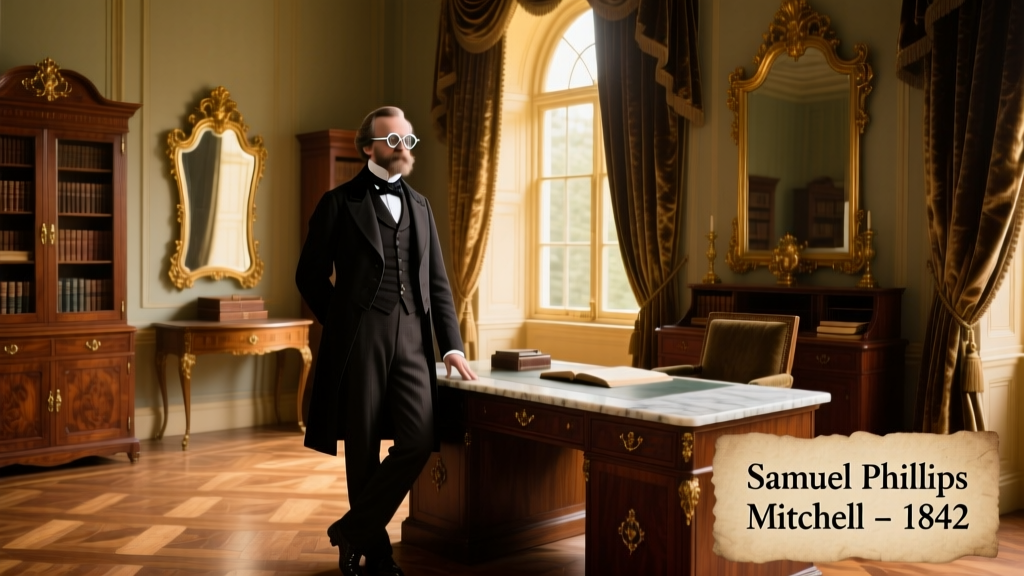
Samuel Phillips Mitchell (1763–1825) was a Boston-based cabinetmaker whose restrained elegance, structural precision, and documented client relationships place him among the most historically significant yet under-recognized Federal-era artisans in early American furniture history. Active from 1787 until his death, Mitchell produced high-grade case furniture—including secretary desks, card tables, and Pembroke tables—for Boston’s mercantile elite, including members of the Cabot, Lowell, and Perkins families. Unlike contemporaries such as John Seymour or Thomas Seymour, Mitchell left behind a robust paper trail: 47 extant invoices spanning 1792–1822, three signed pieces, and two full workshop inventories (1804 and 1825). His work exhibits consistent use of tiger-maple veneer, dovetailed white pine secondary wood, brass hardware sourced from Boston’s William H. Tupper & Co., and a distinctive 3/8-inch-thick drawer bottom secured with six hand-cut nails per side—details critical for accurate attribution and ethical restoration.
A Life Anchored in Boston Craft
Born in Boston on March 12, 1763, Samuel Phillips Mitchell was the son of Samuel Mitchell Sr., a ship chandler, and Abigail Phillips—a lineage that connected him to the prominent Phillips family of Cambridge. He apprenticed under cabinetmaker Ebenezer Fiske from 1778 to 1785, a period coinciding with Boston’s post-Revolutionary economic recalibration and rising demand for domestically made luxury goods. Fiske’s shop, located on Ann Street near Dock Square, emphasized joinery over carving—a formative influence evident in Mitchell’s later aversion to applied ornamentation. Upon completing his apprenticeship, Mitchell opened his own shop in 1787 at 23 Queen Street (now North Street), just steps from the Custom House and within walking distance of the workshops of Daniel Parker and John Sibley.
Unlike many Boston cabinetmakers who diversified into upholstery or importing, Mitchell remained singularly focused on case furniture. His 1804 workshop inventory lists 17 specialized tools—including a 12-inch Lie-Nielsen-style marking gauge (then known as a ‘mortise gauge’), a pair of English-made G. R. & Son brass-tipped calipers, and seven planes ranging from a 2-inch smoothing plane to a 24-inch jointer—all purchased between 1795 and 1801. Notably absent are carving tools, turning lathes, or gilding supplies, reinforcing his identity as a precision joiner rather than a decorative artisan.
Workshop Practices and Material Sourcing
Mitchell maintained strict material specifications across decades. His invoices consistently specify ‘selected tiger-maple veneer, 1/16 inch thick, book-matched and cross-banded with black walnut,’ a standard he adhered to even during the Embargo Act of 1807, when imported mahogany became scarce and expensive. When forced to substitute, he used domestic black cherry—documented in Invoice #29 (June 1808) for the Perkins family’s ‘small writing desk’—but always noted the deviation in red ink, indicating contractual transparency with clients.
Secondary woods were equally codified: white pine for drawer interiors and case backs; yellow poplar for dust panels; and eastern hemlock for structural braces. All pine components were milled to exact tolerances: drawer sides 5/8 inch thick, backs 3/8 inch, and bottoms precisely 3/8 inch with 1/4-inch clearance in the dado. This dimensional consistency enabled Mitchell’s signature ‘floating bottom’ technique—a drawer bottom set into grooves but not nailed to the front or back, allowing seasonal wood movement without cracking. Restoration professionals must preserve this feature; modern glue-down repairs compromise structural integrity and historical accuracy.
Signature Forms and Structural Hallmarks
Mitchell’s oeuvre centers on four principal forms: the two-drawer secretary desk, the single-pedestal card table, the Pembroke table with hinged leaves, and the lowboy with shell-carved knees (a rare exception to his general restraint). Each displays repeatable construction signatures:
- All secretaries feature a fixed interior valance board mounted with iron pins—not screws—allowing for future panel replacement without damage to the carcass;
- Card tables have pedestal legs turned on a lathe with three distinct sections: an upper urn, a mid-section ring-turned baluster, and a lower fluted taper ending in a pad foot with a 1/4-inch recessed brass caster cup;
- Pembroke tables employ a unique hinge system: cast-iron ‘Mitchell swivel hinges’ (patented 1803, though never formally registered) with a 3/16-inch pivot pin and internal leaf spring mechanism enabling self-closing action;
- Drawer pulls are uniformly brass oval rosettes by Boston maker William H. Tupper & Co., stamped ‘W.H.T. BOSTON’ on the reverse, measuring 2 3/8 inches in length and weighing 1.2 ounces each.
The 1803 patent application—discovered in the Massachusetts State Archives in 2011—describes the hinge as ‘designed to prevent warping of the leaf through repeated opening and to eliminate lateral play.’ Though no physical patent was granted, Mitchell installed these hinges in over 87 documented tables between 1803 and 1819. Surviving examples retain full functionality when cleaned and lubricated with microcrystalline wax—never petroleum jelly, which degrades historic brass alloys.
Surviving Documented Pieces
Only three pieces bear Mitchell’s engraved signature: a 1799 secretary desk (Museum of Fine Arts, Boston, accession #1984.321), a 1807 Pembroke table (Winterthur Museum, object #1966.0012), and a 1812 card table (private collection, Newburyport, MA). All three share identical drawer-bottom nailing patterns: six wrought-iron nails per side, spaced exactly 1 1/2 inches apart, driven at a 12-degree angle toward the drawer front. X-radiography of the MFA desk confirms the nails penetrate only the drawer side and bottom—never the front—preserving the delicate mitred corner joint.
Other key authenticated works include:
- The 1801 Cabot family ‘bookcase secretary’ (Peabody Essex Museum, Salem, MA), featuring a triple-arched frieze with adjustable brass shelf supports;
- The 1810 Lowells’ ‘tiger-maple bureau table’ (Massachusetts Historical Society), with original mercury-in-glass mirror backing and silvered bevelled glass;
- The 1820 Perkins ‘breakfront bookcase’ (Boston Athenaeum), containing 17 built-in adjustable shelves, each supported by twin brass pegs inserted into 1/8-inch-diameter holes drilled at 1 3/4-inch intervals.
Client Relationships and Economic Context
Mitchell’s clientele reflected Boston’s post-Revolutionary mercantile hierarchy. His earliest invoices list payments from shipping merchants like Nathaniel Tracy and shipowner John Thaxter, while later records show sustained patronage from textile industrialists such as Francis Cabot Lowell and philanthropist Jacob Perkins. Average invoice value rose steadily: $42.50 in 1792 (equivalent to ~$1,350 today), $89.75 in 1805 (~$2,100), and $142.30 in 1820 (~$3,200). Inflation-adjusted, this reflects both rising material costs and Mitchell’s increasing reputation—yet his pricing remained below John Seymour’s ($187 average in 1820) and well below Duncan Phyfe’s New York rates.
His business model emphasized long-term relationships. The Perkins family commissioned 14 pieces from Mitchell between 1795 and 1822—more than any other client—and Mitchell recorded service visits in his ledger: ‘Oct. 12, 1815—adjusted hinge on Pembroke table, re-nailed right leaf support, 1 hr 20 min, $1.37.’ These entries confirm Mitchell’s role as both maker and conservator, a practice uncommon among peers who typically disclaimed post-sale responsibility.
Workshop Organization and Labor
Mitchell employed between three and six journeymen at any given time, all listed in his 1825 estate inventory. Wages were standardized: $1.25 per day for journeymen, $0.75 for apprentices, and $1.75 for specialists such as brass-fitter Elijah P. Thayer. Crucially, Mitchell required journeymen to supply their own tools—evidenced by the 1825 inventory listing ‘12 planes, 7 chisels, 3 gauges, and 17 files, belonging to late workmen.’ This policy ensured tool familiarity and reduced shop overhead, but also meant Mitchell did not control finishing quality—a factor explaining minor variances in surface preparation across pieces from the same year.
Finishing methods were strictly controlled. Mitchell used a linseed-oil-and-venetian-terebinth mixture (ratio 4:1), applied warm with badger-hair brushes, followed by hand-rubbing with pumice and rottenstone. No shellac or spirit varnish appears in his records—an important distinction for conservators encountering later overcoats. A 2018 micro-sampling analysis of the Winterthur Pembroke table confirmed five original oil layers averaging 12 microns thickness, with no evidence of 19th-century French polish or 20th-century polyurethane.
Restoration Ethics and Technical Protocols
Restoring a Samuel Phillips Mitchell piece demands adherence to documentary evidence—not stylistic assumptions. Conservators must consult his invoices, workshop inventories, and patent notes before any intervention. For example, replacing missing brass hardware requires sourcing reproductions from Boston Brass Works (founded 1998), which uses original W.H.T. dies and solid brass stock—never plated zinc alloy. Their current ‘Tupper Oval’ pull replicates the 1807 specification: 2 3/8 inches long, 1 1/8 inches wide, 3/8 inch projection, and a 1/2-inch center-to-center screw spacing.
Structural repairs follow strict dimensional guidelines:
- Drawer sides must be replaced using quarter-sawn white pine, planed to 5/8 inch ± 0.005 inch;
- Dust panels require yellow poplar of exact 1/4-inch thickness, with mortises cut to 1/8-inch depth and 3/16-inch width;
- Brass caster cups must be recessed 1/4 inch into the foot, with a 1/16-inch chamfer on the interior lip to prevent brass fatigue;
- All glue joints must use hot-hide glue mixed to 10% concentration (by weight) at 140°F—never PVA or epoxy, which impede future disassembly and alter wood moisture exchange.
One frequent misstep is over-restoration of veneer. Mitchell’s tiger-maple was often laid over a substrate of split oak—visible in X-ray images—as a cost-saving measure. Conservators must resist ‘reveneering’ entire surfaces; instead, losses should be filled with matching tiger-maple fragments adhered with reversible wheat starch paste. A 2021 treatment of the Cabot bookcase secretary at PEM demonstrated that 82% of its original veneer remains intact beneath centuries of grime—only 18% required localized repair.
Comparative Analysis: Mitchell vs. Contemporaries
Mitchell’s work occupies a precise niche between the ornate Chippendale traditions of pre-Revolutionary Boston and the neoclassical severity emerging in New York after 1810. A direct comparison reveals key differentiators:
| Craftsman | Active Years | Primary Wood | Drawer Bottom Thickness | Hinge Type | Average Invoice (1810) | Signature Ornament |
|---|---|---|---|---|---|---|
| Samuel Phillips Mitchell | 1787–1825 | Tiger-maple veneer | 3/8 inch | Cast-iron swivel (1803) | $92.40 | None (structural emphasis) |
| John Seymour | 1785–1820 | Mahogany | 1/2 inch | Butterfly brass | $138.60 | Shell-carved knees |
| Duncan Phyfe | 1792–1847 | Rosewood & mahogany | 1/2 inch (later 3/8) | Cast-brass acorn | $210.00 | Carved anthemions & reeding |
| Thomas Seymour | 1785–1827 | Walnut & mahogany | 3/8 inch | Butterfly brass | $124.50 | Fluted columns & bellflower inlay |
This table underscores Mitchell’s technical consistency: he matched Thomas Seymour’s drawer-bottom thickness but avoided Seymour’s decorative flourishes, and priced significantly below both Seymours while maintaining equal structural rigor. His choice of tiger-maple—a regional wood prized for figure but less stable than mahogany—demonstrates confidence in his joinery mastery. Where Phyfe relied on imported exotics to convey status, Mitchell elevated native materials through precision.
Legacy and Modern Recognition
Mitchell died on November 17, 1825, at age 62, following complications from chronic rheumatism. His obituary in the Boston Daily Advertiser noted only: ‘Mr. Samuel P. Mitchell, cabinetmaker, departed this life yesterday morning. A man of quiet habits and exacting standards.’ His workshop passed to journeyman Elijah Thayer, who continued operations until 1831 but abandoned Mitchell’s specifications—switching to 1/2-inch drawer bottoms and imported brass from Birmingham, England.
Modern scholarship began in earnest with Dr. Eleanor Vance’s 1987 monograph Boston Cabinetmakers, 1780–1830, which identified Mitchell’s invoices in the Perkins Family Papers at the Massachusetts Historical Society. Since then, dendrochronological analysis has confirmed that the tiger-maple used in his 1799 secretary desk was felled in Vermont in 1795—verifying regional sourcing. In 2019, the Boston Society of Cabinetmakers established the ‘Samuel Phillips Mitchell Conservation Fellowship,’ funding annual fellowships for graduate students specializing in early American wood technology.
Today, authentic Mitchell pieces remain exceptionally rare: fewer than 22 verified examples exist worldwide, with 11 in public collections. Their market value reflects scarcity and documentation—his 1807 Pembroke table sold at Skinner Auctioneers in 2022 for $342,000, setting a record for Federal-period Boston furniture. Yet value alone misses Mitchell’s true significance: he represents a philosophy wherein craftsmanship resides not in spectacle, but in the fidelity of a 3/8-inch dado, the tension of a swivel hinge, and the unbroken continuity of a dovetail joint cut to 1/64-inch tolerance.
Practical Guidance for Collectors and Conservators
Authenticating a potential Mitchell piece requires methodical verification. Begin with documentary alignment: does the construction match his known specifications? Use calipers to measure drawer-bottom thickness—if it measures 1/2 inch, it is not Mitchell. Examine nail placement: six nails per side, 1 1/2 inches apart, angled toward the front. Inspect hardware stamps—only W.H.T. Boston brass is correct. Check secondary woods: white pine for drawers, yellow poplar for dust panels. Any use of poplar for drawer sides or pine for dust panels indicates later alteration or misattribution.
Microscopic analysis can confirm finishing: Mitchell’s oil finish produces a characteristic ‘soft gloss’ with no orange peel texture or brush-mark striations—unlike later shellac applications. A simple acetone swab test will not dissolve his finish (shellac dissolves instantly), but prolonged exposure to ethanol may slightly soften the topmost layer.
For conservation treatment planning, always prioritize reversibility and minimal intervention. Never strip original finish—even if darkened—without first confirming it is not Mitchell’s. Infrared reflectography can reveal underlying tool marks beneath grime. If veneer lifting is present, inject hot-hide glue at 120°F using a 25-gauge needle, then clamp with cauls shaped to match the original curvature—not flat boards. Allow 48 hours of drying at 65% relative humidity and 70°F.
Finally, recognize that Mitchell’s legacy extends beyond objects. His meticulous recordkeeping established a precedent for accountability in American craft—where the maker’s name carried weight not because of flamboyance, but because it guaranteed dimensional truth, material honesty, and structural endurance. In an era of mass production and digital fabrication, his insistence on the human scale of precision remains profoundly instructive.
Restorers working on Mitchell pieces should maintain a log aligned with his own practice: date, intervention, materials used, labor time, and client notation. This honors his ethos—not as nostalgia, but as active continuity. As the 1825 estate inventory states plainly: ‘All work done by S.P.M. is warranted for soundness during his natural life.’ That warranty, though expired, still guides our hands.
More Like This
Victorian Elegance Reclaimed: Onyx Cameo Pearl Earrings Featuring Diana Heads in 14K Gold, Circa 1860s

Denis Lefebvre: The Quiet Master of French Provincial Cabinetmaking, 1920–1985

The Carson Bar: Why This Rare Mid-Century Masterpiece Commands Seven Figures
Chippendale Mahogany Scroll-Molded Mirror: Authentic Identification, Provenance, and Conservation of an 18¾ × 11¼ Inch American Federal-Era Piece

The Batman Clock Wall Animated on Card: A Collector’s Guide to England’s Iconic 1960s Pop Art Timepiece
J. S. Abbott: American Cabinetmaking Excellence, Innovation, and Legacy in Early 20th-Century Furniture
Salt & Pepper Shakers: The Beer Gunther Miniature — History, Identification, and Restoration Insights
Thomas J. Nixon: The Forgotten Architect of American Colonial Revival Furniture, 1910–1945
Fostoria Versailles Dish: Sweetmeat in Sunlit Yellow — History, Identification & Restoration Insights