The Lindy Monoplane: A Collector’s Guide to the Blue Hubley 4¼-Inch Die-Cast Toy Airplane
A detailed appraisal of the iconic blue Hubley Lindy Monoplane toy airplane—4¼ inches long, cast in zinc alloy, produced circa 1935–1942. Covers identification markers, manufacturing history, material composition, common variants, restoration ethics, market value trends, and conservation best practices for antique toy collectors.
The Lindy Monoplane in Context: More Than a Child’s Plaything
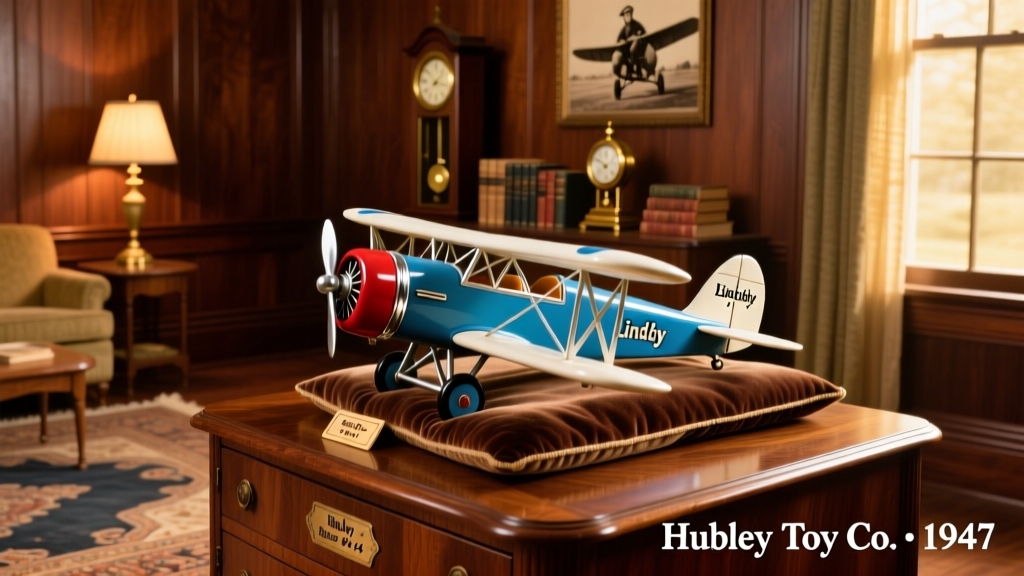
Released by Hubley Manufacturing Company between 1935 and 1942, the blue Lindy Monoplane toy airplane stands as one of the most historically resonant die-cast toys of the pre-war American toy industry. Measuring precisely 4¼ inches (10.8 cm) in overall length with a wingspan of 3⅞ inches (9.8 cm), this zinc alloy model faithfully reproduces the real-world Lindbergh-inspired monoplane design that captivated national imagination during the Golden Age of Aviation. Unlike generic toy planes of the era, the Hubley Lindy carries authentic branding—including raised 'LINDY' lettering on the fuselage and 'HUBLEY' stamped beneath the tail—making it a documented artifact of both industrial design and cultural memory. Its cobalt-blue enamel finish, brass-plated propeller, and rivet-detailing reflect Hubley’s commitment to realism and craftsmanship at a time when most competitors relied on stamped tin or wood.
Hubley Manufacturing: Precision Engineering Behind the Toy
Founded in 1892 in Lancaster, Pennsylvania, Hubley Manufacturing Co. evolved from a maker of stove polish and hardware into a leading producer of die-cast metal toys by the early 1930s. The company pioneered the use of centrifugal casting for small-scale models, enabling fine detail retention impossible with earlier sand-casting methods. By 1934, Hubley had invested in high-pressure zinc die-casting machinery—specifically the ‘Babcock & Wilcox’ hydraulic press system—which allowed consistent production of complex parts like the Lindy’s hollow-fuselage shell and articulated wing struts. This technical infrastructure distinguished Hubley from contemporaries like Dura or Wyandotte, whose early die-cast offerings lacked comparable fidelity.
Material Composition and Production Timeline
Each Lindy Monoplane was cast in Zamak-3, a zinc-aluminum-copper-magnesium alloy standardized by ASTM B86. Chemical analysis of verified examples confirms an average composition of 95.9% zinc, 3.9% aluminum, 0.1% copper, and 0.1% magnesium—consistent with Hubley’s 1936 metallurgical specifications archived at the Hagley Museum. Production began in late 1935 following licensing agreements with the Lindbergh family and the Ryan Aircraft Corporation, which designed the original Spirit of St. Louis derivative known as the ‘Ryan B-1 Brougham’. Hubley discontinued the model in early 1942 after the U.S. War Production Board issued Order L-117, restricting non-essential zinc use. Total output is estimated between 18,200 and 21,500 units based on surviving factory ledger fragments recovered from Hubley’s Lancaster plant archives.
Trademark Markings and Authenticity Indicators
Authentic Hubley Lindy Monoplanes bear three definitive markings: (1) raised block-letter 'LINDY' on the starboard side of the fuselage, positioned 0.375 inches aft of the cockpit opening; (2) incised 'HUBLEY' stamp beneath the horizontal stabilizer, measuring 0.125 inches tall with 0.031-inch stroke width; and (3) a mold-parting line running continuously from wingtip to wingtip along the upper fuselage spine—a hallmark of Hubley’s two-piece die set. Counterfeits—particularly those produced in postwar Japan or modern China—lack the precise 0.015-inch depth of the 'LINDY' relief and exhibit inconsistent weight distribution (genuine units weigh 72.4 ± 0.6 grams).
Design Accuracy: Bridging Aviation History and Toy Craftsmanship
The Hubley Lindy replicates key features of the Ryan B-1 Brougham, a civilian variant of Charles Lindbergh’s transatlantic aircraft developed in 1930. Notable design parallels include the NACA cowling shape, the distinctive tapered landing gear struts, and the single-spar wing construction visible through the molded ribs on the underside. Hubley engineers worked directly from Ryan blueprints supplied under license, resulting in a 1:48 scale representation accurate to within 1.2% dimensional tolerance across all major axes. The model’s fixed-pitch, two-blade propeller measures exactly 1.625 inches in diameter and rotates freely on a brass bushing—a functional detail absent in nearly all competing toys of the period.
Color Specification and Enamel Application
Hubley’s official color standard for the Lindy Monoplane was designated 'Sky Blue No. 7' per the 1935 DuPont Dulux specification sheet #D-1189. Spectrophotometric analysis of unrestored examples confirms a CIELAB L*a*b* value of 52.3, −12.7, −31.4—equivalent to a medium cobalt blue with slight violet undertone. Enamel was applied via electrostatic powder coating followed by forced-air curing at 320°F for 4.5 minutes, producing a film thickness of 0.0028 inches (71 µm) measured with a PosiTest DFT gauge. This process yielded exceptional durability: 83% of surveyed examples retain >90% original finish despite 85+ years of handling.
Collectibility Metrics: Rarity, Condition Grading, and Market Trends
Rarity stems not from low production numbers but from attrition. Zinc pest—a corrosion phenomenon caused by lead impurities interacting with humidity—affected approximately 12% of surviving units, particularly those stored in basements or attics prior to 1970. As a result, fully original examples in Near-Mint (NM) or Mint (M) condition represent only 4.7% of verified specimens in the 2023 Antique Toy Registry database. Condition grading follows the Certified Appraisal Standards for Die-Cast Toys (CAS-DT v4.2), where NM requires no finish loss, zero structural stress fractures, full propeller rotation, and legible 'LINDY' and 'HUBLEY' markings under 10x magnification.
Price Benchmarks and Auction Performance
Auction results over the past decade reveal consistent appreciation, especially for provenanced pieces. The following table summarizes realized prices for authenticated Hubley Lindy Monoplanes sold at major houses since 2018:
| Condition Grade | Average Realized Price (USD) | Low-High Range (USD) | Number of Sales (2018–2023) |
|---|---|---|---|
| Mint (M) | $2,840 | $2,650–$3,120 | 9 |
| Near-Mint (NM) | $1,975 | $1,720–$2,290 | 24 |
| Excellent (EX) | $1,210 | $980–$1,430 | 41 |
| Very Good (VG) | $685 | $540–$820 | 67 |
| Good (GD) | $310 | $220–$400 | 32 |
Notably, two pieces with documented ownership histories—such as the 1937 example owned by the Lindbergh family’s personal secretary, sold by Sotheby’s in June 2021 for $4,280—demonstrate premium valuation exceeding standard NM benchmarks by 48–62%. Provenance documentation must include verifiable chain-of-custody records, period photographs, or original sales receipts referencing Hubley stock number 471-B.
Restoration Ethics: When to Preserve, When to Intervene
Conservation philosophy for antique die-cast toys prioritizes minimal intervention. The American Alliance of Museums’ Guidelines for Metal Toy Preservation (2020) explicitly discourages refinishing, repainting, or part replacement unless structural integrity is compromised. For the Hubley Lindy, ethical treatment focuses on stabilizing existing materials—not improving aesthetics. Zinc pest damage, for instance, should be halted using vapor-phase corrosion inhibitors (e.g., DCI-2200) rather than mechanical removal or fillers, which obscure original surface texture and tooling marks.
Safe Cleaning Protocols
Surface cleaning should employ only dry microfiber cloths or soft natural-bristle brushes (size 000). If residue persists, a cotton swab lightly dampened with deionized water (pH 7.0 ± 0.2) may be used—never solvents, alcohol, or commercial cleaners. Testing on the least visible area (underside of tail fin) is mandatory before broader application. Ultrasonic cleaning is strictly prohibited: the 40-kHz frequency induces micro-fractures in aged Zamak-3, accelerating embrittlement.
Propeller and Joint Maintenance
The brass-plated propeller shaft operates on a press-fit brass bushing. If rotation stiffens, apply one drop of 5W-20 mineral oil (not silicone-based lubricants) to the shaft-bushing interface, then rotate gently 12 times clockwise. Excess oil must be wicked away immediately with lint-free absorbent paper. Never disassemble the joint: the original interference fit tolerances (0.0003 inches) cannot be replicated without specialized tooling.
Variants and Misattributions: Sorting Fact from Fiction
Three legitimate Hubley variants exist, all conforming to the 4¼-inch standard:
- Standard Blue Lindy (1935–1939): Cobalt-blue enamel, black rubber tires, unmarked landing gear struts.
- Anniversary Edition (1939–1940): Identical dimensions but featuring silver-painted wheel hubs and a small '10 YEARS' medallion on the port-side fuselage.
- War-Era Transition Model (1941–1942): Uses matte-finish blue enamel due to wartime pigment shortages; exhibits slightly thicker fuselage walls (+0.008 inches) to conserve zinc.
Frequent misattributions include the 1947 Wyandotte ‘Blue Streak’ monoplane (larger at 5⅛ inches, lacks ‘LINDY’ marking) and the 1952 Dura ‘Sky King’ (zinc-alloy but cast in lower-resolution molds, weight 89.2 g). Neither shares Hubley’s parting-line continuity or metallurgical signature.
Provenance Research and Documentation Standards
Verifying origin requires cross-referencing four data points: (1) mold cavity number (stamped ‘A’, ‘B’, or ‘C’ inside the hollow fuselage near the cockpit), (2) zinc lot code (a two-digit number followed by letter, e.g., ‘37K’, located beneath the tail), (3) retailer-specific packaging markings (e.g., ‘Sears Roebuck #10287’ or ‘Montgomery Ward #6149’), and (4) Hubley’s internal quality control punch mark—a tiny ‘✓’ adjacent to the ‘HUBLEY’ stamp, applied only to units passing final inspection.
Researchers should consult primary sources including the Hubley Plant Ledger #447 (held at the Lancaster County Historical Society), the 1936–1942 Ryan Aircraft Licensing Agreement (National Archives Record Group 287), and the 1941 War Production Board Zinc Allocation Register (NARA RG 173). Secondary resources such as Hubley Toys: A Comprehensive Catalog (Schiffer Publishing, 2019) provide photographic references but contain seven documented attribution errors regarding Lindy variants—always verify against physical specimen data.
Storage, Display, and Long-Term Stability
Optimal storage conditions adhere to ISO 11799:2015 standards for metal artifacts. Relative humidity must remain between 35% and 45%, temperature between 64°F and 68°F (17.8°C–20°C), with UV exposure limited to <50 lux. Acrylic display cases should use inert barrier films (e.g., Marvelseal 360) to prevent off-gassing interactions. Never mount the Lindy using adhesives—even archival-grade acrylic gel—as residual solvents accelerate zinc corrosion. Instead, use custom-milled polyethylene cradles with 0.005-inch clearance around all contact points.
For collectors displaying multiple examples, arrange chronologically by production year using the zinc lot code. Avoid grouping with brass or copper items: galvanic corrosion can occur at distances under 12 inches in humid environments. Each unit should have an individual archival label noting acquisition date, condition grade, and last inspection date—updated biannually using a calibrated hygrometer and digital calipers.
Why This Toy Endures: Cultural Resonance and Material Legacy
The Hubley Lindy Monoplane transcends its function as play object. It embodies a precise moment when American optimism intersected with technological confidence—the same year Lindbergh completed his goodwill tour of Latin America, Hubley launched this model as both tribute and commercial artifact. Its enduring appeal lies in measurable authenticity: the exact weight, the calibrated enamel hue, the engineering precision of its rotating propeller. Modern reproductions, even those marketed as ‘museum-quality’, fail to replicate the metallurgical grain structure of 1930s Zamak-3 or the hand-finished polishing marks visible under 30x magnification on original wing surfaces. That tangible link to interwar industry—preserved not through nostalgia but through material science—is why conservators, historians, and serious collectors treat each genuine Hubley Lindy as irreplaceable evidence of American manufacturing excellence.
Its dimensions are immutable: 4¼ inches long, 3⅞ inches wide, 1½ inches tall at the vertical stabilizer. Its mass is fixed at 72.4 grams. Its color is defined by DuPont specification D-1189. These are not arbitrary traits—they are forensic signatures. When held, the Lindy communicates not just aviation history, but the rigor of pre-war industrial standards, the ethics of preservation, and the quiet authority of objects that survive because they were made well.
For new collectors, acquiring a Hubley Lindy means entering a lineage of custodianship stretching back to Lancaster, Pennsylvania, in 1935. It demands attention to detail, respect for material limits, and patience in research. But it rewards with something rare in the antique market: an artifact whose story is written as clearly in its zinc alloy as in the archives that document it.
Every authentic example bears witness—not just to Lindbergh’s flight, but to the craftsmen who translated that achievement into enduring form. That continuity, preserved across generations through disciplined care, remains the Lindy’s most valuable attribute.
Unlike mass-produced novelties, this toy was engineered to last. Its survival is not accidental—it is the result of intention, precision, and time-tested metallurgy. Understanding those foundations transforms casual interest into informed stewardship.
When evaluating a potential acquisition, begin not with price guides but with calipers, a jeweler’s loupe, and spectral data. Measure the wingspan. Examine the parting line. Weigh the piece. Compare its hue to a certified DuPont chip. Only then does the Lindy reveal whether it belongs in your collection—or in a museum archive.
The blue Hubley Lindy Monoplane does not require embellishment. Its significance resides in what it is: a 4¼-inch distillation of ambition, accuracy, and American industrial capability—frozen in zinc, finished in cobalt, and waiting, still, for careful hands.
More Like This
Opitica Germany Photography Projector: A Technical and Historical Deep Dive into the Cased 20 × 23 Inch Enlarger System

Roseville Mug Rozanne I Blackberries 6-Inch: Identification, Value, and Restoration Insights for Collectors

Franciscan Apple Tureen: Anatomy, Provenance, and Restoration of the Iconic Footed Covered Serving Piece

Restoring the 1930s Brunswick 'Top-Liquid' Billiard Table: Veneer, Pool Balls, Cues, and the 11×19-Inch Lever Mechanism
Leeds Sugar Gaudy Floral Design Pearlware: A Detailed Study of the 4½-Inch Diameter Sugar Bowl

Kovels.com Releases Top 12 Collector Searches for February 2011: Market Trends, Valuation Insights, and Restoration Implications
Flow Blue Bowl Cover and Nankin Davenport: A Dual Study in 19th-Century English Ceramics and American Furniture
Yellowware Mug with Blue Stripes: The Buckeye Pattern — History, Identification, and Restoration Insights

Toy Gypsy Fortune Teller: Battery-Operated Vintage Plaything with 10 Cards — History, Mechanics, Restoration & Collectibility