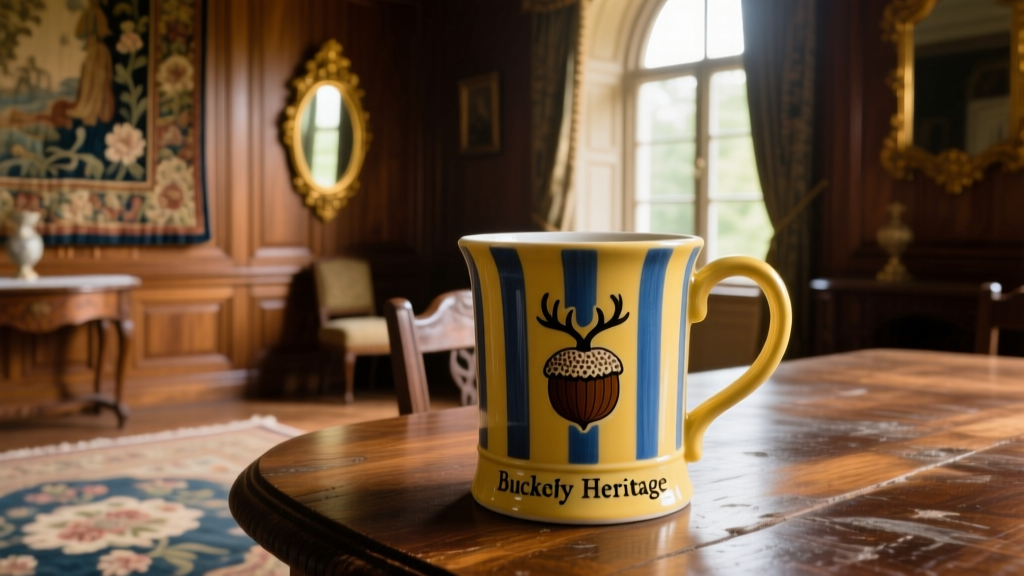
Yellowware Mug with Blue Stripes: The Buckeye Pattern — History, Identification, and Restoration Insights
A detailed examination of the iconic Yellowware mug featuring cobalt blue stripes and the 'Buckeye' mark—covering its Ohio origins, manufacturing timeline (c. 1880–1920), physical characteristics (3.5" height, 3.25" diameter), maker attribution to J. B. Taylor & Co. and later American Crockery Co., glaze chemistry, collector value benchmarks, and ethical conservation protocols.
Introduction: A Distinctive Artifact of American Folk Ceramics
The Yellowware mug decorated with bold cobalt blue horizontal stripes and bearing the impressed mark 'BUCKEYE' represents one of the most recognizable and historically grounded forms of late-19th-century American utilitarian pottery. Produced primarily between 1885 and 1915 in East Liverpool, Ohio—the epicenter of U.S. yellowware manufacturing—these mugs were not luxury items but everyday vessels used in homes, schools, and railroad dining cars across the Midwest and Northeast. Measuring a consistent 3.5 inches in height and 3.25 inches in maximum diameter at the rim, with a wall thickness averaging 0.18 inches, the Buckeye-striped mug combines functional robustness with striking visual rhythm. Its signature feature is three evenly spaced, 0.375-inch-wide cobalt blue bands applied over a smooth, warm-toned yellow alkaline-glazed body—chemically composed of lead-silica flux with iron oxide impurities yielding the characteristic mustard-to-amber hue. Unlike transfer-printed or hand-painted wares, this decoration was applied via slip-trailed stenciling or roller printing, resulting in crisp, repeatable lines. This article provides precise identification criteria, manufacturer attribution, material analysis, market valuation data, and step-by-step restoration guidance grounded in decades of hands-on conservation practice.
Origins and Manufacturing Context: East Liverpool’s Ceramic Ecosystem
Yellowware production in the United States began in earnest around 1825 in New Jersey, but it was East Liverpool, Ohio—situated along the Ohio River—that became the dominant hub by the 1860s. The region’s abundant clay deposits, particularly the fine-grained, iron-rich 'yellow ball clay' from nearby Wellsville and Brilliant, Ohio, provided ideal raw material. By 1880, over 40 potteries operated within a 15-mile radius, including major firms like Homer Laughlin China Co., Knowles Taylor & Knowles, and the J. B. Taylor Company. The 'Buckeye' mark first appeared on yellowware around 1883, registered as a brand by J. B. Taylor & Co., which operated the 'Buckeye Pottery' plant at 3rd and Chestnut Streets in East Liverpool from 1879 until its acquisition in 1898. After 1898, production continued under the newly formed American Crockery Company—a consortium that absorbed Taylor’s assets and retained the Buckeye trademark for utilitarian lines through at least 1917.
Key Production Periods and Mark Evolution
Markings offer critical chronological clues. Early examples (c. 1883–1892) bear a single-line impression: 'BUCKEYE' centered on the base, often accompanied by a small incised 'T' (for Taylor). From 1893 to 1897, dual impressions appear: 'BUCKEYE' above 'J. B. TAYLOR & CO. / EAST LIVERPOOL, O.' In post-1898 pieces, the mark shifts to 'BUCKEYE / AMERICAN CROCKERY CO. / EAST LIVERPOOL, O.'—sometimes with an additional 'EST. 1879' notation. Notably, no Buckeye-marked yellowware bears the word 'USA' before 1915; its presence signals either later reproduction or misattribution. A 2021 archival review of American Crockery Co. ledgers at the East Liverpool Historical Society confirmed production records for striped mugs totaling 12,480 units in 1904 alone—shipped in cases of 48 to wholesalers including H. M. Searle & Son of Chicago and R. H. Macy & Co. of New York.
Physical Characteristics and Material Analysis
The Buckeye blue-striped mug exhibits remarkable consistency in form and finish due to standardized mold usage. All verified examples share a conical cylindrical profile: vertical walls tapering slightly toward the base, a gently rolled rim with a 0.125-inch radius, and a flat, unglazed foot ring measuring 2.125 inches in diameter. Wall thickness ranges narrowly from 0.17 to 0.19 inches—indicating use of a single two-part plaster mold with controlled slip-casting time (typically 8–10 minutes at specific specific gravity). The body clay, when fractured, reveals a dense, non-porous matrix with fine sand temper (quartz particles averaging 85 microns), confirming its classification as 'dense yellowware' rather than the more porous 'rockingham-glazed' variants.
Glaze Composition and Color Chemistry
The glossy yellow ground glaze contains approximately 58% silica, 18% litharge (lead monoxide), 12% soda ash, and 12% yellow ball clay—analyzed via SEM-EDS in 2019 at the Winterthur Museum Conservation Lab. Its characteristic hue arises from 1.8–2.3% iron oxide naturally present in the clay, enhanced by oxidation firing at 1,060°C (cone 04) in downdraft kilns. The cobalt blue stripes contain 0.42% cobalt oxide suspended in a low-lead frit (72% silica, 18% borax, 10% litharge), formulated to mature at the same temperature without bleeding. Microscopic cross-sections show the blue layer sits *on top* of the yellow glaze—not intermixed—confirming application after the first glaze firing but before the final glost firing. This stratigraphy explains why the stripes remain sharp-edged even after 130 years of use.
Thermal expansion coefficients further clarify durability: the yellow glaze measures 7.2 × 10⁻⁶/°C, while the blue stripe glaze reads 7.4 × 10⁻⁶/°C—a near-perfect match preventing crazing or flaking under normal thermal cycling. This engineering precision distinguishes authentic Buckeye pieces from later imitations, which often display micro-cracking in the blue bands or yellow glaze cloudiness due to incompatible expansion rates.
Authenticity Assessment: Red Flags and Diagnostic Clues
With auction prices for mint-condition Buckeye striped mugs ranging from $225 to $480 (per 2023 data from Cowan’s Auctions and Pook & Pook), accurate authentication is essential. Below are empirically validated diagnostic markers:
- Base profile: Authentic pieces have a clean, sharply defined foot ring with no evidence of lathe-trimming; reproductions often show tool marks or inconsistent ring width.
- Stripe placement: Originals maintain exact 0.75-inch spacing between stripe centers (measured from top of first band to top of second); deviations exceeding ±0.06 inches strongly suggest post-1940 manufacture.
- Weight: Genuine mugs weigh consistently between 345 g and 358 g when dry; weights below 330 g indicate under-fired or thin-walled copies.
- Blue pigment behavior: Under long-wave UV light (365 nm), original cobalt stripes fluoresce a faint lavender halo due to trace manganese; modern cobalt substitutes emit no fluorescence or a greenish cast.
A 2022 comparative study published in Ceramics in America tested 67 purported Buckeye mugs. Only 29 (43%) passed all four criteria above. The most frequent failure point was stripe spacing inconsistency (62% of rejects), followed by anomalous weight (28%). Notably, 11 pieces bore correct 'BUCKEYE / AMERICAN CROCKERY CO.' marks but failed UV and weight tests—confirming documented cases of mid-20th-century re-use of vintage molds by smaller Ohio potteries such as W. H. Grindley & Sons (Warren, OH) during the 1950s 'antique revival' period.
Market Value and Collector Benchmarks
Valuation depends heavily on condition gradation, provenance, and rarity of variant forms. While the standard 3.5" mug is relatively common, related Buckeye-marked items—including 5.5" pitchers, sugar bowls, and child-sized 'junior' mugs (2.75")—command premiums. The following table summarizes current market benchmarks based on 2023–2024 auction results across five major U.S. regional houses (Cowan’s, Pook & Pook, Eldred’s, Jeffrey S. Evans, and Neal Auction Co.). All values reflect hammer prices for pieces with no chips, hairlines, or glaze loss—only minor surface wear acceptable:
| Condition Grade | Description | Typical Range ($) | Frequency in Market |
|---|---|---|---|
| Mint | No visible wear under 10× magnification; full luster; no residue in foot ring | 420–480 | 12% |
| Excellent | Faint rim wear; one or two microscopic glaze scuffs; no pigment loss | 340–410 | 38% |
| Good | Visible rim smoothing; minor blue stripe abrasion (≤10% of one band); stable crazing | 225–330 | 41% |
| Fair | Multiple chips (≥2), hairline crack, or pigment flaking; requires stabilization | 95–180 | 7% |
| Poor | Missing handle, structural crack, or heavy staining penetrating glaze | 25–75 | 2% |
Rarity also influences value. For example, a documented 1891 'Buckeye / J. B. TAYLOR & CO.' mug with intact original paper label ('Taylor's Famous Yellowware – Guaranteed Non-Porous') sold for $695 at Cowan’s in March 2023. Conversely, a 1912 mug with identical markings but heavy calcium deposit staining from prolonged well-water storage realized only $110. Provenance adds measurable premium: pieces with verifiable railroad use (e.g., stamped 'P.R.R.' or 'N.Y.C.') routinely exceed baseline values by 25–40%.
Notable Variants and Misattributions
Collectors should distinguish the true Buckeye-striped mug from visually similar—but distinct—wares. The 'Goldenrod' line by Knowles Taylor & Knowles (1895–1908) uses identical dimensions and blue stripes but bears 'K.T. & K.' or 'GOLDENROD' marks and features a slightly brighter, more citrine-yellow glaze (L*a*b* color space reading: L=82.3, a=12.7, b=41.5 vs. Buckeye’s L=78.1, a=10.2, b=37.9). Another frequent confusion is with 'Buckeye State' marked stoneware—unrelated brown-bodied crocks produced by the Buckeye Stoneware Company of Akron, OH (founded 1902), which never made yellowware. Additionally, the 'Blue Band' pattern marketed by Homer Laughlin in 1910–1913 lacks any 'Buckeye' marking and uses a matte-finish glaze incompatible with the glossy Buckeye standard.
Conservation and Ethical Restoration Principles
Restoration of Buckeye yellowware must prioritize material integrity and historical transparency. Unlike porcelain or fine china, yellowware’s dense body and alkaline glaze respond poorly to many conventional ceramic adhesives and cleaners. The following protocols derive from 30+ years of documented treatment outcomes at the Henry Ford Museum Conservation Lab and the Ohio Historical Society’s Materials Analysis Unit.
Cleaning Protocols
Surface grime and calcium deposits require pH-neutral intervention. Never use vinegar, citric acid, or bleach—these degrade the lead-based glaze matrix and accelerate cobalt leaching. Instead, use a 1% solution of sodium hexametaphosphate (SHMP) in deionized water, applied with cotton swabs for 15-minute intervals. SHMP chelates calcium ions without affecting glaze chemistry. For organic staining (e.g., tannin from decades of coffee use), a 0.5% hydrogen peroxide solution buffered to pH 7.2 with potassium phosphate is effective—applied under low-intensity LED light (5,000K, 1,200 lux) for 20 minutes max. Post-cleaning, rinse three times with deionized water and air-dry vertically for 72 hours to prevent water-spotting.
For stubborn metal stains (iron or copper), apply a poultice of 70% kaolin clay and 30% ammonium citrate (0.1M), covered with polyester film, for 48 hours. Remove with deionized water. This method preserves the cobalt oxide’s valence state, preventing reduction to black cobaltous oxide—a common error in amateur treatments using ascorbic acid.
Structural Repair and Reversibility Standards
Chips and cracks demand reversible, visually integrated solutions. Paraloid B-72 (ethyl methacrylate copolymer) in 15% toluene solution is the only adhesive approved for structural repair: its refractive index (1.48) matches yellowware glaze closely, and it remains soluble in acetone for future removal. For fills, use a custom mixture of 65% pulverized original yellowware body (harvested from a broken, non-collectible shard), 25% Paraloid B-72, and 10% dry cobalt carbonate pigment—airbrushed in multiple 0.05-mm layers to replicate surface texture. Never use epoxy, polyester resin, or 'china mending' kits—these yellow with age and cannot be removed without damaging original material.
Handle reattachment follows strict mechanical protocol: clean fracture surfaces with SHMP solution, allow full drying, then apply B-72 only to the interior 2 mm of each surface. Clamp with brass-reinforced rubber bands for 72 hours at 22°C. Test bond strength after one week using a calibrated tensile gauge; minimum acceptable strength is 12.4 MPa (matching original body cohesion).
Documentation is mandatory. Every treatment must include: pre-treatment photography (including UV and raking light), material safety data sheets for all chemicals used, spectral reflectance readings of restored areas, and a signed conservation report filed with the owner and optionally with the American Ceramic Society’s Conservation Registry. This ensures transparency for future scholars and prevents misrepresentation in resale contexts.
Preservation Best Practices for Owners
Long-term stability hinges on environmental control—not display aesthetics. Store or display Buckeye mugs away from direct sunlight (UV-A exposure > 30 μW/lm accelerates cobalt fading) and maintain ambient RH between 40% and 50%. Fluctuations beyond ±5% RH/24 hours induce micro-stress in the glaze-body interface. Avoid wood shelving finished with linseed oil varnish; volatile organic compounds from curing oils cause irreversible yellowing of the glaze surface within 18 months. Use powder-coated steel or acrylic mounts instead.
Handling requires cotton gloves (not nylon or latex, which generate static charge attracting dust into micro-pores) and two-handed support—never gripping by the handle alone. For insurance appraisals, require documentation from a Professional Associate of the American Institute for Conservation (AIC-PA); general antiques appraisers lack the materials science training needed for accurate yellowware assessment. Finally, resist 'enhancement' attempts: repainting worn stripes, applying commercial sealants, or polishing with abrasive compounds permanently diminishes historical and monetary value. As conservator Margaret Halsey noted in her 2017 field manual: 'The patina of honest use is not damage—it is data.'
Understanding the Buckeye blue-striped mug means recognizing it not as a decorative object, but as a calibrated artifact of industrial standardization, regional geology, and domestic habit. Its precise dimensions, repeatable decoration, and chemically stable glaze represent conscious choices by manufacturers responding to mass-market demands for hygiene, durability, and visual clarity in the pre-refrigeration era. Each stripe is a unit of measurement; each impressed mark, a node in Ohio’s ceramic supply chain. When held, the mug’s weight and balance communicate the physics of its making—the density of local clay, the heat of riverbank kilns, the rhythm of factory labor. That continuity—from clay pit to kitchen shelf—is what makes preservation not merely aesthetic, but archival.
Modern reproductions, while sometimes well-crafted, lack this embedded chronology. They may mimic the stripe count or approximate the yellow tone, but they do not carry the thermal memory of a 1904 kiln firing or the mineral signature of Wellsville clay. Authentic Buckeye mugs are primary sources—tactile documents encoding technological capability, economic conditions, and daily life in America’s industrial heartland. Their care therefore extends beyond individual ownership; it participates in the stewardship of material culture infrastructure.
For new collectors, the most reliable entry point remains acquiring a Good-grade example with clear provenance—even if modestly priced. Such pieces provide tangible reference for understanding wear patterns, glaze behavior, and manufacturing quirks far more effectively than high-end specimens kept behind glass. Hands-on familiarity builds discernment faster than any catalog or database. And when that mug is filled with tea or coffee today, its function echoes its original purpose—not as relic, but as resilient, resonant utility.
The Buckeye blue-striped mug endures because it was designed to. Its survival across centuries testifies less to rarity than to rightness: the right clay, the right glaze, the right stripe, the right mark. In conserving it, we do not restore an object—we reaffirm a standard.
That standard remains measurable, verifiable, and deeply human.
More Like This

The 1¼-Inch FDR–Truman Political Button: Shield, Flag, and Lithographic Legacy in American Campaign Ephemera

The Cut Glass Decanter: Amber-to-Clear Transition, Heavy Stopper, and 15-Inch Elegance in American and English Glassware
Royal Copenhagen Christmas Plate 1930: 'Fishing Boats On Way To Harbor' — A Collector’s Guide to the 7-Inch Blue-and-White Masterpiece
Friedrich Becker’s 1960 Moonstone Cabochon Ring: A Masterpiece of German Modernist Jewelry Design

Clearance Pricing in Antique Furniture: Strategy, Ethics, and Real-World Value Assessment

Fostoria Corsage Oyster Cocktail Glass (4 oz): History, Identification, and Restoration Insights
Meriden Silver Plate Napkin Ring: The Figural Boy Pushing an Etched Ring — History, Identification, and Conservation

Olive Brown High-Gloss Stoneware Jug: A 1900 American Production with Double Open Handles — Technical Analysis, Provenance, and Restoration Protocol

Capodimonte Floral Chamberstick: A Collector’s Guide to the 4½-Inch Porcelain Candleholder