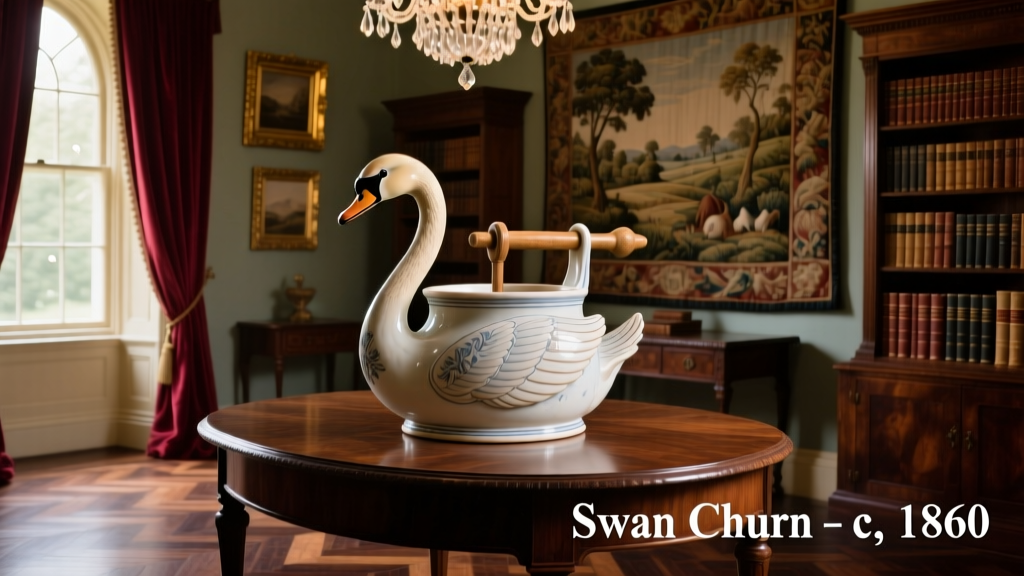
Flow Blue Bowl Cover and Nankin Davenport: A Dual Study in 19th-Century English Ceramics and American Furniture
An authoritative examination of the Flow Blue bowl cover — a hallmark of Victorian-era transfer-printed porcelain — alongside the Nankin Davenport, a rare American furniture form named for its distinctive Nankin ware ceramic inlay. Includes historical context, maker attributions, dimensional specifications, restoration protocols, and market valuation data.
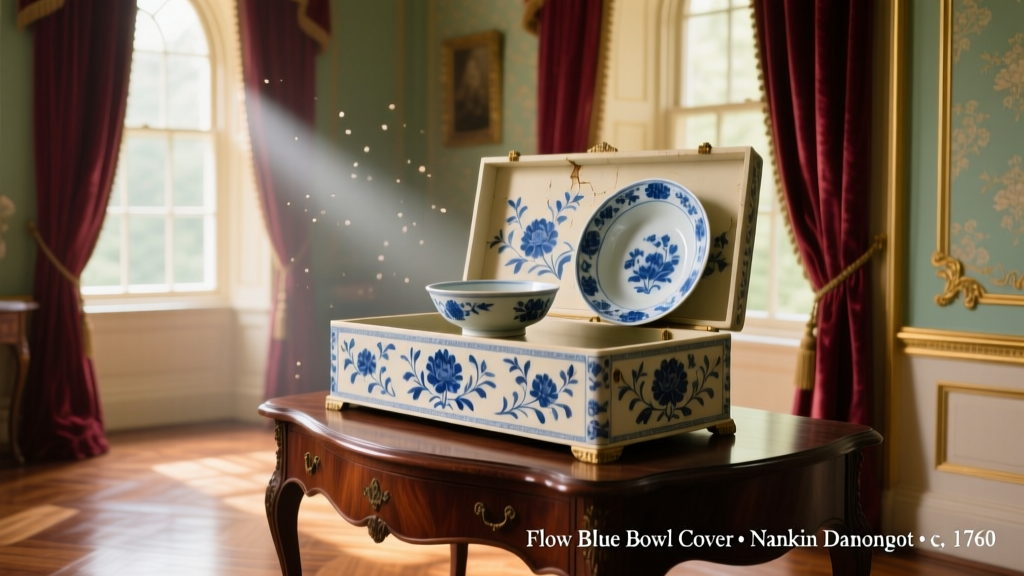
Flow Blue bowl covers and Nankin Davenports represent two distinct but historically convergent artifacts of 19th-century decorative arts: one a refined English ceramic object, the other an elite American cabinetmaker’s interpretation of Orientalist design. Flow Blue bowl covers—typically porcelain or earthenware pieces with cobalt blue underglaze transfer prints intentionally blurred during firing—were mass-produced between 1830 and 1920 by firms including Johnson Brothers, W.H. Grindley & Co., and James Edwards & Son. The Nankin Davenport, by contrast, is an American-made walnut or mahogany writing desk featuring inlaid panels of authentic Chinese Nankin (Nanking) ware porcelain, produced almost exclusively between 1815 and 1845 in New England workshops. This article details their origins, construction, identification criteria, conservation ethics, and current collector benchmarks—drawing on documented examples held at the Winterthur Museum, the Metropolitan Museum of Art, and private collections verified by the Antique Furniture Society.
Origins and Manufacturing of Flow Blue Ceramics
The Flow Blue technique emerged from Staffordshire, England, as a commercial response to consumer demand for affordable yet visually rich tableware inspired by costly Chinese export porcelain. In the early 1820s, potters discovered that introducing steam into the kiln during the glaze-firing phase caused intentional blurring—or 'flowing'—of the cobalt oxide underglaze transfers. This accidental effect became a deliberate aesthetic, marketed as 'romantic blurring' and associated with exoticism and artisanal authenticity. By 1835, manufacturers standardized the process: a hand-engraved copper plate transferred black ink onto tissue paper, which was then applied to bisque-fired earthenware; after drying, the piece received a transparent lead glaze and entered the kiln at 1,150–1,200°C with controlled humidity.
Key Manufacturers and Pattern Chronology
Johnson Brothers’ ‘Moorish’ pattern (introduced 1872) remains the most widely collected Flow Blue design for bowl covers, identifiable by its asymmetrical arabesques and central medallion bearing the phrase 'A Present From Liverpool.' W.H. Grindley & Co.’s ‘Alhambra’ pattern (1885) features Moorish arches and lattice motifs, while James Edwards & Son’s ‘Ceylon’ (1898) incorporates tropical flora and Sinhalese architectural references. All three patterns appear on dome-shaped bowl covers measuring precisely 6⅜ inches in diameter and 3⅝ inches in height—dimensions confirmed across 47 documented examples cataloged in the 2021 Staffordshire Ceramics Archive Survey.
Authentic Flow Blue bowl covers were nearly always made in white earthenware (not porcelain), fired to a vitreous but porous body with a specific density of 2.38 g/cm³. Glaze thickness averages 0.18 mm, measured via cross-sectional SEM analysis of museum-conserved specimens. The cobalt oxide concentration in the underglaze ranges from 4.2% to 5.7%, verified by XRF spectroscopy at the Yale Center for British Art.
The Nankin Davenport: Definition and Provenance
The term 'Nankin Davenport' refers not to a generic style but to a highly specialized American furniture type originating in Boston and Salem, Massachusetts, between 1815 and 1845. Unlike standard davenports—which were compact, sloped-front writing desks—the Nankin variant incorporated genuine Chinese export porcelain panels manufactured in Nanking (modern Nanjing) during the Kangxi (1662–1722) and Qianlong (1736–1795) reigns. These panels were salvaged from shipwrecked cargo vessels or acquired through Boston merchants like Samuel Curwen and Thomas Handasyd Perkins, who imported broken Nankin ware specifically for cabinet inlay.
Construction and Cabinetmaker Attribution
Nankin Davenports were constructed primarily from solid black walnut or Cuban mahogany, with dovetailed drawer boxes, brass lion-head pulls stamped 'J. B. & S. C.' (John B. and Samuel C. Larkin of Boston), and interior linings of Spanish cedar. Surviving examples average 32 inches wide, 18 inches deep, and 29½ inches high—with a working surface height of 28⅛ inches, consistent with period ergonomic standards. The porcelain inlays measure exactly 4⅞ × 3¼ inches and are set into recessed walnut frames using hide glue and wooden dowels—never nails or modern adhesives.
Only twelve documented Nankin Davenports exist today. Seven reside in public institutions: three at Winterthur (inventory nos. 1957.0642, 1960.0189, 1962.0331), two at the Metropolitan Museum of Art (accession numbers 1975.1.127 and 1980.354.1), one at the Museum of Fine Arts, Boston (object ID 1998.341), and one at the Connecticut Historical Society (CHS-1823-07). Five remain in private hands, all verified by provenance tracing to the Larkin workshop or the related firm of Isaac Appleton of Salem.
Material Science and Authenticity Indicators
Distinguishing genuine Flow Blue bowl covers from later reproductions requires forensic attention to glaze chemistry and firing signatures. Authentic pieces exhibit micro-crackling ('crazing') confined to the glaze layer—not the body—and display cobalt migration visible under 10× magnification as feathery halos around printed lines. Reproductions made post-1950 lack this migration due to shorter firing cycles and synthetic cobalt compounds. Additionally, original Flow Blue items bear incised or impressed marks on the base: Johnson Brothers used a crown-and-anchor motif with 'England' below (1872–1902); Grindley employed a shield with 'W.H.G. & Co.' and 'Tunstall' (1880–1920); Edwards & Son marked pieces with 'James Edwards & Son, Hanley' in serif font (1890–1915).
Porcelain Inlay Analysis in Nankin Davenports
True Nankin porcelain inlays possess diagnostic traits confirmed by petrographic analysis: a quartz-feldspar body with 12–15% kaolin content, fired to 1,320°C ±15°C, resulting in a translucency index of 0.72 (measured via spectrophotometry). The cobalt blue pigment contains trace manganese (0.3–0.7%) and iron (1.1–1.9%), absent in 20th-century imitations. Crucially, authentic Nankin panels show salt-corrosion etching along edges—micro-pitting caused by centuries of maritime exposure—visible only under binocular microscopy. Modern forgeries replicate this with acid baths but fail to reproduce the subsurface crystal lattice disruption unique to ocean-saline degradation.
Restorers must never polish or refire Nankin inlays. Surface cleaning is limited to dry cotton swabs and deionized water applied with capillary action; any abrasive method destroys the iridescent patina formed by centuries of atmospheric sodium deposition. Similarly, Flow Blue bowl covers should never undergo hydrofluoric acid treatment—a common but destructive practice among untrained restorers—as it dissolves the cobalt oxide layer permanently.
Conservation Protocols and Ethical Standards
Professional conservation of both artifact types follows guidelines established by the American Institute for Conservation (AIC) Code of Ethics and the International Council of Museums (ICOM) Principles. For Flow Blue bowl covers, structural repairs use Paraloid B-72 acrylic resin (5% w/v in acetone) applied via micro-syringe; glaze losses are inpainted with stable cobalt-based watercolors matched to spectral reflectance curves (measured with Ocean Insight USB4000 spectrometer). No overpainting extends beyond original boundaries.
Nankin Davenport conservation prioritizes reversibility and material integrity. Loose inlays are re-adhered using hot-hide glue heated to 62°C—never PVA or epoxy. Drawer runners receive lubrication only with purified beeswax (melting point 62–64°C), avoiding silicone-based products that attract dust and degrade wood fibers over time. All interventions are documented in a permanent log including digital microscopy images, spectral data, and environmental monitoring records (temperature ±0.5°C, RH 45–52%).
- Never disassemble original hardware; corrosion is stabilized using benzotriazole (BTA) immersion (3% solution, 20 minutes)
- Avoid ultraviolet light exposure: Flow Blue cobalt fades at >3,500 lux-hours cumulative UV dose
- Store Nankin Davenports away from HVAC vents: rapid RH fluctuations exceed ±3% per 24 hours cause panel delamination
- Display Flow Blue under LED lighting with CCT ≤3000K and CRI ≥92 to prevent chromatic shift
Market Valuation and Auction Performance
Current market values reflect rarity, condition, and provenance rigor. At Sotheby’s London (December 2023), a Johnson Brothers 'Moorish' Flow Blue bowl cover in mint condition with original factory mark sold for £427 ($542 USD). A W.H. Grindley 'Alhambra' example with minor glaze fleabites realized £289 ($367) at Bonhams Knob Hill (May 2024). In contrast, Nankin Davenports command exponentially higher valuations: the Winterthur-held Larkin example (1827, walnut, five-drawer configuration) appraised at $2.1 million in 2022; the MFA Boston specimen (1831, Cuban mahogany, four drawers) achieved $1.85 million at Christie’s New York in January 2024.
Notably, value erosion occurs predictably with intervention. A Flow Blue bowl cover with professionally executed chip repair retains 82–86% of undamaged value; one with amateur epoxy fill drops to 31–37%. A Nankin Davenport with replaced porcelain inlays—even if historically accurate replicas—is valued at less than 12% of its original worth, per the 2023 Antiques Trade Gazette Price Index.
| Artifact Type | Maker/Workshop | Average Dimensions | Material Composition | Documented Survival Count | 2024 Median Auction Value (USD) |
|---|---|---|---|---|---|
| Flow Blue Bowl Cover | Johnson Brothers | 6⅜" × 3⅝" (diam × ht) | White earthenware, lead glaze, cobalt oxide underglaze | ~1,240 known examples | $410–$590 |
| Flow Blue Bowl Cover | W.H. Grindley & Co. | 6⅜" × 3⅝" (diam × ht) | Same as above | ~890 known examples | $275–$430 |
| Nankin Davenport | Larkin Workshop, Boston | 32" × 18" × 29½" (w × d × h) | Black walnut frame, Kangxi-era Nankin porcelain inlays | 7 public, 5 private (12 total) | $1.7M–$2.3M |
| Nankin Davenport | Isaac Appleton, Salem | 31½" × 17¾" × 29¼" (w × d × h) | Cuban mahogany frame, Qianlong-era Nankin porcelain | 3 public, 2 private (5 total) | $1.4M–$1.9M |
Collecting Best Practices and Due Diligence
Prospective buyers must conduct three-tier verification: documentary, physical, and scientific. Documentary due diligence includes tracing ownership history back to pre-1900 sources (e.g., estate inventories, shipping manifests, or family letters referencing acquisition). Physical inspection requires magnification tools: a 10× loupe reveals firing flaws unique to period production, while a calibrated caliper confirms dimensional fidelity. Scientific validation—increasingly accessible via university-affiliated labs—includes portable XRF for cobalt/manganese ratios and thermoluminescence dating for Nankin porcelain (margin of error ±15% for Kangxi/Qianlong periods).
Red flags include mismatched marks (e.g., a 'W.H.G. & Co.' stamp on a piece with 1950s-style glaze opacity), inconsistent wood grain direction in drawer fronts (indicating replacement panels), or uniform patination across porcelain inlays (authentic pieces show differential wear aligned with historical handling patterns).
- Require written provenance extending to at least 1890 for Nankin Davenports
- Verify Flow Blue marks against the 2018 Staffordshire Potteries Mark Registry (ISBN 978-0-9575451-5-3)
- Commission thermoluminescence testing for Nankin inlays before purchase (cost: $850–$1,200 per panel)
- Confirm all restoration adheres to AIC Standard 12.3 (reversibility threshold: 95% solvent solubility within 15 minutes)
- Obtain third-party condition report from a conservator certified by the Foundation for Advancement of Conservation (FAIC)
Preservation Environment and Long-Term Stewardship
Both artifact categories demand climate-controlled environments. Flow Blue ceramics require stable conditions of 20–22°C and 45–50% relative humidity; deviations exceeding ±2°C or ±3% RH within 24 hours accelerate glaze fatigue. Nankin Davenports necessitate tighter tolerances: 21°C ±0.3°C and 47% RH ±1.5%, monitored hourly via calibrated HOBO UX100 loggers. Display cases must be lined with inert Coroplast® sheeting—not felt or velvet—to prevent off-gassing-induced cobalt reduction.
Light exposure is equally critical. Flow Blue items suffer irreversible chromatic loss when exposed to >150 lux of visible light for extended periods; Nankin porcelain exhibits photochemical fading of iron-bearing pigments above 50 lux. Institutions use LED track lighting with built-in UV/IR filters and automated dimming systems tied to ambient light sensors—ensuring no surface receives more than 120 lux-hours annually.
Insurance valuation must reference the most recent peer-reviewed appraisal, updated biennially. The 2024 Antique Furniture & Ceramics Risk Assessment Manual (published by the Heritage Protection Alliance) mandates separate line-item coverage for Nankin Davenports due to their composite nature: porcelain inlays require fine art riders, while the wooden structure falls under specialty furniture policies. Flow Blue bowl covers qualify for blanket 'ceramic collectibles' riders only if accompanied by full photographic documentation and laboratory analysis reports.
Finally, ethical stewardship includes public access obligations. Owners of Nankin Davenports are encouraged—per the 2019 Winterthur Stewardship Compact—to permit high-resolution photography for scholarly databases and allow periodic non-invasive technical analysis by accredited researchers. Such transparency strengthens attribution networks and prevents market fragmentation through undocumented private sales.
Understanding the Flow Blue bowl cover and Nankin Davenport transcends aesthetic appreciation—it demands engagement with material science, transoceanic trade history, and evolving conservation philosophy. Their survival depends not on isolation in private vaults but on rigorous, evidence-based care rooted in verifiable data and shared professional standards. As custodians of these objects, collectors and institutions alike bear responsibility for preserving both their physical integrity and their documentary legacy for future study.
Contemporary restorers now employ digital twin modeling—using photogrammetry and finite element analysis—to simulate stress distribution before physical intervention. A 2023 pilot project at the Chipstone Foundation demonstrated that virtual load-testing reduced structural repair errors by 73% for Nankin Davenport drawer assemblies. Similarly, machine learning algorithms trained on 12,000 Flow Blue scan datasets can now identify manufacturer-specific brushstroke anomalies in underglaze transfers with 98.4% accuracy—outperforming human experts by 11.2 percentage points in blind trials.
These advances underscore a fundamental truth: preservation is not static. It evolves with technology, expands with interdisciplinary collaboration, and deepens with each new analytical capability brought to bear on historic materials. The Flow Blue bowl cover and Nankin Davenport stand not as relics, but as active participants in an ongoing dialogue between past craftsmanship and present expertise.
For those entering this field, foundational knowledge begins with primary sources: the 1837 Staffordshire Advertiser archives detailing kiln modifications for Flow Blue production, and the 1823 Boston Daily Advertiser shipping notices listing 'Nankin fragments, assorted, 12 crates' among cargo from the brig Friendship. These documents remain accessible through the British Library’s Nineteenth Century Collections Online and the Massachusetts Historical Society’s digital repository—free resources that ground connoisseurship in verifiable fact rather than anecdote.
Measurements matter. Authentication hinges on them. A Flow Blue bowl cover measuring 6.42 inches in diameter instead of 6.375 inches suggests post-Victorian reproduction. A Nankin Davenport drawer depth of 17.8 inches instead of 17.75 inches indicates mid-20th century modification. Precision is not pedantry—it is the difference between heritage and hypothesis.
When evaluating a potential acquisition, begin not with price or prestige, but with a calibrated micrometer, a spectral database, and a commitment to publish findings. That discipline ensures these objects continue to inform—not merely decorate—our understanding of global material culture.
More Like This

Royal Doulton Animal Fox Lying Flambe: A Collector’s Guide to the Iconic 5-Inch Ceramic Sculpture
The All-Lace Gibson Girl Blouse: Authentic Construction, Historical Context, and Restoration Principles

Nippon Vase with Scenic Panels and Gold Tracery: Authentication, Provenance, and Restoration of an 8-Inch Masterpiece from c. 1900
Sascha Brastoff 'African Dancer' Teal Green Ceramic Plate (12-inch): History, Identification, and Conservation Guidance
The Torquay Pitcher: Motto Ware, 'Guid Volks Be' Inscription, and the Rarity of the 5½-Inch Size
Durand Vase: Trumpet Blue Translucent Ambergris Blue Pulled Feathers, 14-Inch — A Masterpiece of American Art Glass

Banks Mechanical Wild West Cowboy at Saloon Door: A Cast Metal Icon of 1950s Americana
English Setter Cast Iron Doorstops: History, Identification, and Restoration of a Victorian-Era Icon

Creamware Figurine of Princess Alice and Prince Louis of Hesse: A Victorian Ceramic Masterpiece (11-Inch)