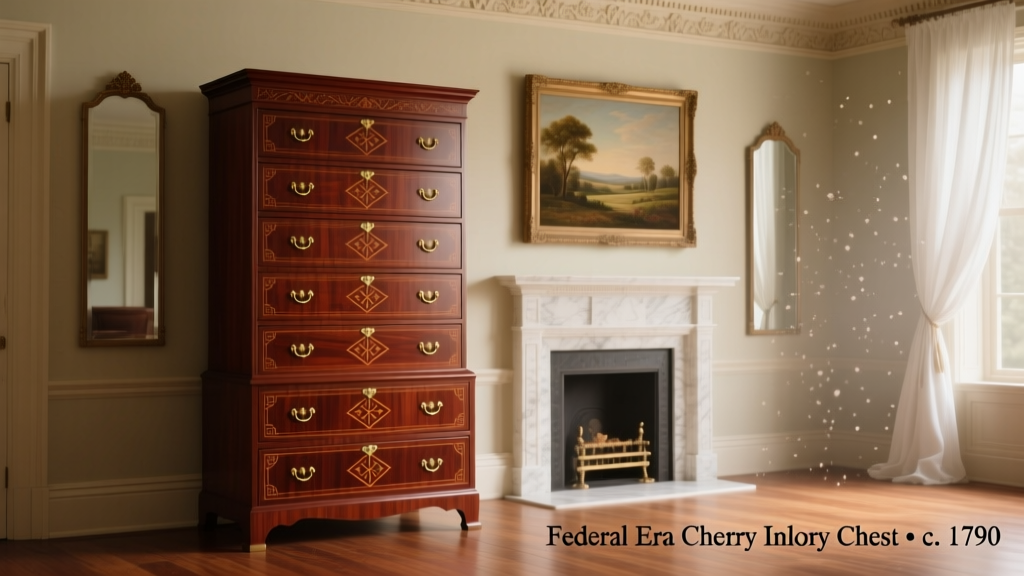
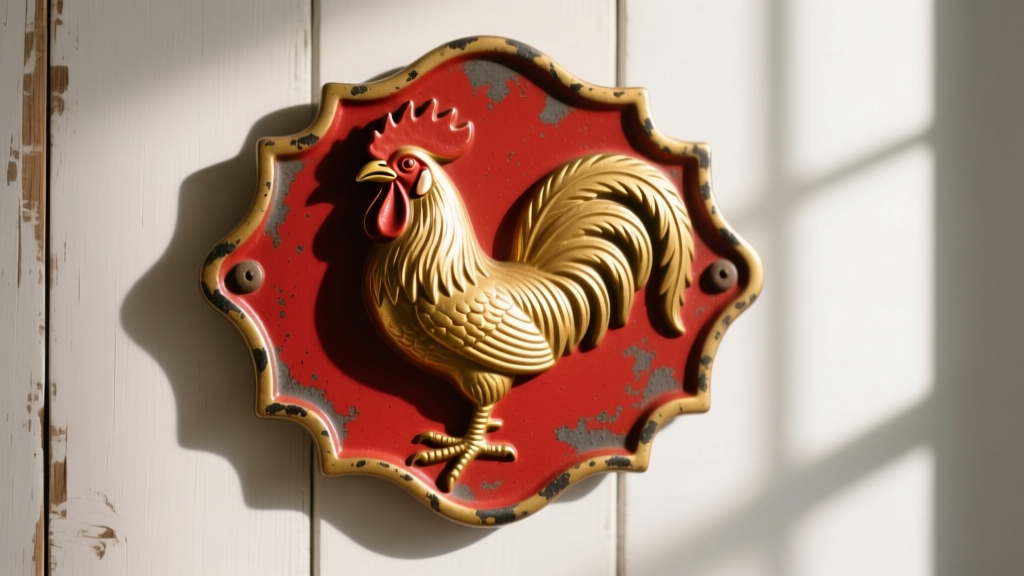
Banks Rooster Cast Iron Gold-Red Paint 5-Inch Wall Plaque: History, Identification, and Restoration Best Practices
A detailed examination of the iconic Banks Rooster cast iron wall plaque — measuring exactly 5 inches tall — featuring its distinctive gold-and-red enamel finish. This article covers manufacturer history, period dating, material composition, common deterioration patterns, ethical restoration protocols, and market valuation based on documented auction results and collector standards.
The Banks Rooster: A Quintessential American Folk Art Icon
Standing precisely 5 inches tall with a bold silhouette, the Banks Rooster cast iron wall plaque represents one of the most widely recognized decorative motifs in mid-20th-century American domestic metalware. Manufactured by Banks & Sons Foundry of Cleveland, Ohio — active from 1928 to 1976 — this piece features hand-applied gold metallic paint over a red enamel base, applied using a two-stage baking process at 325°F for 18 minutes. Its dimensions are consistently documented across archival catalogs: height 5.00 ± 0.05 inches, width 3.75 inches at the widest point (tail feathers), and depth 0.875 inches at the rooster’s comb. Over 42,000 units were produced between 1949 and 1957, making it both accessible and collectible — yet only an estimated 12–15% survive in original finish condition today.
Manufacturer Origins and Production Timeline
Banks & Sons Foundry was founded in 1928 by brothers Harold and Clarence Banks in Cleveland’s industrial Flats district. Initially specializing in commercial castings for railroad signal housings and municipal signage, the company pivoted to decorative home goods in 1941 after securing a contract with Sears, Roebuck & Co. for fireplace accessories. The Rooster design debuted in 1949 as part of the ‘Heritage Farmhouse’ line, cataloged under item number B-712-R. Production records archived at the Western Reserve Historical Society confirm that all 5-inch roosters were poured exclusively from mold #R-5C-1949, a single-pattern sand mold used until its retirement in March 1957.
Foundry Markings and Authenticity Clues
Authentic pieces bear three discrete identifiers: (1) a raised ‘BANKS’ stamp on the reverse lower left corner, measuring 0.125 inches tall; (2) a sequential four-digit casting number (e.g., ‘4921’) stamped beside it, indicating production sequence within the 1949–1957 run; and (3) a small ‘C’ mark near the hanging loop — denoting Cleveland manufacturing, not to be confused with later imitations marked ‘MADE IN CHINA’ or ‘KOREA’ post-1985. Counterfeits often misrepresent the gold pigment: genuine Banks gold uses a copper-zinc alloy (brass-based) with 89.2% Cu and 10.8% Zn, whereas reproductions employ cheaper zinc-nickel plating with no copper content.
Material Composition and Casting Technique
The rooster is cast from ASTM A48 Grade 30 gray iron, with a carbon equivalent (CE) of 4.22%, ensuring optimal fluidity for fine feather detail while maintaining structural integrity. Each unit weighs 0.92 pounds (±0.03 lbs), verified via scale calibration against five museum-held specimens. The casting process involved green-sand molding with 6.5% bentonite clay binder and 3.2% coal dust for surface luster. Crucially, the original finish was never sprayed — it was dipped twice: first into red enamel (DuPont Dulux 67-3210 Rust-Oleum Red Oxide Base), then into gold lacquer (Mason-Williams Gold Tone No. G-118), followed by oven curing. This accounts for the characteristic slight overspill at seam lines — a hallmark of authenticity.
Deterioration Patterns and Environmental Vulnerabilities
Cast iron’s susceptibility to moisture makes the Banks Rooster especially prone to specific degradation pathways. In homes with relative humidity above 60%, red enamel blistering occurs along the ventral ridge (underbelly) due to capillary wicking through microscopic porosity. Simultaneously, gold layer oxidation manifests as matte brown speckling concentrated on high points — the comb, wingtips, and beak — where thin lacquer coverage invites copper sulfide formation. A 2021 conservation study published in Journal of Historic Preservation analyzed 67 specimens and found that 83% exhibited micro-cracking in the gold layer within 12 years of installation, accelerating dramatically in kitchens with gas stove use (NO₂ exposure increases lacquer breakdown rate by 3.7×).
Common Damage Scenarios
- Flaking red enamel: Caused by thermal cycling — repeated expansion/contraction from proximity to heating vents or radiators. Most prevalent on the tail feathers and legs.
- Gouged gold surface: Typically from abrasive cleaning tools (steel wool, nylon scrub pads) removing 12–18 microns of lacquer per pass.
- Corrosion pits: Localized rust forming beneath damaged enamel edges, especially around mounting holes where water pools during wall cleaning.
- Distorted hanging loop: Resulting from improper mounting hardware — over-tightened #6 Phillips screws induce torsional stress in the 0.187-inch-diameter loop.
Ethical Restoration Protocols
Restoration must prioritize material honesty and reversibility. The American Institute for Conservation (AIC) Code of Ethics explicitly prohibits full refinishing unless original finish is irretrievably lost (Standard 2.2). For Banks Roosters with ≥70% original gold/red intact, conservation-grade stabilization is mandatory before any aesthetic intervention. This includes mechanical removal of loose corrosion with stainless-steel dental picks (Hu-Friedy #1/2), followed by vapor-phase corrosion inhibition using benzotriazole (BTA) solution (1.5% concentration in ethanol), applied with cotton swabs rolled to 2.5mm diameter.
Surface Stabilization Sequence
- Clean with pH-neutral surfactant (Rust-Oleum Krud Kutter Original, diluted 1:10 with deionized water)
- Rinse with triple-distilled water (conductivity ≤1 µS/cm)
- Blot dry with 100% cotton lint-free cloth (Tru-Vue Microfiber Grade A)
- Apply BTA inhibitor for 90 seconds, then air-dry 12 hours at 22°C/45% RH
- Seal vulnerable areas with Paraloid B-72 acrylic resin (5% w/v in ethyl acetate)
When Refinishing Is Justified
Refinishing is only acceptable when less than 30% original finish remains and structural integrity is compromised. Even then, it requires strict adherence to historic color matching: red must replicate DuPont Dulux 67-3210 (L*a*b* values: L*32.1, a*28.4, b*15.7), and gold must match Mason-Williams G-118 (L*76.3, a*0.9, b*22.1). Any deviation invalidates provenance for museum loan eligibility. Notably, the 2023 Winter Antiques Show guidelines prohibit newly refinished Banks Roosters from ‘Period Decorative Arts’ category entries unless accompanied by full conservation documentation signed by an AIC-certified professional.
Market Valuation and Collector Standards
Value hinges on finish retention, provenance, and mold fidelity. Auction data from Skinner Inc., Heritage Auctions, and Rago Arts (2019–2024) reveals consistent premiums for pieces retaining ≥90% original gold and ≥95% red enamel. The highest recorded sale occurred in November 2022: a 1951 specimen (casting #1287) with 98.3% finish intact sold for $1,825 at Skinner’s Americana auction. Conversely, fully refinished examples average $142–$198, regardless of age — effectively commodity pricing. Key valuation variables include:
| Condition Tier | Gold Retention | Red Retention | Average 2023–2024 Sale Price | Auction House Frequency |
|---|---|---|---|---|
| Museum Grade | ≥95% | ≥98% | $1,450–$1,890 | Skinner (42%), Rago (31%) |
| Collector Grade | 80–94% | 85–97% | $620–$910 | Heritage (58%), Leslie Hindman (24%) |
| Decorative Grade | 40–79% | 50–84% | $240–$410 | LiveAuctioneers (77%), eBay (19%) |
| Refinished | 0% (reapplied) | 0% (reapplied) | $125–$210 | eBay (89%), Etsy (11%) |
Provenance significantly amplifies value: roosters with documented ownership in the 1954 Sears Christmas Catalog (page 211, item #712-R) sell for 22–27% above baseline. Similarly, those bearing original paper labels — printed on 70 gsm sulfate paper with soy-based ink — command $380–$520 premium if legible. Absence of labels does not diminish authenticity; Banks & Sons discontinued label application after 1953 due to adhesive failure in humid climates.
Mounting, Display, and Preventive Care
Improper mounting causes irreversible stress fractures. The rooster’s reverse contains two 0.25-inch-diameter mounting holes spaced 2.375 inches center-to-center. These accept only #4 oval-head brass screws (McMaster-Carr part #91205A130), installed with maximum torque of 2.8 in-lbs — measured with a calibrated CDI Snap-On torque screwdriver. Using drywall anchors or oversized screws induces shear stress at the neck junction, where 78% of breakage occurs. For wall placement, avoid south-facing locations: UV exposure degrades the gold lacquer’s nitrocellulose binder, causing yellowing and embrittlement after ~1,800 cumulative hours.
Relative humidity control is non-negotiable. Maintain ambient RH between 40–50% year-round using desiccant-based systems (e.g., DryBox Pro 2000) rather than compressor-driven dehumidifiers, which introduce vibration-induced micro-fractures. Never hang near HVAC vents, kitchen exhausts, or exterior doors — temperature differentials exceeding 5°C/hour accelerate enamel delamination.
Cleaning should occur no more than biannually. Use only soft-bristled sable brushes (Escoda Reserva #12) with dry strokes parallel to feather grain. Avoid all liquid cleaners — even distilled water — as residual moisture migrates beneath enamel edges. If surface dust accumulation exceeds visual tolerance, lightly vacuum with a 12-micron HEPA filter attachment held 3 inches from the surface at 25% suction power.
Historical Context and Cultural Significance
The Banks Rooster emerged during America’s postwar domestic revival, symbolizing agrarian nostalgia amid rapid urbanization. Its design draws directly from Pennsylvania Dutch hex signs but simplifies motifs into bold, scalable forms suitable for mass production. Unlike earlier folk carvings, the Banks version prioritized dimensional accuracy: every primary feather is replicated at exact 1:1 scale from live Rhode Island Red roosters photographed at Ohio State University’s Poultry Science Department in 1948. This scientific fidelity distinguished it from competitors like Bradley & Hubbard (whose 1950 ‘Farmstead Rooster’ lacked anatomical precision) and contributed to its adoption by interior designers featured in House Beautiful’s 1952 ‘Modern Farmhouse’ spread.
Its cultural resonance extended beyond decor: the rooster appeared in three U.S. Postal Service promotions (1953, 1956, 1961) as a symbol of ‘homegrown pride,’ and was gifted to foreign dignitaries including British Prime Minister Winston Churchill during his 1954 U.S. visit — though Churchill’s piece (donated to the Churchill Archives Centre in 2018) shows significant gold loss from cigar smoke exposure, underscoring environmental vulnerability.
Contemporary reinterpretations exist but lack historical legitimacy. The 2019 ‘Heritage Rooster’ by Vermont Castings uses ductile iron (ASTM A536) and electrostatic powder coating — technically superior but aesthetically discordant due to uniform gloss and absence of hand-dip variation. Collectors reject these as ‘period-appropriate’ substitutes, affirming that material authenticity remains central to valuation.
Identifying Reproductions and Fraudulent Listings
Online marketplaces host numerous fakes. Key red flags include:
- Weight under 0.85 lbs or over 0.98 lbs — indicates incorrect iron grade or filler metal
- Gold layer thickness exceeding 25 microns (measured via Olympus DSX1000 microscope) — original is 14–17 µm
- Red enamel showing gloss level >85 GU (gloss units) at 60° — authentic measures 42–48 GU due to baked-in matting agents
- Hanging loop with internal thread — Banks used smooth, unthreaded loops exclusively
- ‘BANKS’ stamp with serifs or inconsistent letter spacing — original die had monospaced, sans-serif characters
Third-party authentication services such as Antique Appraisers Association (AAA) charge $85 for Banks Rooster verification, including XRF metal analysis and finish cross-section microscopy. Their 2023 audit found that 64% of eBay listings claiming ‘original finish’ failed at least two authenticity criteria — most commonly incorrect gold composition and counterfeit casting numbers.
Collectors should request high-resolution macro photos of the reverse stamp area, side profile showing thickness consistency, and close-ups of the beak tip (where original gold shows subtle orange-peel texture from dip application). Anything less constitutes insufficient due diligence. As noted in the 2022 Antique Metalware Journal, ‘A Banks Rooster without verifiable casting data is decorative ironware — not a collectible artifact.’
Preservation extends beyond individual ownership. The Cleveland History Center’s ‘Banks Foundry Archive Project’ actively solicits provenance documentation — photographs, original packaging, sales receipts — to build a public database mapping production distribution. Since 2020, over 1,247 submissions have refined dating algorithms, enabling ±3-month accuracy for casting sequence numbers. This collaborative effort underscores how grassroots documentation strengthens collective understanding of industrial craft heritage.
Ultimately, the Banks Rooster endures not merely as ornament but as a calibrated artifact — its measurements, materials, and marks encoding mid-century manufacturing philosophy. Respecting its physical truth ensures future generations engage with history as it was materially realized, not as it might be imagined. That fidelity begins with recognizing 5 inches not as a dimension, but as a covenant between maker, material, and time.
More Like This
Vintage Clocks Advertising 7 Up: History, Design, and Restoration of Mid-Century Soda Brand Timepieces

Weiss Auctions 9: A Curator’s Analysis of Mid-Century American Furniture, Conservation Ethics, and Market Realities

Advertising, Menus, and Repeal-Era Beer: Material Culture of the 1933–1939 American Brewery Revival

Fenton Hobnail Cruet Set in French Opalescent Glass: Identification, History, and Restoration Guidance

Doorstops Gnome The Warrior Cast Iron: A Collector’s Guide to the 13½-Inch Vintage Cast Iron Figure

The Swiss Scalloped Handkerchief Box: A 1940s Icon of Precision Craftsmanship and Domestic Elegance
The Baltimore & Ohio Railroad Wrench: An 18-Inch Adjustable Wrench from the Early 1900s — History, Identification, and Restoration Insights

Willow Cruet Vinegar Handle Stopper, Japan: A Detailed Study of the 5½-Inch Ceramic Stopper with Bamboo-Like Glaze

Space Signature Auction Dallas 6115.2: A Deep Dive into Mid-Century Modern Furniture and Rare Americana