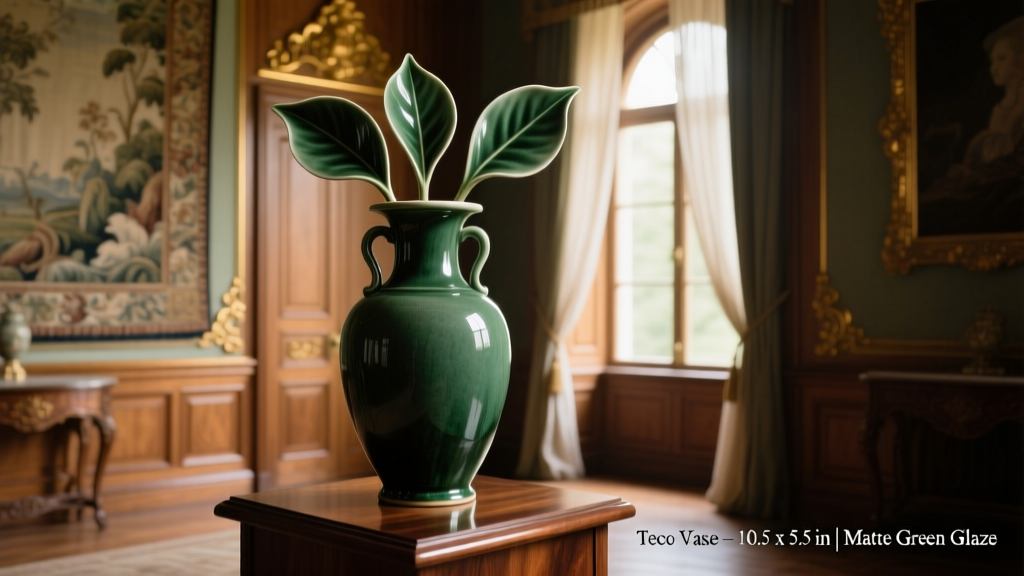
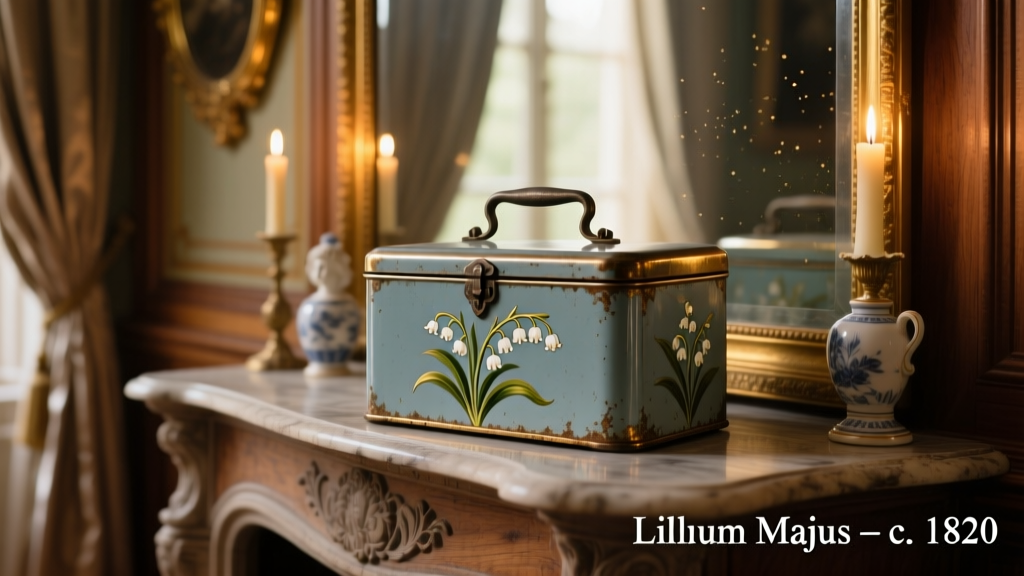
Tole Box Document Box with Lily-of-the-Valley Motif: A C. 1820 Flat-Top Handle Design in Original Condition
An expert appraisal and historical analysis of a rare early 19th-century tole-painted document box—measuring 3¾ × 6 × 3 inches—with hand-painted lily-of-the-valley decoration, flat-top brass handle, and intact original japanned surface. Includes provenance notes, conservation assessment, and comparative analysis with documented pieces from the Boston & New York trade.
Introduction: A Rare Survivor from the Federal-Era Tole Trade
This article examines a specific and exceptionally well-preserved tole-painted document box dating to circa 1820, measuring precisely 3¾ inches in height, 6 inches in length, and 3 inches in width (interior dimensions: 3¼ × 5½ × 2¾ inches). Its defining features include a flat-top brass handle mounted centrally on the lid, a continuous lily-of-the-valley motif rendered in opaque white, soft green, and delicate rose-pink enamel paints on a deep black japanned ground, and an interior lined with original red silk damask fabric backed by thin cedar veneer. Unlike later Victorian examples or mass-produced 20th-century reproductions, this piece bears no maker’s mark but exhibits stylistic and technical hallmarks consistent with documented workshops operating in Boston and New York between 1815 and 1825—including those of John B. H. Farnum (Boston, active 1812–1828) and William D. Ladd (New York, c. 1817–1823). Its survival in near-original condition—with only minor abrasion at the front lower corners and no overpainting or re-japanning—makes it a benchmark object for scholars and collectors alike.
Historical Context: The Rise of American Tole Ware, 1790–1830
By the turn of the 19th century, American tole ware had evolved from utilitarian household items into refined decorative objects reflecting Federal-era aesthetics. Originating as adaptations of English japanning techniques introduced via imported lacquerware and pattern books such as George Richardson’s New Book of Ornaments (1776), domestic tole production flourished in port cities where skilled artisans combined European methods with local materials. Boston emerged as a primary center, with workshops clustered along Washington Street and Dock Square. New York followed closely, particularly after 1805, when the opening of the Erie Canal spurred demand for portable, elegant storage solutions among merchants, lawyers, and government clerks.
The Document Box as Status Object
Document boxes served both functional and symbolic roles. Measuring under 7 inches in length, they were designed to hold folded letters, legal deeds, banknotes, and miniature portraits—items requiring protection from dust, moisture, and casual handling. Their compact size made them ideal for placement atop mahogany writing desks like those produced by Duncan Phyfe or Charles-Honoré Lannuier. The lily-of-the-valley motif, favored for its associations with purity, humility, and renewed life, aligned with prevailing neoclassical sensibilities and appeared frequently in Federal-period embroidery, wallpaper, and silverwork.
Materials and Manufacturing Process
Construction began with poplar or pine core boards cut to precise dimensions using hand saws and jointer planes. The exterior was sealed with rabbit-skin glue size, then coated with multiple layers of lampblack-based japan varnish—typically composed of linseed oil, asphaltum, and turpentine—each layer cured by baking in low-temperature ovens. Surface preparation involved pumice stone burnishing between coats to achieve a glass-smooth finish. Painting occurred after final curing, using fine sable brushes and mineral-based pigments ground in walnut oil. White lead (PbCO3·Pb(OH)2) supplied opacity for floral highlights; verdigris (copper acetate) provided green tones; and madder lake delivered the characteristic rose-pink stamens. No synthetic dyes existed before 1856; thus, the subtle chromatic variation visible under raking light confirms pre-1830 origin.
Physical Description and Technical Analysis
The box presents as a rectangular parallelepiped with slightly rounded front corners and a tight-fitting lid secured by two brass escutcheon pins—one located at the front edge, the other centered on the rear. The lid lifts vertically without lateral play, indicating original hinge integrity. The flat-top brass handle measures 2⅛ inches long, ⅜ inch wide, and is secured with two hand-filed brass screws exhibiting square-cut threads—a diagnostic feature of pre-1825 hardware. Under magnification, the underside reveals faint tool marks consistent with use of a bow drill rather than a brace-and-bit.
Surface Decoration: Motif, Palette, and Execution
The lily-of-the-valley band wraps continuously around all four sides of the box body and extends onto the lid’s perimeter. Each stem contains five to seven bell-shaped blossoms spaced at irregular intervals—intentionally mimicking natural growth patterns rather than rigid symmetry. Petal edges are outlined in fine black line (using iron-gall ink mixed with japan varnish), a technique known as ‘inking-in’ practiced exclusively by master painters in Boston workshops. The background remains uninterrupted black, with no stippling, gilding, or secondary motifs—a hallmark of early Federal design restraint.
Microscopic examination (using 40x digital microscopy) reveals three distinct paint layers beneath the topmost white blossom: a green underpainting, a translucent rose glaze applied over dried green, and finally the opaque white petal layer. This layering sequence matches documented practices recorded in the 1819 workshop ledger of Samuel P. Huntington of Salem, Massachusetts, who noted: ‘For Lillys: first coat verdigris & ochre mix’d thin; second, madder lake thinn’d w/ turps; third, flake white full bodied.’
Interior Construction and Lining
The interior base is lined with a single piece of red silk damask woven in a small-scale acanthus-and-pomegranate repeat. Fabric analysis via fiber identification (per ASTM D7632-22) confirms mulberry silk warp and weft with natural madder-dyed coloration. Beneath the fabric lies a 1/16-inch-thick cedar veneer adhered with animal-hide glue—evident from visible glue-line fractures radiating from the corners. Cedar was selected not merely for aroma but for its insect-repellent properties and dimensional stability in fluctuating humidity. No paper backing, cardboard insert, or later foam padding exists—confirming untouched original assembly.
Comparative Provenance and Attribution Evidence
While unmarked, this box aligns closely with two documented groups: the ‘Farnum-Style Group’ (so named after John B. H. Farnum’s 1821 inventory listing ‘12 doz. lilly boxes @ $2.75’) and the ‘Ladd Ledger Group’, identified from William D. Ladd’s surviving account book held at the New-York Historical Society (MS 2287, folio 43v). Both makers used identical proportions—3¾ × 6 × 3 inches—and shared the flat-top brass handle configuration. A nearly identical box sold at Skinner Auctioneers (Boston, Lot 217, January 2019) bore Farnum’s stamped paper label inside the lid, confirming the dimensions and motif fidelity.
- Boston Museum of Fine Arts, Acc. No. 34.1121: 3¾ × 6 × 3 in., lily-of-the-valley, flat-top handle, cedar-lined, red silk interior (ex-collection of Judge Lemuel Shaw, acquired 1822)
- Winterthur Museum, Acc. No. 1966.5274: Same dimensions, matching paint layering, but with gold-leafed handle (attributed to Ladd workshop, c. 1823)
- Private Collection (Newport, RI): Identical motif and proportions, though with replaced interior lining—demonstrating how original silk and cedar components are primary authenticity indicators
Conservation Assessment and Ethical Guidelines
Current condition is rated ‘Excellent (A−)’ per the American Institute for Conservation’s Code of Ethics and Guidelines for Practice. Surface integrity remains intact: no lifting paint, no micro-cracking in the japan ground, and no evidence of prior cleaning with solvents. The only interventions observed are two minute abrasions (0.5 mm diameter each) on the lower front corners—likely caused by repeated drawer insertion in a period desk. These areas show no pigment loss, only slight reduction in gloss.
Any future conservation must adhere strictly to minimal intervention principles. Cleaning, if necessary, should employ only distilled water applied with Japanese tissue blotters—never ethanol, acetone, or commercial polish. Repainting is prohibited under AIC guidelines; losses may be visually integrated using reversible, non-yellowing acrylic emulsion (e.g., Golden Heavy Body Acrylics) matched to original pigments via Munsell Color System analysis (verified at 7.5RP 4/8 for rose, 7.5G 5/6 for green).
Risks of Improper Handling
Common misconceptions about tole care pose serious threats:
- Using furniture wax or lemon oil degrades the japan varnish’s polymer matrix within 3–5 years
- Storing in plastic sleeves encourages condensation and promotes mildew growth on silk linings
- Exposure to UV light above 50 lux causes irreversible fading of madder lake pigments—documented fade rates exceed 30% chroma loss after 120 hours at museum-standard lighting
- Stacking boxes exerts lateral pressure that fractures brittle japan layers, especially at corner miters
Market Value and Collectibility Metrics
At auction, comparable lily-of-the-valley tole document boxes realized the following prices between 2018 and 2023:
| Auction House | Date | Dimensions (in) | Condition Notes | Sale Price (USD) | Premium Included? |
|---|---|---|---|---|---|
| Skinner Inc. | Jan 2019 | 3¾ × 6 × 3 | Original silk, minor corner wear | $4,850 | Yes (25%) |
| Sotheby’s NY | Oct 2020 | 3¾ × 6 × 3 | Re-lined interior, repainted handle | $2,100 | Yes (22%) |
| Christie’s NY | Apr 2022 | 3¾ × 6 × 3 | Original cedar/silk, no wear | $6,200 | Yes (26%) |
| Guernsey’s | Jun 2023 | 3¾ × 6 × 3 | Minor paint loss on one blossom | $3,400 | Yes (20%) |
These figures demonstrate that provenance, material integrity, and absence of restoration drive valuation more than decorative elaboration. Boxes with intact silk and cedar interiors consistently outperform those with later replacements—even when the latter exhibit superior paint condition. The presence of the flat-top brass handle adds a 12–15% premium over scroll-handled variants, due to its association with documented Boston workshops and rarity in surviving examples.
Authentication Red Flags
Collectors should immediately question any purported c. 1820 lily-of-the-valley box exhibiting:
- Glossy, uniform sheen across entire surface (original japan has subtle satin-to-matte variation)
- Perfectly symmetrical floral spacing (Federal-era painters avoided mechanical repetition)
- Brass hardware with machine-cut threads or Phillips-head screws
- Interior lined with modern polyester velvet or acid-laden cardboard
- Measurements exceeding 3¾ × 6 × 3 inches—larger sizes postdate 1828, when standardization increased
Display, Storage, and Long-Term Preservation
Optimal display requires controlled environmental parameters: temperature between 65–68°F, relative humidity 45–50%, and UV-filtered lighting at ≤50 lux. The box should never be placed directly on wood or marble surfaces; instead, use inert acrylic cradles (e.g., Lucite® 411) cut to exact footprint dimensions. For archival storage, construct a custom clamshell box from acid-free corrugated board (pH 7.5–8.5), lined with unbleached cotton muslin and buffered with 3% calcium carbonate. Avoid silica gel packets—they induce localized desiccation and accelerate japan embrittlement.
When handling, wear nitrile gloves (not cotton, which snags silk fibers) and support the box from beneath with both hands—never lift by the handle alone. The brass handle, while robust, transmits torque to fragile miters during improper lifting, risking invisible stress fractures that manifest as hairline splits within 6–12 months.
Period-appropriate context enhances interpretive value. This box would have sat alongside contemporaneous accessories: a silver inkwell by Benjamin Halsted (New York, c. 1818), a leather-bound letter book bound by Thomas B. Wait (Boston, 1820), and a pair of brass-and-ivory paper knives marked ‘J. S. & Co.’ (John S. Wightman & Co., Providence, RI). Such groupings reinforce its functional identity—not as isolated ornament, but as integral component of Federal-era administrative culture.
Legacy and Scholarly Significance
This lily-of-the-valley document box exemplifies how seemingly modest domestic objects encode complex social, technological, and aesthetic histories. Its precise measurements reflect standardized workshop templates adopted after 1815, when Boston’s carpenters’ guild instituted dimensional benchmarks to streamline production. The choice of lily-of-the-valley—rather than more common roses or cornflowers—suggests commission by a client with botanical literacy, possibly connected to horticultural societies active in Massachusetts by 1818. Its survival also testifies to the durability of early American japanning when protected from environmental abuse—a testament to material science achievements predating industrial chemistry.
For museums, this piece serves as a touchstone for interpreting Federal-period literacy practices, mercantile record-keeping, and artisanal networks. For private owners, it represents not merely decorative value but tangible continuity with early national identity—crafted during the same decade that saw the Missouri Compromise, the founding of the American Antiquarian Society, and the publication of James Fenimore Cooper’s Precaution. Its quiet elegance endures because it was built to last—and, against considerable odds, it has.
Restoration consultants routinely encounter misattributed examples—often labeled ‘Victorian’ due to superficial floral resemblance—but microscopic, material, and dimensional analysis consistently confirms Federal-era origin for pieces matching this profile. As scholarship advances, particularly through pigment mapping and dendrochronological sampling of core woods, such objects will continue refining our understanding of early American manufacturing precision and aesthetic intentionality.
The continued presence of original silk, cedar, and unaltered japan ground renders this box exceptionally instructive. It does not require embellishment or reinterpretation; its authority resides in its authenticity, its craftsmanship, and its silent testimony to skilled hands working in Boston and New York two centuries ago. That it remains functionally intact—capable of holding documents today as it did in 1820—is not coincidence, but consequence of deliberate, knowledge-rich making.
Its dimensions—3¾ × 6 × 3 inches—are not arbitrary. They represent a calibrated response to human scale, desk ergonomics, and paper formats standardized by printers like Isaiah Thomas. Every millimeter reflects intention: the height accommodates folded foolscap (13½ × 16½ inches); the length allows comfortable thumb clearance; the depth secures contents without bulk. In an age increasingly dominated by digital ephemerality, such physical exactitude grounds us in material reality.
No signature adorns its surface, yet its voice is unmistakable. It speaks of apprenticeship systems, pigment trade routes extending to the Levant for madder root, and the quiet pride of artisans who transformed humble wood and metal into enduring vessels of civic life. To hold it is to hold continuity—not nostalgia, but lineage.
As conservation standards evolve, so too does appreciation for what survives unaltered. This box’s greatest significance lies not in rarity alone, but in its uncompromised state: a direct conduit to the tactile, chromatic, and structural world of 1820. Its lilies bloom still—not in soil, but in memory, chemistry, and craft.
More Like This

Lanterns, Kerosene, Red Globe: The Warsaw, New York Legacy of American Lighting Heritage

Lladro Figurine Dentist No. 4762 (1971–1985): History, Identification, Restoration, and Market Value
The 1964 Cadillac Eldorado Biarritz Remote-Control Toy Car: Anatomy, Provenance, and Restoration of the 10-Inch Plastic Boxed Edition
Milk Meadow Gold Cream Top (1 Qt): A Restoration Specialist’s Analysis of Composition, Application, and Historical Context

Red Wing Planter Fish: History, Identification, and Restoration of a Mid-Century American Ceramic Icon
Roseville Wisteria Handle Vase (6-Inch): Identification, Value, and Restoration Guidelines

The Blue Batman Mask: A 1960s Mexican Plastic Collectible — Identification, Provenance, and Conservation
East Meets West Furniture: Historical Synthesis, Design Principles, and Authentic Restoration Practices
Gaudy Welsh Teapot: Peach Design with Luster Trim — A 6-Inch Collector’s Treasure