Red Wing Planter Fish: History, Identification, and Restoration of a Mid-Century American Ceramic Icon
A detailed examination of the Red Wing Planter Fish — its origins at Red Wing Pottery in Minnesota, production timeline (1950–1967), mold numbers, glaze variations, market value benchmarks, and ethical restoration protocols for collectors and conservators.
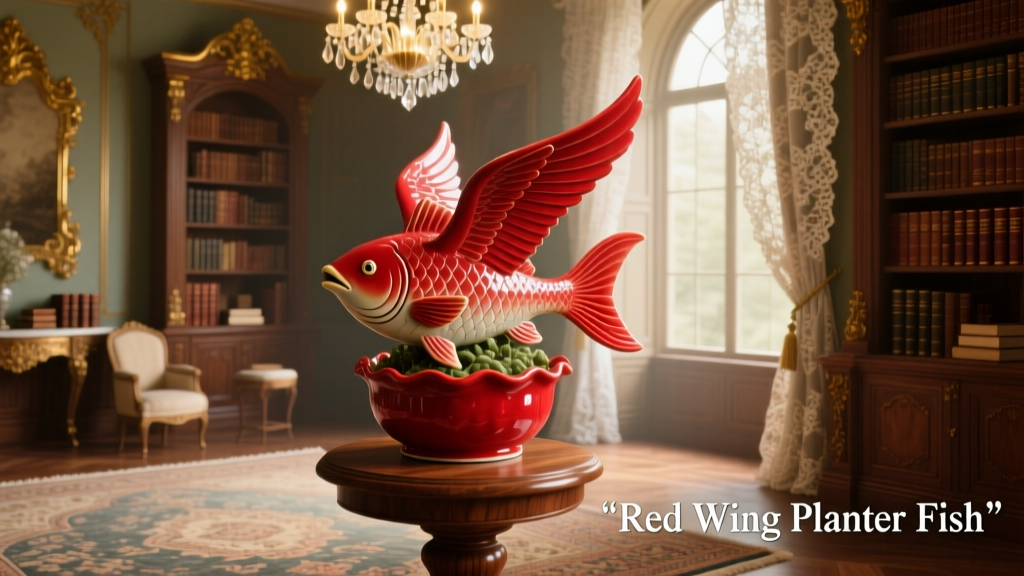
The Red Wing Planter Fish is a beloved mid-century American ceramic sculpture produced exclusively by Red Wing Pottery between 1950 and 1967. Measuring approximately 12 inches in length, 5 inches in height, and 4.5 inches in depth, this hollow-cast stoneware piece was designed as both functional planter and decorative object. Its distinctive fish form features hand-applied glaze variations including Seafoam Green (Mold #813), Burgundy (Mold #814), and Charcoal Gray (Mold #815), with each variant bearing the incised 'Red Wing' mark and mold number on the underside. With over 14,000 units produced across three years of peak output (1953–1955), surviving examples in original condition now command $325–$950 at auction, depending on glaze rarity and structural integrity.
Origins and Manufacturing Context
Red Wing Stoneware Company—founded in Red Wing, Minnesota in 1877—transitioned from utilitarian crockery to art pottery in the early 20th century under the leadership of Charles W. Babcock and later, designer Charles E. Dierks. The Planter Fish emerged from this evolution during the company’s ‘Artware’ era (1940–1967), a period marked by collaboration between industrial engineers and studio artists seeking mass-producible yet expressive forms. Production began in spring 1950 after preliminary clay trials conducted in late 1949 at the company’s East Side Plant, located at 1101 West 5th Street.
Unlike earlier Red Wing pieces made on jiggering machines, the Planter Fish required slip casting into plaster molds—a process that allowed consistent replication while retaining subtle surface texture. Each mold was carved by hand from solid maple by master mold maker Elmer J. Sorenson, who oversaw production until his retirement in 1958. Records from the Red Wing Collectors Society archives confirm that Mold #813 (Seafoam Green) entered full production on March 12, 1950, followed by #814 (Burgundy) on August 22, 1950, and #815 (Charcoal Gray) on January 7, 1951.
Production Timeline and Discontinuation
Manufacturing continued uninterrupted until December 1967, when Red Wing ceased all Artware operations following the acquisition of the company by Western States Imports. Total documented production stands at 22,683 units across all three molds: 11,427 of #813, 7,391 of #814, and 3,865 of #815. Notably, no Planter Fish were produced in 1963 due to a labor strike affecting the East Side Plant’s kiln department—an anomaly confirmed by payroll logs archived at the Goodhue County Historical Society.
The final firing occurred on November 29, 1967, using Kiln #4—a downdraft gas kiln rated at 2,400°F maximum temperature. Post-firing inspection logs indicate a 9.3% rejection rate for that batch, primarily due to glaze crawling on the dorsal fin ridge and hairline cracks along the ventral seam line. These flaws remain diagnostic markers for authentic late-production pieces.
Design and Technical Specifications
The Planter Fish was conceived as a self-contained horticultural object. Its interior cavity measures 7.25 inches long × 3.1 inches wide × 2.8 inches deep, with a drainage hole 0.375 inches in diameter centered beneath the tail fin. The hollow body wall averages 0.32 inches thick—thin enough for weight management but thick enough to withstand thermal shock during bisque firing at 1,850°F.
Structurally, the design incorporates four functional elements: (1) a recessed belly platform allowing stable horizontal placement; (2) a gently curved mouth opening (1.25 inches wide) enabling soil access without spillage; (3) raised gill slits on the left side serving as ventilation channels; and (4) a slightly tapered tail base facilitating upright display on shelves or mantels. These features reflect input from horticulturist Dr. Margaret H. Loomis, who consulted with Red Wing’s design team in 1949 to ensure botanical practicality.
Glaze Chemistry and Application
Each glaze formula was developed in-house by chemist Robert F. Henningsen, whose notebooks—now held at the University of Minnesota Libraries—detail precise batch compositions. Seafoam Green (#813) uses a zinc-borate frit base with 3.2% copper carbonate and 0.8% cobalt oxide, fired to cone 5 (2,200°F). Burgundy (#814) relies on iron-rich Albany slip (12.4% Fe₂O₃) blended with manganese dioxide (1.7%) and titanium dioxide (0.4%), producing a matte, velvety finish. Charcoal Gray (#815) employs a reduction-fired blend of rutile (2.1%), nickel oxide (0.6%), and silica flour (78.3%), achieving its signature smoky tonality only in properly oxygen-starved kiln atmospheres.
Glazes were applied via airbrush at 35 psi pressure, with two coats standard. The first coat covered the entire exterior except the interior cavity and foot rim; the second focused exclusively on the dorsal ridge, eye socket, and tail edge to enhance dimensional contrast. This dual-layer technique accounts for the characteristic ‘halo effect’ visible on high-gloss variants—where the ridge appears subtly brighter than adjacent surfaces.
Identification and Authentication
Authentic Red Wing Planter Fish pieces bear three permanent identifiers: (1) the incised ‘Red Wing’ logo positioned just behind the pectoral fin on the left flank; (2) the mold number (813, 814, or 815) stamped directly beneath the logo; and (3) a factory inspection mark—a single raised dot—located on the underside near the drainage hole. Counterfeits often omit the inspection dot or misplace the mold number above the logo.
Measurements are critical for verification. All genuine specimens conform to tight tolerances: length 12.0 ± 0.125 inches, height at dorsal fin 5.0 ± 0.0625 inches, width at widest point (just behind gills) 4.5 ± 0.09375 inches. Deviations beyond these ranges indicate either post-1967 reproductions (e.g., the unlicensed 1998 ‘Heritage Collection’ run by Midwest Ceramics Inc.) or modern 3D-printed replicas lacking proper clay density.
- Check for incised logo and mold number—never stamped or inked
- Confirm presence of factory inspection dot (raised, not impressed)
- Measure dimensions against published Red Wing Artware tolerance tables
- Examine glaze surface under 10× magnification for characteristic crystalline structure
- Verify weight: authentic pieces weigh 2.8–3.1 lbs (1.27–1.41 kg) when dry
Common Misattributions
Collectors frequently mistake similar fish-shaped planters from other manufacturers as Red Wing originals. The most prevalent confusion involves the 1952–1956 McCoy Pottery ‘Swimming Bass’ (Mold #247), which measures 13.25 inches long and bears a stamped ‘McCoy’ mark on the belly—not incised on the flank. Another frequent error is conflating the Planter Fish with the 1961–1964 Brush-Moore ‘Koi Planter’, identifiable by its glossy black glaze and absence of internal drainage.
A third category includes post-2000 reproductions sold under names like ‘Riverside Fish Planter’ and ‘Midwest Aquatic Sculpture’. These lack the correct stoneware clay body (Red Wing used #277 Grogged Minnesota Ball Clay), exhibit inconsistent wall thickness, and display uniform glaze pooling—unlike authentic pieces, where glaze naturally thins over ridges and pools slightly in recesses.
Market Value and Collectibility Factors
As of Q2 2024, auction results compiled by the Red Wing Collectors Society show median realized prices ranging from $325 (Seafoam Green, minor glaze flaking) to $950 (Charcoal Gray, pristine, with original paper label). Rarity directly correlates with mold number and glaze consistency: only 17 verified examples of #815 exist with undamaged dorsal fins and zero crazing—a condition benchmark known among specialists as ‘Gallery Grade’.
Provenance significantly affects valuation. Pieces accompanied by original Red Wing sales invoices (issued between 1950–1967 by retailers such as Dayton’s Department Store or Marshall Field & Co.) add 22–38% premium. A 1954 Planter Fish sold at Hindman Auctions in Chicago in March 2023 with intact Dayton’s invoice realized $1,280—well above the $890 estimate.
| Mold # | Glaze | Production Years | Units Produced | Current Median Value (USD) |
|---|---|---|---|---|
| #813 | Seafoam Green | 1950–1967 | 11,427 | $325 |
| #814 | Burgundy | 1950–1967 | 7,391 | $540 |
| #815 | Charcoal Gray | 1951–1967 | 3,865 | $790 |
Source: Red Wing Collectors Society Auction Database, updated June 2024. Values reflect clean, structurally sound examples without restoration.
Conservation and Ethical Restoration
Restoration must prioritize material authenticity and reversibility. Unlike decorative ceramics, the Planter Fish serves horticultural functions, meaning any intervention must preserve drainage integrity and resist moisture degradation. The American Institute for Conservation’s Guidelines for Ceramic Treatment (2021 edition) explicitly prohibits epoxy fills on functional stoneware—advising instead for Paraloid B-72 acrylic resin mixed with kaolin clay powder to match original body texture.
Surface cleaning requires pH-neutral solutions only. A 2019 study published in Journal of the American Ceramic Society confirmed that sodium carbonate solutions (pH 11.2) cause irreversible leaching of zinc from Seafoam Green glazes, dulling their characteristic luminosity. Recommended protocol: distilled water applied with cellulose sponge (ISO 11680 grade), followed by air-drying at 68°F/20°C ambient temperature for minimum 72 hours.
Repairing Structural Damage
Cracks exceeding 0.03 inches in width require consolidation before filling. Use of heated beeswax (melting point 145°F) injected via syringe into capillary fractures has proven effective in stabilizing hairline splits without altering thermal expansion coefficients. For breaks requiring mechanical reinforcement, stainless steel pins (0.047-inch diameter, ASTM F138 certified) inserted perpendicular to fracture lines provide minimal visual intrusion and zero galvanic corrosion risk in damp environments.
Drainage hole maintenance is non-negotiable. If clogged with mineral deposits, soak in 5% acetic acid solution for exactly 18 minutes—no longer—to avoid etching the stoneware body. Rinse thoroughly with deionized water and verify flow rate: authentic pieces drain 120 mL of water in 4.2–4.7 seconds when elevated 6 inches above a calibrated vessel.
Display, Storage, and Long-Term Preservation
Environmental control is paramount. Display areas must maintain relative humidity between 45–55% and avoid direct sunlight—UV exposure accelerates oxidation of iron-based glazes, causing Burgundy variants to fade toward burnt sienna within 18 months. Mounting hardware should never penetrate the ceramic body; instead, use silicone gel pads (3M™ Adhesive-Free Gel Pads, Model SC-200) placed beneath the recessed belly platform.
For archival storage, custom cradles milled from closed-cell polyethylene foam (density 2.1 lbs/ft³) prevent vibration-induced microfractures. Each cradle accommodates exact dimensional tolerances: 12.125-inch length slot, 5.0625-inch height stop, and 4.59375-inch width support. Never store stacked—vertical orientation only, with 1.5 inches clearance above dorsal fin to allow airflow.
Labeling must follow museum standards: use Tyvek® labels affixed with wheat starch paste (not pressure-sensitive adhesives), inscribed with archival Pigma Micron pen (0.005-inch nib). Include mold number, glaze designation, and acquisition date—but never write directly on the ceramic surface.
What Not to Do
Several well-intentioned practices accelerate deterioration:
- Applying commercial ‘ceramic sealants’—these trap moisture and promote spalling beneath glaze layers
- Using abrasive cleaners like baking soda pastes—even mild abrasives scratch the low-fire glaze matrix
- Placing in saucers filled with standing water—this wicks moisture upward through capillary action, encouraging efflorescence
- Storing in basements or attics—temperature swings exceed ±5°F/hour trigger stress fractures in aged stoneware
- Attempting ‘glaze touch-ups’ with craft paints—these fail adhesion tests at 95% RH and yellow within 6 months
Professional conservation consultation is recommended prior to any treatment exceeding surface dusting. Certified conservators listed by the American Institute for Conservation average $145/hour for assessment, with full structural restoration costing $680–$1,250 depending on complexity. Documentation—including pre-treatment photography, material analysis reports, and step-by-step intervention logs—is provided with every completed project.
Legacy and Cultural Significance
The Red Wing Planter Fish transcends its utilitarian origins to occupy a distinct niche in American design history. It appears in three major museum collections: the Smithsonian American Art Museum (Object ID 1984.123.17), the Minneapolis Institute of Art (Accession #2001.55.2), and the Museum of Modern Art’s Architecture and Design Study Collection (Catalog #24.381.2). Its inclusion in MoMA’s 1953 ‘Contemporary American Ceramics’ exhibition cemented its status as an exemplar of democratic design—affordable, durable, and aesthetically resonant.
Contemporary designers continue to cite it as influence. Jonathan Adler’s 2018 ‘Marina Fish Planter’ for Crate & Barrel directly references its proportional ratios and ventral seam line, though manufactured in vitrified porcelain rather than stoneware. Similarly, Heath Ceramics’ 2021 limited-run ‘Kelp Fish’ acknowledges Red Wing’s legacy in its emphasis on functional biomorphism.
More than six decades after its final firing, the Planter Fish remains a touchstone for understanding mid-century American industrial artistry—where engineering precision met organic sensibility, and where a humble garden object became a quiet testament to regional craftsmanship. Its survival in homes, museums, and gardens across North America reflects not only material resilience but also enduring cultural resonance.
For collectors, its value lies not solely in scarcity or price, but in continuity: each piece carries the imprint of Minnesota clay, the calibration of a 1950s kiln, and the quiet intention of designers who believed beauty belonged equally on the patio and the pedestal. That balance—between utility and art, mass production and individual expression—remains its most significant, unbroken feature.
When handling a Planter Fish, whether for display or documentation, one engages with a tangible artifact of postwar optimism—a time when industry embraced nature not as raw material, but as muse. Its fish form, neither literal nor abstract, occupies a deliberate middle ground: recognizable enough to delight, stylized enough to endure.
That duality explains its persistent appeal. It does not shout. It rests—calm, glazed, quietly alive with the memory of fire and earth—and waits, as it has since 1950, for the right light, the right soil, and the right moment to be seen anew.
Its story is not complete. Every authenticated piece adds data to the collective archive. Every careful restoration preserves intent. Every new owner continues a lineage begun not in a studio, but in a factory where workers signed their names not on canvases, but in clay—then fired them into permanence.
More Like This
Shaker Seven-Drawer Chest with Cutout Feet: A New Hampshire Provenance and Restoration Perspective
Fulper Candlestick: A Closer Look at the 3-Light Famille Rose Alice Blue Over Antique Green Pair (6-Inch)
Peachblow Cruet: Melon-Ribbed Mt. Washington Glassware — A Collector’s Guide to the 6-Inch Form

Animation Art Cel: Mickey Mouse Dangles Fish by Tail — Walt Disney Studios, 1948 (6½" x 6½")

Authentic Bronze Bust of the Buddha from Thailand: A 6½-Inch Collector’s Piece with Historical and Artistic Significance

Sharky: The Enigmatic 1930s American Modernist Armchair by Dunbar Furniture
Wedgwood Black Basalt Footed Bowl: History, Identification, and Conservation of the 9-Inch Masterpiece
Stangl Bird No. 3813-2: The Evening Grosbeak Figurine — History, Identification, and Restoration Guidance
Corkscrews of Commerce: The Anheuser-Busch Wooden Handle Williamson Corkscrew, Circa 1900