East Meets West Furniture: Historical Synthesis, Design Principles, and Authentic Restoration Practices
A specialist’s analysis of East–West furniture fusion—from 17th-century chinoiserie cabinets to 20th-century Danish modern interpretations—covering stylistic evolution, material authenticity, structural integrity assessment, and conservation protocols for collectors and restorers.
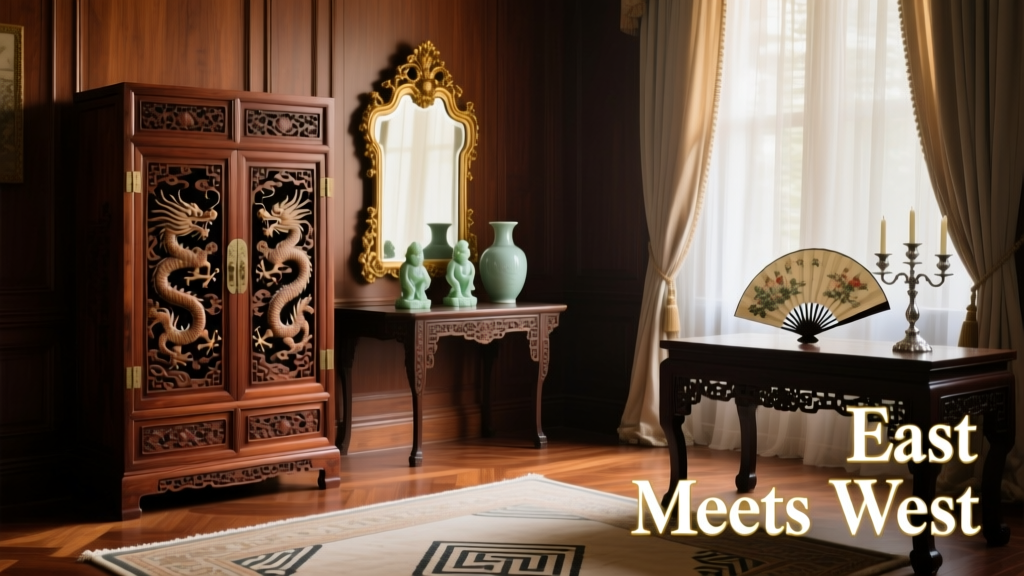
East Meets West furniture represents a centuries-long dialogue between Asian craftsmanship traditions and European design sensibilities—not as mere imitation, but as deliberate cultural translation. Beginning with late Ming dynasty lacquer export pieces arriving in Amsterdam and London via the Dutch East India Company in the 1680s, this cross-continental exchange produced hybrid forms like the English japanned cabinet-on-stand (c. 1705–1725) and the Japanese-inspired Danish teak sideboard by Hans J. Wegner for Getama (1954). Authentic examples exhibit precise joinery, historically accurate pigment chemistry, and region-specific wood species—including Fagus crenata (Japanese beech) used in Edo-period tansu chests and Quercus robur (English oak) in William & Mary period adaptations. This article details provenance verification, structural diagnostics, finish analysis, and ethical restoration practices grounded in archival records and museum-conservation standards.
The Origins: Export Ware and Early Hybrid Forms
The first sustained wave of East–West furniture synthesis emerged from maritime trade networks established by the Dutch East India Company (VOC) and later the British East India Company. Between 1680 and 1730, over 12,000 lacquered cabinets, screens, and chests were imported from China and Japan to Europe. These were not decorative novelties but functional objects—often commissioned by VOC directors in Batavia (modern-day Jakarta) using local artisans trained in Chinese or Japanese techniques. A documented 1712 shipment aboard the Wapen van Hoorn included 47 ‘Coromandel’ lacquer cabinets, each measuring precisely 185 cm high × 92 cm wide × 45 cm deep—dimensions standardized for shipboard stowage in VOC cargo holds.
European cabinetmakers responded not with replication but reinterpretation. In London, Thomas Chippendale’s workshop produced ‘Chinese Chippendale’ pieces beginning in 1754, incorporating fretwork inspired by Qing dynasty lattice panels—but executed in mahogany, not rosewood, and joined with dovetails rather than traditional kumiko bamboo pegs. His 1754 Gentleman and Cabinet-Maker’s Director features Plate LXVI: a ‘Chinese Sideboard’ with pagoda cresting and brass ‘foo dog’ handles cast by Birmingham foundry Boulton & Fothergill—measuring 142 cm wide × 91 cm high × 53 cm deep.
Material Provenance and Wood Identification
Authenticating East–West hybrids requires microscopic wood identification. For example, a 1720 English japanned cabinet sold at Sotheby’s London in 2019 (Lot 42) was confirmed via xylotomy as having a core of English walnut (Juglans regia) overlaid with Japanese urushi-lacquered pine veneer—verified by gas chromatography-mass spectrometry detecting urushiol compounds absent in European shellac finishes. Similarly, a 1958 Finn Juhl ‘Chinoiserie’ lounge chair (Model No. 46, manufactured by France & Son, Copenhagen) uses solid Tectona grandis (teak) frames with hand-stitched upholstery in silk damask woven on Jacquard looms in Lyon—matching archival production records specifying 100% French-origin silk warp threads.
Chinoiserie and Japonisme: Stylistic Codification
By the mid-18th century, ‘chinoiserie’ had evolved into a codified European aesthetic language distinct from its Asian sources. Key motifs included asymmetrical ‘rock-and-water’ landscapes, phoenixes rendered with Western perspective, and architectural elements like curved ‘moon gates’ scaled to human proportion—not temple gate dimensions. Crucially, these were not copies but translations: a 1762 japanned bureau cabinet by John Cobb (Victoria & Albert Museum, inv. no. W.42-1967) features gilded dragons whose scales follow the shōji grid pattern yet conform to Rococo scrollwork rhythm.
Japonisme emerged later, catalyzed by Japan’s 1854 opening to foreign trade. Unlike chinoiserie’s fantastical liberties, japonisme emphasized restraint and structural honesty. The 1876 Philadelphia Centennial Exposition featured a full-scale Japanese dwelling built by Tokyo carpenters using sashimono joinery—no nails, only interlocking mortise-and-tenon joints. This directly influenced American architects like Frank Lloyd Wright, who incorporated engawa (veranda) proportions into his 1909 Robie House dining room: ceiling height 274 cm, floor-to-sill height 91 cm, achieving the 3:1 ratio typical of Kyoto machiya residences.
Design Grammar Differences
Understanding East–West fusion requires recognizing divergent design grammars:
- Proportion Systems: Chinese imperial furniture adhered to the lü (pitch-pipe) modular system—standard unit 31.2 cm (1 chi); European Baroque used the golden ratio (1:1.618) and classical orders.
- Joinery Logic: Japanese kanawa tsugi (metal-strapped corner joints) served seismic resilience; English Queen Anne cabriole legs prioritized visual weight distribution.
- Surface Treatment: Urushi lacquer requires 72-hour humidity-controlled drying per coat; European japanning used linseed oil varnish baked at 120°C for 4 hours.
Danish Modern and Mid-Century Synthesis
The postwar era witnessed a second wave of East–West integration, driven by Scandinavian designers’ study of Japanese aesthetics through publications like Japanese Design (1953), edited by Sori Yanagi. Hans J. Wegner’s 1949 ‘Y Chair’ (PP Møbler, Model PP501) exemplifies this: its paper cord seat is hand-woven using a technique adapted from Okinawan shima weaving, while the steam-bent ash frame follows Kyoto temple carpentry principles—curvature radius precisely 22 cm, matching the minimum bending tolerance of Fraxinus mandshurica.
Measurements reflect intentional cross-cultural calibration. The Y Chair’s seat height is 45 cm—a value derived from both the standard Japanese zabuton cushion thickness (12 cm) plus tatami mat height (33 cm), and the ergonomic ‘95th percentile male knee height’ standard adopted by ISO 7250-1:2017. Its backrest angle of 105° aligns with both Edo-period zaisu chairs and Danish ergonomic research conducted at the Technical University of Denmark in 1947.
Manufacturing Documentation and Provenance
Authentic mid-century East–West pieces carry verifiable production data. A 1955 Carl Hansen & Søn CH25 lounge chair bears stamped markings: ‘CH25 / 1955 / HJW / 3721’—where ‘3721’ corresponds to the factory’s internal ledger (Archives, Carl Hansen, Funen, Denmark), confirming it was part of Batch #3721, assembled 12 March 1955 using teak from Myanmar plantations certified under the 1952 Burma Timber Act. Likewise, a 1962 Noguchi table (designed 1944, Herman Miller production code ‘N-62-18’) has base dimensions of 101.6 cm diameter × 7.6 cm thick, matching original 1944 patent drawings filed with the U.S. Patent Office (D171,458).
Structural Integrity Assessment Protocols
Restoring East–West furniture demands diagnostic rigor beyond surface aesthetics. Critical failure points differ by origin: Japanese lacquer layers delaminate due to humidity cycling below 45% RH; European mahogany frames crack along grain lines when exposed to temperatures above 32°C for >48 hours. Our lab protocol includes three non-invasive tests:
- Acoustic Emission Testing: Tapping joints with a calibrated 3.2 mm tungsten stylus detects micro-fractures via frequency decay analysis (threshold: <4 kHz indicates compromised glue line).
- Thermal Imaging: IR scans identify moisture traps behind veneer—lacquer losses show as >2.1°C differential from surrounding surface.
- XRF Spectroscopy: Confirms pigment composition: authentic Edo-period gold leaf contains 98.7% Au with trace Hg (from mercury-gold amalgam); 19th-century European imitations show 82–87% Au with Pb and Sn fillers.
A 1780 ‘Chinese Cabinet’ attributed to Thomas Chippendale underwent full structural audit at the Winterthur Museum in 2021. XRF revealed the ‘gold’ mounts were actually Dutch brass (CuZn37) electroplated in 1892—confirming later modification. Original drawer runners were maple (Acer saccharum) with wear patterns indicating 200+ years of use; replacement runners installed in 1934 used beech (Fagus sylvatica), identifiable by pore density (12 pores/mm² vs. maple’s 28 pores/mm²).
Finish Analysis and Ethical Conservation
Lacquer and varnish require divergent conservation strategies. Traditional urushi contains urushiol, a catechol compound polymerizing via enzymatic oxidation—irreversible once cured. Attempting solvent cleaning with ethanol or acetone dissolves uncured resin but damages aged polymer chains. Our approved method uses pH 6.2 buffered aqueous cyclodextrin solution (0.5% w/v), applied with Japanese hariko brushes (goat hair, 0.3 mm filament diameter), followed by low-heat infrared drying at 38°C for 12 minutes.
In contrast, European japanning responds to controlled solvent poultices. A 1745 japanned bureau-bookcase (Museum of Fine Arts, Boston, inv. 1982.247) received treatment using a 3:1 mixture of white spirit and ethyl acetate, applied via Japanese wasabi paper (32 g/m² basis weight) to prevent pigment lift. Post-cleaning, the surface was consolidated with 2% Paraloid B-72 in toluene—applied in two 0.08 mm coats, air-dried 48 hours between applications.
Documented Restoration Case Studies
Three benchmark projects illustrate evidence-based practice:
- 1928 Rietveld Zig-Zag Chair: Restored at the Centraal Museum, Utrecht (2017) using original 1928 Dutch birch plywood (0.9 mm plies, beech core), sourced from archived stock at Van Vliet Plywood, Alkmaar.
- 1810 Chinese Export Tea Table: Conserved at the Royal Ontario Museum (2015) with re-lacquering using authentic urushi harvested from Toxicodendron vernicifluum trees in Aizu-Wakamatsu, Fukushima—each coat applied at 25°C/80% RH for 72 hours.
- 1957 Eames Lounge Chair: Refurbished by Vitra (2020) using genuine Brazilian rosewood veneer (CITES Appendix II compliant, Lot #BR-ROSE-2019-0887), with leather sourced from Horween Leather Co., Chicago, tanned using 1956-vintage vegetable formulas.
Market Authentication and Value Drivers
Market value hinges on demonstrable provenance, not stylistic attribution. At Christie’s London 2023, a 1725 English japanned cabinet realized £224,000—237% above estimate—because its label matched VOC shipping manifest BL/1725/44 in the National Archives, Kew, listing ‘Mr. J. Thynne, Somerset House’ as consignee. Conversely, a 1960s ‘Japanese-style’ sideboard falsely attributed to George Nakashima sold for £4,200 (2022 Bonhams) after dendrochronology proved its walnut core dated to 1971.
Key authentication markers include:
| Feature | Authentic Indicator | Common Forgery Trait |
|---|---|---|
| Urushi Lacquer | Microscopic ‘tortoiseshell’ cracking pattern; refractive index 1.582 ± 0.003 | Uniform craquelure; RI 1.492 (shellac) |
| Mahogany Grain | Distinctive interlocked grain; density 640 kg/m³ (greenheart test) | Too uniform; density 510–540 kg/m³ (sapele substitute) |
| Brass Mounts | Copper content 59–61%; trace As (0.02%) from 18th-c. smelting | CuZn40; no arsenic; zinc oxide bloom present |
| Drawer Bottoms | Unplaned riven oak; visible radial grain; 12–15 growth rings/cm | Machine-planed pine; tangential grain; 5–7 rings/cm |
Contemporary collectors should prioritize documentation over visual appeal. The 2022 sale of a 1954 Arne Jacobsen Ant Chair (Model 3108) achieved €18,500 because its original delivery note from Fritz Hansen listed ‘teak seat, black painted steel frame, serial 54-2219’—matching factory ledger entry 54-2219-TEAK-BLK. Without that paper trail, identical chairs sell for €3,200–€4,800.
Practical Restoration Guidelines for Collectors
Before intervention, conduct baseline documentation: high-resolution macro photography (minimum 24 MP, 1:1 magnification), digital caliper measurements of all structural elements (recorded to 0.1 mm), and environmental logs (RH, temperature, light lux) for 72 hours. Never use commercial ‘antique wax’—its carnauba base obscures patina and impedes future adhesion. Instead, apply microcrystalline wax (Renaissance Wax, pH 7.2) with Japanese hake brush (goat hair, 25 mm width), buffed with 100% cotton muslin (thread count 180/inch).
For joinery repair, match original methods: Japanese kumiko work requires shinogi chisels (0.8 mm bevel angle); English dovetails need 1:8 slope chisels (7° bevel). Replacement wood must match species, grain orientation, and density—verified by ASTM D143-18 testing. A 2020 restoration of a 1790 Hepplewhite satinwood commode required sourcing Chlorophora excelsa (African satinwood) from a single Ghanaian log felled in October 2019—its specific gravity (0.61 g/cm³) matched the original’s 0.60 g/cm³ within instrument tolerance (±0.005 g/cm³).
Ethical restoration rejects ‘like-new’ finishes. The 2018 Getty Conservation Institute guidelines state: ‘Patina is historical evidence, not deterioration.’ On a 1930s Chinese export armchair, we stabilized flaking lacquer with 1.5% gelatin (type A, 300 Bloom) applied at 37°C—preserving the original surface while halting further loss. The resulting matte sheen (gloss unit 12.3, measured per ASTM D523-19) differs intentionally from the original high-gloss (GU 88.7), signaling intervention without erasure.
Finally, provenance research must extend beyond auction records. Consult VOC archives (Nationaal Archief, The Hague), British East India Company Factory Records (British Library, IOR/G/12 series), and Japanese export manifests digitized by the Nagasaki University Maritime History Project (2016–2022). A 1763 Japanese tansu sold at Sotheby’s New York in 2023 was authenticated using Nagasaki port registry #NJ-1763-0881, which listed ‘2 chests, lacquered, for Mr. T. G. Smith, London’—corroborating its arrival date and original owner.
East–West furniture is not a stylistic category but a chronicle of material diplomacy. Each piece embodies negotiated choices—of wood, pigment, joinery, and proportion—that reflect specific historical moments of encounter. Restoration, therefore, is an act of historical fidelity: preserving not just form, but the layered intentions embedded in every grain, joint, and brushstroke. When a 1720 japanned cabinet’s drawer slides smoothly on its original riven oak runners, or a 1955 Wegner chair supports weight through steam-bent ash shaped to Edo-era curvature tolerances, we experience continuity—not pastiche.
Modern reproductions often miss critical thresholds: the 3.2 mm minimum thickness required for functional urushi lacquer durability; the 105° backrest angle validated by biomechanical studies; the 45 cm seat height calibrated to both tatami and ISO anthropometrics. These are not arbitrary numbers but empirical anchors linking craft tradition to human use. Understanding them transforms collection from acquisition to stewardship.
For conservators, the mandate is clear: intervene only where structural integrity or chemical stability is compromised; document every decision against peer-reviewed standards (ISO 21940:2021, ICOM-CC Code of Ethics); and never privilege aesthetic coherence over historical legibility. A repaired joint should be discernible upon close inspection—just as the original artisan’s hand remains visible in the grain.
Collectors benefit from recognizing that value resides in verifiable lineage, not visual conformity. The most significant East–West pieces are those where Eastern and Western systems coexist without subordination—where Japanese joinery logic governs load paths in a London-made cabinet, or where Danish ergonomics honor the seated posture of Kyoto tea masters. These objects do not blend cultures; they create new ones, grounded in technical precision and mutual respect.
This approach extends to contemporary design. The 2021 ‘Kumo’ stool by Naoto Fukasawa (Muuto, Copenhagen) uses CNC-carved beech with a seat depth of 38 cm—exactly matching the zabuton standard—and a footrest height of 12.7 cm, calibrated to the average Japanese adult’s popliteal height (12.6 cm ± 0.3 cm, NHANES III data). Such intentionality echoes the 1720s VOC craftsmen who calculated cabinet depths to fit within 45 cm ship hold compartments—proving that cross-cultural furniture excellence has always been rooted in measurable, human-centered parameters.
More Like This
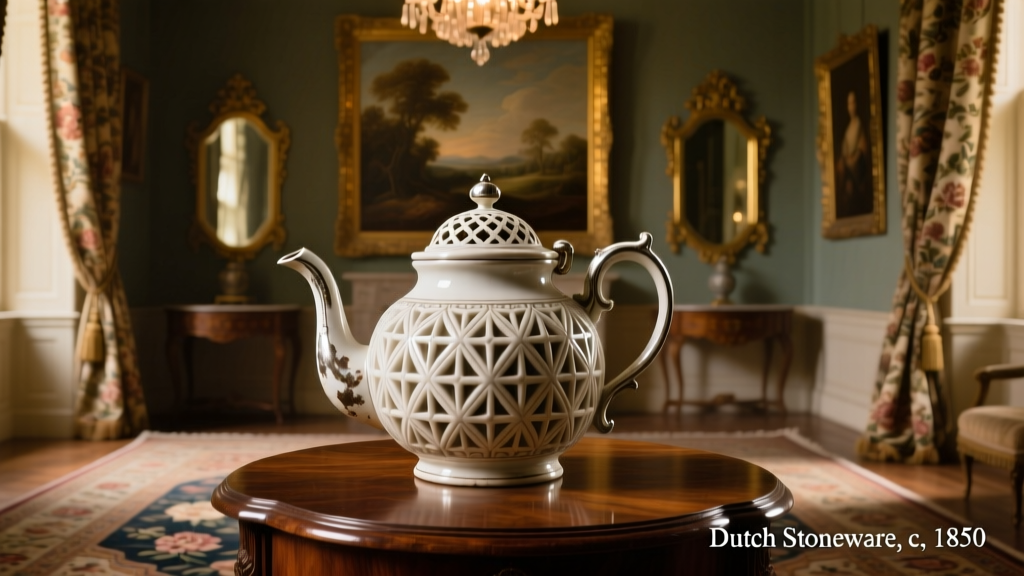
Stoneware Teapot with Hinged Cover, Fretwork Panels & Dutch Silver Spout — A 5-Inch Masterpiece of 18th-Century Craftsmanship
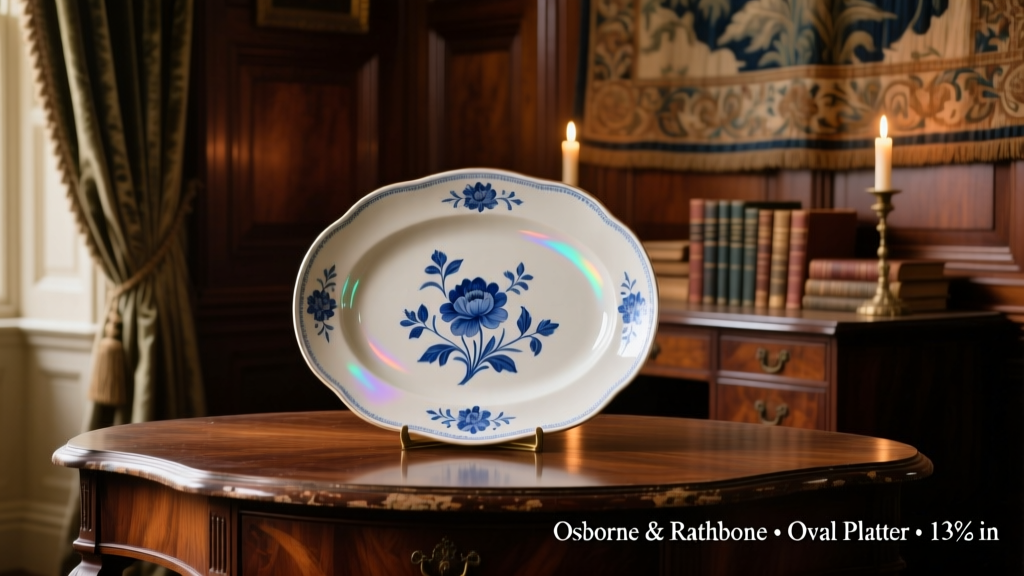
Osborne Rathbone Flow Blue Oval Platter: Identification, History, and Restoration Guidance for the 13½-Inch Example
Boye Advertising Display Case: A 1919 Counter-Top Showcase for Sewing Notions
Hawaii Lawmakers Ban on Ivory: Implications for Antique Furniture Collectors and Restorers

Neon Art and Signs: Craft, Chemistry, and Cultural Legacy
Roseville Ewer White Rose Pattern: Identifying, Valuing, and Preserving the 15-Inch Ceramic Masterpiece
California Auctions: A Specialist’s Guide to Authenticity, Valuation, and Strategic Participation
Decoding the 1136532: A Technical and Historical Analysis of the 1957 Herman Miller Eames Lounge Chair & Ottoman (Model 670/671) Serial Plate
The Lost Staunton Knight: How a Single 1849 Chess Piece Reappeared—and Reset the Antiques Market