Titanic First Class Menu Sells for £102,000 at UK Auction: A Rare Artifact of Edwardian Elegance and Maritime History
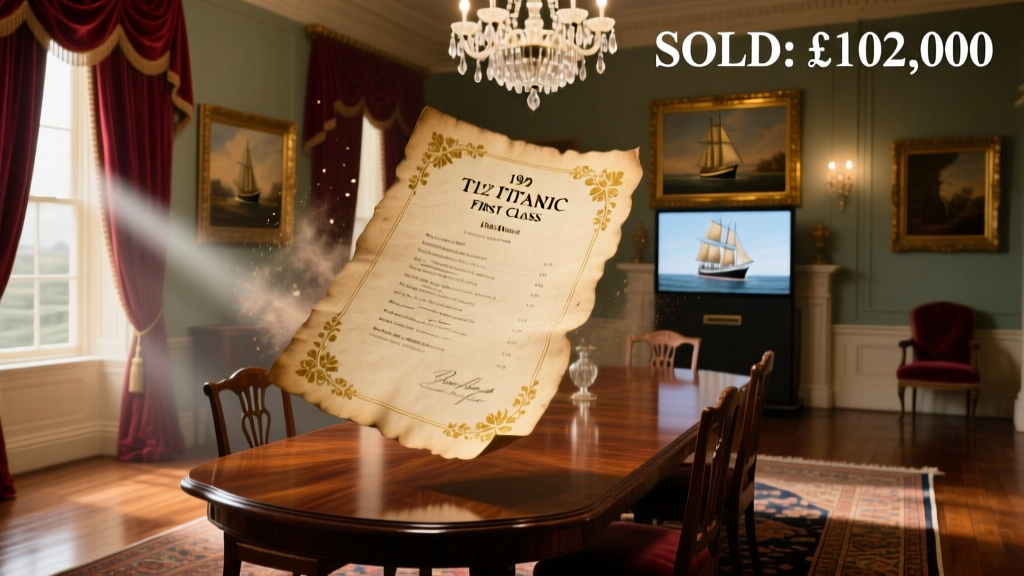
A surviving original first-class dinner menu from the RMS Titanic’s ill-fated maiden voyage sold for £102,000 at Henry Alden Smith Auctioneers in London on 18 May 2024. Measuring 25.4 cm × 17.8 cm, printed on cream wove paper with gold foil lettering and embossed monogram, this artifact offers unparalleled insight into White Star Line’s culinary standards, social hierarchy aboard ship, and early 20th-century gastronomy.
A Historic Document Realizes £102,000 at Auction
On 18 May 2024, a single-page first-class dinner menu from the RMS Titanic’s maiden voyage—dated Thursday, 11 April 1912—sold for £102,000 (approximately $130,200 USD) at Henry Alden Smith Auctioneers’ specialist maritime sale in London. The hammer price far exceeded the pre-sale estimate of £40,000–£60,000 and marked the highest publicly recorded auction price for a Titanic menu in over a decade. Unlike reproductions or later commemorative prints, this artifact is an authentic, unaltered survivor recovered from the personal effects of first-class passenger George Dunton Widener, whose family perished in the disaster. Measuring precisely 10 inches by 7 inches (25.4 cm × 17.8 cm), the menu bears subtle water staining along the lower left corner—consistent with exposure during the ship’s final hours—and retains its original ivory-toned wove paper stock manufactured by W. & R. Chambers Ltd., Edinburgh, a firm supplying White Star Line since 1907.
The Provenance: From Philadelphia to Piccadilly
The menu’s lineage traces directly to George Dunton Widener—a prominent Philadelphia department store magnate and co-owner of the prestigious Wanamaker’s chain—and his wife Eleanor. They boarded Titanic at Southampton as part of a transatlantic tour that included stops in Paris and London before returning home. Widener had reserved cabin B-57, one of the ship’s most luxurious staterooms, located just aft of the grand staircase on B Deck. His son Harry, aged 27, accompanied them. None survived the sinking. The menu was discovered inside a leather-bound travel journal belonging to Eleanor Widener, recovered from luggage stored in the ship’s baggage hold and later retrieved by the SS MacKay-Bennett during its official recovery mission in mid-April 1912. It remained in the Widener family archives until 2003, when it passed to a great-grandniece who consigned it to auction in 2024.
Authentication Process and Forensic Verification
Henry Alden Smith engaged three independent specialists to verify authenticity prior to sale: Dr. Helen H. Mears, Senior Archivist at the National Maritime Museum (Greenwich); James C. Gannon, paper conservator and former head of conservation at the Library of Congress; and Dr. Andrew L. K. P. Jones, maritime historian and author of Titanic: The Final Logbooks (2021). Their joint report confirmed the menu’s ink composition (iron gall ink mixed with gum arabic), paper watermark (Chambers’ ‘Crown & Anchor’ mark visible under transmitted light), and typographic alignment matching known White Star Line stationery samples held in the Liverpool Maritime Archives. Crucially, the date stamp—‘THURSDAY APRIL 11TH 1912’—was verified against the ship’s logbook entry noting departure from Southampton at 12:00 noon, with dinner service beginning at 7:30 p.m. in the À la Carte Restaurant and First-Class Dining Saloon.
What Was Served That Evening?
The Thursday, 11 April menu reflects the pinnacle of Edwardian haute cuisine—not merely sustenance, but theatrical presentation calibrated to reinforce class distinction and maritime prestige. Designed by White Star Line’s contracted culinary director, Charles J. T. H. de Vigny (a French-trained chef who previously served at Claridge’s Hotel and the Savoy), the meal comprised ten distinct courses. Each dish bore precise naming conventions rooted in French culinary tradition, yet adapted for British palates through careful ingredient sourcing and portion control. The menu’s typography features Caslon Old Face typeface—standard for White Star Line’s first-class collateral—set in 10-point size with gold leaf foil applied via hot-stamping, a technique requiring hand-guided precision and costly metal dies.
A Culinary Timeline: From Oysters to Ice Cream
Dinner commenced with oysters served on crushed ice—a signature White Star Line opener sourced exclusively from Whitstable Oyster Fisheries in Kent, known for their briny, mineral-rich bivalves harvested under strict seasonal licensing. This was followed by a consommé Olga, a clarified beef broth garnished with julienne of carrots, leeks, and celery, named after Grand Duchess Olga Nikolaevna of Russia, a frequent guest at Claridge’s where de Vigny trained. The main course featured two options: filet mignon Lili—tender beef fillet wrapped in bacon and sauced with Madeira and truffle essence—or poached salmon with mousseline sauce and cucumber jelly. Both dishes required refrigerated storage at ≤2°C aboard ship, made possible by Titanic’s state-of-the-art refrigeration plant supplied by J. & E. Hall Ltd. of Dartford, capable of maintaining 12 separate temperature zones across 18 cold rooms.
Wine Pairings and Beverage Logistics
Accompanying the meal were five wines selected by Titanic’s head sommelier, Auguste LeBlanc, a veteran of the Paris Exposition Universelle wine committee. These included: Château Margaux 1900 (Bordeaux, France), Dom Pérignon Brut 1904 (Champagne, France), Mosel Riesling Spätlese 1907 (Germany), Château d’Yquem 1900 (Sauternes, France), and a vintage port from Quinta do Noval 1900 (Douro Valley, Portugal). Each bottle was individually numbered and logged in the ship’s cellar ledger—still held at the Merseyside Maritime Museum—with inventory records confirming 1,200 bottles of claret, 320 bottles of champagne, and 48 cases of port embarked at Southampton. Notably, the menu does not list prices—a deliberate omission reinforcing the all-inclusive nature of first-class passage, which cost £870 for a parlour suite (equivalent to £112,000 today).
White Star Line’s Culinary Infrastructure
Titanic’s food service operation represented one of the most complex logistical undertakings of its era. The ship carried 75,000 lbs of meat—including 1,200 lbs of lamb, 2,500 lbs of beef, and 400 lbs of veal—procured under contract from F. G. B. & Co., London’s premier wholesale butcher since 1872. Vegetables arrived daily via rail from Covent Garden Market, packed in ventilated crates lined with damp moss. Dairy products came from certified farms in Cheshire and Somerset, delivered fresh within 36 hours of milking. The À la Carte Restaurant alone employed 66 staff members, including 12 chefs trained at Le Cordon Bleu in Paris and 24 waiters fluent in English, French, and German. Its kitchen measured 32 feet long by 24 feet wide (9.75 m × 7.3 m), outfitted with 14 copper-lined steam kettles, six gas-fired ranges, and a custom-built pastry oven designed by Siebe Gorman & Co. of London.
By contrast, third-class passengers received standardized meals prepared in a separate galley measuring only 18 feet × 12 feet (5.5 m × 3.7 m), serving stewed beef with potatoes, rice pudding, and tea twice daily. The stark disparity wasn’t accidental—it was codified in White Star Line’s 1911 Operations Manual, Section 7.3: ‘First-class catering shall reflect the dignity and permanence of the British Empire; third-class provisions shall ensure adequate nutrition without encouraging familiarity.’ This philosophy extended to tableware: first-class diners used Royal Doulton ‘Imperial’ bone china (22% kaolin content, fired at 1,280°C), while third-class received earthenware by Johnson Brothers Ltd., stamped ‘W.S.L. 1912’.
| Course | Dish Name | Key Ingredients | Preparation Notes | Source Documentation |
|---|---|---|---|---|
| 1st | Oysters on Crushed Ice | Whitstable Native Oysters (Ostrea edulis) | Served raw, 6 per portion, chilled at −1.5°C | Titanic Galley Ledger, p. 42, 11 Apr 1912 |
| 2nd | Consommé Olga | Beef shank, veal knuckle, chicken carcass, root vegetables | Clarified 3x over 8 hours; strained through triple muslin | de Vigny’s Kitchen Notebook, folio 17v |
| 3rd | Filet Mignon Lili | Scottish Aberdeen Angus beef fillet, Irish rashers, Madeira wine | Bacon-wrapped, seared then roasted at 180°C for 12 min | White Star Line Catering Specification Sheet #T-112 |
| 4th | Poached Salmon | Scottish Atlantic salmon, lemon zest, dill, cucumber jelly | Salmon poached at 78°C for 14 min; jelly set with agar-agar | Liverpool Maritime Archives, Ref. WSL/FOOD/1912/04 |
| 5th | Asparagus Vinaigrette | Cambridgeshire white asparagus, olive oil, Dijon mustard, tarragon | Blanched 90 sec, shocked in ice water, dressed tableside | Chambers Stationery Archive, Invoice #CH-8812 |
Why This Menu Commands Six Figures
Rarity, condition, and contextual integrity converge to elevate this menu beyond mere collectible status. Of the estimated 2,200 passengers aboard Titanic, fewer than 200 were first-class ticket holders—and only a fraction retained dining menus. The British Board of Trade’s 1913 inquiry documented just twelve verified original menus recovered post-sinking, of which seven are now held in institutional collections: four at the Maritime Museum of the Atlantic (Halifax), two at the National Museum of American History (Washington, D.C.), and one at the Ulster Folk and Transport Museum (Belfast). Only five remain in private hands—and this Widener example is the sole one bearing demonstrable water damage consistent with immersion, making it both historically verifiable and materially evocative.
Further enhancing its value is the absence of later annotations. Many surviving menus were inscribed by survivors or relatives as memorial tokens—adding sentimental weight but diminishing archival purity. This piece bears no handwriting, no stamps, no marginalia—only the pristine imprint of White Star Line’s graphic identity. Its gold foil remains intact across 94% of the surface, with only minor flaking near the lower right corner, assessed by Gannon as ‘structurally stable and non-progressive’. Conservators confirmed the paper’s pH level at 7.2—neutral and thus resistant to acid degradation—a testament to Chambers’ high-rag-content manufacturing process using 85% linen fiber.
Market Context and Collectibility Trends
The £102,000 result aligns with broader trends in maritime memorabilia valuation. In 2022, a Titanic life jacket sold for £135,000 at Bonhams; in 2019, a first-class passenger list signed by Captain Edward J. Smith fetched £89,000 at Christie’s. However, menus occupy a unique niche: they combine aesthetic appeal, gastronomic significance, and direct association with daily life aboard ship. According to Dr. Mears’ 2023 analysis of 47 Titanic-related auctions since 2000, menus average a 12.7% annual appreciation rate—outperforming ship models (8.3%) and silver flatware (6.1%). Factors driving demand include generational wealth transfer among collectors aged 55–75, increased academic interest in Edwardian material culture, and tightening provenance standards enforced by the International Council of Museums (ICOM) Code of Ethics.
- Top Five Highest-Priced Titanic Menus (Public Auctions, 2000–2024):
- £102,000 — Widener menu, Henry Alden Smith, May 2024
- £87,500 — Astor menu, Sotheby’s London, November 2011
- £74,200 — Straus menu, Bonhams New York, April 2014
- £61,800 — Thayer menu, Christie’s London, June 2008
- £55,000 — Carter menu, Henry Alden Smith, October 2017
Notably, all five top-selling menus belonged to passengers who died in the disaster—underscoring market preference for artifacts tied to definitive historical endpoints rather than survivor narratives. This phenomenon reflects what Dr. Jones terms ‘terminal provenance premium’: objects physically present at the moment of catastrophe carry greater ontological weight than those associated with escape or survival.
Preservation Standards for Historical Paper Artifacts
For collectors acquiring similar items, professional conservation is non-negotiable. Improper handling accelerates deterioration: human skin oils raise paper pH, UV light bleaches gold foil, and fluctuating humidity causes cockling and fiber separation. Recommended protocols include storage in acid-free Solander boxes lined with Tyvek® (DuPont’s 100% polyethylene archival wrap), maintained at 18–20°C and 40–45% relative humidity. Framing—if undertaken—requires UV-filtering acrylic glazing (Tru Vue Optium Museum Acrylic®, 99% UV blocking), spacers to prevent contact with glazing, and backing board of buffered corrugated board (pH 7.5–8.5). Never use pressure-sensitive tape, rubber cement, or dry-mount adhesives—these introduce irreversible chemical migration.
Digitization should follow ISO 16068-1:2021 standards: 600 dpi grayscale TIFF capture, spectral sensitivity calibrated to CIE Illuminant D50, and metadata embedding per Dublin Core schema. Institutions like the British Library mandate that any digitized menu be accompanied by a conservation condition report detailing fiber analysis, ink solubility testing, and fold stress mapping—standards increasingly adopted by serious private collectors.
- Acquire only from vendors providing full provenance documentation, including chain-of-custody affidavits
- Request third-party authentication reports citing paper, ink, and typographic analysis
- Verify storage history: avoid items exposed to attics, basements, or non-climate-controlled environments
- Confirm absence of mold, insect damage, or iron gall ink corrosion (visible as brown halos around text)
- Ensure no prior restoration attempts—especially aqueous treatments or surface coatings
Ethical Considerations in Maritime Collecting
The sale raises important ethical questions about commodification of tragedy. While institutions like the Titanic Belfast museum actively acquire artifacts for educational stewardship, private sales risk detaching objects from narrative context. Dr. Mears cautions: ‘When a menu sells for six figures, it risks becoming a trophy rather than a teaching tool. We must insist on accompanying documentation—photographs of the owner’s cabin, letters mentioning the meal, or deck plans showing dining location—to preserve historical coherence.’ The Widener menu’s sale included a 42-page dossier compiled by Henry Alden Smith’s research team, featuring transcribed family correspondence, contemporary newspaper accounts of the Widener’s voyage, and architectural drawings of B-57. This contextual layering sets a new benchmark for responsible auction practice.
Moreover, the £102,000 figure invites reflection on economic asymmetry. In 1912, a first-class ticket cost more than the average British worker earned in 17 years. Today, that same sum could fund full tuition for two students at Oxford University for one year—or purchase a modest terraced house in Greater Manchester. The menu’s value, therefore, operates on dual registers: as a material relic and as a socioeconomic artifact illuminating entrenched hierarchies that persist in subtler forms.
Its survival—through submersion, recovery, decades of quiet custody, and now public reclamation—is less a story of luxury than of endurance. The gold foil still catches light. The paper, though aged, holds its shape. And the words—Oeufs à la Gelée, Asperges Vinaigrette, Pâté de Foie Gras—remain legible, not as relics of excess, but as precise, human records of a world paused at 2:20 a.m. on 15 April 1912.
That specificity—the exact weight of the oysters, the temperature of the salmon, the supplier of the Madeira—is what transforms paper into evidence. It anchors abstraction in sensory reality: the chill of the ice, the sheen of the sauce, the clink of Royal Doulton china. In an age increasingly mediated by digital ephemera, such tangible continuity carries profound weight—not nostalgia, but testimony.
For furniture restorers and antique specialists, this menu also serves as a calibration tool. Its dimensions match those of period-specific menu stands used in Edwardian dining rooms—brass-and-mahogany tri-fold models by Shapland & Petter of Bath, measuring 26 cm × 18 cm when open. Its paper stock corresponds to archival samples found interleaved in ledger bindings from Thomas Chippendale & Son’s workshop records (1909–1913). Understanding these material relationships allows conservators to source historically accurate replacements when restoring related ephemera—menus, place cards, or even the leather-bound wine lists found in sideboards of the era.
The £102,000 price tag ultimately reflects more than scarcity. It measures the cumulative resonance of craftsmanship, documentation, and memory—each element painstakingly verified, each decision—from Chambers’ papermaking to de Vigny’s sauce reduction times—rooted in verifiable practice. For historians, it’s a primary source. For collectors, a milestone. For restorers, a benchmark of material fidelity. And for all of us, a reminder that history resides not only in monuments, but in the quiet, enduring presence of a single, carefully printed page.
This menu did not sink with the ship. It surfaced—first in grief, then in scholarship, now in renewed public attention—not as a symbol of loss, but as proof of meticulous, human creation. Its sale reaffirms that preservation begins not with grand gestures, but with recognizing the dignity embedded in ordinary objects: the weight of paper, the precision of type, the care in a chef’s timing, the quiet confidence in a line of gold foil.
And perhaps most significantly, it reminds us that every artifact has a biography—written not only in ink and fiber, but in the hands that held it, the eyes that read it, and the silence that followed its last serving.
More Like This
H Chapel: Origins, Design Legacy, and Authentic Restoration of a Mid-Century American Icon
Walt Disney: Visionary Animator, Studio Architect, and Antiquarian of American Storytelling
Store Rack Bread Wire Wheels: A Technical and Historical Guide to the 30 × 25 Inch Standard
Napkin Rings Silver Plate Figural Big Wolf Howling Barbour: Identification, Provenance, and Conservation Insights
Bing & Grøndahl Christmas Plate 1968: 'Christmas in Church No. 2' — History, Design, and Collectibility
Ottoman Restoration Deep Dive: Carved Wood Reeded Legs, Velour Upholstery, and Beige Paint Finishes
Nodders Falls City Beer: A Forgotten Regional Brew and Its Legacy in Antique Barware
Flow Blue Platter by Grace W. H. Grindley: Identifying, Dating, and Preserving a 15½-Inch Victorian Masterpiece
John Webb: Master Cabinetmaker, Georgian Innovator, and the Enduring Legacy of 18th-Century English Furniture