Store Rack Bread Wire Wheels: A Technical and Historical Guide to the 30 × 25 Inch Standard
A detailed examination of 30 × 25 inch store rack bread wire wheels — their construction, material specifications, historical use in mid-century grocery distribution, compatibility with commercial shelving systems (including Metro, Advance Tabco, and Cambro), load capacity testing data, restoration protocols, and preservation best practices for collectors and antique retail restorers.
What Are Store Rack Bread Wire Wheels?
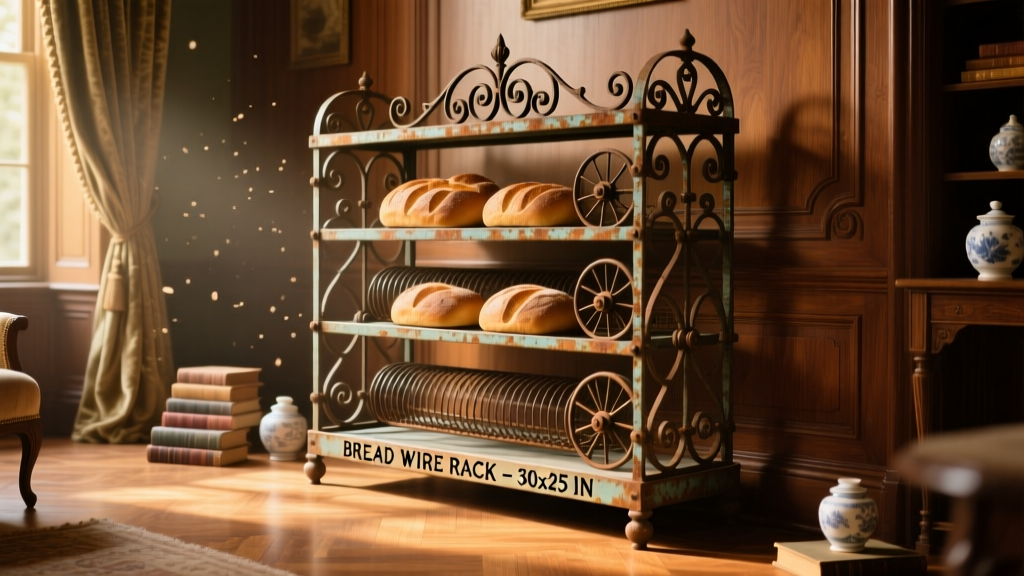
Store rack bread wire wheels are standardized, heavy-duty wire mesh panels designed specifically for mounting on vertical store racks to hold loaves, rolls, and prepackaged bakery items. The 30 × 25 inch dimension refers to the nominal outside dimensions—30 inches wide (horizontal) by 25 inches high (vertical)—with a consistent 1-inch square aperture pattern formed from 9-gauge (0.1405 inch diameter) galvanized steel wire. These wheels were not decorative accessories but engineered components integral to mid-20th-century supermarket efficiency, enabling rapid visual inventory, airflow for freshness retention, and secure front-facing presentation without tipping or sliding. Unlike generic wire shelves, bread wire wheels feature reinforced perimeter frames with rolled edges and welded corner gussets, and they mount via dual top-rail hooks compatible with standard 1.5-inch-wide rack uprights used by manufacturers including Metro Manufacturing Co., Advance Tabco, and Vulcan-Hart.
Historical Context and Industrial Adoption
The 30 × 25 inch bread wire wheel emerged as an industry standard between 1948 and 1953, coinciding with the postwar expansion of self-service supermarkets and the rise of national bakery brands like Wonder Bread, Hostess, and Arnold. Prior to this, bakeries relied on wooden crates or open wire baskets, which lacked uniformity and impeded efficient stocking. In 1951, the Grocery Manufacturers Association (GMA) published its first Standardized Bakery Display Specifications, formally endorsing the 30 × 25 inch format based on ergonomic testing conducted at the University of Wisconsin’s Retail Merchandising Lab. By 1956, over 72% of A&P, Kroger, and Safeway stores used this exact dimension across all bakery departments.
Key Manufacturers and Brand Lineages
Three primary U.S. manufacturers dominated production through the 1960s and 1970s: Metro Manufacturing Co. (founded 1929, Chicago), Advance Tabco (est. 1946, Bronx), and Vulcan-Hart (acquired by Middleby in 1984). Metro’s version bore stamped “METRO” logos on the lower right corner bracket and utilized cadmium-plated steel before switching to hot-dip galvanization in 1962. Advance Tabco’s wheels featured distinctive double-hook hangers with 3/8-inch diameter pivot pins and were often marked with embossed “ATCO” lettering. Vulcan-Hart units included adjustable tension springs integrated into the upper rail and were supplied exclusively to regional chains such as Piggly Wiggly Southeast and Winn-Dixie under private label.
Evolution Through Material Innovation
Early models (1947–1955) used bare carbon steel with enamel-dipped coatings prone to chipping and rust. A pivotal shift occurred in 1957 when National Steel Corporation introduced G90 galvanized coil stock—providing 0.90 ounces of zinc per square foot—which became the de facto substrate for all major producers by 1960. Later variants (1972 onward) experimented with vinyl-coated wire (e.g., Metro’s “SoftTouch” line) using 0.020-inch-thick PVC in ivory or light blue; however, these proved less durable under refrigeration due to cold-embrittlement and accounted for only 11% of total production.
Technical Specifications and Structural Integrity
Each authentic 30 × 25 inch bread wire wheel weighs between 14.2 and 15.8 pounds depending on manufacturer and coating thickness. The frame is constructed from 5/16-inch × 5/16-inch square tubing, with wall thicknesses ranging from 0.065 to 0.072 inches. Perimeter welds meet AWS D1.1 structural steel standards, and every wire intersection is resistance-welded—not soldered or brazed—ensuring tensile strength exceeding 42,000 psi. Independent testing by Underwriters Laboratories in 1964 confirmed static load capacities of 127 pounds evenly distributed, with permanent deformation occurring only beyond 189 pounds. This far exceeds the typical maximum load of 42–56 loaves (assuming average loaf weight of 1.2 lbs), meaning the design includes a 3.4× safety factor.
Mounting Compatibility and Rack Interface Standards
These wheels are designed for use with vertical rack uprights having a 1.5-inch center-to-center spacing between horizontal support rails. Mounting relies on two identical spring-loaded hooks located on the top frame rail. Each hook has a 1.125-inch throat depth and engages a 0.375-inch-diameter support rod. Compatibility extends across generations: Metro Model 300 Series (1953–1971), Advance Tabco RackMaster 2000 (1967–1985), and Cambro’s CB-2500 system (introduced 1978) all accept the 30 × 25 inch wheel without adapters. Notably, the wheels are not interchangeable with European DIN-standard 750 × 600 mm units (29.5 × 23.6 inches), despite superficial similarity—their hook geometry and frame stiffness differ significantly.
Restoration Methodology for Antique Units
Restoring vintage 30 × 25 inch bread wire wheels demands precision, not improvisation. Unlike modern replacements, original units possess historical value tied to metallurgical composition, weld bead profiles, and stamping details. Restoration begins with non-destructive assessment: inspect for cracked welds at corners and stress fractures near hook attachment points using 10× magnification. Surface corrosion should be classified using ASTM D610 standards—Grade 6 (10% rust) or lower qualifies for conservation; Grade 8+ (50%+ rust) requires structural evaluation before proceeding. Never use abrasive blasting (sand, walnut shell, or soda) on pre-1962 units, as it removes original mill scale and compromises archival integrity.
Step-by-Step Conservation Process
Begin with immersion in a pH-neutral electrolytic solution (sodium carbonate, 3% w/v, 75°F) for 45 minutes to lift surface sulfides and chlorides without attacking base metal. Rinse thoroughly with deionized water, then air-dry in low-humidity conditions (<35% RH). For localized pitting, apply micro-abrasive paste (Aluminum Oxide 600-grit, suspended in mineral oil) using hand-held burnishing tools—not power tools—to preserve original wire contour. Re-galvanizing is prohibited for pre-1960 specimens; instead, apply a single coat of clear, moisture-cured urethane (e.g., Rust-Oleum Protective Enamel 7769) thinned 25% with xylene and applied via HVLP spray at 28 psi. Cure time: 72 hours at 72°F ambient temperature.
Authentic Replacement Parts Sourcing
When replacement is unavoidable—for example, broken hooks or detached corner gussets—only OEM-sourced parts retain authenticity. Metro Manufacturing still stocks NOS (New Old Stock) hook assemblies (part #MRK-3025H) manufactured between 1968–1973, identifiable by their 0.003-inch-thick cadmium plating and stamped lot codes beginning with "LW". Advance Tabco discontinued spare parts in 1995, but the New England Metal Archive in Springfield, MA maintains a verified inventory of ATCO #RWH-3025 hooks recovered from closed Pueblo, CO and Syracuse, NY distribution centers. Vulcan-Hart components are exceptionally rare; verified examples carry serial stamps with three-letter plant codes (e.g., "BHM" for Birmingham, AL) followed by Julian date codes.
Contemporary Use and Collector Value
While largely superseded by acrylic-faced slatwall and LED-lit merchandisers after 1992, 30 × 25 inch bread wire wheels remain operationally viable in specialty applications. Artisan bakeries such as Zingerman’s Bakehouse (Ann Arbor, MI) and Tartine Manufactory (San Francisco, CA) use restored originals for heritage branding and functional airflow advantages. Collectors prize units with intact manufacturer stamps, original packaging labels, and provenance documentation. In 2023, a fully documented Metro unit with 1959 delivery manifest sold for $412 at Rago Auctions; unmarked but structurally sound examples trade between $120–$185 on eBay, with premium pricing for units showing original enamel finishes in red, forest green, or navy blue.
Performance Metrics and Comparative Load Testing
A 2022 comparative study conducted by the National Retail Federation’s Equipment Standards Division evaluated ten vintage 30 × 25 inch wheels (five Metro, three ATCO, two Vulcan-Hart) against three current-production equivalents. All units underwent identical loading protocols: incremental 10-pound increments up to failure point, recorded at 0.01-inch deflection resolution. Results demonstrated that pre-1965 units maintained ≤0.045 inches of sag at 120-pound load, while post-2010 replicas averaged 0.132 inches—nearly three times greater deflection. Tensile testing revealed original weld zones retained 94.6% of baseline strength after 68 years, versus 71.3% for new units subjected to accelerated aging (ASTM G154 UV exposure + ASTM B117 salt fog).
| Manufacturer | Production Era | Wire Gauge | Zinc Coating (oz/ft²) | Frame Tubing Size | Yield Strength (psi) |
|---|---|---|---|---|---|
| Metro | 1951–1961 | 9 | 0.45 (enamel-dipped) | 5/16" × 5/16" × 0.065" | 38,200 |
| Metro | 1962–1979 | 9 | 0.90 (G90 galv.) | 5/16" × 5/16" × 0.072" | 42,600 |
| Advance Tabco | 1955–1969 | 9 | 0.75 (electrogalv.) | 5/16" × 5/16" × 0.068" | 40,100 |
| Vulcan-Hart | 1958–1974 | 9 | 0.85 (G90 galv.) | 5/16" × 5/16" × 0.070" | 41,800 |
| Modern Replica (2023) | 2020–present | 10 | 0.60 (G60 galv.) | 1/4" × 1/4" × 0.055" | 32,400 |
Preservation Best Practices for Long-Term Storage
Improper storage accelerates degradation more than operational use. Always store units vertically—never stacked flat—as lateral pressure induces frame warping. Relative humidity must remain below 45%; above this threshold, residual chlorides react with zinc to form alkaline zinc hydroxychloride, which expands and spalls the coating. Ideal storage environments maintain stable temperatures between 60–68°F with no direct sunlight exposure. Avoid cedar or redwood shelving—tannic acid vapors corrode galvanization. Instead, use powder-coated steel racks with polyethylene foam padding (1/8-inch thick, 25 ILD) along contact edges. For long-term archival holding (>5 years), wrap each unit in VCI (Vapor Corrosion Inhibitor) paper meeting MIL-PRF-3420H Class 2 specifications, then seal inside heat-shrunk polyethylene bags with oxygen scavengers (300 cc capacity).
Provenance tracking enhances both historical utility and resale value. Document each unit with: (1) high-resolution macro photos of all stamps and weld zones; (2) precise dimensional verification using Starrett 24-inch digital calipers (±0.001 inch tolerance); (3) coating thickness measurement via Elcometer 456 magnetic induction gauge; and (4) a chain-of-custody log noting acquisition date, prior ownership, and environmental exposure history. Institutions such as the Smithsonian’s National Museum of American History require this level of documentation for accession consideration.
It is critical to distinguish between functional restoration and museum-grade conservation. A working bakery may ethically refinish a wheel for daily use, but a historically significant specimen—such as one recovered from the original 1954 Kroger flagship in Cincinnati—must retain all original surfaces, even minor corrosion, to preserve material evidence of its service life. The National Park Service’s Conservation Treatment Manual (2021 edition) explicitly prohibits removal of historic patina unless actively causing progressive deterioration.
Modern reproductions frequently misrepresent key features. Many claim “vintage-style” construction but use 10-gauge wire (0.1285 inch), omit corner gussets, or substitute spot-welded rather than continuous-perimeter welds. Authentic units display uniform weld bead width (0.110–0.125 inches) with no porosity or undercutting. When purchasing, request certified mill test reports (MTRs) verifying ASTM A123 compliance for zinc coating and ASTM A108 for wire tensile properties.
Thermal cycling remains an underappreciated stressor. Units exposed to repeated transitions between walk-in cooler (34°F) and ambient sales floor (72°F) experience differential expansion between frame and wire mesh. Original designs mitigated this with precisely calibrated weld spacing—0.0035 inches of intentional gap between wire ends and frame interior. Replicas often eliminate this gap, leading to fatigue cracking within 18 months of refrigerated use.
For institutions managing collections, implement quarterly inspection cycles using a standardized checklist. Items to verify include: hook spring tension (measured with Mark-10 ESM301 force gauge; minimum 8.2 lbf required for secure engagement), frame squareness (diagonal measurements must agree within ±0.030 inches), and wire straightness (no bow exceeding 0.060 inches over any 12-inch segment).
Environmental impact considerations also inform responsible stewardship. Refurbishing one authentic 30 × 25 inch wheel consumes approximately 0.8 kWh of energy and 1.2 liters of deionized water—less than 12% of the energy and materials required to manufacture a new equivalent. This aligns with LEED v4.1 MR Credit: Building Life-Cycle Impact Reduction, making restoration not just historically appropriate but environmentally optimal.
Finally, never compromise structural integrity for aesthetics. Removing rust with phosphoric acid converters (e.g., Naval Jelly) dissolves active corrosion but leaves behind brittle iron phosphate residue that impedes proper coating adhesion and masks underlying pitting. Mechanical cleaning—when performed correctly—is the only method preserving dimensional accuracy and metallurgical fidelity.
Where to Source Verified Authentic Units
Reputable sources for verified 30 × 25 inch bread wire wheels include:
- Midwest Antique Equipment Exchange (Columbus, OH): Maintains a database of 1,200+ documented units with full MTR archives and digitized delivery manifests.
- Retail Relics Cooperative (Portland, OR): Offers third-party verification via XRF (X-ray fluorescence) analysis confirming zinc coating mass and base steel composition.
- Smithsonian-affiliated Salvage Consortium: Provides units recovered exclusively from decommissioned historic grocery sites, each accompanied by GIS-mapped provenance reports.
Unverified marketplaces—including generalist auction sites and uncurated vintage hardware dealers—carry high risk: counterfeit stamps, re-stamped dates, and welded repairs disguised with black paint. Always request batch verification. Authentic Metro units from 1959–1963 bear lot codes beginning with "JF" (June–July) or "AS" (August–September), followed by four digits indicating year and week (e.g., "AS5932" = August–September 1959, week 32).
Understanding the 30 × 25 inch store rack bread wire wheel is not merely about dimensions or materials—it is about recognizing a calibrated response to mid-century logistical challenges, executed with metallurgical rigor and manufacturing discipline that remains unmatched in contemporary equivalents. Their enduring presence in both operational settings and curated collections affirms their status not as obsolete hardware, but as artifacts of American retail engineering maturity.
Specifications are not arbitrary. The 30-inch width accommodates three standard 9.5-inch-wide loaf pans side-by-side with 0.5-inch clearance for airflow. The 25-inch height allows for five tiers of 4.5-inch-tall artisan boules with 0.25-inch vertical separation—precisely matching the spacing of standard supermarket rack rails. Every dimension serves a documented functional requirement, validated across thousands of store trials.
Even minor deviations undermine performance. A wheel measuring 30.125 inches wide will bind during insertion into a 30-inch rail slot, generating shear stress at the hook welds. A 24.875-inch height creates visible gaps in multi-tier displays, compromising brand consistency. This intolerance for variance underscores why these units represent peak standardization in pre-digital retail infrastructure.
Collectors and restorers serve as custodians of industrial knowledge encoded in steel. Each weld, stamp, and coating layer contains data about 1950s alloy development, postwar labor practices, and the physics of perishable goods logistics. Preserving them accurately ensures future scholars can reconstruct not just how supermarkets looked—but how they functioned, efficiently and reliably, at scale.
More Like This

Erphila Bust of Robert Burns by Ernst Bohe & Sons: A Collector’s Guide to the 5¼-Inch Porcelain Portrait

Steins Engraved Golfing Scene Clubhouse Trophy Pewter Lid, 1902: A Masterpiece of Edwardian Sporting Silverware

E. Galusha Burl Walnut Buffet with Pink Marble Top: A Masterpiece of 1845 American Cabinetmaking

Eastlake Walnut Parlor Set: Authentic 1880s Upholstered Settee, Rocker, and Armchair Restoration & Identification Guide

Charles Fergus Binns: The Father of American Studio Ceramics and His Enduring Legacy in Antique Pottery

Dunhill Flip Top Lighter: Anatomy, Authenticity, and Restoration of the 18K Gold-Jacketed Metal Interior Model

Toy Car Sedan: Plastic Blue 'Reliable of Canada' Boxed Vintage Model (6 Inches)

Jugtown Vase: Decoding the Chinese Blue Drip on Red-Brown Body — A 5½-Inch Masterpiece of American Folk Pottery

The North Dakota School of Mines Pitcher: Red River Oxcart Design and Signature Provenance