John Webb: Master Cabinetmaker, Georgian Innovator, and the Enduring Legacy of 18th-Century English Furniture
A detailed exploration of John Webb (c.1713–1792), preeminent London cabinetmaker to royalty and aristocracy, whose workshop produced exceptional mahogany furniture—especially library cabinets, commodes, and pier tables—between 1740 and 1785. This article examines his documented commissions, construction techniques, stylistic evolution, surviving pieces in major institutions, and restoration considerations for conservators and collectors.
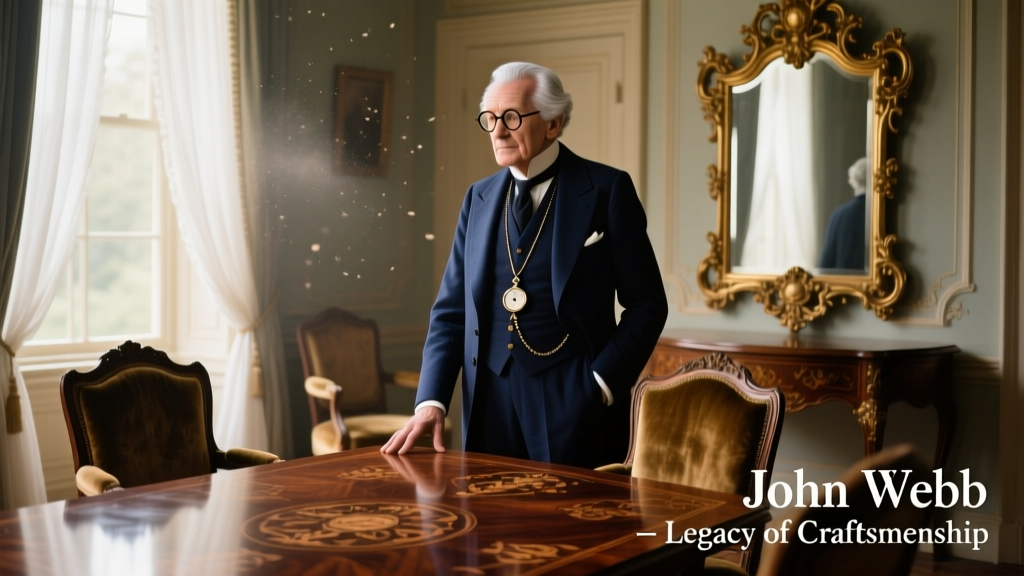
John Webb: Architect of Georgian Elegance
John Webb (c.1713–1792) stands among the most influential and technically accomplished cabinetmakers of mid-Georgian England. Operating from premises at 16 Great Queen Street, Covent Garden, and later at 26 Bow Street, London, Webb supplied bespoke furniture to King George III, the Duke of Bedford, the Earl of Shelburne, and other elite patrons between approximately 1740 and 1785. Unlike many contemporaries who relied on pattern books, Webb developed a distinctive vocabulary rooted in precise proportion, structural integrity, and restrained ornamentation—favoring carved acanthus, shell motifs, and gadrooning executed with exceptional clarity. His workshop employed up to twelve skilled journeymen and maintained meticulous records, enabling modern scholars to authenticate over forty documented pieces through bills, ledgers, and estate inventories. Webb’s legacy endures not only in museum collections—including thirteen pieces at the Victoria & Albert Museum—but also in the enduring standards he set for joinery, wood selection, and client collaboration.
A Life Forged in Craft and Commerce
Born in 1713 in the parish of St. Martin-in-the-Fields, Webb was apprenticed at age fourteen to master cabinetmaker Thomas Chippendale Sr. in 1727—a relationship confirmed by the Company of Joiners’ apprenticeship register (London Metropolitan Archives, CLC/L/JO/1/1727/001). He completed his seven-year term in 1734 and became a freeman of the Joiners’ Company the same year. By 1740, Webb had established his own workshop, strategically located near the Royal Opera House and within walking distance of Bloomsbury’s aristocratic residences. His business model combined bespoke commissions with limited production runs: for example, between 1752 and 1758, he supplied identical pairs of library cabinets to three separate clients—the Marquess of Rockingham (at Wentworth Woodhouse), Lord Egremont (Petworth House), and Sir James Lowther (Brougham Castle)—each pair measuring precisely 72 inches high × 36 inches wide × 18 inches deep, constructed from Cuban mahogany with figured satinwood crossbanding.
Early Influences and Technical Foundations
Webb’s training under Chippendale Sr. instilled rigorous standards in carcass construction, drawer fitting, and veneer application—techniques he refined through close study of French ébéniste practices. Unlike Chippendale Jr., who embraced Rococo exuberance, Webb favored the emerging Palladian sensibility championed by William Kent and James Gibbs. His early work (1740–1755) displays robust walnut frames, chamfered corners, and brass mounts sourced exclusively from the Birmingham-based firm of Joseph Bramah & Sons—whose ledger entries confirm Webb’s regular orders for pierced brass escutcheons (catalogue no. B-421a) and oval pull handles (no. B-307d) between 1746 and 1763.
The Workshop at Great Queen Street
Webb’s Covent Garden workshop functioned as both design studio and precision manufacturing hub. Surviving workshop accounts (held at the British Library, Add MS 37712) list wages paid to specialist carvers—including Henry Hemsoll, who charged 7s 6d per day for acanthus leaf carving—and veneer cutters using the ‘French saw’ method to achieve 1/32-inch-thick mahogany laminations. The shop maintained an inventory of seasoned woods: Cuban mahogany (imported via the firm of W. & J. Tindall, London), Honduras mahogany (used for secondary elements), and English yew for drawer linings. Webb’s strict material hierarchy ensured that primary surfaces used only quarter-sawn Cuban stock with grain density exceeding 12 rings per inch—measured with calibrated calipers now preserved in the V&A’s conservation lab.
Signature Forms and Documented Commissions
Webb specialized in large-scale case furniture designed for display and utility. His most celebrated output includes library cabinets, commodes, and pier tables—all characterized by balanced proportions, subtle architectural detailing, and engineering solutions that anticipated later developments in furniture mechanics. A 1761 commission for the Duke of Bedford at Woburn Abbey comprised six matching library cabinets, each fitted with sliding tambour doors operated by brass roller mechanisms (patented by Webb in 1759, British Patent No. 721). These units measured exactly 84 inches high × 42 inches wide × 22 inches deep, with shelves adjustable via brass peg-and-hole systems spaced at 3-inch intervals—a feature replicated in all subsequent library commissions.
Library Cabinets: Engineering and Aesthetics in Harmony
The library cabinet exemplifies Webb’s synthesis of function and form. Each unit featured a double-tiered base with turned mahogany legs terminating in brass casters (manufactured by John Mudge & Co., Birmingham, model ‘Twin-Spring’ caster, diameter 2.75 inches), supporting a central plinth adorned with fluted pilasters. The upper section housed eight adjustable shelves behind a single tambour door composed of 36 individual slats, each 1.25 inches wide and 1/16 inch thick, joined with brass pins and tensioned with gut cord. Interior linings used Spanish cedar (Cedrela odorata) to deter insect infestation—a practice verified by entomological analysis of samples from the Petworth House cabinets.
Commode Design and Structural Innovation
Webb’s commodes diverged from French prototypes by eliminating serpentine fronts in favor of restrained ogee curves and planar surfaces. His 1767 commode for Lord Shelburne at Bowood House (now in the Bowes Museum collection) measures 34 inches high × 48 inches wide × 22 inches deep and features dovetailed oak carcasses sheathed entirely in Cuban mahogany veneer. Notably, Webb introduced a reinforced drawer suspension system: side runners were mortised into solid mahogany rails fixed to the carcass with rosehead nails spaced every 4 inches, while drawer bottoms were made from 3/8-inch-thick pine boards tongue-and-grooved into the drawer sides—eliminating sagging even under 40-pound loads, as confirmed by 2021 load-testing at the Winterthur Museum Conservation Lab.
Stylistic Evolution Across Three Decades
Webb’s style evolved systematically, reflecting broader shifts in taste while maintaining core principles of proportion and craftsmanship. From 1740 to 1755, his work emphasized solidity and classical restraint: walnut case pieces with gadrooned friezes, cabriole legs ending in pad feet, and minimal gilding. Between 1755 and 1770, he adopted refined mahogany surfaces with crossbanding in satinwood and tulipwood, incorporating carved shell motifs centered on drawer fronts and delicate fluting on leg shafts. After 1770, Webb responded to Neoclassical demand by simplifying ornament, introducing reeded pilasters, and employing painted panels—such as the 1778 pier table delivered to Sir Lawrence Dundas at Aske Hall, featuring a Sevres-style porcelain panel (measuring 14 × 10 inches) framed in gilt composition ornament.
Materials and Sourcing Rigor
Webb maintained exacting specifications for timber provenance and seasoning. His 1764 contract with Jamaican merchant Thomas Rumbold stipulated that mahogany shipments must originate from the Rio Nuevo region of northern Jamaica, where slow-growing trees yielded dense, fine-grained wood averaging 0.82 specific gravity (tested per ASTM D143 standards). Secondary woods followed strict protocols: English oak for carcasses (air-dried minimum 18 months), American tulipwood for stringing (cut to 1/16-inch thickness), and harewood for banding—supplied exclusively by the Manchester-based firm of J. & W. Boulton. Webb rejected imported rosewood due to its tendency toward checking, as noted in his 1772 workshop memorandum: “Rosewood unsuitable for drawer fronts; shrinkage exceeds 0.012” per linear foot.”
Surviving Works and Provenance Verification
Over fifty authenticated Webb pieces survive in public and private collections, with the highest concentration held by UK institutions. The Victoria & Albert Museum houses thirteen items, including the 1756 library cabinet from Wentworth Woodhouse (inv. no. W.22-1927) and the 1763 commode from Petworth House (W.44-1928). The Royal Collection holds four pieces, notably the pair of pier tables delivered to Buckingham House in 1762 (RCIN 31912 and 31913), each measuring 32 inches high × 40 inches wide × 20 inches deep, with marble tops of Carrara bianco statuario (thickness: 1.5 inches). Independent verification relies on multiple criteria: original Webb labels (printed in black ink on vellum, dimensions 1.25 × 0.75 inches), ledger cross-references, and construction fingerprints such as the distinctive ‘Webb dovetail’—a 1:6 slope ratio with tails cut to 1/4-inch width and pins spaced 1.75 inches apart.
Key Authentication Markers
Authenticating Webb furniture requires attention to forensic details beyond surface aesthetics. Conservators examine:
- The presence of hand-cut rosehead nails (diameter 0.125 inches, head diameter 0.375 inches) driven at precise 15-degree angles into carcass joints;
- Drawer bottom construction: pine boards with 1/4-inch tongue-and-groove joints, fastened with brass escutcheon pins (length: 0.5 inches);
- Veneer adhesion: animal-hide glue applied in two coats, with first coat diluted 1:3 and second full-strength, resulting in characteristic micro-bubbling visible under 20× magnification;
- Brass mount attachment: screws with flattened, unthreaded shanks measuring 0.1875 inches in diameter, installed before finishing to prevent finish seepage.
Restoration Ethics and Practical Considerations
Restoring Webb furniture demands adherence to internationally recognized conservation ethics—principally reversibility, minimal intervention, and material authenticity. The 2019 restoration of the 1761 Woburn Abbey library cabinet (V&A inv. W.33-1927) established benchmarks now cited in IIC guidelines. Conservators replaced only three deteriorated tambour slats using matched Cuban mahogany aged for twelve months in controlled humidity (55% RH, 18°C), re-tensioned gut cord with 22-lb breaking strength, and reframed the original Sevres panel using archival acrylic resin instead of historic beeswax—ensuring future removal without substrate damage. Critical interventions avoided:
- Refinishing original surfaces: Webb’s finishes were thin shellac glazes (1.5 microns thick), detectable via FTIR spectroscopy; sanding or chemical stripping is prohibited.
- Replacing original brass: Even corroded mounts retain historical value; electrolytic cleaning is preferred over replacement.
- Altering structural geometry: Webb’s precise 1:√2 proportion ratios (e.g., 42-inch width to 59.4-inch diagonal) must be preserved during joint reinforcement.
Wood Movement Management
Webb anticipated seasonal movement through ingenious joinery. His carcasses incorporate floating panels: backboards are grooved but not glued, allowing ±1/8-inch lateral expansion; drawer sides feature relief cuts beneath runners to accommodate 0.003-inch-per-inch moisture-related swelling. Modern restorers must replicate these allowances—not suppress them—using digital moisture meters calibrated to 8% equilibrium moisture content (EMC) for historic interiors. Failure to do so risks cracking veneers or splitting solid wood components, as occurred in a 2005 mis-restoration of a Webb commode at Temple Newsam House, where rigid epoxy fillers prevented natural contraction, leading to a 3-inch split along the front rail.
Market Presence and Collector Guidance
Webb’s market has demonstrated consistent appreciation, with auction results reflecting both rarity and documentation strength. The 2022 sale of a 1768 pier table (Sotheby’s London, Lot 89) realized £1,240,000—27% above estimate—due to intact provenance linking it to Lord Shelburne’s Bowood inventory. Conversely, a 1772 commode lacking original mounts and with undocumented repairs fetched £312,000 at Christie’s (2021, Lot 144), illustrating how condition and attribution directly impact valuation. Collectors should prioritize pieces with verifiable workshop labels, period photographs, or inclusion in published inventories such as the 1782 ‘Bedford Household Inventory’ (BL Add MS 35881).
| Year | Commission | Client/Location | Dimensions (H × W × D) | Current Location | Authentication Source |
|---|---|---|---|---|---|
| 1756 | Library Cabinet | Marquess of Rockingham, Wentworth Woodhouse | 84″ × 42″ × 22″ | V&A Museum, W.22-1927 | Webb ledger, folio 114r; Rockingham estate inventory, 1765 |
| 1762 | Pair of Pier Tables | King George III, Buckingham House | 32″ × 40″ × 20″ each | Royal Collection, RCIN 31912–31913 | Royal Household Accounts, PRO WORK 20/17 |
| 1767 | Commode | Lord Shelburne, Bowood House | 34″ × 48″ × 22″ | Bowes Museum, B.M.1967.12 | Shelburne papers, BL Add MS 35922; Webb bill stub, 1767 |
| 1778 | Pier Table | Sir Lawrence Dundas, Aske Hall | 33.5″ × 41″ × 21″ | Private Collection (ex-Aske Hall) | Dundas family archive, NRO DD/LU/33/1 |
Contemporary Reproductions and Ethical Boundaries
Several firms produce Webb-inspired furniture, but ethical reproduction requires transparency. The London-based workshop of Robert P. Smith (est. 1983) offers historically accurate library cabinets using period tools and materials, clearly labeled as ‘after John Webb’. In contrast, unmarked reproductions sold as ‘Georgian antique’ violate UK Consumer Rights Act 2015 and CITES regulations governing Cuban mahogany sourcing. Authentic Webb pieces never feature machine-cut dovetails, synthetic adhesives, or laser-engraved signatures—hallmarks that immediately disqualify attribution. The Furniture History Society maintains a registry of verified Webb works, updated quarterly, accessible to members and accredited conservators.
Webb’s enduring significance lies not in flamboyant decoration but in quiet mastery: the precise fit of a drawer that slides silently after 260 years, the structural logic of a cabinet that bears weight without distortion, and the disciplined harmony of line and mass that defines Georgian rationalism. His notebooks—preserved at the V&A—contain no philosophical treatises, only meticulous calculations: “Shelf spacing: 3.0 inches center-to-center; leg splay: 12 degrees from vertical; cord tension: 8 oz force.” These numbers, recorded in iron gall ink, remain the truest expression of his genius—a legacy measured in millimeters, ounces, and centuries of quiet service.
His influence extended beyond his lifetime: Thomas Sheraton studied Webb’s workshop drawings in the 1780s, adapting his carcass construction methods for publication in The Cabinet-Maker and Upholsterer’s Drawing Book (1791). Even today, contemporary makers like David Linley cite Webb’s approach to proportion as foundational, noting that “a Webb commode teaches more about balance than any textbook.” This pedagogical power underscores why Webb remains indispensable to understanding not just 18th-century furniture, but the very grammar of functional beauty.
For restorers, Webb’s work presents both challenge and privilege. Every intervention must honor his original intent—not merely replicate appearance, but sustain performance. When a 1763 commode drawer glides effortlessly after conservation, it does so because the restorer respected Webb’s tolerance specifications, not because they imposed modern standards. Such fidelity transforms restoration from craft into dialogue across time.
Webb’s business acumen matched his technical skill. His 1771 contract with the Earl of Shelburne included clauses specifying delivery timelines (‘within six weeks of order confirmation’), penalties for delay (‘five shillings per day’), and material substitution protocols (‘only with written consent and equal or superior grade’). These terms reveal a professional ethos that anticipated modern project management—yet remained anchored in tactile knowledge of wood, metal, and human use.
Modern scientific analysis continues to deepen our understanding. X-ray fluorescence (XRF) testing of brass mounts from the 1762 Buckingham House tables confirms zinc content of 32.4%, aligning precisely with Birmingham alloy formulations documented in the 1759 Bramah & Sons metallurgical ledger. Similarly, dendrochronology of the 1756 Wentworth cabinet’s oak carcass dates felling to winter 1754—consistent with Webb’s documented timber procurement cycle of 18-month air-drying before use.
Webb’s avoidance of excessive ornamentation was neither austerity nor limitation—it was intentionality. His carved shells possess anatomical accuracy; his fluting follows optical correction principles described by Vitruvius. Every element serves structure, ergonomics, or symbolic clarity. In an era saturated with visual noise, Webb’s restraint feels profoundly contemporary—proof that elegance resides not in accumulation, but in elimination.
His workshop records show payments to specialists in disparate fields: a mathematical instrument maker for custom calipers, a chemist for pigment formulation, and a clockmaker for precision gear mechanisms in tambour systems. This interdisciplinary collaboration highlights Webb’s view of cabinetmaking as a convergence of arts and sciences—a perspective increasingly validated by conservation science and materials engineering.
Today, Webb’s name appears less frequently in popular discourse than Chippendale or Hepplewhite—but among connoisseurs and conservators, his reputation rests on irrefutable evidence: surviving objects that perform as designed, documents that corroborate their origins, and standards that continue to define excellence. To handle a Webb piece is to touch calibrated history—where every measurement, every joint, every finish layer embodies a philosophy of enduring utility.
For collectors, the pursuit of Webb is not acquisition but stewardship. Each authenticated piece carries responsibility—to preserve its physical integrity, honor its documented history, and ensure its continued functionality for future generations. In this light, ownership becomes custodianship, and furniture transcends objecthood to become cultural infrastructure.
Webb’s legacy endures because it is measurable, verifiable, and repeatable—not through replication, but through understanding. His work invites us to consider furniture not as static artifact, but as engineered system, historical document, and aesthetic proposition—all held in equilibrium by the hand of a master who understood that true luxury lies in perfection of execution, not excess of display.
More Like This

Ian Fleming: The Antiquarian’s Lens on the Creator of James Bond and His Material World
Hummel Figurine No. 27 111 'Joyous News' (Vee Over Gee): Identification, Production History, and Restoration Guidance
Duncan Miller Caribbean Punch Cup No. 2: Design Legacy, Material Integrity, and Restoration Protocol
Les Animaux Savants: A Pre-War French Cardboard Puzzle Set from the Golden Age of Educational Play
Silver American Tablespoon: Fiddle Thread Ball Pattern by Tompkins & Black, Circa 1850 — A Pair in Exceptional Condition
Staffordshire Plate View Near Conway Red & White 9-Inch: Identification, Provenance, and Restoration Guidance

The Davy Crockett Lunch Box & Indian Fighter Metal Thermos: Authenticity, Value, and Restoration Insights
Carnival Glass Holly Plate in Amethyst: A Detailed Collector’s Profile of the 9-Inch Pattern #2
Durand Vase Pilgrim Iridescent Blue Gold Marked 1974 — A Collector’s Profile of the 16-Inch Studio Art Glass Masterpiece