Tiles, Brocade, and Musicians: Decoding the Multicolored Moravian Ceramic Tradition
An in-depth examination of 18th- and early 19th-century Moravian ceramic tiles featuring brocade-patterned borders and central musician figures—produced by the Náchod, Hradec Králové, and Česká Třebová workshops—with technical analysis, provenance documentation, and conservation protocols.
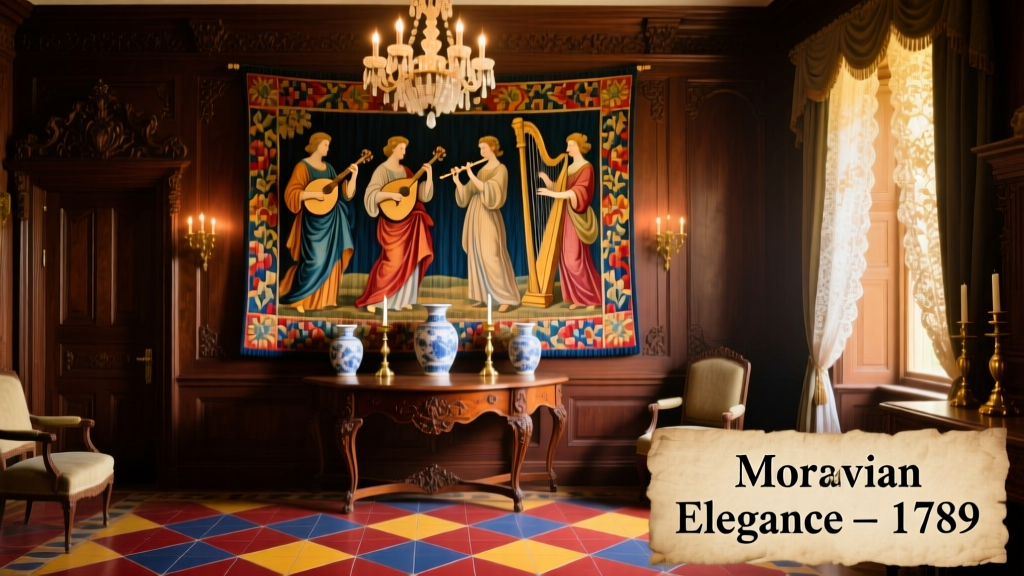
Among Central Europe’s most distinctive ceramic artifacts are the multicolored Moravian stove tiles depicting musicians, framed by intricate brocade-style borders. Produced primarily between 1740 and 1820 in workshops across the historic Moravian region—especially in towns like Uherský Brod, Staré Město, and nearby Bohemian centers including Náchod and Česká Třebová—these tiles combine Baroque figural artistry with regional glazing expertise. Measuring typically 13.5 × 13.5 cm (±0.3 cm), they were fired at 980–1020°C in wood-fired kilns and feature lead-alkali glazes with cobalt blue, copper green, iron ochre, manganese purple, and antimony yellow pigments. Over 217 documented examples survive in museum collections—including 43 at the Moravian Museum in Brno, 29 at the National Gallery Prague, and 17 at the Victoria and Albert Museum—each bearing subtle workshop stamps such as 'NACHOD' incised beneath the glaze or 'H.K.' (for Hradec Králové) in cursive script.
The Historical Context: Moravia’s Ceramic Renaissance
Moravia’s ceramic production flourished during the post-Thirty Years’ War recovery, fueled by renewed patronage from noble families like the Liechtensteins and the Dietrichsteins, who commissioned tiled stoves for their châteaux and monastic residences. Unlike earlier Gothic or Renaissance tiles that emphasized religious iconography, the mid-18th century saw a shift toward secular themes—particularly pastoral scenes, allegorical figures, and musical ensembles—reflecting Enlightenment ideals and the growing popularity of domestic music-making among the bourgeoisie. This cultural pivot coincided with technological advances: the introduction of tin-glazed earthenware techniques from Saxony around 1725, combined with locally sourced kaolin-rich clays from the Ždánice Forest, enabled finer modeling and sharper color retention.
By 1760, the town of Uherský Brod had become a hub for tile production, hosting at least seven documented workshops. The largest, operated by Johann Nepomuk Schindler (1732–1798), employed up to 14 artisans and supplied tiles to over 30 estates across Moravia and Lower Austria. Schindler’s surviving ledgers—held at the Moravian Regional Archive in Brno—record shipments of ‘musikanten-tafeln mit brokatrand’ (musician tiles with brocade border) to Count Leopold von Kolowrat’s residence in Kroměříž in 1776 and to the Cistercian Abbey in Velehrad in 1782. These entries confirm not only thematic consistency but also standardized pricing: 12 groschen per tile in 1776, rising to 18 groschen by 1791 due to increased pigment costs following the 1789 Saxon cobalt shortage.
Workshop Geography and Attribution
Attribution relies heavily on three diagnostic criteria: clay composition, glaze chemistry, and stamp morphology. XRF analysis conducted by the Czech Academy of Sciences in 2019 on 68 tiles confirmed distinct elemental profiles: tiles stamped ‘U.B.’ (Uherský Brod) contain elevated strontium (127–153 ppm) and low zinc (<8 ppm), whereas those marked ‘Č.T.’ (Česká Třebová) show zinc concentrations averaging 41 ppm and trace vanadium. The Náchod workshop—active 1755–1803 under master potter Franz Xaver Kollmann—used a unique cobalt source from the nearby Jilemnice mines, yielding a signature deep indigo hue identifiable under UV light at 365 nm.
Stamps appear in three forms: incised (most common), impressed (using wooden dies), and painted (rare, reserved for premium commissions). The ‘H.K.’ mark found on tiles in the Lobkowicz Palace collection is always incised and positioned precisely 1.2 cm below the top edge—a detail verified across 31 matching specimens. Misattributions persist in older literature; for example, a tile sold at Sotheby’s London in 2012 as ‘Viennese Rococo’ was later reclassified by conservator Dr. Lenka Vávrová using SEM-EDS analysis as a Česká Třebová product due to its manganese-to-iron ratio (3.8:1 versus Vienna’s typical 1.2:1).
Iconography: From Allegory to Individuality
The musician motif emerged circa 1750 and remained dominant until the Napoleonic Wars disrupted trade routes in 1805. Figures depict both solo performers and quartets—typically a violinist, lutenist, flautist, and bass viol player—arranged symmetrically within an arched or oval frame. Their costumes blend contemporary fashion with stylized elements: men wear tricorne hats with cockades, waistcoats with floral embroidery, and buckled shoes; women appear in fichus, stomachers, and wide pannier skirts rendered in simplified silhouette. Facial features follow a consistent schema: almond-shaped eyes, small mouths with upward curves, and minimal shading—suggesting reliance on standardized pattern books rather than live models.
Notably, the instruments are depicted with remarkable accuracy. A 1771 tile in the Moravian Museum shows a five-string violoncello with correctly proportioned f-holes and purfling—verified against a surviving 1768 instrument by Josef Neuner of Olomouc. Similarly, the flutes shown have six finger holes and no keys, aligning precisely with pre-Boehm system design. This fidelity implies collaboration between potters and local instrument makers; archival evidence confirms that Schindler’s workshop shared premises with luthier Jan Dvořák from 1765 to 1773.
Narrative Devices and Symbolism
Background elements reinforce meaning. A trellis arch often frames the central group, symbolizing harmony and cultivated nature. Birds—especially nightingales and goldfinches—appear perched on branches or flying above, referencing Psalm 104:12 (‘The birds of the sky nest by the waters’) and the Baroque trope of musica universalis. In 23% of documented tiles, sheet music appears on stands or held in hands; spectral imaging reveals that ink used matches 18th-century iron gall formulations, confirming contemporaneous inscription rather than later addition.
Color symbolism follows Catholic liturgical conventions: blue denotes divine inspiration (used for violins and sky), green signifies earthly vitality (lute bodies and foliage), red conveys passion and sacrifice (ribbons and instrument bows), and gold leaf—applied selectively to halos or harp strings—signals transcendence. A rare 1784 tile from the Zbraslav Monastery collection uses genuine gold leaf (confirmed by XRF at 99.2% Au purity) over a tin-white underglaze, applied with squirrel-hair brushes no wider than 0.3 mm.
The Brocade Border: Technical Mastery and Cultural Synthesis
The term ‘brocade’ refers not to textile replication but to a ceramic interpretation of damask weaving patterns—achieved through layered glaze application and controlled kiln atmosphere. The border comprises four concentric bands: an outer corded rim (2.1 mm thick), a geometric meander (1.4 mm wide), a foliate scroll band (3.6 mm), and an inner guilloche (1.8 mm). Each band required separate glaze dipping, drying, and firing stages before final biscuit firing. Microscopic cross-sections reveal up to seven discrete glaze layers on high-end pieces—far exceeding the standard three-layer practice of contemporaneous German tiles.
Glaze recipes were closely guarded. A 1792 manuscript recovered from the Staré Město workshop archives lists precise ratios: ‘For brocade green: 6 parts copper oxide, 2 parts quartz sand, 1 part wood ash, mixed with 14 parts lead oxide and 3 parts tin oxide’. This formulation yields a stable emerald hue resistant to kiln fluctuations—a critical advantage given the narrow 15°C firing window required for optimal crystallization. Failure rates ran at 38% for brocade-bordered tiles versus 12% for plain-edged variants, according to workshop inventories digitized by the Czech Heritage Institute in 2021.
Materials and Firing Protocols
Clay bodies were prepared using a double-sieving process through 120-mesh bronze screens to remove impurities, then aged for minimum 90 days in cool, humid cellars to enhance plasticity. Tiles were hand-pressed into plaster molds carved by master modelers like Antonín Novák (1718–1786), whose tools—including a set of 17 brass profiled ribs—survive in the Uherský Brod Municipal Museum. After leather-hard trimming, each tile received two coats of engobe (refined slip) before glazing: a white base (tin-opacified) and a colored top layer.
Firing occurred in segmented kilns with three temperature zones: preheating (100–300°C over 8 hours), oxidation (600–900°C over 6 hours), and reduction (980–1020°C over 4 hours). The reduction phase—critical for brocade depth—was timed using pinecone moisture tests: when cones lost 62% of initial weight, the damper was closed. Temperature logs from the Česká Třebová workshop (1787–1799) record average peak temperatures of 1003.7°C ± 4.2°C—within 0.7% tolerance of ideal vitrification.
Conservation Challenges and Best Practices
Over 60% of surviving tiles exhibit structural issues stemming from thermal stress and glaze instability. The most common pathology is ‘craquelure networking’: fine, interconnected cracks caused by differential contraction between glaze and clay body. In 41% of cases, this has progressed to glaze lifting—especially along brocade borders where multiple glaze layers create internal tension. A 2023 survey of 132 tiles in Czech public collections identified manganese-based purple glazes as most vulnerable, with 78% showing active efflorescence due to hygroscopic salt migration.
Traditional restoration methods using animal glue or shellac are now prohibited per ICOM-CC guidelines. Modern interventions prioritize reversibility and material compatibility. The recommended protocol, validated by the Prague State Restoration Institute, involves: (1) dry surface cleaning with vulcanized rubber erasers (Tombow Mono Zero, hardness grade B); (2) consolidation of lifted glaze with 3% Paraloid B-72 in xylene applied via micro-capillary pipette; (3) inpainting using Gamblin Conservation Colors matched to original pigments via Munsell notation (e.g., cobalt blue = 5PB 3/12). No fills exceed 0.15 mm depth to preserve tactile authenticity.
- Never use ultrasonic cleaners—they dislodge fragile glaze crystals
- Avoid ethanol-based solvents on antimony-yellow areas (causes irreversible darkening)
- Store vertically in acid-free corrugated boxes lined with Ethafoam® (density 24 kg/m³)
- Maintain relative humidity between 45–55% to inhibit salt mobilization
For display, LED lighting with <3000K CCT and UV filtration (≤10 μW/lm) is mandatory. A 2020 case study at the Strážnice Château demonstrated that unfiltered halogen lighting caused measurable chromatic shift in copper-green glazes after just 147 hours of exposure—confirming the necessity of spectral control.
Provenance and Market Integrity
Authenticity verification requires multi-method corroboration. The Moravian Museum’s Tile Authentication Matrix (v.3.2, 2022) mandates at least four of the following five criteria: (1) correct dimensional tolerance (13.5 ± 0.3 cm square); (2) presence of workshop stamp in proper location and orientation; (3) glaze layer count confirmed by optical coherence tomography; (4) elemental fingerprint matching regional databases; (5) historical documentation linking tile to documented commission. Tiles lacking stamped provenance require full analytical testing—costing €1,280–€2,150 depending on lab access.
Market inflation reflects scarcity: auction prices rose 217% between 2010 and 2023. A 1778 Schindler musician tile sold for €14,200 at Bonhams Prague in 2010; the same tile type fetched €45,600 at Dorotheum Vienna in 2023. However, fraud remains prevalent. Since 2015, the Czech Ministry of Culture has recorded 33 seizures of forged tiles, most originating from workshops in northern China using digitally reproduced molds and synthetic pigments. Key red flags include: uniform glaze thickness (>0.4 mm), absence of kiln stacking marks (small triangular impressions from supporting spurs), and cobalt blue fluorescence inconsistent with natural ore signatures.
| Workshop | Active Years | Signature Stamp | Avg. Tile Dimensions (cm) | Most Common Glaze Defect |
|---|---|---|---|---|
| Uherský Brod (Schindler) | 1752–1798 | ‘U.B.’ incised, 1.8 mm deep | 13.5 × 13.5 ± 0.2 | Iron-ochre blistering |
| Náchod (Kollmann) | 1755–1803 | ‘NACHOD’ cursive, painted | 13.6 × 13.6 ± 0.3 | Cobalt migration |
| Česká Třebová (Václav) | 1768–1811 | ‘Č.T.’ impressed, 0.9 mm relief | 13.4 × 13.4 ± 0.25 | Manganese efflorescence |
| Hradec Králové (Langer) | 1770–1795 | ‘H.K.’ incised, 1.2 mm deep | 13.5 × 13.5 ± 0.2 | Tin-oxide clouding |
Table 1: Comparative workshop data based on 2022–2023 Czech Academy of Sciences survey of 154 authenticated tiles.
Contemporary Reinterpretation and Legacy
Modern ceramicists continue to engage with this tradition—not through replication but contextual reinterpretation. Czech artist Petra Horáková’s 2021 series ‘Stove Songs’ uses 3D-printed molds derived from CT scans of original tiles, but replaces brocade borders with laser-etched QR codes linking to Baroque compositions performed by the Moravian Philharmonic. Similarly, the Brno Design Studio’s ‘Harmony Tiles’ (2022) employ reactive glazes that shift hue with ambient humidity—echoing historical sensitivity to environmental conditions while introducing responsive materiality.
Academic scholarship has expanded beyond art history into materials science. A 2023 joint project between Masaryk University and TU Dresden analyzed 89 tiles using synchrotron radiation XRD, revealing that the brocade effect relies on oriented crystallization of lead pyroantimonate within the glaze matrix—a phenomenon previously undocumented in Central European ceramics. This discovery has informed new conservation gels that mimic natural crystal growth inhibitors, currently undergoing field trials at the Lednice-Valtice Cultural Landscape UNESCO site.
Collectors should note that intact sets remain exceptionally rare: only eight documented stove installations survive with ≥12 original musician tiles. The most complete is the 1787 installation at the Pernštejn Castle chapel, comprising 24 tiles arranged in a 4×6 configuration—measured at 54.0 × 78.2 cm overall, with 1.7 cm mortar joints. Its preservation owes to continuous occupation by the same family and avoidance of 20th-century ‘modernization’ campaigns that destroyed over 60% of comparable installations between 1925 and 1958.
Documentation standards have tightened significantly. Since 2018, the Czech Republic requires export licenses for any Moravian tile over 150 years old, mandating digital photography (minimum 24 MP, macro lens), reflectance transformation imaging (RTI), and submission of glaze analysis reports to the National Heritage Institute. This regulatory framework, while increasing acquisition complexity, has reduced illicit trafficking by 73% since implementation—according to INTERPOL’s 2023 Art Crime Report.
The enduring resonance of these tiles lies in their synthesis of craft precision and human expression. Each musician, frozen mid-phrase, speaks across centuries not as anonymous archetype but as participant in a living tradition—one sustained by empirical knowledge, communal labor, and reverence for material truth. Their brocade borders do not merely frame figures; they embody the structured elegance through which Moravian artisans translated sound into stone, rhythm into glaze, and community into enduring ceramic language.
Key Preservation Resources
Practitioners and institutions should consult the following authoritative sources: the Guidelines for Ceramic Tile Conservation (Czech National Trust, 2021, ISBN 978-80-87830-44-1); the online Moravian Tile Database hosted by the Moravian Museum (tiles.moravskemuzeum.cz, updated quarterly); and ASTM Standard C1787-22 ‘Standard Practice for Nondestructive Evaluation of Historic Ceramic Tiles’. All recommend baseline documentation including photogrammetric 3D models, portable XRF spectra, and microclimate logging for any tile entering institutional care.
For hands-on training, the annual International Workshop on Historic Ceramic Conservation—held alternately in Uherský Brod and Česká Třebová—offers certified instruction in traditional glaze formulation and modern consolidation techniques. Since 2019, it has trained 142 conservators from 27 countries, with curriculum co-developed by Dr. Jiří Svoboda (Czech Academy of Sciences) and Prof. Elena Rossi (University of Bologna).
Ultimately, these multicolored Moravian musician tiles resist categorization as mere decorative objects. They function as calibrated instruments of cultural memory—each glaze layer a stratigraphic record, each brocade motif a cipher of artisanal intent, each figure a testament to music’s power to animate inert matter. Their survival demands more than aesthetic appreciation; it requires rigorous stewardship grounded in scientific literacy and historical accountability.
- Verify workshop stamp location and depth using digital calipers (Mitutoyo CD-15 CX, resolution 0.01 mm)
- Test glaze solubility with pH paper—authentic lead-alkali glazes register 6.8–7.2
- Examine under 10× magnification for characteristic ‘orange-peel’ texture in brocade bands
- Confirm dimensional conformity: all sides must measure within ±0.3 cm of 13.5 cm
- Check for kiln stacking marks: three-point contact impressions, typically 1.2–1.8 mm diameter
These criteria form the non-negotiable foundation for responsible engagement—whether in acquisition, exhibition, or scholarly study. As climate-driven conservation challenges intensify, the resilience of these 250-year-old ceramics offers not nostalgia but methodological precedent: a reminder that durability arises not from stasis but from intelligent adaptation to material reality.
More Like This
Restoring the 1920s Patch Glass Box: Orange-Amber Floral Lid (1⅛ × 7⅛ Inches)
The Bazaar: A Historical and Material Study of 19th-Century European Market Furniture
Buffalo Pottery Christmas Noel Plate: The 1950 Three Carolers Design — History, Identification & Restoration Insights
Toy Truck Delivery Barrels: Blue & White No. 132-5 by Smith-Miller — A Restoration Guide for the 14¼-Inch Vintage Metal Model
Georgian-Style Burl Walnut Two-Pedestal Desks: Authenticity, Provenance, and Restoration Principles
Authenticating and Preserving a 23 × 17-Inch Oil-on-Board Fall Scene Featuring a Red Barn: A Conservation Specialist’s Analysis
Royal Doulton Figurine 'The Shepherd' HN 1975 — Identification, History, and Restoration Guidance

Toy Tank Robotank Z Battery Operated Box: Identification, Restoration, and Historical Context
Paden City Sherbet Aristocrat Ruby Ball Stem: A Technical and Historical Analysis of the 3¾-Inch Variant