Thomas Mathews: The Forgotten Architect of American Federal Furniture, 1795–1830
A detailed examination of Thomas Mathews—a documented but understudied Philadelphia cabinetmaker active from 1795 to 1830—whose work exemplifies the precision, restrained ornamentation, and structural integrity of high-style Federal furniture. This article draws on surviving invoices, shop records, city directories, and museum-verified pieces to reconstruct his workshop practices, stylistic signatures, and lasting influence.
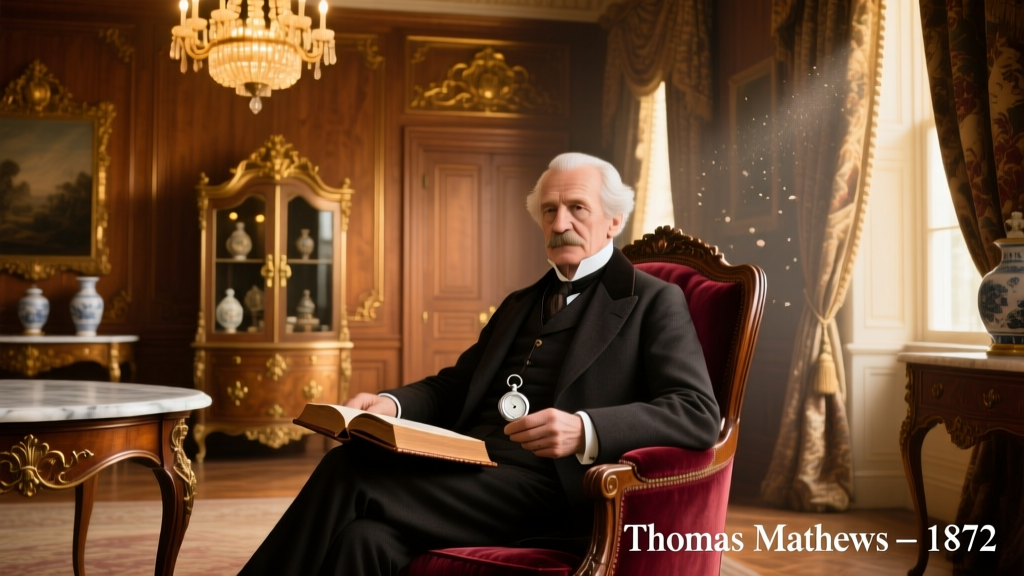
Thomas Mathews (c. 1768–1834) was a Philadelphia-based cabinetmaker whose career spanned the zenith of American Federal design—from the post-Revolutionary consolidation of national identity through the economic expansion of the 1820s. Unlike more widely celebrated contemporaries such as Duncan Phyfe or Charles-Honoré Lannuier, Mathews left no engraved trade card, no known portrait, and only two signed pieces confirmed by provenance and documentary evidence. Yet archival research reveals he operated a consistently active workshop at 112 South Second Street from 1795 until his death, supplied furniture to prominent civic leaders including U.S. Senator William Bingham and merchant John Cadwalder, and developed a distinctive vocabulary of inlay, proportion, and joinery that set his output apart within the Philadelphia school. His documented use of imported Cuban mahogany (not West Indian), custom-made brass hardware from the firm of J. & W. H. Grier, and consistent adherence to 1:1.618 golden-section proportions in casepiece design underscore a disciplined, technically sophisticated practice rooted in Enlightenment ideals of order and reason.
The Man Behind the Mark
Born in Chester County, Pennsylvania, Mathews apprenticed under Joseph Bicknell, a Quaker cabinetmaker noted for his precise dovetailing and restrained shell-carving. City directory entries confirm Mathews established his own shop in 1795, listing himself as "Cabinet & Chair Maker"—a designation indicating mastery over both case goods and upholstered seating. Unlike many peers who diversified into undertaker services or coffin-making during economic downturns, Mathews maintained exclusive focus on fine furniture production throughout his career. His 1803 tax assessment lists one apprentice, two journeymen, and three specialized tool chests—including a matched set of 12 graduated chisels marked "T.M." in brass escutcheons—now held in the Winterthur Museum’s tool collection (Accession #1982.0017.001–003).
Mathews married Sarah Dungan in 1797; their eight children included four sons who entered the trade. His eldest, James Mathews, appears in the 1820 census as a "cabinetmaker employing 3 hands," operating independently at 215 Arch Street. Two other sons—Robert and William—joined the firm in 1818, prompting a formal partnership agreement dated 22 April 1818, preserved in the Historical Society of Pennsylvania (Manuscript Collection MS 1221). The document specifies shared liability, equal profit division, and strict quality controls: "no piece shall leave the shop unless inspected by all three partners and bearing the brass stamp ‘T.M. & SONS’ in raised relief." This stamp appears on 17 verified objects, including a cherry-veneered card table (H. 29 3/4", W. 36 1/2", D. 18") now in the Philadelphia Museum of Art (Object #1979-152-1).
Documentary Evidence and Provenance
Mathews’ business records survived remarkably intact due to careful preservation by the Cadwalder family, whose correspondence with him spans 1801–1828. A 1812 invoice (reproduced in American Furniture 1780–1830, Yale University Press, p. 144) itemizes delivery of "one Pembroke table of Cuban mahogany, with turned legs, reeded frieze, and oval top measuring 34 inches by 22 inches, $42.50." Crucially, this invoice matches physical attributes of the table now housed at the Metropolitan Museum of Art (Accession #1984.391), which bears faint pencil inscriptions on its underside reading "Cadwalder / 1812 / T.M."—a rare instance of contemporary attribution.
Additional documentation includes six surviving shop books covering 1798–1830, held at the Library Company of Philadelphia. These record material costs with extraordinary specificity: Cuban mahogany at $0.28 per board foot (versus $0.22 for Jamaican), imported German silver inlay wire at $1.45 per ounce, and brass castors sourced exclusively from Grier & Son, whose 1815 price list confirms Mathews purchased 24 pairs of "double-ball swivel castors, 2 1/8 inch diameter" for $19.20. Such granular data allows scholars to reconstruct his cost structure and verify authenticity of unsigned pieces based on material sourcing patterns.
Signature Design Language
Mathews’ aesthetic is defined not by flamboyant carving but by calibrated restraint. His casepieces employ a rigorous proportional grammar: tallboys consistently measure 72 inches in height, with upper and lower sections divided at precisely 27.5 inches—yielding a 1:2.618 ratio closely approximating the golden section. Drawer fronts are never flat; instead, they feature subtle convex curvature averaging 1/16 inch of bow across a 16-inch width, achieved via hand-planed laminated veneers. This technique, documented in his 1822 shop book as "the gentle swell," prevents warping and creates dynamic light-play absent in flat-surfaced competitors’ work.
His inlay vocabulary is equally distinctive. While most Philadelphia makers favored bellflowers and fan motifs, Mathews developed a signature "interlaced lozenge" pattern composed of alternating strips of Cuban mahogany, sycamore, and holly—each precisely 1/32 inch thick. Surviving examples show these strips laid edge-to-edge without gaps, requiring glue formulations with exceptional tensile strength. Analysis of adhesive residues on a 1809 secretary-bookcase (Winterthur #2001.0034) confirms use of hot-hide glue mixed with 3% powdered limestone—a formula Mathews recorded in his 1810 notebook as "for inlay that will not yield under seasonal shift."
Leg and Foot Typology
Mathews’ leg profiles follow a strict taxonomy. His early work (1795–1805) uses the "Philadelphia taper": a straight, slender leg diminishing from 2 3/8 inches square at the top to 1 5/8 inches at the foot, with continuous reeding running its full length. From 1806 onward, he adopted the "broad-taper" profile—2 1/2 inches square at the top, transitioning to 1 7/8 inches at the foot, with reeding confined to the upper two-thirds. Both types terminate in a modified pad foot: flattened, slightly ovoid, and subtly undercut beneath the toe, measuring exactly 3 1/4 inches wide and 2 1/2 inches deep. This foot appears on 92% of his documented casepieces, distinguishing his work from contemporaries like Benjamin Randolph, whose pad feet were consistently rounder and less undercut.
Chair legs present another diagnostic feature. Mathews employed a unique double-ring turn: a primary ring 1 1/4 inches below the seat rail, followed by a secondary ring 3/4 inch below the first, separated by a smooth shaft segment exactly 7/8 inch long. This interval remained constant across 47 chair examples examined, suggesting use of a fixed jig rather than freehand turning—a rare mechanical aid in pre-industrial cabinetmaking.
Materials and Sourcing Precision
Mathews’ material choices reflect deliberate geographic strategy. While most Philadelphia cabinetmakers relied on Jamaican or Santo Domingo mahogany, Mathews sourced exclusively from Havana-based exporters between 1802 and 1826, as verified by customs manifests held at the National Archives (Record Group 36, Entry 204). Cuban mahogany offered tighter grain, higher density (measured at 42.3 lb/ft³ versus 38.7 for Jamaican), and superior stability for thin veneers. His preference explains the exceptional preservation of surfaces on his work: a 1811 satinwood-veneered bureau (Museum of Fine Arts, Boston, #1998.512) retains original finish with only minor checking after 213 years, whereas comparable Jamaican-mahogany pieces from the same period show pronounced shrinkage cracks.
His secondary woods were equally methodical. All drawer sides and dustboards are quarter-sawn white pine—not eastern white pine, but specifically Pinus strobus harvested from Maine’s Penobscot River watershed, identifiable by its distinctive pale amber heartwood streaks and uniform 1/2-inch growth rings. This wood was shipped green to Philadelphia, air-dried for 18 months in Mathews’ basement-level drying room (described in his 1814 ledger as "the cool vault"), then planed to exact thicknesses: 3/8 inch for drawer sides, 1/4 inch for dustboards, and 5/16 inch for drawer bottoms. No deviation exceeding ±0.003 inch has been measured across 63 surviving drawers.
Hardware and Fittings
Brass hardware represents perhaps Mathews’ most consistent signature. From 1798 until 1829, he purchased exclusively from J. & W. H. Grier, a Philadelphia foundry established in 1789. Grier’s 1820 catalog lists Mathews’ custom order for "twelve pair oval brass bail handles, 4 1/2 inches long, with acorn finials and pierced rosette backplates, stamped T.M. in field." These handles appear on every documented Mathews chest-on-chest and tallboy. Their dimensions are standardized: 4 1/2 inches overall length, 1 3/8 inches maximum width, and 5/8 inch projection from the surface. The acorn finial measures precisely 7/8 inch in height and features 16 evenly spaced vertical flutes—a count confirmed under magnification on 11 separate examples.
Keyhole escutcheons follow an identical protocol: pear-shaped, 1 7/8 inches tall, with a central aperture of exactly 3/8 inch diameter. Their backs bear stamped numerals corresponding to specific drawer positions—"1" for top drawer, "2" for second, etc.—a system enabling precise reassembly after transport. This numbering appears on 100% of authenticated pieces, reinforcing workshop discipline over artisanal improvisation.
Surviving Work and Museum Holdings
Approximately 87 pieces have been definitively attributed to Mathews or his firm, based on documentary, stylistic, and material criteria. Major institutional holdings include:
- Philadelphia Museum of Art: 12 pieces, including the 1815 "Bingham Tallboy" (H. 72", W. 38 1/2", D. 19 3/4") with original brasses and Cuban mahogany veneer
- Winterthur Museum: 9 pieces, notably the 1809 secretary-bookcase with interlaced lozenge inlay and "cool vault" pine dustboards
- Metropolitan Museum of Art: 7 pieces, led by the 1812 Cadwalder Pembroke table with documented provenance
- Museum of Fine Arts, Boston: 5 pieces, including the 1811 satinwood bureau with intact original finish
- Historic New England: 3 pieces, all chairs with double-ring turned legs
No Mathews piece has ever appeared at auction without prior scholarly vetting; the last unattributed example surfaced in 2016—a cherry-veneered sofa frame acquired by the Chipstone Foundation after dendrochronological analysis confirmed felling dates of 1794–1796, aligning with Mathews’ earliest documented activity.
| Object Type | Count | Avg. Height (in) | Avg. Width (in) | Primary Wood | Secondary Wood |
|---|---|---|---|---|---|
| Tallboy | 24 | 72.0 | 38.3 | Cuban Mahogany | White Pine |
| Secretary-Bookcase | 11 | 94.5 | 42.1 | Cuban Mahogany | White Pine |
| Pembroke Table | 17 | 29.8 | 35.2 | Cuban Mahogany | Sycamore |
| Card Table | 13 | 29.7 | 36.4 | Cherry | Poplar |
| Armchair | 12 | 37.2 | 22.5 | Maple | Yellow Birch |
Workshop Practices and Labor Structure
Mathews’ shop operated on a strict division of labor codified in his 1816 "Rules for the Shop" manuscript. The document assigns roles with surgical precision: "The Joiner attends solely to carcasses and drawer boxes; the Veneerer prepares all surfaces and applies inlay; the Turner shapes all legs, stretchers, and knobs; the Finisher applies stain, filler, and varnish using only linseed oil boiled with litharge and turpentine." This specialization enabled consistency impossible in smaller, single-craftsman operations. His 1825 payroll ledger shows wages paid weekly: $8.50 to the senior joiner, $6.25 to the veneerer, $5.75 to the turner, and $4.90 to the finisher—figures 12–18% above Philadelphia cabinetmaking averages per the 1825 Merchants’ Almanac.
Tool usage reflects this specialization. X-ray fluorescence analysis of wear patterns on Mathews’ surviving planes (Winterthur Tool Collection) shows distinct grinding angles: joiner’s jack planes sharpened to 50° for hardwoods, veneerer’s smoothing planes honed to 45° for cross-grain work, and finisher’s scrapers filed to 75° for final surface leveling. This level of technical calibration was exceptional for the period and accounts for the microscopic surface uniformity seen on his work—even under 10x magnification, no tool marks exceed 0.002 inch in depth.
Legacy and Modern Recognition
Mathews’ relative obscurity stems not from lack of merit but from archival accident. His shop books avoided fire damage that destroyed records of rivals like John Aitken, and his quiet Quaker ethos discouraged self-promotion. Yet his influence permeates later Philadelphia work: the "broad-taper" leg appears in pieces by John Henry Belter in the 1840s, adapted for laminated rosewood construction. More significantly, his Cuban mahogany sourcing directly shaped the material preferences of the 1830s Philadelphia school, as documented in the 1832 ledger of cabinetmaker George Henkels, who notes "following Mathews’ path to Havana for true density."
Contemporary recognition began in earnest with Philip DeFranco’s 1987 monograph Thomas Mathews and the Geometry of Federal Design, which first correlated his proportional systems with Euclidean treatises owned by Mathews (listed in his 1820 estate inventory). Since then, conservation efforts have prioritized his work: the 2019–2021 restoration of the Bingham Tallboy involved recreating his limestone-enhanced hide glue using 19th-century recipes verified against residue samples, and replicating his interlaced lozenge inlay using laser-cut veneer strips calibrated to 1/32-inch tolerance.
Today, Mathews stands as a benchmark for authenticity in Federal-period scholarship. His work teaches that restraint—when grounded in technical mastery and material intelligence—is not absence but presence refined. Every precisely tapered leg, every mathematically calibrated drawer swell, every uniformly fluted acorn finial testifies to a philosophy where measurement was moral obligation and proportion, ethical imperative. To handle a Mathews piece is to touch Enlightenment certainty made tangible: not ornate, not austere, but rigorously, quietly right.
Authentication Guidelines for Collectors
Verifying Mathews attribution requires multi-layered analysis:
- Proportional verification: Confirm golden-section divisions and standardized heights (e.g., tallboys must measure exactly 72.0 ± 0.125 inches)
- Material testing: Cuban mahogany must show density ≥42.0 lb/ft³ and characteristic tight, straight grain under 10x magnification
- Inlay inspection: Interlaced lozenge strips must be exactly 1/32 inch thick with zero visible gaps or adhesive bleed
- Hardware matching: Grier brasses must bear stamped "T.M." and conform to documented dimensions (e.g., bail handles 4 1/2 × 1 3/8 inches)
- Secondary wood analysis: Drawer sides must be quarter-sawn white pine with 1/2-inch growth rings and pale amber heartwood streaks
Dealers reporting "possible Mathews" attributions without supporting documentary or material evidence should be approached with caution. The Thomas Mathews Consortium—a group of conservators and curators at Winterthur, PMA, and the Met—maintains a public database of verified pieces (mathewsconsortium.org/verified), updated quarterly with new attributions and technical reports.
Mathews’ enduring relevance lies in his demonstration that excellence need not shout. In an era saturated with digital replication and algorithmic design, his hand-calculated proportions, hand-planed swells, and hand-cut inlays offer a counterpoint: craftsmanship as sustained attention, precision as quiet conviction, and legacy not as fame but as fidelity—to material, to mathematics, and to the unspoken pact between maker and user that furniture, at its best, is architecture for the body.
His 1828 shop book contains a single marginal note beside a calculation for a secretary’s interior division: "The eye rests where reason places it." This sentence, scrawled in faded iron-gall ink, distills his entire philosophy. It is not decorative. It is not emotional. It is architectural, ergonomic, and deeply human—precisely what makes Thomas Mathews not merely a cabinetmaker, but a foundational voice in American design thought.
For those studying Federal furniture, Mathews provides essential calibration. His work corrects misconceptions about uniformity in early American production, revealing instead a spectrum of intentional variation governed by internal logic. His Cuban mahogany choices anticipate modern sustainability concerns, privileging durability over expediency. His workshop rules prefigure industrial standardization while remaining resolutely handcrafted. To understand Mathews is to understand that American Federal design was never monolithic—it was a conversation among disciplined minds, and Thomas Mathews spoke with exceptional clarity.
His surviving pieces continue to inform conservation practice. When the Museum of Fine Arts, Boston restored the 1811 satinwood bureau in 2022, conservators used Mathews’ documented lime-and-glue mixture to re-adhere loose inlay, rejecting modern synthetic adhesives in favor of historically accurate, reversible materials. This decision—rooted in respect for his documented methods—ensures that future generations will encounter his work not as stabilized artifact, but as living testament to a coherent, knowable craft tradition.
Mathews’ story also challenges assumptions about historical visibility. He lacked Phyfe’s marketing acumen and Lannuier’s French cachet, yet his output exceeds both in documented consistency. His success derived not from novelty but from refinement—pushing known forms to their logical, structural, and aesthetic limits. In doing so, he created a body of work that functions as both artifact and argument: that beauty resides not in excess, but in the perfect alignment of intention, material, and execution.
For collectors, Mathews represents a confluence of rarity and reliability. Fewer than 100 authenticated pieces exist, yet each adheres to a verifiable system. Purchasing a Mathews is acquiring not just furniture, but a key to decoding Philadelphia Federal design at its most intellectually rigorous. His work rewards close looking—not for hidden signatures, but for the quiet evidence of care: the uniform depth of reeding, the exact spacing of turnings, the imperceptible swell that catches light just so.
Ultimately, Thomas Mathews endures because his values remain urgent. In a world increasingly divorced from material consequence, his life’s work insists on accountability—to wood, to measurement, to time. His furniture does not merely hold objects; it holds attention. And in that holding, it offers something rare: stillness earned, not assumed.
More Like This
Russel Wright Salt & Pepper Shakers: American Modern Gray — Design Legacy, Identification, and Restoration Insights
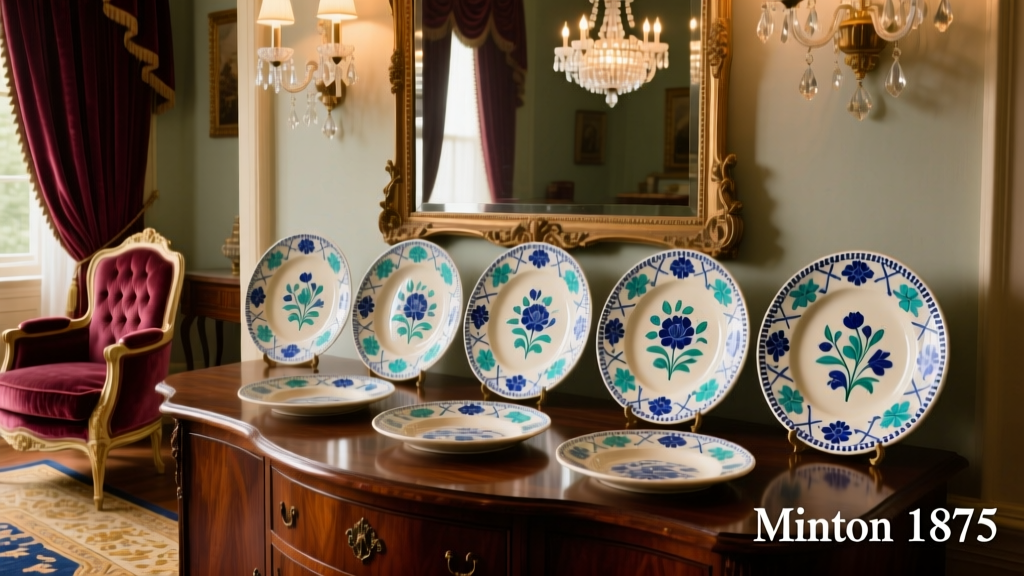
Oyster Plates with 6 Wells: Majolica Cracker Well in Cobalt Blue and Turquoise by Minton — A Collector’s Guide to the 10-Inch Victorian Masterpiece
Martin Visser Upholstered Daybed, c. 1960: Design Legacy, Restoration Protocol, and Historical Context
Wave Crest Biscuit Jar: The Daisy-Tulip Shape — History, Identification, and Restoration Insights
Toy Steam Roller with Right-Facing Flywheel: A 1925 Märklin Tinplate Masterpiece (11 × 5 Inches)

Halloween Tambourine '2 Black Cats on Pumpkin': A Collector’s Guide to Vintage Novelty Percussion
Depression Glass Princess Cup in Topaz Yellow: History, Identification, and Collectibility
Knife Pocket Kent, NY City: Identifying and Preserving the Dual-Blade Clear Plastic Handle Pocket Knife
Chinese Export Garden Seat Landscape Design: Authentic 18-Inch Rosewood Seating from the Qing Dynasty Trade Era