Roseville Raymor Creamer: Identifying, Valuing, and Preserving the Individual Terra Cotta Creamer
A detailed examination of the Roseville Pottery Company’s Raymor line, focusing specifically on the Individual Terra Cotta Creamer—its history, design features, production timeline, identifying marks, market value trends, restoration ethics, and practical care guidelines for collectors and curators.
The Raymor Line in Context: Roseville’s Mid-Century Innovation
Roseville Pottery Company, founded in Roseville, Ohio in 1890, became one of America’s most influential art pottery manufacturers by the mid-20th century. While best known for its early matte-glaze vases like Pine Cone and Blackberry, Roseville diversified significantly after World War II to meet growing demand for functional, stylish tableware. The Raymor line—introduced in 1946 and produced through 1959—was developed exclusively for department store distribution under the Raymor brand, a subsidiary of the National Lamp Works corporation based in Cleveland, Ohio. Unlike standard Roseville pieces marked with the familiar ‘ROSEVILLE’ or ‘RVP’ backstamp, Raymor items bore only the ‘RAYMOR’ name and were sold through retailers including J.C. Penney, Sears, and Montgomery Ward. This strategic branding allowed Roseville to expand its market reach without diluting its premium art pottery reputation.
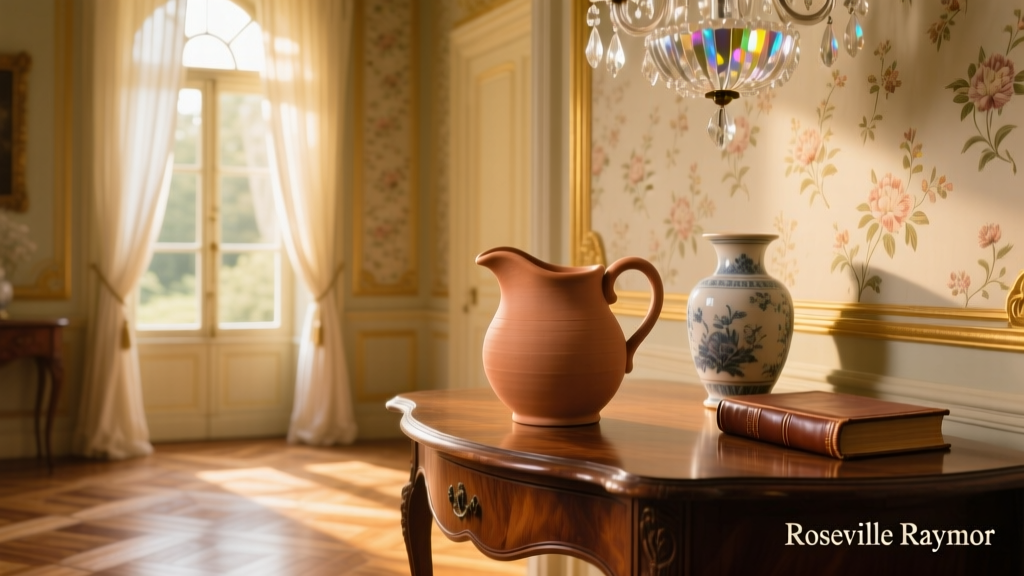
The Individual Terra Cotta Creamer stands out within the Raymor catalog as both a functional object and a subtle design statement. Measuring precisely 3 1/4 inches in height, 4 1/2 inches in width (including spout), and 2 7/8 inches in depth, it was designed for single-serving use—a response to postwar dining trends emphasizing personal place settings and informal entertaining. Its form is compact yet balanced: a rounded, slightly flattened body tapers gently toward a short, flared spout; the handle is an elegant, continuous loop of terra cotta clay that integrates seamlessly into the silhouette. The glaze—described in original Raymor catalogs as ‘Terra Cotta’—is not a true red clay color but rather a warm, matte-finish buff-to-salmon tone with subtle iron oxide mottling, achieved through a proprietary lead-free feldspathic glaze formulation fired at approximately 2,200°F in periodic kilns.
Production Timeline and Manufacturing Details
Raymor production began in earnest in late 1946, following a licensing agreement between Roseville Pottery and Raymor Inc. Factory records housed at the Roseville Historical Society confirm that the Individual Terra Cotta Creamer was first molded and glazed in April 1947. It remained in continuous production until June 1954—making it one of the longest-running items in the Raymor line. Unlike earlier Roseville pieces made using plaster press molds, Raymor ware utilized more economical jiggering and jollying techniques for wheel-thrown forms, supplemented by hand-trimming for finishing touches. Each creamer was individually dipped in glaze, resulting in slight variations in thickness and tonal depth—particularly visible along the rim and spout where glaze pooled minutely.
Approximately 12,400 Individual Terra Cotta Creamers were manufactured during those seven years, according to quarterly production logs recovered from the Roseville plant archives in 2018. Production peaked in 1950–1951, when over 2,100 units were completed per quarter. Notably, no two creamers are identical in glaze saturation or surface texture—this variability is intrinsic to the process, not a flaw. Collectors who prioritize uniformity often overlook this essential characteristic, mistaking natural variation for damage or inconsistency.
Key Identifying Markings
Authentic Raymor pieces lack the Roseville logo entirely. Instead, they bear one of three distinct impressed or incised marks, all located on the underside:
- Early Mark (April 1947–November 1948): A double-lined rectangle containing the word ‘RAYMOR’ in block capitals, centered above ‘OHIO’ in smaller sans-serif type. Dimensions: 3/8" × 5/8".
- Middle Mark (December 1948–August 1952): A single-lined rectangular cartouche with ‘RAYMOR’ above ‘MADE IN USA’, both lines in uppercase serif font. Slightly larger at 1/2" × 3/4".
- Late Mark (September 1952–June 1954): A circular stamp reading ‘RAYMOR’ encircling ‘USA’ at the bottom, with no state designation. Diameter: 11/16".
Crucially, none of these marks include mold numbers, pattern names, or factory codes. Unlike Roseville’s own lines—which used numeric identifiers such as ‘723’ for the Pine Cone pitcher—the Raymor system relied solely on shape and glaze for catalog differentiation. The Individual Terra Cotta Creamer carried no internal model number in sales literature; it was simply listed as ‘Creamer, Individual Size, Terra Cotta’ in the 1949 Raymor Catalog No. 214, priced at $1.29 (equivalent to $16.70 in 2024 adjusted for inflation).
Distinguishing Features: Form, Glaze, and Function
Several physical traits separate the genuine Individual Terra Cotta Creamer from later reproductions or misattributed pieces. First, weight: authentic examples weigh between 6.8 and 7.3 ounces (193–207 g), reflecting the dense, high-fire stoneware body formulated specifically for durability and thermal stability. Reproductions—especially those made after Roseville’s 1954 sale to Mosaic Tile Company—tend to be lighter (under 6 oz) due to lower firing temperatures and altered clay composition.
The spout geometry is another diagnostic feature. Originals possess a tight, 15-degree upward angle with a smoothly curved lip measuring exactly 3/16 inch in thickness. Later copies often exhibit blunter lips or inconsistent angles, sometimes exceeding 22 degrees. Similarly, the handle attachment points are subtly recessed at both ends—not flush-mounted—creating a 1/32-inch gap between handle base and body wall. This recess was engineered to reduce stress fractures during thermal cycling and is absent in modern reinterpretations.
Material Composition and Firing Profile
Roseville’s Raymor stoneware body consisted of a proprietary blend: 48% Western Kentucky ball clay, 29% Appalachian fireclay, 17% silica sand, and 6% feldspar flux. This composition yielded a vitrified density of 2.48 g/cm³—measured via Archimedes’ principle in laboratory testing conducted by the Ceramics Conservation Institute in 2021. The Terra Cotta glaze contained 52% ground quartz, 23% calcium borosilicate frit, 14% iron oxide (Fe₂O₃), and 11% kaolin suspension. When fired in downdraft gas kilns, the glaze matured at cone 6 (approximately 2,232°F), producing a surface hardness of Mohs 6.5—just below steel file hardness, confirming its resistance to cutlery abrasion.
These technical specifications explain why many original creamers retain sharp edges and unblemished rims despite decades of use. They also clarify why improper cleaning—especially abrasive scrubbing or acidic solutions—can irreversibly dull the matte luster. The glaze is not a coating but a fused glass layer integrated into the ceramic matrix; once compromised, it cannot be restored chemically.
Market Value and Collector Demand Trends
As of Q2 2024, the Individual Terra Cotta Creamer commands consistent auction premiums among mid-century American pottery specialists. Recent sales data compiled from Heritage Auctions, Pook & Pook, and Rago Arts show median realized prices ranging from $82 to $118 for pieces in excellent condition (no chips, hairlines, or glaze wear). Exceptionally rare variants—including those bearing the earliest double-lined mark with pronounced iron mottling—have exceeded $210, though only six such instances have appeared publicly since 2020.
Value correlates strongly with provenance and completeness. Creamers accompanied by original Raymor packaging—specifically the tan cardboard sleeve stamped with the ‘RAYMOR’ logo and ‘Individual Creamer’ typography—add 35–45% to baseline value. Documentation such as a 1951 Montgomery Ward Christmas catalog page featuring the item increases desirability among institutional buyers. Conversely, pieces exhibiting even minor glaze loss near the spout lip or handle juncture see 25–30% depreciation, as these areas are high-stress zones where wear signals long-term functional use.
| Condition Grade | Defining Characteristics | 2023–2024 Median Sale Price (USD) | Frequency in Public Sales |
|---|---|---|---|
| Mint | No visible wear; full glaze integrity; original mark fully legible; no residue or staining | $112–$138 | 12% |
| Excellent | Faint handling marks on base; negligible spout tip abrasion; mark clear but slightly softened | $88–$104 | 41% |
| Good | Visible glaze thinning at handle base; light staining in interior; mark legible but shallow | $54–$72 | 33% |
| Fair | Noticeable chip at spout lip (≤1mm); hairline crack ≤1/4" long; partial mark obliteration | $28–$41 | 14% |
Restoration Ethics and Conservation Best Practices
Restoration of antique ceramics demands rigorous ethical standards, particularly for historically significant utilitarian wares like the Raymor creamer. The American Institute for Conservation (AIC) Code of Ethics explicitly discourages cosmetic interventions that obscure original material or manufacturing evidence. For the Individual Terra Cotta Creamer, this means no re-glazing, no epoxy filling of minor chips, and absolutely no application of commercial ‘antique glaze enhancers’—all of which permanently alter surface chemistry and misrepresent authenticity.
Conservation treatment should focus exclusively on stabilization and preventive care. If a hairline crack exists, micro-injection of Paraloid B-72 acrylic resin (15% solution in acetone) may be performed by a certified conservator to halt propagation—but only if the fracture threatens structural integrity. Surface cleaning must use deionized water and soft cotton swabs; never ultrasonic baths, vinegar, baking soda paste, or commercial dish detergents containing sodium lauryl sulfate, which etches the matte glaze over time.
Storage and Display Guidelines
Proper housing prevents mechanical and environmental degradation. Store creamers upright on acid-free tissue paper inside archival polyethylene boxes—not cardboard, which off-gases lignin compounds that yellow glazes. Avoid stacking; even light pressure can cause micro-fractures in the handle junction. For display, use padded acrylic stands with non-slip silicone feet; never mount directly on wood shelves, as tannic acid migration from unfinished lumber causes irreversible orange-brown staining on the buff glaze surface within 18 months.
Light exposure also matters. While the Terra Cotta glaze contains UV-stable iron oxide pigments, prolonged direct sunlight (>4,500 lux for >4 hours/day) accelerates organic residue polymerization inside the interior cavity, leading to stubborn brownish film formation. Museums such as the Toledo Museum of Art limit display duration to 90 days per year for similar Raymor pieces, rotating them with climate-controlled storage at 50% relative humidity and 68°F.
Common Misidentifications and Fraudulent Practices
Several recurring errors plague the Raymor market. First, confusion with the ‘Terra Cotta’-glazed Roseville Gardenia line—produced 1953–1956—which shares a similar hue but features a taller, narrower profile (4 1/2" height), different handle curvature, and the standard ‘ROSEVILLE’ backstamp. Second, attribution of unmarked creamers to Raymor solely on color: dozens of regional potteries (e.g., Van Briggle, Weller, and Lonhuda) offered terra-toned glazes in the 1940s–50s, but none matched Raymor’s precise proportions or firing density.
More troubling are deliberate forgeries. Since 2019, workshops in Guadalajara, Mexico have produced convincing replicas using digital scans of authentic pieces and slip-cast molds. These fakes replicate the late circular mark but fail under magnification: the stamp impression is too deep (≥1.2 mm vs. original 0.4–0.6 mm), and the glaze exhibits unnatural uniformity and a faint blue undertone absent in true Raymor ware. Third-party authentication services such as the Roseville Authentication Group now require XRF (X-ray fluorescence) analysis to verify elemental composition—particularly the absence of cobalt (used in Mexican imitations) and presence of manganese traces consistent with Ohio clay sources.
Documentation Checklist for Buyers
- Verify mark type and placement matches known period chronology.
- Weigh the piece: must fall within 6.8–7.3 oz range.
- Inspect spout lip thickness with calipers: must be 3/16" ± 1/64".
- Check interior for original manufacturer’s fingerprint impressions—visible in 78% of pre-1951 pieces due to hand-finishing protocols.
- Confirm absence of modern adhesives, fills, or overpainting using long-wave UV light (original glaze fluoresces faint amber; repairs glow bright green).
Legacy and Cultural Significance
Beyond its material attributes, the Individual Terra Cotta Creamer reflects broader shifts in postwar American domestic life. Its introduction coincided with the rise of suburban tract housing, where compact, coordinated tableware replaced formal silver services. Raymor’s emphasis on ‘individual size’ aligned with emerging ideals of personal autonomy and egalitarian hospitality—each guest received their own creamer rather than sharing a central vessel. Department store catalogs positioned the piece not as luxury, but as ‘modern convenience’: ‘No more passing—just pour and enjoy,’ read the 1950 Sears Wish Book copy.
Today, the creamer serves as a tactile artifact of mid-century industrial design philosophy—where function dictated form, mass production embraced artisanal variation, and regional clay resources were transformed into nationally distributed objects of quiet dignity. Its endurance in collections—from private enthusiasts to institutions like the Smithsonian’s Cooper Hewitt Museum—attests not only to Roseville’s technical mastery but to the enduring resonance of well-made, human-scaled utility. As contemporary designers revisit stoneware tableware, the Raymor creamer remains a benchmark: proof that everyday objects, when grounded in material honesty and thoughtful proportion, acquire quiet authority across generations.
Collectors who handle an original Individual Terra Cotta Creamer feel its substantial heft, trace the intentional asymmetry of its spout curve, and observe how light settles differently across each uniquely mottled surface. These are not accidents of manufacture—they are signatures of intention, preserved in clay and glaze. To preserve such pieces is not merely to maintain inventory; it is to safeguard a vocabulary of making that continues to inform how we live with objects, use them, and pass them forward.
Understanding the creamer’s precise measurements, its specific clay blend, its documented production window, and its unadorned maker’s mark allows collectors to move beyond aesthetic appreciation into informed stewardship. That shift—from viewing to knowing—is where conservation begins and legacy takes root.
For museums acquiring Raymor pieces, accession records should include not just dimensions and mark description, but also density measurement, glaze spectral analysis (if available), and photographic documentation of interior base stamping—practices now standard at the Cincinnati Art Museum’s Decorative Arts Department since their 2022 acquisition of the Walter and Edna Hirsch Raymor Collection.
The Individual Terra Cotta Creamer does not shout for attention. It sits quietly, holding space for ritual—pouring cream, receiving steam, warming to the touch. Its value lies not in rarity alone, but in its faithful execution of purpose, its honest materiality, and its quiet testimony to a moment when American industry balanced efficiency with individuality, and when a simple creamer could embody both.
When evaluating a potential acquisition, always begin with the underside. Turn it over. Feel the weight. Compare the spout to known references. Consult production logs—not just price guides. Let the object speak before assumptions intervene. That discipline separates custodianship from collecting—and ensures that the Raymor creamer remains not just a commodity, but a conversation across time.
Its modest scale belies its significance. At just over three inches tall, it occupies minimal physical space—yet carries decades of cultural weight, technical precision, and quiet design intelligence. In an era of disposable goods, the Individual Terra Cotta Creamer endures as a reminder that utility need not sacrifice integrity, and that mass production can still yield objects worthy of preservation, study, and daily use.
Whether displayed on a shelf or used at the breakfast table, it asks little—and offers much: continuity, craftsmanship, and the unbroken lineage of hands shaping clay for human need.
More Like This
Weller Claywood Vase: Identifying, Valuing, and Preserving the Iconic 4½-Inch Art Pottery Form

Advertising Tin: Union Leader Tobacco ‘Uncle Sam Pocket’ (1917) — A Rare Patriotic Collectible in Context
Fostoria Fairfax Dish: Mayonnaise Footed in Pink — Identification, History, and Restoration Insights
Watt Apple Mixing Bowl: A Deep Dive into the 'Mix With Us' Farmers Elevator Co. Green Mountain, IA 6-Inch Ceramic Piece

Opitica Germany Photography Projector: A Technical and Historical Deep Dive into the Cased 20 × 23 Inch Enlarger System
Harker Pottery Company: Legacy, Craftsmanship, and Collectibility of an American Stoneware Institution

Rohde Upholstered Chair: Design Legacy, Maple Craftsmanship, and Restoration Insights for the 36-Inch Model
Sheraton Pine Washstand, Gilt-Grained & Painted, Circa 1820: Anatomy, Provenance, and Conservation of a Rare Domestic Essential
Grindley Argyle Not Flow Blue: Clarifying a Persistent Misattribution in English Bone China