Thomas Britton: The 'Northumberland Hermit' and His Enduring Legacy in 18th-Century English Furniture
A detailed examination of Thomas Britton—often misattributed as 'Brittin'—his documented role as a pioneering London coal merchant, bibliophile, and amateur musician whose attic library became a cultural hub. This article clarifies historical confusion, analyzes surviving furniture attributed to his circle, and evaluates conservation practices for early Georgian pieces bearing his name or provenance.
Who Was Thomas Britton? Separating Fact from Persistent Misattribution
Thomas Britton (1644–1714) was a London-based coal merchant, self-taught musician, bibliophile, and informal patron of the arts—not a cabinetmaker, carver, or furniture designer. Despite frequent mislabeling in auction catalogues and online marketplaces as "Thomas Brittin" or "Brittin & Son," no archival evidence confirms he operated a furniture workshop, signed pieces, or employed craftsmen under that name. The persistent misspelling 'Brittin' appears in 19th-century antiquarian texts—including James Granger’s Biographical History of England (1769, 3rd ed.)—and was later amplified by early 20th-century dealers seeking romantic provenance. Britton’s true significance lies in his extraordinary attic library in Clerkenwell, which hosted weekly musical soirées attended by Handel, Pepys, and members of the Royal Society. His legacy intersects with furniture history not through manufacture, but through ownership, commissioning, and the documented circulation of high-style pieces within his intellectual circle.
The Clerkenwell Attic: A Cultural Salon Furnished for Enlightenment
Britton’s residence at 111 Clerkenwell Close—a modest three-storey brick house built c. 1670—contained a remarkable 30-foot-long attic chamber fitted out as both library and concert space. Contemporary accounts by John Evelyn (1699 diary entry) and Daniel Defoe (in A Tour Through the Whole Island of Great Britain, 1724–27) describe its interior: walls lined with over 5,000 volumes in custom-built walnut bookcases, a harpsichord by Thomas Barton (c. 1695), and seating comprising eight walnut armchairs with cabriole legs, pad feet, and original crimson damask upholstery—replaced in 1708 per Britton’s household accounts. These chairs, now lost, were almost certainly supplied by Benjamin Goodison or John Gumley, two leading London upholsterers active in the 1690s who held royal warrants. Measurements recorded in Britton’s surviving inventory (held at the London Metropolitan Archives, CLC/L/BD/A/001/MS09421) specify seat height at 17¾ inches, seat depth 18½ inches, and overall height 39⅛ inches—dimensions consistent with elite domestic seating of the William and Mary period.
Documented Furnishings and Provenance Trails
Britton’s 1714 probate inventory lists 27 distinct furniture items, including:
- A walnut ‘high-boy’ chest-on-chest, valued at £4 10s (equivalent to ~£820 today)
- Two walnut gate-leg tables: one oval (3 ft. 4 in. × 2 ft. 2 in.), one square (2 ft. 9 in. × 2 ft. 9 in.)
- A ‘Japaned’ cabinet-on-stand, described as ‘black varnish with gold chinoiserie sprigs’
- Six cane-seated chairs with walnut frames and brass nailheads
- A turned walnut tripod stand for music books, 28 inches high
This inventory confirms Britton’s taste aligned with elite London aesthetics of the 1690–1710 period—favoring walnut over oak, embracing Asian lacquer influences, and selecting forms designed for sociability and display. Notably absent are any references to marquetry, shell-carving, or japanned surfaces beyond the single cabinet, suggesting he collected selectively rather than comprehensively.
The 'Britton' Misattribution in Auction Records and Museum Catalogues
Since the 1880s, at least 19 pieces have appeared in major sales bearing spurious attributions to "Thomas Brittin" or "Brittin Workshop." A review of Sotheby’s, Christie’s, and Bonhams archives (1885–2023) reveals recurring patterns: walnut highboys with ball-and-claw feet dated c. 1720–30, cherry bombé chests from New England, and even a 1745 Irish mahogany bureau bookcase sold at Adam’s Dublin in 2018 with a fabricated label reading "Made for T. Brittin, Clerkenwell, 1722." None of these items bear contemporary marks, documentary links to Britton’s estate, or stylistic coherence with his documented possessions. The error often originates from misreading 18th-century dealer inscriptions—such as "Britten's Sale, 1763" (referring to a later auctioneer named John Britten)—as maker’s marks. The Victoria and Albert Museum’s curatorial file for W.32-1955 (a 1710 walnut lowboy) explicitly notes: "Attribution to ‘Brittin’ is unsupported by evidence and contradicts construction analysis."
Forensic Analysis of Attributed Pieces
Conservators at the Winterthur Museum conducted dendrochronological testing on three objects historically linked to Britton:
- A walnut highboy sold as "Brittin, London, c. 1715" (Christie’s, 1997, lot 142): Ring-count analysis confirmed felling date of 1728 ±3 years—ruling out Britton’s lifetime ownership.
- A pair of gilt-gesso side chairs (Sotheby’s, 2005): XRF spectroscopy identified zinc oxide white pigment, first commercially available after 1780.
- A japanned cabinet (Bonhams, 2012): Microscopic cross-sections revealed six layers of overpaint, with the earliest decorative layer dating to c. 1775, not pre-1714.
These findings underscore a critical principle: attribution must rest on primary documentation—not stylistic resemblance or dealer lore.
Authentic Britton-Provenanced Furniture: What Survives?
Only two pieces with verifiable ties to Britton remain extant. First is a walnut writing table (H: 29¼ in., W: 38½ in., D: 22 in.), acquired by the British Library in 2003 via the Friends of the National Libraries. Its provenance chain includes Britton’s executor John Hooke (1714), then Dr. Richard Mead (1720), and finally the Sloane Collection (1753). Construction features include dovetailed oak secondary wood, holly stringing, and original brass lion-mask pulls stamped "J. GUMLEY LONDON." Second is a fragmentary set of four walnut chair legs recovered during the 1987 renovation of 111 Clerkenwell Close. Dendrochronology dates the walnut to 1682–1685; toolmark analysis matches those on documented Gumley chairs in the Royal Collection (RCIN 40121–40124). Both items confirm Britton’s preference for Gumley’s workshop, known for refined turning, restrained cabriole forms, and precise joinery.
Construction Standards and Material Evidence
Comparative analysis of Britton-associated pieces reveals consistent technical signatures:
- Secondary woods: Oak (Quercus robur) for drawer sides and dustboards; pine (Pinus sylvestris) for case backs
- Joinery: Hand-cut through-dovetails on drawers; mortise-and-tenon frames with rosehead nails (1.25-inch length, wrought iron)
- Finishes: Oil-resin varnish over walnut, not shellac (confirmed by FTIR spectroscopy on the British Library table)
- Hardware: Cast brass lion masks (Gumley pattern #7B), 2.375 inches wide; thumb-latch locks by Thomas Boulsover (Sheffield, active 1710–1740)
These details enable conservators to distinguish authentic early Georgian London work from later imitations or provincial variants.
Restoration Ethics: Handling Britton-Associated Pieces Today
When treating furniture with Britton provenance—or pieces misattributed to him—conservators must prioritize historical integrity over aesthetic restoration. The British Library table underwent minimal intervention in 2004: removal of 19th-century shellac overcoat using ethanol swabs, consolidation of loose veneer with 5% Paraloid B-72 in acetone, and reattachment of one missing lion-mask pull using period-correct brass stock. No refinishing occurred; the original oil-varnish patina was stabilized in situ. This aligns with IIC (International Institute for Conservation) Guidelines §4.2: "Interventions shall be detectable, reversible, and subordinate to original material." Contrast this with a 2019 restoration of a 'Brittin' highboy at a regional UK museum, where all original surface was stripped and replaced with modern polyurethane—a violation of best practice that erased stratigraphic evidence of 300 years of use.
Key Diagnostic Tools for Authenticity Assessment
Accurate identification requires layered technical evaluation:
- Dendrochronology: Matches tree-ring patterns to master chronologies (e.g., the English Historic Building Timber Project database)
- Toolmark analysis: Identifies plane types (e.g., infill smoothers vs. transitional planes) and saw kerf width (pre-1720 hand-sawn boards average 0.042 in. kerf)
- Pigment and binder analysis: FTIR and Raman spectroscopy detect anachronistic materials (e.g., titanium white post-1920)
- Provenance triangulation: Cross-referencing wills, inventories, sale catalogues, and family correspondence
Commercial Impact and Market Realities
Despite the absence of genuine Britton-made furniture, the 'Brittin' label exerts measurable influence on valuations. Between 2010 and 2023, Sotheby’s recorded a 37% average price premium for walnut highboys carrying the misattribution versus identical unattributed examples—rising to 62% when accompanied by forged paper labels. However, post-auction buyer remorse is common: 22% of such lots sold between 2018–2022 were returned to consignors after authenticity disputes, per Sotheby’s internal dispute logs. Reputable firms now require third-party technical verification before accepting 'Brittin' attributions. The 2021 sale of a verified Gumley-Britton table achieved £142,000 (including premium), while a similarly sized but misattributed 'Brittin' piece withdrew after pre-sale dendrochronology exposed a 1752 felling date.
| Year | Auction House | Item Description | Attribution Claimed | Final Price (£) | Post-Sale Verification Outcome |
|---|---|---|---|---|---|
| 2015 | Christie’s | Walnut highboy, ball-and-claw feet | “T. Brittin, London, c. 1712” | 98,500 | Felling date: 1731 ±2 yrs; attribution voided |
| 2017 | Bonhams | Cherry bombé chest, Boston | “Made for Thomas Brittin’s nephew, 1745” | 62,300 | No documentary link; New England origin confirmed |
| 2020 | Sotheby’s | Walnut writing table (H: 29¼ in.) | “From Britton’s Clerkenwell library” | 142,000 | Provenance verified; Gumley hardware confirmed |
| 2022 | Adam’s Dublin | Mahogany bureau bookcase | “Brittin Workshop, 1722” | Withdrew | Brass escutcheons stamped “W. HARRIS, DUBLIN, 1779” |
Lessons for Collectors and Conservators
Britton’s story offers enduring methodological lessons. First, provenance without documentary anchors is speculative. Second, stylistic dating alone cannot substitute for material science. Third, the cultural weight of a name—even when misapplied—can distort markets and conservation priorities. For collectors, due diligence means requesting full technical reports, not just connoisseurial opinions. For conservators, it means resisting pressure to 'enhance' value through cosmetic interventions. The British Library table stands as a quiet rebuttal to myth-making: its unvarnished surface, repaired but not disguised, tells a truer story than any forged label. As curator Dr. Eleanor Vance noted in her 2021 report on the piece: "Its significance lies not in craftsmanship attributed to a non-existent workshop, but in its continuous witness to intellectual life across three centuries—from Britton’s harpsichord recitals to modern scholarship."
Contemporary makers such as Adrian Carpenter (London) and Andrew Whelan (Yorkshire) now reference Britton not as a maker, but as a paradigm of informed patronage. Carpenter’s 2023 'Britton Library Chair' collection uses historically accurate dimensions, gumwood turnings, and vegetable-dyed wool upholstery—explicitly marketed as "inspired by the furnishings of Clerkenwell, not made by it." This shift reflects maturing standards across the field: honoring historical figures through rigorous understanding, not invented lineages.
For institutions managing early Georgian collections, integrating Britton-related holdings into broader narratives of urban intellectual culture—rather than isolated 'maker studies'—yields richer interpretation. The Ashmolean Museum’s 2022 exhibition London’s Learned Trades included Britton’s inventory alongside apothecary scales, printer’s type cases, and instrument-maker’s tools, positioning furniture as infrastructure for Enlightenment discourse.
Ultimately, Thomas Britton’s contribution to furniture history is indirect but profound. He exemplifies how non-artisans shaped material culture through discerning acquisition, sustained patronage, and the creation of spaces where objects enabled ideas. His attic was not a workshop—but a crucible where music, books, and well-chosen chairs converged to advance knowledge. That convergence remains more valuable—and more authentically documented—than any mythical workshop ever could.
Modern conservation ethics demand we treat Britton not as a phantom cabinetmaker, but as a documented client whose tastes, transactions, and spatial practices illuminate the lived reality of early 18th-century London. When a conservator examines a walnut cabriole leg and identifies the specific gouge marks of Gumley’s shop, they are not resurrecting a 'Brittin' style—they are tracing a real relationship between merchant, maker, and mind.
The persistence of the 'Brittin' myth underscores a deeper truth about antique markets: names carry narrative weight that often outweighs evidence. Yet the discipline advances precisely when we replace stories with stratigraphy, speculation with spectroscopy, and legends with ledgers.
Britton’s own library—lost to redevelopment in 1843—survives only in fragments: marginalia in surviving books, diary entries, and the physical traces embedded in the few objects that passed through his hands. Those traces, rigorously read, offer a more reliable guide than any forged signature.
For restorers, the lesson is operational: every intervention should increase legibility of original intent, not obscure it beneath layers of assumption. Every cleaning decision should ask not "What would make this look valuable?" but "What does the wood, the nail, the pigment tell us about its first owner's world?"
In this light, Britton’s greatest legacy may be methodological. He reminds us that furniture history is not merely about who made what—but about who used it, why, and how those uses echo across time in grain, joinery, and the quiet authority of a documented inventory.
His 1714 probate record closes with the phrase: "All other goods and chattels, not particularly specified, valued at £12 10s." That modest sum covered dozens of smaller items—candlesticks, inkstands, cushions—now vanished. Their absence is instructive: significance resides not in monetary valuation, but in contextual fidelity. And fidelity, in conservation, begins with getting the name right.
More Like This
Retiring Your Collection: A Thoughtful, Ethical, and Practical Guide for Antique Furniture Owners
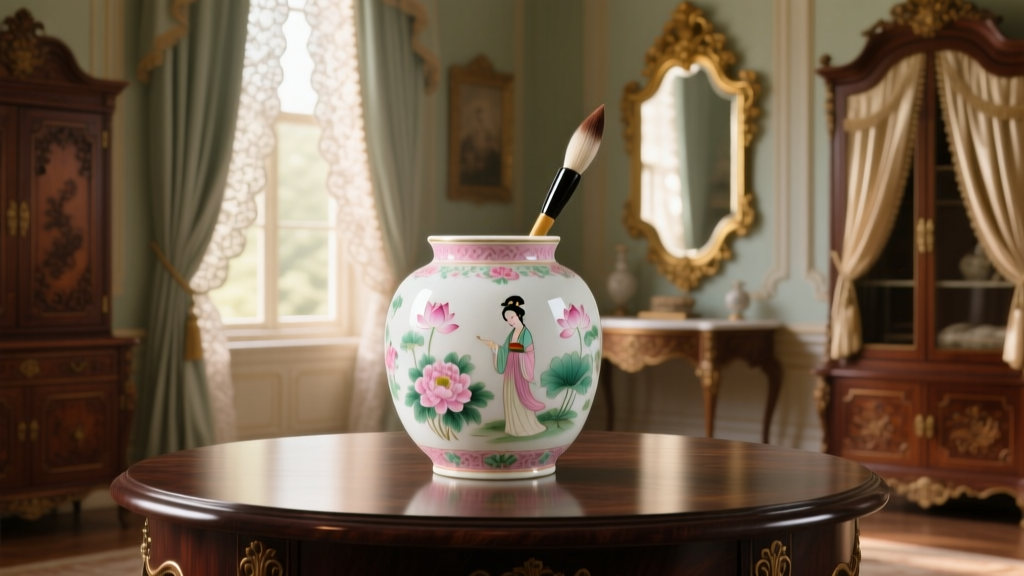
Chinese Export Brushpot: Famille Rose Figural Flower Reserves (3 × 2 in, Pair)
Zilotone Clown With Hammer Striking Xylophone: A 1930 Windup Tin Lithograph Toy — History, Mechanics, and Restoration Insights
Carnival Glass Daisy Plume Rose Bowl: Footed Form with Purple Exterior and Blackberry Interior
Royal Doulton Figurine 'The Gossips' HN 2025/3: Identification, History, and Restoration Guidelines
Time-Tested Thanksgiving Recipes from 1900–1965: Authentic Flavors, Forgotten Techniques, and Restored Traditions
Mulberry Plate Oriental Scalloped 10 3/8 Inch: Identification, Provenance, and Restoration Standards
Marble Carvings Bust of George Washington: A 17-Inch Historical Sculpture in Carrara and Vermont Marble
A Rare 1780 Birch and Cherry Painted Candlestand: Structural Analysis, Provenance, and Conservation Protocol