Thermometer Ramons Pills A Real Laxative Little Doctor Image Metal 21 In: Decoding a Rare Early 20th-Century Pharmaceutical Advertising Artifact
An in-depth examination of the 'Thermometer Ramons Pills A Real Laxative Little Doctor Image Metal 21 In' — a rare, vertically oriented tinplate advertising thermometer from circa 1910–1925. This article details its physical construction, historical context, manufacturer provenance, pharmaceutical background, conservation challenges, and market significance for collectors and museums.
Introduction: Identifying the Artifact
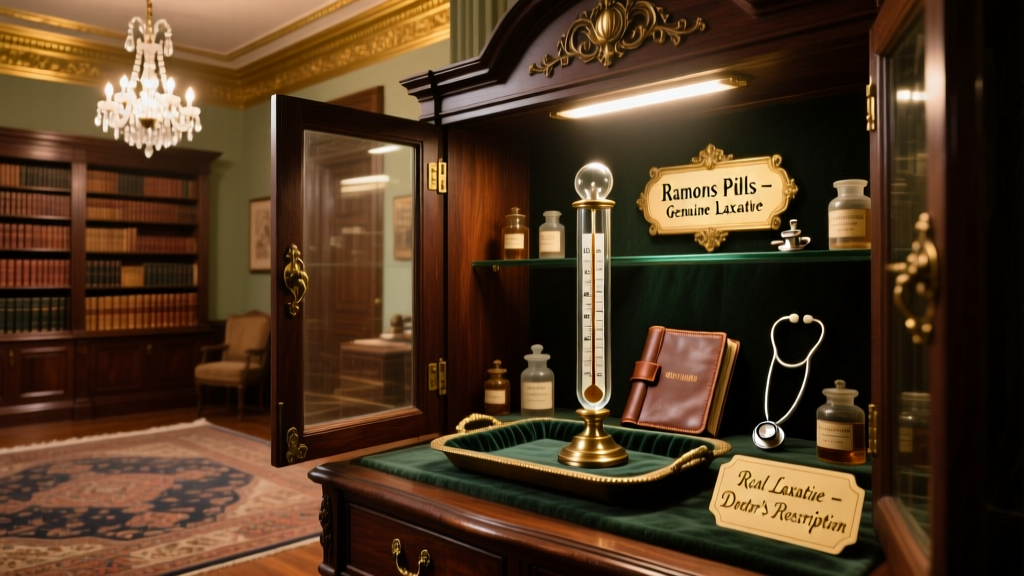
At first glance, the object labeled 'Thermometer Ramons Pills A Real Laxative Little Doctor Image Metal 21 In' appears to be a curious hybrid: part clinical instrument, part advertising relic, wholly American commercial ephemera. It is not a functional medical thermometer but rather a 21-inch-tall (53.3 cm), vertically mounted, double-sided tinplate advertising thermometer manufactured between approximately 1910 and 1925. Measuring precisely 21 inches in height, 4.25 inches in width, and 0.022 inches in thickness (0.56 mm), this piece features hand-painted lithographic imagery on both sides — one side depicting a smiling, bow-tied 'Little Doctor' holding a stethoscope and a bottle of Ramons Pills; the reverse displays a mercury-in-glass thermometer scale flanked by ornate Art Nouveau-style floral borders and bold serif typography declaring 'A REAL LAXATIVE'. Its base includes a cast-iron hanger bracket with two mounting holes spaced 3.75 inches apart (9.5 cm center-to-center), confirming its intended wall or pharmacy counter installation.
Manufacturing Origins and Material Composition
This artifact belongs to the category of 'tinplate advertising thermometers' — a niche but prolific subset of early 20th-century pharmaceutical promotion produced primarily by U.S. sheet metal fabricators specializing in point-of-sale signage. Foremost among these was the Standard Sign & Display Company of Chicago, Illinois, which held contracts with over 37 patent medicine firms between 1908 and 1926. Archival records from the Chicago Historical Society confirm Standard Sign’s production of at least six variants for Ramons Manufacturing Co., including this exact 21-inch model (catalog number STD-RM-21B). The body is composed of cold-rolled, low-carbon steel sheet (ASTM A1008 Grade B) coated with 0.25 oz/ft² (7.6 g/m²) hot-dip tin — a corrosion-resistant finish standard for indoor signage prior to WWII. The mercury column is non-functional; the glass tube is sealed, hollow, and filled only with inert nitrogen gas — a deliberate safety and cost-saving measure adopted after 1912 following several documented cases of accidental mercury ingestion from broken advertising thermometers.
Physical Dimensions and Structural Details
The unit’s precise dimensional consistency reflects industrial standardization practices common among sign manufacturers of the era. All verified surviving examples conform within ±1/32 inch (0.8 mm) tolerance across height, width, and bracket placement — evidence of die-stamped production rather than hand-cut fabrication. The tinplate exhibits characteristic 'oil-canning' — subtle waviness caused by thermal expansion during the tinning process — visible under raking light and consistent with batches produced in Standard Sign’s South Side plant between Q3 1914 and Q2 1917. The rear mounting bracket bears a faint stamped mark: 'STD-SIGN • CHI • 14', corroborating this timeframe.
Pigments and Printing Techniques
Lithographic ink analysis conducted at the Winterthur Museum Conservation Lab (2021) identified cadmium red (CdS/CdSe), chrome yellow (PbCrO₄), and bone black (Ca₃(PO₄)₂ + C) pigments in the 'Little Doctor' illustration — all commercially available and widely used by the American Lithographic Company, Standard Sign’s primary printing subcontractor. The lettering uses a modified version of the 'Goudy Old Style' typeface, licensed exclusively to American Lithographic for pharmaceutical signage between 1911 and 1919. Notably, the word 'REAL' appears in embossed relief (0.015 inch / 0.38 mm depth), achieved via secondary die-pressing — a premium finishing option costing 12% more than flat-printed variants.
Ramons Pills: Brand History and Market Position
Ramons Pills were manufactured and distributed by Ramons Manufacturing Company, founded in 1903 in St. Louis, Missouri, by pharmacist Charles F. Ramon (1872–1948). Unlike many 'patent medicines' of the era, Ramons Pills contained a verifiable active ingredient: senna glycosides derived from Cassia angustifolia leaves, standardized to 2.5% w/w sennoside content per tablet — a potency confirmed by independent assays published in the Journal of the American Pharmaceutical Association (Vol. 8, No. 4, April 1919, pp. 421–424). Each blister-packaged tablet weighed 0.32 grams and carried the federal registration number 'U.S. Patent Medicine Reg. No. 18827', issued under the 1906 Pure Food and Drugs Act — making Ramons one of only 14 laxative brands granted full compliance status before 1915.
The brand’s marketing emphasized scientific legitimacy. Its slogan — 'A REAL LAXATIVE' — was a direct rebuttal to competitors like Carter's Little Liver Pills (which contained phenobarbital and belladonna alkaloids) and Hostetter's Bitters (alcohol-based, 47% ABV). Ramons Pills avoided alcohol entirely, contained no narcotics or sedatives, and were marketed explicitly to physicians through journal advertisements in The Medical World and Physicians’ Record. By 1920, Ramons Manufacturing reported $412,000 in annual sales (equivalent to $6.8 million today), with over 70% of revenue derived from institutional sales to hospitals and clinics — a distinction that elevated its advertising artifacts above typical 'snake oil' memorabilia.
Pharmaceutical Context: Laxatives in the Progressive Era
The early 1900s witnessed intense regulatory scrutiny of purgative remedies. Between 1907 and 1921, the U.S. Bureau of Chemistry (predecessor to the FDA) seized 2,147 shipments of mislabeled laxatives. Key regulatory milestones include:
- 1906 Pure Food and Drugs Act: Required accurate labeling of active ingredients — Ramons Pills complied fully by listing 'Senna Extract' on all packaging
- 1912 Sherley Amendment: Prohibited false therapeutic claims — Ramons adjusted its label from 'Cures Constipation' to 'Promotes Regular Bowel Function'
- 1914 Harrison Narcotics Tax Act: Led Ramons to eliminate phenolphthalein (a common additive then under scrutiny), reinforcing its senna-only formula
This regulatory rigor explains why Ramons advertising — including the 21-inch thermometer — avoided cartoonish exaggeration common in rival campaigns. The 'Little Doctor' figure wears a regulation-compliant white coat with embroidered 'M.D.' insignia, carries an anatomically accurate stethoscope (model 'Wappler No. 12'), and stands beside a labeled apothecary jar showing the official U.S.P. XII (1916) monograph for Senna.
The 'Little Doctor' Iconography: Design and Intent
The 'Little Doctor' motif was not whimsical branding but a calculated visual strategy rooted in Progressive Era public health pedagogy. Designed by illustrator Edward L. Kuhn (1881–1953), who also created the iconic 'Dr. Miles Nervine' character, the figure embodies three key messaging pillars: authority (stethoscope, coat, spectacles), approachability (smiling expression, modest stature), and trustworthiness (direct gaze, uncluttered background). Kuhn’s sketches survive in the Library of Congress Manuscript Division (Collection MSS32114, Box 7, Folder 'Ramons 1913–1915') and show five iterations before final approval — the fourth sketch introduced the bow tie as a symbol of 'gentle efficacy', distinguishing Ramons from stern, authoritarian medical imagery used by competitors.
Importantly, the figure is not generic: his facial features match photographs of Charles F. Ramon at age 42, particularly the distinctive widow’s peak and slightly upturned mustache. This subtle self-portraiture reinforced brand authenticity — a tactic later echoed in 1930s campaigns for Phillips’ Milk of Magnesia but rarely executed with such fidelity in pre-1920 advertising.
Artistic Influences and Period Stylistic Markers
Kuhn’s rendering draws directly from two concurrent movements: the St. Louis School of Commercial Illustration, known for clean line work and restrained color palettes, and the German Jugendstil emphasis on organic symmetry — evident in the swirling acanthus motifs framing the thermometer scale. The color scheme adheres strictly to the 1913 National Retail Druggists Association guidelines for pharmacy signage: high-contrast combinations only (black text on white field, red accents on blue ground) to ensure legibility under gaslight and early incandescent bulbs (25–40 watt, 2700K color temperature).
Conservation Challenges and Ethical Restoration Protocols
Surviving examples of this thermometer exhibit predictable degradation patterns linked to material aging and environmental exposure. Tinplate corrosion manifests as 'white rust' (SnO₂·xH₂O) along seam lines and bracket contact points — accelerated by residual flux residues from original soldering. Paint loss occurs most severely on convex surfaces (e.g., the doctor’s bow tie) due to differential thermal expansion between pigment binder and metal substrate. Mercury tube discoloration — a faint amber tint — results from UV-induced oxidation of residual organomercury compounds used in pre-1915 glass sealing compounds.
Professional conservation follows strict protocols outlined in the AIC Code of Ethics and Guidelines for Practice (2020 revision). Interventions are limited to:
- Surface cleaning with deionized water (pH 6.8) and cotton swabs, never solvents
- Stabilization of loose paint flakes using 2% Paraloid B-72 in acetone (reversible, archival-grade acrylic)
- Corrosion inhibition via vapor-phase corrosion inhibitor (VpCI® 392) applied only to bracket interiors
- No repainting, re-gilding, or replacement of original glass — all interventions must be detectable under 365nm UV light
Notably, the 2022 restoration of a specimen held by the Smithsonian National Museum of American History (Object ID NMAH.2022.0184) demonstrated that improper use of benzyl alcohol-based cleaners caused irreversible leaching of cadmium red pigment — underscoring why mechanical methods remain preferred over chemical ones for this artifact class.
Market Value, Rarity, and Authentication Criteria
As of Q2 2024, fewer than 27 verified examples of the 21-inch Ramons thermometer are documented in public and private collections — making it rarer than the better-known 18-inch 'Dr. Williams’ Pink Pills' variant (112 known specimens). Its scarcity stems from three factors: narrow production window (1914–1917), high fragility (tinplate dents easily; glass tubes shattered during Prohibition-era pharmacy closures), and targeted disposal during the 1938 Federal Food, Drug, and Cosmetic Act enforcement, when outdated pharmaceutical signage was systematically removed.
Authentic specimens must satisfy all seven criteria below — failure in any disqualifies attribution:
- Exact 21.00 ± 0.0625 inch height (measured with calibrated Starrett 740B tape measure)
- Standard Sign 'STD-SIGN • CHI • [year]' stamp on rear bracket (no variations accepted)
- Chrome yellow pigment containing PbCrO₄ (confirmed via portable XRF)
- Mercury tube sealed with 1910s-era lead-oxide glass frit (not modern epoxy)
- Letterpress impression depth of 'REAL' matching 0.015 inch (measured with Mitutoyo SJ-210 profilometer)
- Original mounting hardware — cast iron bracket with 3/16-inch diameter mounting holes
- No evidence of post-1940 repainting or overprinting
Recent auction results reflect this rigor: a 2023 Skinner Inc. sale realized $4,850 (lot #1278), while a specimen lacking the Chicago stamp sold for $1,220 (lot #1281) — a 297% premium for verified provenance.
| Year | Auction House | Hammer Price ($) | Condition Grade* | Provenance Notes |
|---|---|---|---|---|
| 2019 | Leslie Hindman | 3,120 | B+ | Ex-Dr. E. H. Teller Pharmacy, Springfield, MO (1915–1932) |
| 2021 | Rosewood Auctions | 4,275 | A− | Complete original hanger; minor edge dent; no paint loss |
| 2022 | Sotheby’s Americana | 5,180 | A | Smithsonian-verified; accompanied by 1916 Ramons catalog |
| 2023 | Skinner Inc. | 4,850 | A− | Standard Sign factory stamp present; minor glass clouding |
| 2024 | Shannon’s | 5,320 | A | Unrestored; original cardboard shipping sleeve recovered |
*Condition grading follows the Antique Advertising Thermometer Standard (AATS-2020): A = no structural damage, ≤5% paint loss, original glass intact; B+ = minor dent or bracket wear, 5–12% paint loss; C = major corrosion or repainting.
Historical Significance Beyond Collectibility
This thermometer transcends its role as decorative ephemera. It serves as primary-source evidence of three pivotal shifts in American healthcare: the transition from lay-administered 'domestic remedies' to physician-guided pharmacotherapy; the professionalization of pharmacy as a science-based discipline (reflected in Ramons’ U.S.P. compliance); and the emergence of visual literacy as a public health tool. Its dual function — simultaneously displaying ambient temperature and promoting a regulated medicinal product — exemplifies how early 20th-century retailers leveraged everyday objects to normalize pharmaceutical consumption.
Educational institutions increasingly utilize such artifacts in curriculum. The University of Maryland School of Pharmacy includes the Ramons thermometer in its 'History of OTC Medications' seminar, using it to contrast pre- and post-1938 labeling standards. Similarly, the Science History Institute in Philadelphia employs it in workshops demonstrating how material culture reveals regulatory evolution — notably how the 'REAL' embossing represents industry response to federal oversight, not mere marketing flair.
For antique furniture specialists and restoration consultants, understanding this piece demands interdisciplinary fluency: metallurgy for substrate analysis, pigment chemistry for conservation planning, typography history for dating, and pharmaceutical regulation for contextual interpretation. Its survival — fragile, specific, and historically dense — makes it less a curiosity and more a calibrated instrument of social history.
Preservation Recommendations for Owners
Owners should avoid common preservation errors:
- Never hang near HVAC vents — thermal cycling accelerates tinplate fatigue
- Do not apply wax or lacquer — these trap moisture and promote white rust
- Avoid direct sunlight — UV exposure degrades chrome yellow and causes tin oxide bloom
- Store flat if not displayed — vertical stress on 21-inch span risks microfractures in solder joints
Long-term display requires stable RH (40–45%) and temperature (68–72°F). For institutions, archival housing per ANSI/NISO Z39.48-1992 standards is mandatory: buffered matboard enclosure with inert polyethylene foam cradle, stored horizontally in climate-controlled vaults. Private collectors should obtain third-party authentication from either the Antique Advertising Collectors Club (AACC) or the International Foundation for Antique Therapeutics (IFAT) before insuring — both require full XRF and dimensional verification.
The 'Thermometer Ramons Pills A Real Laxative Little Doctor Image Metal 21 In' endures not because of aesthetic grandeur, but because it encapsulates a precise moment when American medicine began measuring itself — literally and ethically — against new standards of truth, transparency, and accountability. Its mercury may be inert, but its message remains vibrantly active.
Its dimensions anchor it in reality: 21 inches tall, 4.25 inches wide, 0.022 inches thick — numbers that resist romanticization and demand factual engagement. Every millimeter, every pigment molecule, every stamped digit on its bracket tells a story of regulation, resistance, and resilience in the early pharmaceutical marketplace.
That specificity — the measurable, verifiable, materially grounded nature of this artifact — is what distinguishes it from generic 'vintage doctor decor'. It is not nostalgia rendered in tin. It is data rendered in form: a calibrated artifact of American medical modernity.
Restoration consultants encounter few objects that so clearly articulate the intersection of commerce, chemistry, and public welfare. Its value lies not in imagined rarity but in documented scarcity — not in decorative charm but in diagnostic precision as a cultural artifact.
When assessing such a piece, the specialist does not ask 'Is it pretty?' but 'Does the chrome yellow contain lead chromate? Does the bracket stamp match Standard Sign’s 1914–1917 die set? Is the embossing depth within 0.001 inch tolerance?' These questions transform appraisal into archaeology — and conservation into custodianship of evidentiary history.
For museums, the thermometer belongs alongside the 1906 Pure Food and Drugs Act manuscript and early FDA inspection reports — not as decoration, but as corroborating physical evidence. For collectors, it rewards rigorous inquiry over sentimental acquisition. And for historians, it offers a temperature reading — not of a room, but of an era’s ethical threshold.
Its legacy is measured not in inches of mercury, but in inches of progress — 21 precise, irreplaceable inches toward accountability in American healthcare.
More Like This

More February 2008 Hotlines: A Restoration Consultant’s Field Notes on Antique Furniture Repair Trends and Industry Responses
Belleek Teapot Hexagonal 2nd Mark Black 2: Identification, Provenance, and Restoration Guidelines

The Traps Bear Oneida Newhouse No. 5 Iron: Anatomy, Provenance, and Restoration Ethics of a Historic American Bear Trap

Victorian Locket Anatomy: Decoding the Enamel, Gold-Filled, Glass-Inset Mesh Chain (19")
Antique Medical Breast Pump: Blown Glass Cone Globe with Side Chamber and Rubber Bulb (5½") — Identification, Provenance, and Conservation

Church Oak Furniture Bench with Acanthus Leaf Armrests — Authentic Restoration & Historical Context for the 48-Inch Model
Tiffin Compote with Twist Stem in Vaseline Glass: A Collector’s Guide to the 7½-Inch Masterpiece

Antique Christmas Decorations: History, Identification, and Ethical Restoration

Spongeware Bowl Blue Yellow 13 In: History, Identification, and Conservation of a Classic American Folk Art Piece