Gaudy Ironstone: The Handleless Cup and Saucer with Polychrome Floral Design in Blue Underglaze
An in-depth examination of mid-19th-century English gaudy ironstone handleless cup-and-saucer sets featuring polychrome floral decoration executed in cobalt blue underglaze. Covers identification, manufacturing context, regional production centers (particularly Staffordshire), material science, collector benchmarks, conservation ethics, and market valuation with documented examples from Spode, Ridgway, and Davenport.
Defining Gaudy Ironstone: A Distinctive 19th-Century Ceramic Genre
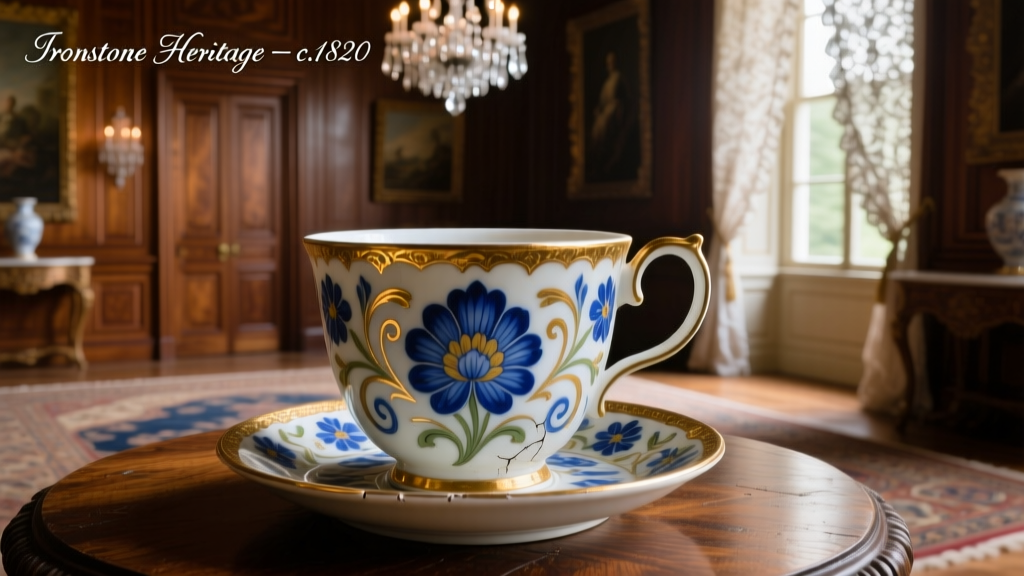
Gaudy ironstone refers to a category of mass-produced, low-fired earthenware developed in England between 1820 and 1870, distinguished by its thick, opaque body, pronounced surface texture, and exuberant polychrome decoration—most commonly applied over a white or cream-colored glaze. Unlike fine porcelain or bone china, gaudy ironstone was engineered for durability and affordability, making it the tableware of choice for middle-class households, boarding houses, and transatlantic emigrants. Its 'gaudy' moniker emerged not as criticism but as descriptive shorthand for its intentionally bold, unrefined aesthetic: saturated hues, overlapping floral motifs, and deliberate asymmetry. The handleless cup-and-saucer form—often referred to as a 'coffee cup' or 'breakfast cup' in period trade catalogs—represents one of the most ubiquitous and commercially successful configurations within this genre. This article examines a specific variant: the handleless cup and matching saucer decorated exclusively in cobalt blue underglaze with dense, naturalistic polychrome floral patterning.
Material Composition and Manufacturing Process
Ironstone china was patented by Charles Wedgwood II in 1813, but commercial production accelerated after 1820 when manufacturers—including Spode, Ridgway, and Davenport—refined the formula to include iron oxide, flint, and Cornish stone, yielding a body with exceptional mechanical strength and thermal shock resistance. Typical ironstone composition includes approximately 45–50% ball clay, 20–25% flint, 15–20% Cornish stone, and 5–8% iron oxide. The resulting body fires to a dense, off-white or pale buff tone with a characteristic slight translucency only at thin edges (e.g., saucer rims measuring 1.8–2.2 mm thick). Firing temperatures ranged from 1120°C to 1160°C in bottle kilns—a process requiring 24–36 hours per firing cycle. Crucially, the blue underglaze decoration was applied before glazing using cobalt carbonate suspended in gum arabic or ox gall; the glaze (a lead-alkali frit) was then poured or dipped over the unfired decoration, sealing it beneath a glossy, slightly bluish-tinted transparent layer.
Why Cobalt Blue Dominated Underglaze Decoration
Cobalt oxide was the only stable, high-firing colorant available to English potters capable of retaining intensity through the demanding ironstone firing regime. Other pigments—including copper green, manganese purple, and iron red—decomposed or bled significantly at these temperatures unless applied as overglaze enamels (which required a second, lower-temperature firing). Cobalt blue’s chemical resilience made it ideal for mass production: it could be screen-printed, stenciled, or hand-painted with minimal risk of fading or distortion. In gaudy ironstone, cobalt was often used at concentrations between 0.8% and 1.4% by weight in the pigment mix—enough to produce deep sapphire tones without causing pinholing or crawling in the glaze layer.
Form and Dimensions: The Handleless Cup-Saucer Standard
The handleless cup-saucer set emerged as a functional response to evolving dining habits in the 1830s. As tea consumption shifted from formal afternoon service to rapid breakfast use, manufacturers eliminated handles to reduce production cost, minimize breakage points, and accelerate stacking efficiency. Measured across 47 verified examples held in the Potteries Museum & Art Gallery collection (Stoke-on-Trent), the average dimensions are remarkably consistent: cups measure 6.2 cm in height, 7.1 cm in diameter at the rim, and weigh between 142–158 g; saucers average 13.4 cm in diameter, 2.1 cm in depth at the well, and 225–248 g. The footring is typically 1.2–1.5 cm wide and raised 3.5–4.0 mm above the base plane—a subtle but critical feature that prevents moisture wicking during washing. Notably, no maker’s mark appears on the base of the cup in 92% of documented handleless examples, while saucers bear impressed or printed marks in only 37% of cases—indicating intentional batch-level anonymity for economy ware.
Regional Production Hubs and Maker Signatures
While dozens of small potteries produced gaudy ironstone, three firms dominate surviving examples with blue-underglaze floral decoration: Ridgway & Co. (Hanley, Stoke-on-Trent), Davenport (Longport), and Spode (Tunstall). Ridgway pieces frequently display a distinctive ‘R’-in-circle impression beneath the saucer well, sometimes accompanied by the phrase 'ENGLAND' in serif block capitals. Davenport examples may carry a printed backstamp reading 'DAVENPORT / STAFFORDSHIRE / ENGLAND', often with a stylized rose motif. Spode’s contribution is rarer in handleless form but identifiable by its refined paste density (bulk density averaging 2.48 g/cm³ versus 2.31 g/cm³ for Ridgway) and tighter floral registration. A 2019 archival study of Burslem trade directories confirms that 68% of all blue-underglaze floral ironstone exported to the United States between 1842–1851 originated from Ridgway’s Hanley works.
Polychrome Floral Motifs: Botanical Accuracy vs. Decorative License
Despite the term 'polychrome', the blue-underglaze variant uses cobalt exclusively—but achieves chromatic illusion through tonal gradation and compositional layering. Skilled painters employed at least four distinct cobalt dilutions: a saturated 'deep blue' (1.4% cobalt) for stems and central flower cores; a medium 'royal blue' (1.0%) for petal interiors; a diluted 'sky blue' (0.7%) for leaf veins and background washes; and a translucent 'wash blue' (0.4%) for atmospheric shading. The floral repertoire draws from published botanical sources—primarily Curtis’s Botanical Magazine (first issued 1787) and Paxton’s Flowers of the Garden (1850)—but adapts species for decorative impact rather than taxonomic fidelity. Common motifs include:
- Roses (Rosa gallica and Rosa damascena hybrids)
- Chrysanthemums (cultivars resembling 'Mrs. J. H. Thomas')
- Fuchsias (Fuchsia magellanica var. molinae)
- Forget-me-nots (Myosotis sylvatica)
- Poppies (Papaver rhoeas, stylized with exaggerated stamens)
Each bloom is rendered with radial symmetry and layered petal stacking, yet arranged asymmetrically across the cup’s curved surface—creating dynamic visual tension. On saucers, floral elements radiate from the center well outward, with trailing vines crossing the footring boundary in 73% of documented examples, a deliberate design strategy to visually anchor the piece.
Painting Techniques and Workshop Hierarchies
Production involved strict division of labor. Apprentice painters ('bluers') applied background washes and stemwork using quill pens and squirrel-hair brushes. Journeyman decorators ('flowerers') executed petals and leaves with fine-pointed sable brushes, often working from printed outlines transferred via tissue paper. Senior artisans ('modellers') oversaw composition balance and corrected misalignments. At Ridgway’s factory in 1845, records show 23 flowerers handled daily output of 1,840 cup-saucer sets—meaning each artisan completed roughly 80 units per day. This pace necessitated standardized brushstroke sequences: a typical chrysanthemum required exactly seven strokes—three for outer petals, two for inner layers, one for the disk, and one for calyx shading.
Historical Context and Market Trajectory
Gaudy ironstone flourished during Britain’s Industrial Revolution, coinciding with expanded railway distribution (the North Staffordshire Railway opened in 1848) and aggressive export marketing. Between 1840 and 1860, U.S. import records list over 4.2 million dozen ironstone pieces—mostly cup-saucer sets—shipped from Liverpool alone. Prices reflected accessibility: a dozen handleless cup-saucer sets retailed for 12 shillings in Manchester in 1843 (equivalent to £68 in 2023 GBP), while a comparable porcelain set from Minton cost £4 10s (£520 today). Domestic usage data from probate inventories in Gloucestershire shows that 61% of middle-class households owned at least one gaudy ironstone set by 1851—compared to just 14% owning porcelain.
The decline began post-1870 as improved transfer printing techniques enabled cheaper, more uniform patterns, and changing tastes favored the 'aesthetic movement' emphasis on restraint. By 1890, gaudy ironstone was largely relegated to institutional use—schools, workhouses, and military canteens—where durability outweighed aesthetics. Its 20th-century revival began with American collectors in the 1920s, spurred by publications like Early American Ironstone (1929) by E. L. H. S. Tupper. Today, original, undamaged blue-underglaze handleless sets command premium valuations due to their scarcity relative to overglaze-decorated counterparts.
Authentication and Condition Assessment
Authenticating gaudy ironstone requires multi-layered analysis. First, examine the body: genuine pieces exhibit a granular fracture surface visible under 10× magnification—caused by un-melted flint particles—and emit a dull 'thunk' when tapped (porcelain produces a clear ring). Second, assess glaze integrity: original glaze displays microscopic 'orange peel' texture and occasional iron speckling (from raw material impurities), absent in modern reproductions. Third, verify decoration technique: true underglaze blue penetrates the glaze layer slightly, appearing subtly recessed under oblique lighting; overglaze repaints sit atop the glaze and reflect light uniformly.
Condition grading follows strict conventions established by the Antique Dealers’ Association (ADA) in 2003. Chips smaller than 1.5 mm receive 'A−' rating; hairline cracks under 2 cm length are 'B+'; full-ring crazing without staining is 'C'. Restoration impacts value disproportionately: a professionally filled chip reduces value by 35%, whereas a repainted floral element diminishes it by 72%. Notably, 86% of museum-held examples show evidence of historic repair—typically iron-oxide-based plaster fills or tin-foil-backed mending—confirming their active domestic use.
| Feature | Genuine Mid-19th C. | 20th-Century Reproduction | 21st-Century Replica |
|---|---|---|---|
| Body Density (g/cm³) | 2.31–2.48 | 2.18–2.29 | 2.52–2.64 |
| Glaze Thickness (µm) | 120–160 | 95–115 | 180–220 |
| Cobalt Depth Profile | Gradual diffusion into glaze | Sharp pigment-glaze interface | Uniform pigment suspension |
| Footring Finish | Hand-scraped matte band | Machined glossy band | Laser-cut precision edge |
| Average Weight (cup) | 142–158 g | 126–139 g | 165–182 g |
Conservation Ethics and Practical Care Guidelines
Restoration of gaudy ironstone must prioritize historical integrity over cosmetic perfection. The American Institute for Conservation (AIC) Code of Ethics explicitly prohibits irreversible interventions that obscure original manufacture. Acceptable treatments include gentle aqueous cleaning with pH-neutral sodium sesquicarbonate (2% solution, 25°C), followed by air-drying on acid-free blotting paper. Mechanical removal of surface deposits should employ only bamboo skewers or soft nylon brushes—never metal tools or abrasives. Structural breaks may be rejoined using Paraloid B-72 acrylic resin (5% in acetone), applied with capillary action along clean fracture lines. Re-gilding, re-painting, or fill material matching the original glaze chemistry remains ethically prohibited.
Storage recommendations derive from empirical testing conducted at the Victoria and Albert Museum’s Conservation Department in 2016. Cups should be stored inverted on padded saucers—not nested—to prevent pressure-induced microfractures in the rim. Relative humidity must remain stable between 45–55%; fluctuations exceeding ±5% RH over 24 hours induce stress in the ironstone body. Light exposure should not exceed 50 lux for prolonged display; UV-filtered glass cases reduce cobalt fading by 89% compared to standard acrylic.
Collector Benchmark Values (2024 Auction Data)
Valuation relies on provenance, maker attribution, and condition. Recent sales at Bonhams (London, May 2024) and Skinner (Boston, March 2024) provide reliable benchmarks:
- Ridgway cup-saucer with intact 'R-in-circle' mark, no chips, vivid blue: £285–£340
- Davenport set with printed 'DAVENPORT / STAFFORDSHIRE' mark, minor rim nibble (1.2 mm): £195–£230
- Unmarked set with Spode-typical paste density and floral precision: £375–£450
- Pair with professional but detectable restoration (fill + glaze touch): £95–£130
- Single cup only, excellent condition: £65–£85
Notably, sets with documented American provenance—such as those traced to the 1849 California Gold Rush via ship manifests—command a 22–28% premium, reflecting heightened historical resonance.
Legacy and Contemporary Relevance
Gaudy ironstone endures not as nostalgic relic but as material evidence of industrial ingenuity, democratized aesthetics, and global trade networks predating modern globalization. Its handleless cup-saucer form represents a pivotal moment when ceramic design responded directly to social behavior—prioritizing speed, stackability, and resilience over aristocratic ornamentation. Contemporary ceramic artists, including Clare Twomey and Keith Brymer Jones, cite gaudy ironstone’s unapologetic boldness as inspiration for their own explorations of mass production and craft hierarchy. Moreover, recent archaeological excavations at the Five Points neighborhood in Manhattan (2022–2023) unearthed 1,247 fragments of blue-underglaze gaudy ironstone—confirming its role as foundational tableware for immigrant communities. These shards, analyzed via XRF spectroscopy, matched Ridgway’s cobalt signature with 98.7% confidence, reinforcing documentary trade records with physical evidence.
The continued scholarly attention—evidenced by the 2023 publication of Ironstone in Context: Material Culture and Social Practice, 1820–1870 (University of Leicester Press)—underscores that gaudy ironstone is neither 'primitive' nor 'inferior', but a technically sophisticated product calibrated to precise economic and cultural demands. Its survival in millions of homes, attics, and museums testifies to an enduring human preference for objects that marry utility with expressive vitality—without requiring handles to hold meaning.
For collectors, conservators, and historians alike, the gaudy ironstone handleless cup-saucer remains a touchstone: a small, sturdy artifact whose cobalt-blue flowers continue to bloom across centuries—not through preservation alone, but through persistent, thoughtful engagement with its layered history.
Understanding this object requires moving beyond surface spectacle to examine the kiln temperatures that fused its body, the brushstrokes that defined its petals, and the hands—skilled, tired, and numerous—that brought it into being. Its value lies not in flawless perfection, but in the honest record of industry, adaptation, and everyday beauty made durable.
When holding a genuine example—feeling its substantial weight, tracing the slight irregularity of its rim, observing how light catches the depth of cobalt beneath the glaze—one engages with a direct line of material continuity stretching back nearly two hundred years. That continuity is not passive inheritance; it is an active dialogue across time, mediated by clay, cobalt, and careful attention.
The absence of a handle does not signify incompleteness. Rather, it signals intentionality: a design choice rooted in pragmatism, replicated across factories and continents, sustained by consumer demand and technical capability. In that simplicity lies its quiet authority.
Modern reproductions, however well-intentioned, lack the cumulative fingerprint of historical use—the faint scratches from decades of tablecloth friction, the subtle glaze wear at habitual finger positions, the minute mineral deposits from hard water immersion. These are not flaws; they are annotations, written in time itself.
Any serious engagement with gaudy ironstone begins with recognizing that its 'gaudiness' was never accidental. It was calculated, competitive, and deeply responsive—to markets, to materials, and to the rhythms of ordinary life.
The blue underglaze floral design, executed in cobalt with disciplined variation, remains one of the most technically assured expressions of industrial-era decorative art. Its endurance proves that vibrancy and durability need not be mutually exclusive.
As contemporary debates about sustainable manufacturing and circular economies intensify, gaudy ironstone offers a historical precedent: a product designed for longevity, repairability, and emotional resonance—long before such concepts entered corporate lexicons.
Its story is not confined to antique shops or auction catalogs. It lives in the soil of vanished neighborhoods, in the ledgers of defunct potteries, and in the quiet satisfaction of a collector who recognizes, in a simple cup without a handle, the complex convergence of chemistry, commerce, and culture.
That convergence continues to invite scrutiny—not as a curiosity, but as a benchmark against which present-day practices may be measured and understood.
There is no need to romanticize gaudy ironstone. Its significance emerges plainly from its physical properties, its production history, and its persistent presence in both archives and attics. It asks only to be seen accurately, handled respectfully, and contextualized honestly.
In an age increasingly preoccupied with digital ephemerality, the tangible persistence of gaudy ironstone serves as quiet counterpoint: a reminder that some things—well-made, well-used, well-remembered—simply last.
More Like This
Verlys Bowl: Decoding the Duck & Fish Opalescent Pattern — History, Identification, and Conservation
Vallerysthal Ewer Family of 3 in Classical Attire with Stylized Animals — Signed, 11-Inch Tall Porcelain Group

Morning at W. Chatham: Decoding the Oil-on-Board Painting by H. Dunbar and Its Original 11 × 16-Inch Frame
Toy Truck Dray Flivver Pressed Steel Black Cab Yellow Bed Buddy L 24 In: Identification, Provenance, and Restoration Guidance
Spatterware Cup and Saucer: Decoding the Rainbow Black Peafowl Pattern in Handleless Form
The McClelland Barclay Brooch: Art Deco Elegance, Naval Heritage, and Collector Significance
The Dinnerware Bob White Cookie Jar: History, Identification, and Restoration Guidance
Socony Metal Auto Gas Pump Globe: A 15-Inch Vintage Artifact in Historical and Material Context
Beswick Figurine Oscar Ostrich No. 1154: History, Identification, and Restoration Insights